Immigration In South Pacific?
pp. 5-6 · Read in the full issue
Should We Control Further Asiatic
SLOWLY, surely, the indigenous races are disap pearing from the Pacific.
The Polynesians—the cleverest and most attrac tive brown-skinned people in the world—are but a remnant now of what they were when Cook came among them. They are gone from the Marquesas; they are going from Tahiti and the Cook Islands; they are outnumbered already by Japanese and Chinese in Hawaii; they show vigorous life, but no increase in numbers in Samoa, Tonga and the Ellice Islands. The introduction of European “culture” was Polynesia’s death-knell.
The more primitive, negroid Melanesians still swarm in their respective territories. But, wherever European settlement has penetrated and established close contact with the social life of these people, their numbers are slowly dwindling—New Hebrides, New Caledonia and the Solomons, for example.
That the time will come—particularly in the Poly nesian islands —when these native peoples will have disappeared, and we must look for some other race to settle on their vacant lands, is unhappily a mat
ter of scientific demonstration and simple calcula tion. All who love the South Seas hope, even yet, that these charming Polynesian races will adapt themselves, like the Maoris of New Zealand, to Euro pean conditions and regain their racial virility; but, hoping for the best, we fear the worst.
We shall be soon confronted in the Pacific terri tories, with a period of expansion, progress and de velopment —that seems inevitable. Within the past decade or two, radio and the internal combus tion engine have destroyed the Islands’ deadly isola tion —deadly or desirable, according to the point of view; while advances in tropical medicine have made even towns like Rabaul, close up under the Equator, safe for European residence. The era of the sea plane as a medium of inter-island communication is about to open. It remains only for the world to re alise —as it surely will —that life in these Territories can be attractive and comfortable; that they are im mensely rich and can produce almost everything; that, for the most part, plantation labour is cheap and house servants plentiful; and that the Islands
are free from the crushing taxation of more ad vanced and enlightened countries—and then the rush will start. All of the southerly groups are “white man’s country”—Fiji, where stay-at-home Euro peans live to a ripe old age, has proved that; and white settlement is quite practicable and successful as far north as Kavieng, in New Ireland.
Between Papua, in the west, and the lonely, fertile Marquesas, in the east, there is room and there soon will be opportunity, for tens of thousands of settlers.
Soon the nations will be over their economic sick ness. All over the world men already are abandon ing the surplus secondary industries that were brought into false existence by the post-war period of forced over-production, and are turning back to the soil and to primary production. This vast, amaz ing, world-wide re-adjustment of economic values will take another year or two. When it is over, new markets for foodstuffs and raw material will de velop, or old ones re-appear. The world will begin to trade again. Then, the “discovery” of the Pacific Islands will come, as certainly as the sunrise. It will be the responsibility of Islands administrators to direct that settlement and development on sound lines.
Therefore, this is the time to consider the future of the indigenous races of the Pacific; and, if they have no future, to decide w r ho shall take their place.
There will be vastly increased settlement, but these great, fertile lands cannot be brought to due
fruitfulness by whites alone. Even if the Polynesians remain, in reduced numbers, there must be a social and industrial sub-stratum of coloured people to provide labour, servants, peasantry—for the Poly nesians provide no dependable labour supply and never will.
What is to be the character of this immigration?
Is it to be Asiatic and, if so, will it be Indian, or Chinese, or Javanese, or what? Will it be under strict indenture, as in the case of Chinese coolies brought to Samoa and Tonkinese brought to New Hebrides? Or should limited land settlement be pro moted, as in Fiji, where nearly 100,000 Indians have been introduced? Or should there be haphazard im migration, as in Hawaii and Tahiti, where Japanese and Chinese have come in and inter-married freely with the Polynesians?
These are matters of tremendous importance to the future of the Pacific. Many men in the South Seas have definite, valuable opinions to offer, based on experience and vision. Unfortunately, they re main inarticulate, simply because there is no medium to give them voice. If only the Pacific Adminis trators —British, French, Dutch, American, Japan ese, Australian, New Zealand—could get together in some sort of conference, to exchange views concern ing only the one subject of future immigration and settlement, the effect on the future of the Pacific might be profound.—R.W.R.
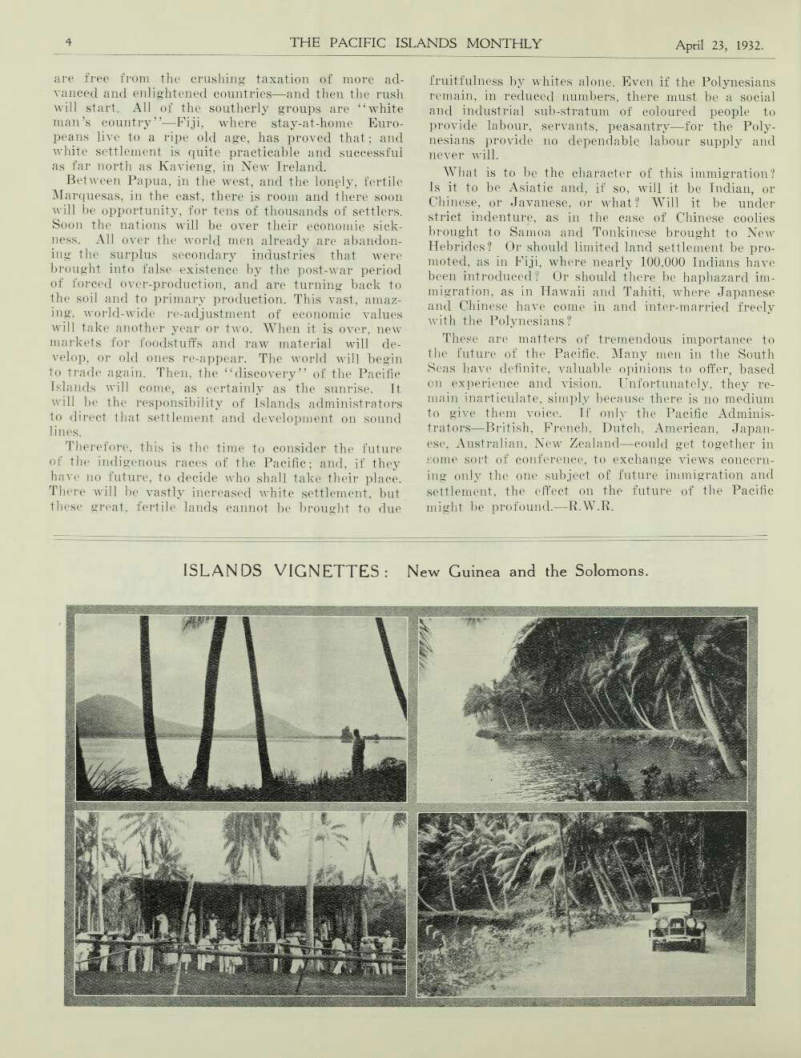
ISLANDS VIGNETTES: New Guinea and the Solomons.