Nauru And Ocean Island.
pp. 43-45 · Read in the full issue
The two Central Pacific islands, Nauru and Ocean, have some unusual and interesting features. They are the scene of a large phosphate industry, carried on by the British Phosphate Commission. Nauru is a League of Nations Mandated Territory, administered at present by Australia; Ocean Island is the headquarters of the administration of the Gilbert and Ellice Islands Colony.
The two islands (165 miles apart) and the ships which transport their pro ducts and imports, are connected by wireless telephone. They all talk with each other quite conveniently and easily.
The following are extracts from an interesting article contributed to the A.W.A. “house magazine,” The Radiogram, by Mr. E. J. Flynn:—
WE are now steaming- around to the eastern side of Nauru, where the settlement is located. Sparks ap proaches the skipper.
“Captain, Mr. Thom, Nauru manager, wishes to speak to you on the ’phone.” ‘‘Hello, Mr. Thom!” They discuss business and the manager advises the captain that the ship will tie up at No. 2 mooring, etc.
Ocean island (165 miles away) now comes in. “Good morning, captain!
What mails have you for Ocean Island?
When do you expect to leave Nauru?” etc.
Each island and also the “Nauru Chief” has been fitted with a half k.w. telephone transmitter, which is owned and operated by the British Phosphate Co. The two islands and the ship use these telephones just as you might use your ordinary office telephone, and con versation is carried on up to 1,000 miles.
Ocean Island and Nauru Island are really the peaks of mountains emerging above the sea. It is impossible for a ship to anchor owing to the great depths. The mountain sides appear to run down thousands of feet. Huge moorings are run out from the shore and fastened to a buoy, the buoy being kept in position by a ton anchor, which clutches the side of the moun tain nearly 1,900 feet below the surface.
Each mooring costs approximately £6,000.
One is agreeably surprised at the or derly lay-out of the Commission set tlement. There are fine white coral gravel streets and paths with white block coral borders. As we proceed along the main thoroughfare, we ob serve fine white weatherboard dwellings almost concealed by beautiful tropical flowering shrubs and palms.
In the centre of the settlement are the Administrative Offices, Social Hall, Post Office, etc. Government adminis tration and military quarters are lo cated in a north-easterly direction one mile around the coast. The drive from the settlement to the Residency is prac tically roofed in by tall coconut palms, intermingled with flowering creepers, and is exceedingly picturesque.
In the south of the island we find the repair shops, where electric locos, and motor boats are repaired, motor launches under construction, also en gines, castings, etc. The island is al most self-contained and is a miniature country, so isolated it necessitates ef fecting its own repairs.
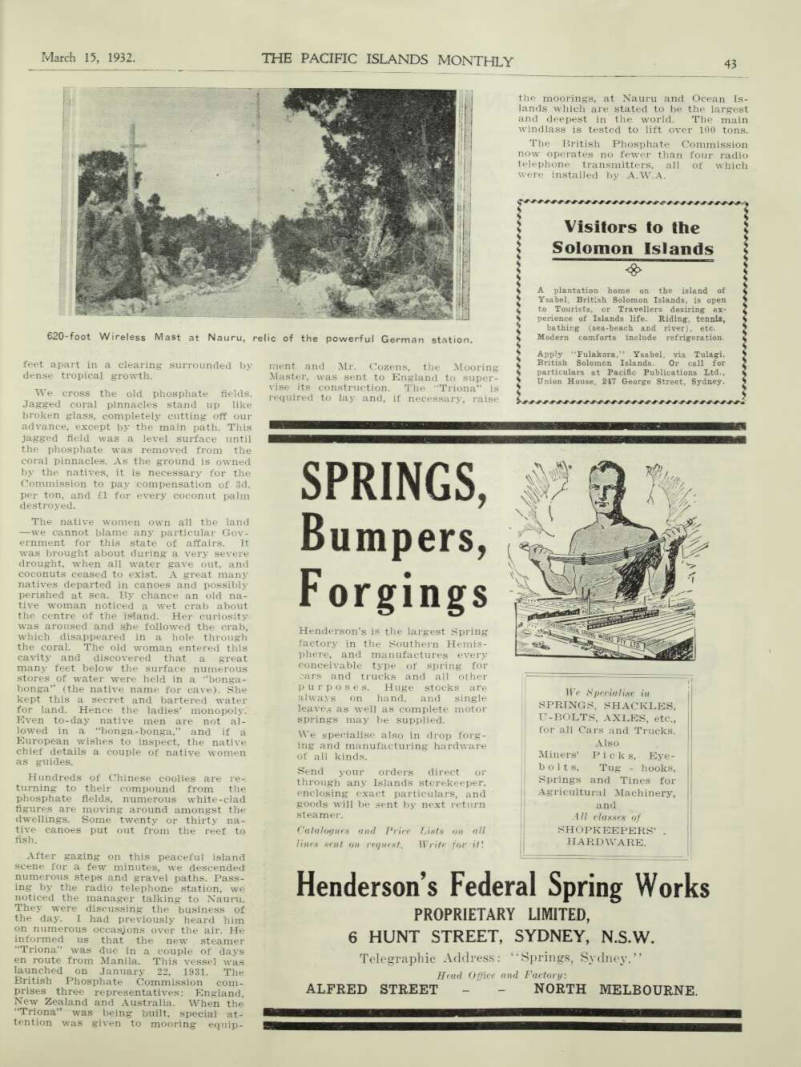
On the crest of the hill we locate the phosphate workings, and the huge mast we observed from the sea is now tow ering above us. It was part of the 65 k.w. spark transmitter installed by Ger many just prior to the outbreak of war and is now obsolete. The phosphate is surface-mined to a depth of approxi mately 30 feet and trucked to the
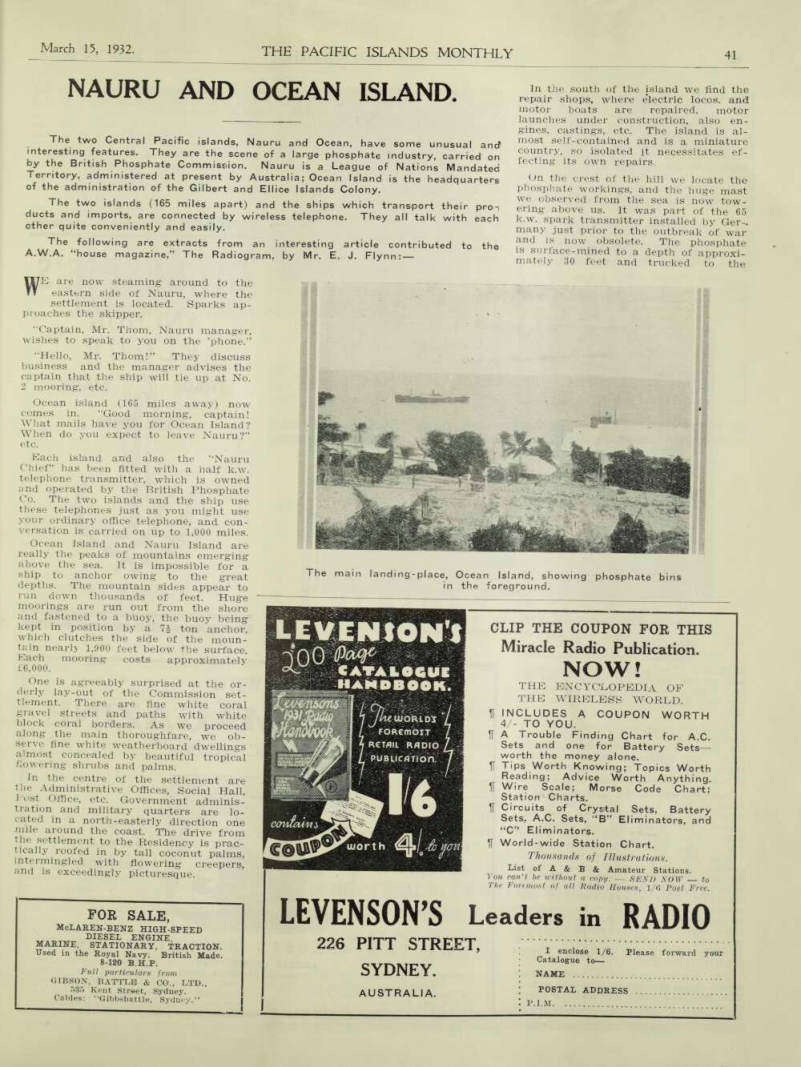
The main landing-place, Ocean Island, showing phosphate bins in the foreground.
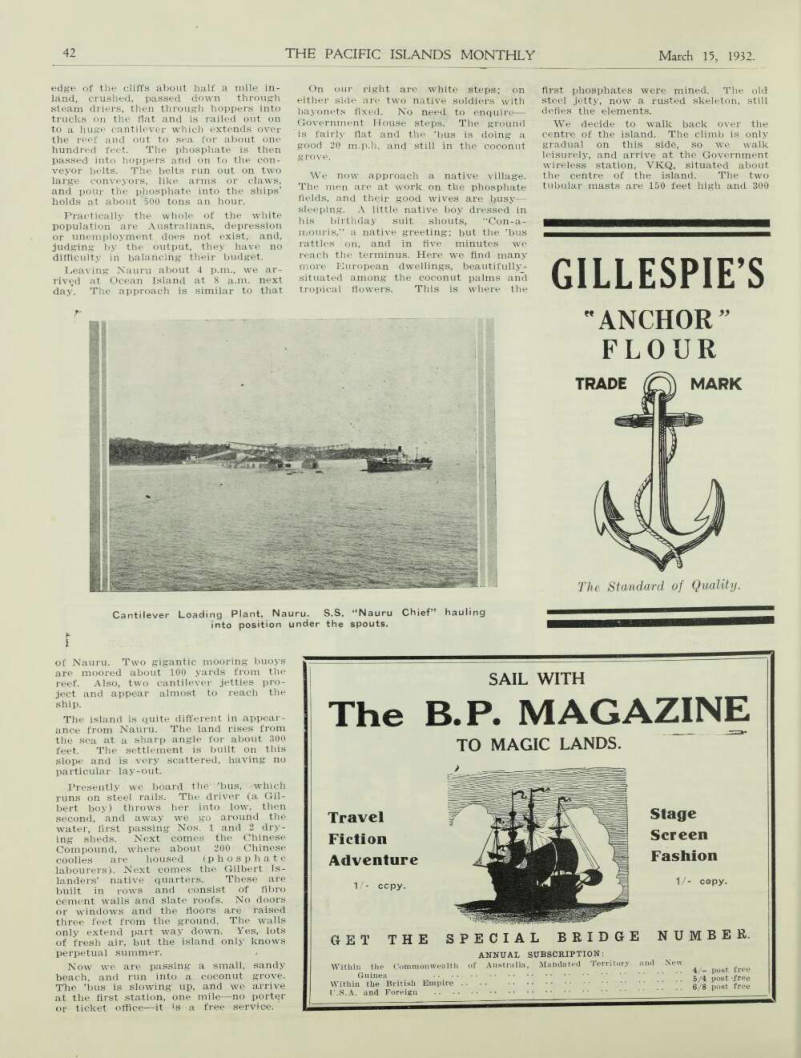
edge of the cliffs about half a mile in land, crushed, passed down through steam driers, then through hoppers into trucks on the flat and is railed out on to a huge cantilever which extends over the reef and out to sea for about one hundred feet. The phosphate is then passed into hoppers and on to the con veyor belts. The belts run out on two large conveyors, like arms or claws, and pour the phosphate into the ships’ holds at about 500 tons an hour.
Practically the whole of the white population are Australians, depression or unemployment does not exist, and, judging by the output, they have no difficulty in balancing their budget.
Leaving Nauru about 4 p.m., we ar rived at Ocean Island at 8 a.m. next day. The approach is similar to that
of Nauru. Two gigantic mooring buoys are moored about 100 yards from the reef. Also, two cantilever jetties pro ject and appear almost to reach the ship.
The island is quite different in appear ance from Nauru. The land rises from the sea at a sharp angle for about 300 feet. The settlement is built on this slope and is very scattered, having no particular lay-out.
Presently we board the ’bus, which runs on steel rails. The driver (a Gil bert boy) throws her into low, then second, and away we go around the water, first passing Nos. 1 and 2 dry ing sheds. Next comes the Chinese Compound, where about 200 Chinese coolies are housed (phosphate labourers). Next comes the Gilbert Is landers’ native quarters. These are built in rows and consist of fibre cement walls and slate roofs. No doors or windows and the floors are raised three feet from the ground. The walls only extend part way down. Yes, lots of fresh air, but the island only knows perpetual summer.
Now we are passing a small, sandy beach, and run into a coconut grove.
The ’bus is slowing up, and we arrive at the first station, one mile —no porter or ticket office —it is a free service.
On our right are white steps; on either side are two native soldiers with bayonets fixed. No need to enquire— Government House steps. The ground is fairly fiat and the ’bus is doing a good 20 m.p.h. and still in the coconut grove.
We now approach a native village.
The men are at work on the phosphate fields, and their good wives are busy— sleeping. A little native boy dressed in his birthday suit shouts, “Con-a mouris,” a native greeting; but the ’bus rattles on, and in five minutes we reach the terminus. Here we find many more European dwellings, beautifully situated among the coconut palms and tropical flowers. This is where the
first phosphates were mined. The old steel jetty, now a rusted skeleton, still defies the elements.
We decide to walk back over the centre of the island. The climb is only gradual on this side, so we walk leisurely, and arrive at the Government wireless station, VKQ, situated about the centre of the island. The two tubular masts are 150 feet high and 300
Cantilever Loading Plant, Nauru. S.S. “Nauru Chief” hauling into position under the spouts.
feet apart in a clearing surrounded by dense tropical growth.
We cross the old phosphate fields.
Jagged coral pinnacles stand up like broken glass, completely cutting off our advance, except by the main path. This jagged field was a level surface until the phosphate was removed from the coral pinnacles. As the ground is owned by the natives, it is necessary for the Commission to pay compensation of 3d. per ton, and £1 for every coconut palm destroyed.
The native women own all the land —we cannot blame any particular Gov ernment for this state of affairs. It was brought about during a very severe drought, when all water gave out, and coconuts ceased to exist. A great many natives departed in canoes and possibly perished at sea. By chance an old na tive woman noticed a wet crab about the centre of the island. Her curiosity was aroused and she followed the crab, which disappeared in a hole through the coral. The old woman entered this cavity and discovered that a great many feet below the surface numerous stores of water were held in a “bonga bonga” (the native name for cave). She kept this a secret and bartered water for land. Hence the ladies’ monopoly.
Even to-day native men are not al lowed in a “bonga-bonga,” and if a European wishes to inspect, the native chief details a couple of native women as guides.
Hundreds of Chinese coolies are re turning to their compound from the phosphate fields, numerous white-clad figures are moving around amongst the dwellings. Some twenty or thirty na tive canoes put out from the reef to fish.
After gazing on this peaceful island scene for a few minutes, we descended numerous steps and gravel paths. Pass ing by the radio telephone station, we noticed the manager talking to Nauru.
They were discussing the business of the day. I had previously heard him on numerous occasions over the air. He informed us that the new steamer “Triona” was due in a couple of days en route from Manila. This vessel was launched on January 22, 1931. The British Phosphate Commission com prises three representatives: England, New Zealand and Australia. When the “Triona” was being built, special at tention was given to mooring equip
ment and Mr. Cozens, the Mooring Master, was sent to England to super vise its construction. The “Triona” is required to lay and, if necessary, raise
the moorings, at Nauru and Ocean Is lands which are stated to be the largest and deepest in the world. The main windlass is tested to lift over 100 tons.
The British Phosphate Commission now operates no fewer than four radio telephone transmitters, all of which were installed by A.W.A.
620-foot Wireless Mast at Nauru, relic of the powerful German station.