Morobe Goldfields
p. 40 · Read in the full issue
How Radio Came To The
THE officer-in-charge o( the New Guinea goldfields radio station, Mr.
C. C. Beckett, gives a very interest mg account, in the February ‘‘The Radiogram” (A.W.A.’s bright little “house” magazine), of how A.W.A. placed the Morobe goldfields in wire less communication with the rest of the world.
Originally, there was a small station at Morobe, on the north-east coast of New Guinea—it had been there since the War, communicating directly with Rabaul radio. Early in 1926, consequent upon the rush to Edie Creek Morobe Radio became very busy. Native run ners brought messages from Edie Creek, down the incredible ranges, to what is now Salamaua, and thence by canoe to Morobe—70 miles. There was a de mand for a wireless station at Edie Creek, and A.W.A. responded quickly.
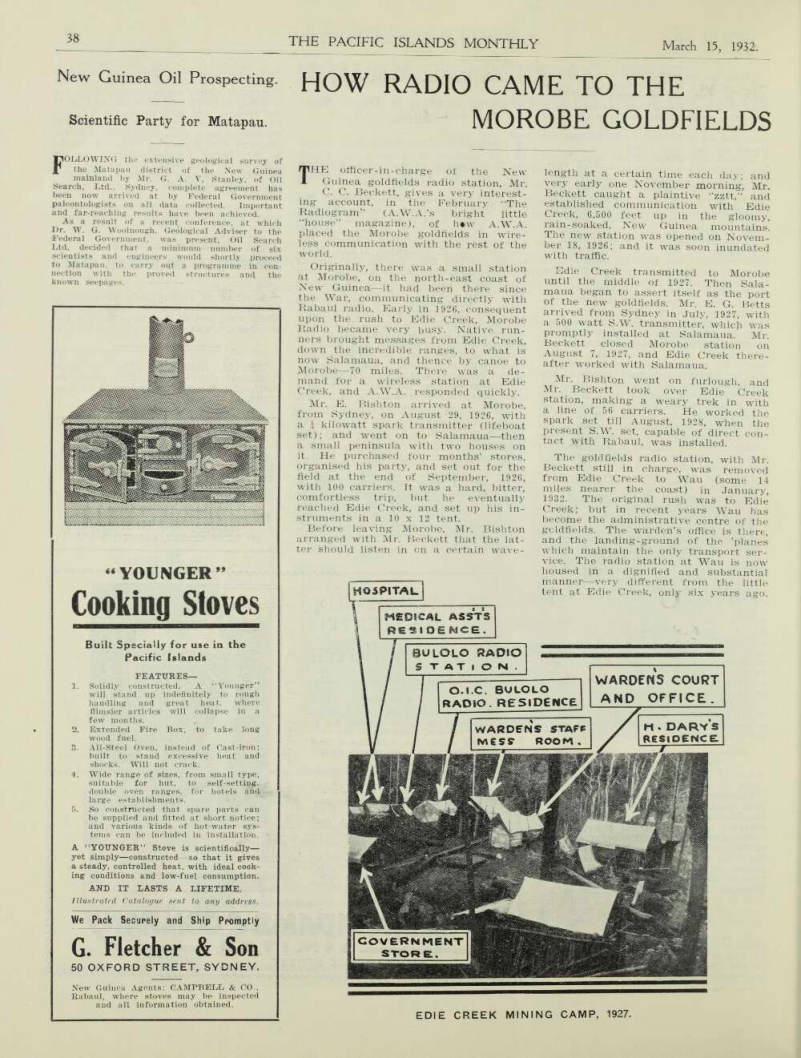
Mr. E. Bishton arrived at Morobe, from Sydney, on August 29, 1926, with a ¼ kilowatt spark transmitter (lifeboat set); and went on to Salamaua—then a small peninsula with two houses on it. He purchased four months’ stores, organised his party, and set out for the field at the end of September, 1926, with 100 carriers. It was a hard, bitter, comfortless trip, but he eventually reached Edie Creek, and set up his in struments in a 10 x 12 tent.
Before leaving Morobe, Mr. Bishton arranged with Mr. Beckett that the lat ter should listen in on a certain wave
length at a certain time each day; and very early one November morning, Mr.
Beckett caught a plaintive “zztt,” and established communication with Edie Creek, 6,500 feet up in the gloomy, rain-soaked, New Guinea mountains.
The new station was opened on Novem ber 18, 1926; and it was soon inundated with traffic.
Edie Creek transmitted to Morobe until the middle of 1927. Then Sala maua began to assert itself as the port of the new goldfields. Mr. E. G. Betts arrived from Sydney in July, 1927, with a 500 watt S.W. transmitter, which was promptly installed at Salamaua. Mr.
Beckett closed Morobe station on August 7, 1927, and Edie Creek there after worked with Salamaua.
Mr. Bishton went on furlough, and Mr. Beckett took over Edie Creek station, making a weary trek in with a line of 56 carriers. He worked the spark set till August, 1928, when the present S.W. set, capable of direct con tact with Rabaul, was installed.
The goldfields radio station, with Mr.
Beckett still in charge, was removed from Edie Creek to Wau (some 14 miles nearer the coast) in January, 1932. The original rush was to Edie Creek; but in recent years Wau has become the administrative centre of the goldfields. The warden’s office is there, and the landing-ground of the ’planes which maintain the only transport ser vice. The radio station at Wau is now housed in a dignified and substantial manner—very different from the little tent at Edie Creek, only six years ago.