Motuan Traders Go West
pp. 38-39 · Read in the full issue
In Their Lakatoi
From Our Own Correspondent.
Pt. Moresby, Feb. 1.
EVERY year at the end of September or the beginning of October, near the close of the south-east season, a fleet of 20 or more lakatoi , as these sailing canoes are called, leave Port Moresby and the neighbouring Motuan villages for the deltas and rivers of the Papuan Gulf.
They are laden with carefully-packed earthenware pots, tobacco and many articles of trade, and they return during the north-west season, after an absence of three months, laden with bundles of sago, the trade of the Koriki, Iari and Vailala people, which they have bartered in exchange.
THESE trading expeditions have been in existence for many generations, and their origin is veiled in the obscurity of time, and of weird legends.
There is great ceremony attached to the whole proceeding, and considerable ritual and preparation, coupled with unity and hard work. Each lakatoi has, in command, two leading men; a Badi tauna, which means, literally, the man at the base, or the originator, and a Doritauna or top-man. These two men have each their two captains a sail and a mast captain and their respective
crews. The whole party amounting to 30 or so men, is therefore divided into two separate commands, neither taking priority of the other.
It is difficult to ascertain to what extent the Baditauna and Doritauna ex ercise the duties of commanders during the voyage. It seems that on occasions ,pf danger their advice is asked and they are obeyed; on ordinary occasions the captains take command, two on the outward trip and the other two on the homeward journey. The whole proceed ing is conducted without any apparent
disorder or confusion, and seems to be regarded in the light of a sacred rite, the duties of each being for the good of the whole.
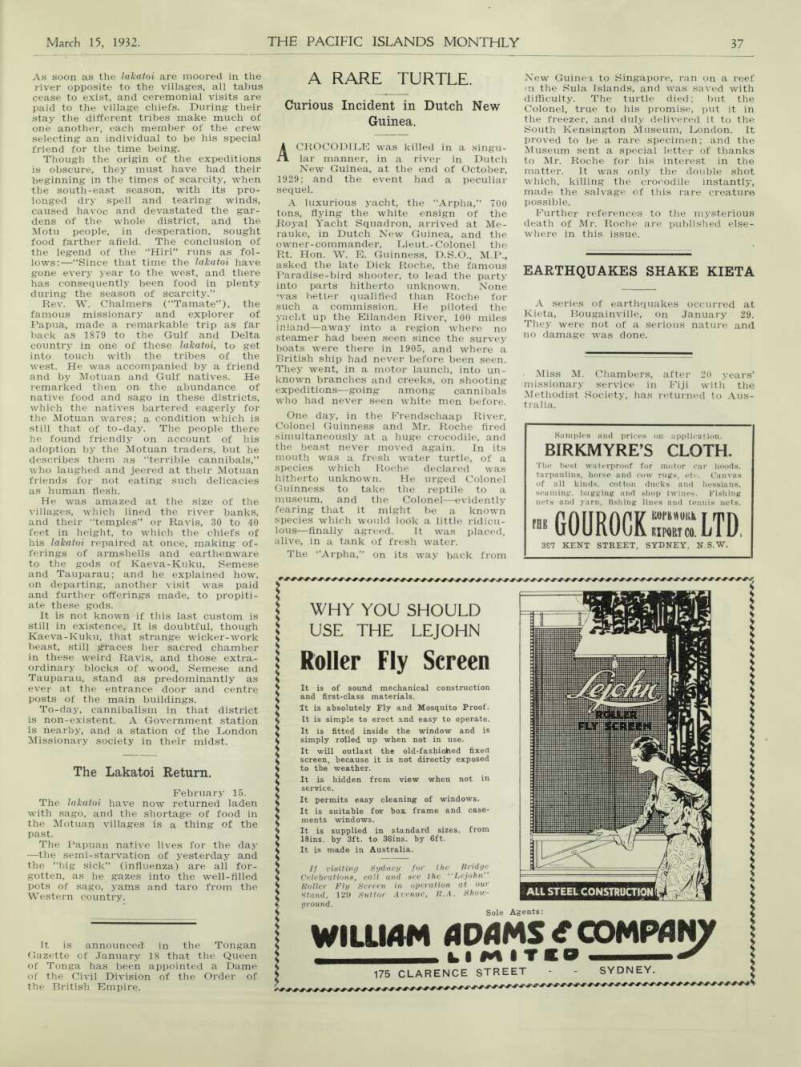
The sails of these vessels are unique in design and are made in the villages of plaited mats. They are cut into the shape of a crab’s claw, sewn together, and attached on either side to long poles. Of later year, European sails have been used in preference; though this is contrary to their old customs and ideas, for it is to the wisdom of the crab, so the legend goes, that they owe the success and safety of these expedi tions.
The arrival of the fleet in the Gulf and Delta country is an occasion of great rejoicing among the people there.
Lakatoi leaving Port Moresby Harbour on their annual trip to the western deltas of Papua.
As soon as the lakatoi are moored in the river opposite to the villages, all tabus cease to exist, and ceremonial visits are paid to the village chiefs. During their stay the different tribes make much of one another, each member of the crew selecting an individual to be his special friend for the time being.
Though the origin of the expeditions is obscure, they must have had their beginning in the times of scarcity, when the south-east season, with its pro longed dry spell and tearing winds, caused havoc and devastated the gar dens of the whole district, and the Motu people, in desperation, sought food farther afield. The conclusion of the legend of the “Hiri” runs as fol lows: —“Since that time the lakatoi have gone every year to the west, and there has consequently been food in plenty during the season of scarcity.”
Rev. W. Chalmers (“Tamate”), the famous missionary and explorer of Papua, made a remarkable trip as far back as 1879 to the Gulf and Delta country in one of these lakatoi, to get into touch with the tribes of the west. He was accompanied by a friend and by Motuan and Gulf natives. He remarked then on the abundance of native food and sago in these districts, which the natives bartered eagerly for the Motuan wares; a condition which is still that of to-day. The people there he found friendly on account of his adoption by the Motuan traders, but he describes them as “terrible cannibals,” who laughed and jeered at their Motuan friends for not eating such delicacies as human flesh.
He was amazed at the size of the villages, which lined the river banks, and their “temples” or Ravis, 30 to 40 feet in height, to which the chiefs of his lakatoi repaired at once, making of ferings of armshells and earthenware to the gods of Kaeva-Kuku, Semese and Tauparau; and he explained how, on departing, another visit was paid and further offerings made, to propiti ate these gods.
It is not known if this last custom is still in existence. It is doubtful, though Kaeva-Kuku, that strange wicker-work beast, still graces her sacred chamber in these weird Ravis, and those extra ordinary blocks of wood, Semese and Tauparau, stand as predominantly as ever at the entrance door and centre posts of the main buildings.
To-day, cannibalism in that district is non-existent. A Government station is nearby, and a station of the London Missionary society in their midst.