Review of Conditions in Tonga
p. 19 · Read in the full issue
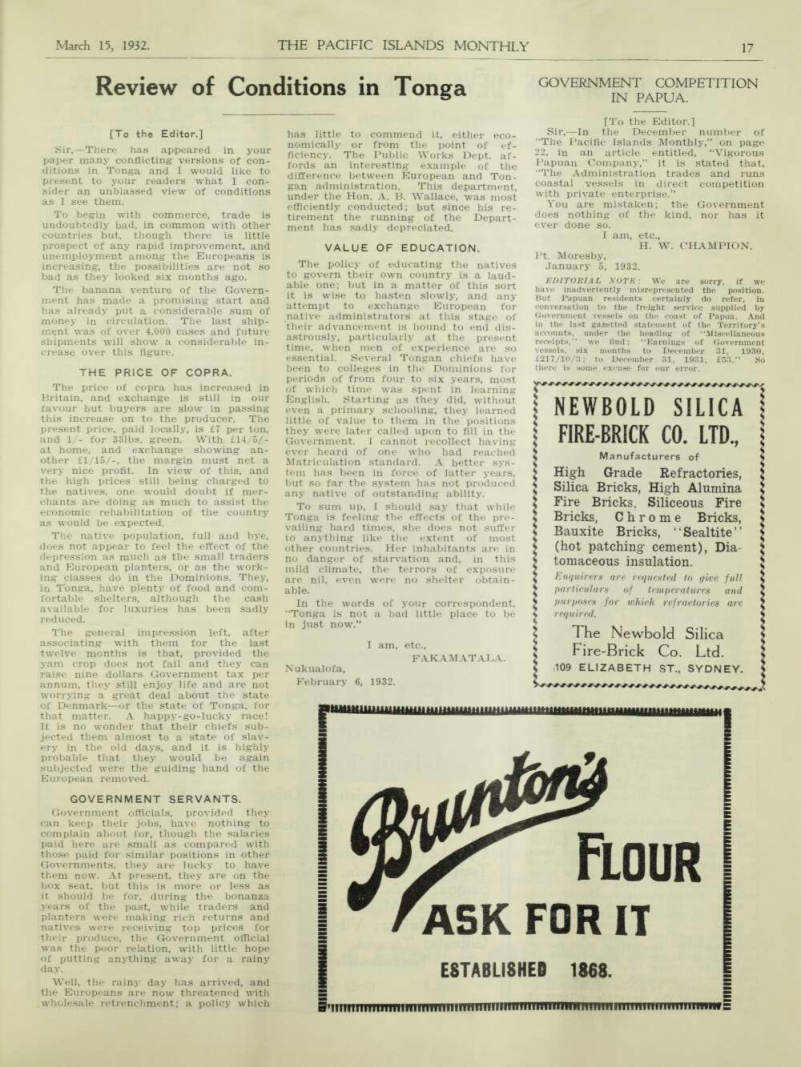
[To the Editor.]
Sir, —There has appeared in your paper many conflicting versions of con ditions in Tonga and I would like to present to your readers what I con sider an unbiassed view of conditions as I see them.
To begin with commerce, trade is undoubtedly bad, in common with other countries but, though there is little prospect of any rapid improvement, and unemployment among the Europeans is increasing, the possibilities are not so bad as they looked six months ago.
The banana venture of the Govern ment has made a promising start and has already put a considerable sum of money in circulation. The last ship ment was of over 4,000 cases and future shipments will show a considerable in crease over this figure.
The Price Of Copra.
The price of copra has increased in Britain, and exchange is still in our favour but buyers are slow in passing this increase on to the producer. The present price, paid locally, is £7 per ton, and 1/- for 331bs. green. With £14/5/at home, and exchange showing an other £1/15/-, the margin must net a very nice profit. In view of this, and the high prices still being charged to the natives, one would doubt if mer chants are doing as much to assist the economic rehabilitation of the country as would be expected.
The native population, full and bye, does not appear to feel the effect of the depression as much as the small traders and European planters, or as the work ing classes do in the Dominions. They, in Tonga, have plenty of food and com fortable shelters, although the cash available for luxuries has been sadly reduced.
The general impression left, after associating with them for the last twelve months is that, provided the yam crop does not fail and they can raise nine dollars Government tax per annum, they still enjoy life and are not worrying a great deal about the state of Denmark—or the state of Tonga, for that matter. A happy-go-lucky race!
It is no wonder that their chiefs sub jected them almost to a state of slav ery in the old days, and it is highly probable that they would be again subjected were the guiding hand of the European removed.
Government Servants.
Government officials, provided they can keep their jobs, have nothing to complain about for, though the salaries paid here are small as compared with those paid for similar positions in other Governments, they are lucky to have them now. At present, they are on the box seat, but this is more or less as it should be for, during the bonanza years of the past, while traders and planters were making rich returns and natives were receiving top prices for their produce, the Government official was the poor relation, with little hope of putting anything away for a rainy day.
Well, the rainy day has arrived, and the Europeans are now threatened with wholesale retrenchment; a policy which
has little to commend it, either eco nomically or from the point of ef ficiency. The Public Works Dept, af fords an interesting example of the difference between European and Ton gan administration. This department, under the Hon. A. B. Wallace, was most efficiently conducted; but since his re tirement the running of the Depart ment has sadly depreciated.
Value Of Education.
The policy of educating the natives to govern their own country is a laud able one; but in a matter of this sort it is wise to hasten slowly, and any attempt to exchange European for native administrators at this stage of their advancement is bound to end dis astrously, particularly at the present time, when men of experience are so essential. Several Tongan chiefs have been to colleges in the Dominions for periods of from four to six years, most of which time was spent in learning English. Starting as they did, without even a primary schooling, they learned little of value to them in the positions they were later called upon to fill in the Govei'nment. I cannot recollect having ever heard of one who had reached Matriculation standard. A better sys tem has been in force of latter years, but so far the system has not produced any native of outstanding ability.
To sum up, I should say that while Tonga is feeling the effects of the pre vailing hard times, she does not suffer to anything like the extent of most other countries. Her inhabitants are in no danger of starvation and, in this mild climate, the terrors of exposure are nil, even were no shelter obtain able.
In the words of your correspondent, “Tonga is not a bad little place to be in just now,”
I am, etc.,
Fakamatala.
Nukualofa, February 6, 1932.