Merauke Of To-Day
An Isolated Corner of Dutch New Guinea
From Our Own Correspondent.
THURSDAY IS., February 20.
Communication between Dutch New Guinea and Thursday Island is of rare occurrence, and, though the two places are less than 200 miles apart, letters by the regular route take over two months to be delivered.
This is an instance of the great gulf which separates various parts of the Island world, and is so typical of many parts of the Pacific, However, this terra incognita has been lately visited by a party of Thurs day Islanders, who have just returned with what news is to be gleamed from the decaying town of Merauke. The occasion was a hunt after an alleged motor launch thief who, after various adventures on his voyage from Cairns, through Torres Straits, arrived at Mer auke and was promptly detained by the authorities there. Constable Grant travelled over from Thursday Island in the Government ketch, Melbidir (which had been requisitioned by the police) for the purpose of bringing the wan dering launch and her erring navigator back from whence they had started many months ago.
During some delay in the completion of the extradition papers, the less of ficial members of the party went sight seeing, and, if rumour be correct, suc ceeded in making themselves thor oughly at home, the only fly in the ointment being the question of ex change. On arrival, the pound note was found to be only worth nine guilders (15/-), but worse was to come.
The next day, a notice at the post of fice informed the Australians that their money values had dropped consider ably during the night; alas! it was now reduced to a few cents over seven guilders.
This portion of the Dutch Empire depends now on a single product—copra —so naturally the district cannot be said to be in a flourishing condition.
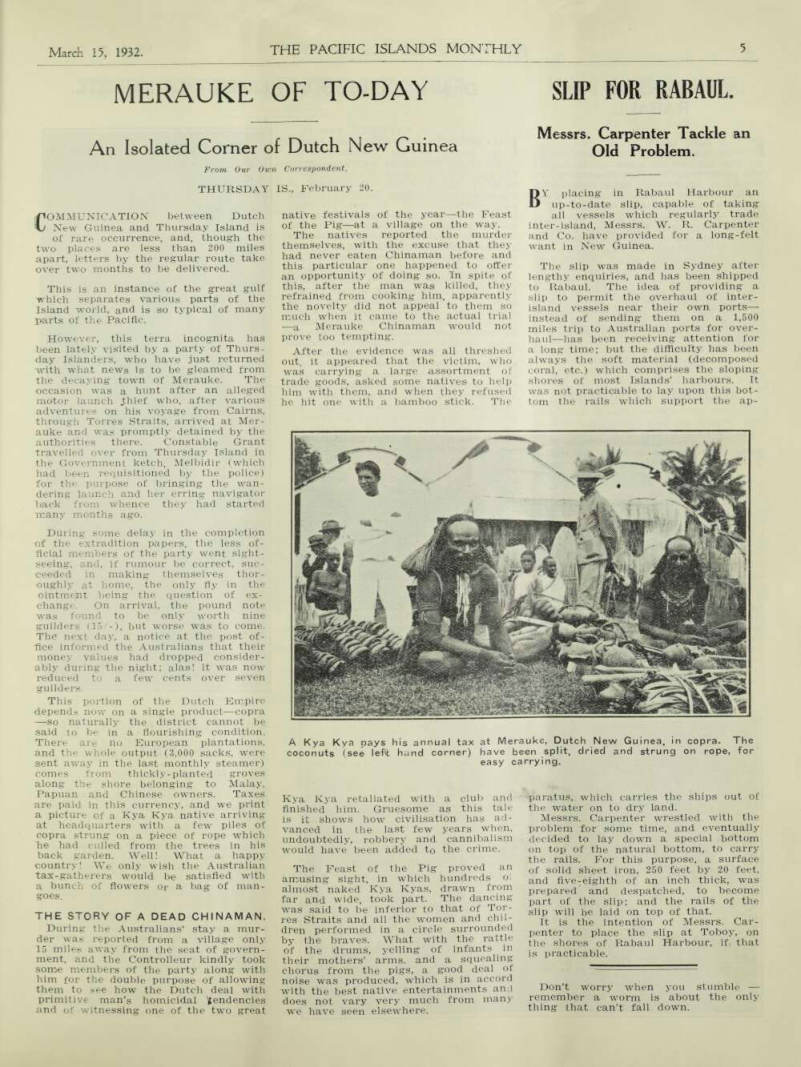
There are no European plantations, and the whole output (3,000 sacks, were sent away in the last monthly steamer) comes from thickly-planted groves along the shore belonging to Malay, Papuan and Chinese owners. Taxes are paid in this currency, and we print a picture of a Kya Kya native arriving at headquarters with a few piles of copra strung on a piece of rope which lie had culled from the trees in his back garden. Well! What a happy country! We only wish the Australian tax-gatherers would be satisfied with a bunch of flowers or a bag of man goes.
The Story Of A Dead Chinaman.
During the Australians’ stay a mur der was reported from a village only 15 miles away from the seat of govern ment, and the Controlleur kindly took some members of the party along with him for the double purpose of allowing them to see how the Dutch deal with primitive man’s homicidal pendencies and of witnessing one of the two great
native festivals of the year—the Feast of the Pig—at a village on the way.
The natives reported the murder themselves, with the excuse that they had never eaten Chinaman before and this particular one happened to offer an opportunity of doing so. In spite of this, after the man was killed, they refrained from cooking him, apparently the novelty did not appeal to them so much when it came to the actual trial —a Merauke Chinaman would not prove too tempting.
After the evidence was all threshed out. it appeared that the victim, who was carrying a large assortment of trade goods, asked some natives to help him with them, and when they refused he hit one with a bamboo stick. The
Kya Kya retaliated with a club and finished him. Gruesome as this tale is it shows how civilisation has ad vanced in the last few years when, undoubtedly, robbery and cannibalism would have been added to the crime.
The Feast of the Pig proved an amusing sight, in which hundreds of almost naked Kya Kyas, drawn from far and wide, took part. The dancing was said to be inferior to that of Tor res Straits and all the women and chil dren performed in a circle surrounded by the braves. What with the rattle of the drums, yelling of infants in their mothers’ arms, and a squealing chorus from the pig's, a good deal of noise was produced, which is in accord with the best native entertainments and does not vary very much from many we have seen elsewhere.
A Kya Kya Days his annual tax at Merauke, Dutch New Guinea, in copra. The coconuts (see left hand corner) have been split, dried and strung on rope, for easy carrying.