A Sunday In Noumea
pp. 17-18 · Read in the full issue
By W. Bruce Rainsford
A SUNDAY in Noumea, the little capital of New Caledonia, is quite different from that spent by most of us in Australia.
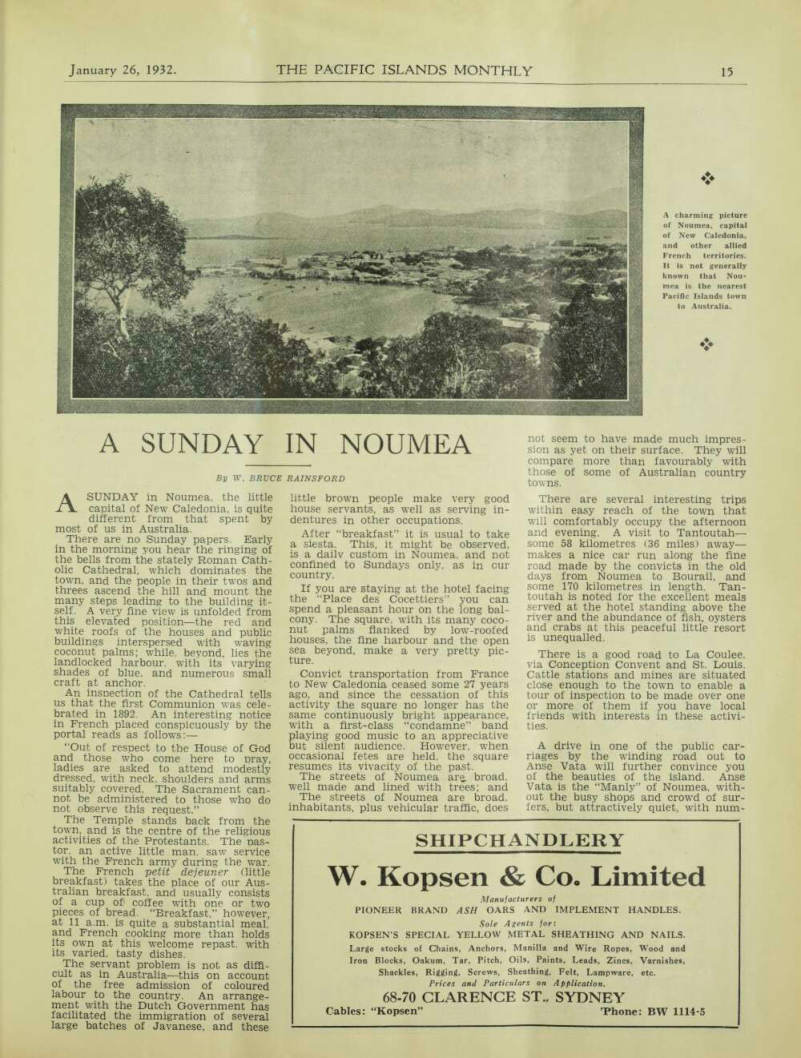
There are no Sunday papers. Early in the morning you hear the ringing of the bells from the stately Roman Cath olic Cathedral, which dominates the town, and the people in their twos and threes ascend the hill and mount the many steps leading to the building it self. A very fine view is unfolded from this elevated position—the red and white roofs of the houses and public buildings interspersed with waving coconut palms; while, beyond, lies the landlocked harbour, with its varying shades of blue, and numerous small craft at anchor.
An inspection of the Cathedral tells us that the first Communion was cele brated in 1892. An interesting notice in French placed conspicuously by the portal reads as follows; “Out of respect to the House of God and those who come here to pray, ladies are asked to attend modestly dressed, with neck, shoulders and arms suitably covered. The Sacrament can not be administered to those who do not observe this request.”
The Temple stands back from the town, and is the centre of the religious activities of the Protestants. The nas tor, an active little man, saw service with the French army during the war.
The French petit dejeuner (little breakfast) takes the place of our Aus tralian breakfast, and usually consists of a cup of l coffee with one or two pieces of bread. “Breakfast,” however, at 11 a.m. is quite a substantial meal, and French cooking more than holds its own at this welcome repast, with its varied, tasty dishes.
The servant problem is not as diffi cult as in Australia—this on account of the free admission of coloured labour to the country. An arrange ment with the Dutch Government has facilitated the immigration of several large batches of Javanese, and these
little brown people make very good house servants, as well as serving in dentures in other occupations.
After “breakfast” it is usual to take a siesta. This, it might be observed, is a daily custom in Noumea, and not confined to Sundays only, as in cur country.
If you are staying at the hotel facing the “Place des Cocettiers” you can spend a pleasant hour on the long bal cony. The square, with its many coco nut palms flanked by low-roofed houses, the fine harbour and the open sea beyond, make a very pretty pic ture.
Convict transportation from France to New Caledonia ceased some 27 years ago, and since the cessation of this activity the square no longer has the same continuously bright appearance, with a first-class “condamne” band playing good music to an appreciative but silent audience. However, when occasional fetes are held, the square resumes its vivacity of the past.
The streets of Noumea broad, well made and lined with trees; and The streets of Noumea are broad, inhabitants, plus vehicular traffic, does
not seem to have made much impres sion as yet on their surface. They will compare more than favourably with those of some of Australian country towns.
There are several interesting trips within easy reach of the town that will comfortably occupy the afternoon and evening, A visit to Tantoutah— some 58 kilometres (36 miles) away— makes a nice car run along the fine road made by the convicts in the old days from Noumea to Bourail, and some 170 kilometres in length. Tan toutah is noted for the excellent meals served at the hotel standing above the river and the abundance of fish, oysters and crabs at this peaceful little resort is unequalled.
There is a good road to La Coulee, via Conception Convent and St. Louis.
Cattle stations and mines are situated close enough to the town to enable a tour of inspection to be made over one or more of them if you have local friends with interests in these activi ties.
A drive in one of the public car riages by the winding road out to Anse Vata will further convince you of the beauties of the island. Anse Vata is the “Manly” of Noumea, with out the busy shops and crowd of sur fers, but attractively quiet, with num
A charming: picture of Noumea, capital of New Caledonia, and other allied French territories.
It is not generally known that Nou mea is the nearest Pacific Islands town to Australia.
erous coconut palms, long curving beach and a quiet sea inside the reef.
Sunday is a good day to take a trip out into the country in New Cale donia’s one and only train, which puffs noisily some thirty kilometres (19 miles) out to Paita in a couple of hours, breakdowns permitting. The train starts punctually from the “Gare” at anything from 2 to 2.30 p.m., crowded with coloured people of all kinds and sizes, in addition, of course, to a goodly number of French citizens taking their weekly outing into the country.
The overcrowding on this little De cauville is far worse than on Sydney’s North Shore line, and the people have become as used to it as the “metro” travellers in Paris. The train traverses some very pretty country, and several of the town residents have established quiet, rustic homes in comfortable sur roundings along the line. There are two trains on Sunday, and the early one carries mostly energetic parties out for a day’s sport—deer shooting, fish ing and picnics are popular week-end activities of the young Caledonian.
The two cinemas do a brisk business on Sunday, with both matinee and evening shows, and, though perhaps not quite up to the standard of the Gaumont-Palace at Paris, yet what would otherwise be an extremely dull New Caledonian evening can be whiled away until 11.30 p.m. among a spell bound audience of various colours and nationalities.