New Uses For Coconut Oil
pp. 11-12 · Read in the full issue
Is It Suitable as a Motor Fuel?
CAN new uses be found for coconut oil? The answer to that question is of vital interest to every resident of the South Seas.
For many decades copra has been the source of the chief raw material for margarine, fine soap, and various other commodities requiring a high quality vegetable oil. But. in recent years, the world has been flooded with refined and deodorised whale oil, and with rival vegetable oils —particularly the products of soya beans, ground nuts and palm kernels. Coconut products still hold a good market, and will continue to do so—but much of the previous profit of coconut planting has disappeared.
There is only one remedy—the uses of coconut oil must be extended, and the demand for it increased. Early in 1931, when it was seen that the supply of whale oil was vastly in excess of the demand, the Scandinavian whale oil interests employed a corps of expert chemists to discover new uses for whale oil. Coconut oil interests could do the same.
An indication of one direction in which inquiries may be made, and inter esting questions raised, is given in the following article.
Is it practicable to use coconut oil as a fuel for Diesel engines? At first sight the proposition appears fantastic. It does not seem possible to use a vege table oil as a motor fuel; nor does it seem practicable to produce coconut oil at a price that will allow of its use as a motor fuel. Yet these, and other obvious objections, are dealt with in the article.
The waiter is Robert Aura Smith, special correspondent of “The New York Times,” who wrote from Manila on September 14, 1931; and the article was pub lished in “The New York Times” on October 11. The article is as follows:
RESEARCH scientists of the Uni versity of the Philippines have carried out the public demon stration of the use of coconut oil as fuel for Diesel engines.
Using a stationary motor, with no change in the mechanism. Professors Crisostomo Ortigas and Luis Gonzaga. assisted by Dr. Amando Clemente, showed that the vegetable product gave the same result as the same quantity of mineral fuel at full load.
This is in spite of the known fact that coconut oil in combustion turns up only 7258 calories as against 10,550 for mineral oil. Professor Ortigas as serts, however, that mineral oil suffers a higher degree of power loss, through malignant cracking, or absorption of heat in the formation of soot, and that therefore the potential power of the
two oils is almost identical.
Similarly this smaller degree of malignant cracking on the part of coconut oil makes the engine operation cleaner, since there is little or no residue or carbonised waste.
Other fuel engineers have asserted that the use of coco nut oil will produce corrosive acids in the cylinders, but this is flatly denied by the three experimenters, who de clare that repeated tests in the laboratory show no such acids, and that no corrosive effects have been observed during combustion.
The significance of the ex periment lies in the fact that they show the possibility of a permanent domestic fuel sup ply in the Philippines. At present that is lacking. There exists in the islands only a small deposit of low grade coal, and petroleum has not been discovered in any com mercially valuable quantity.
Hydroelectric experiments have been successful but re quire an enormous overhead and present unusually diffi cult engineering problems be cause of the climate and
the character of the terrain. At pre sent, therefore, the Philippines is de pendent upon imports for commercial fuel. Coconuts, on the other hand, are in practically inexhaustible supply in every part of the islands.
Cost Of Production
Nevertheless, under present condi tions of production and milling, coco nut oil is far more expensive than pet roleum. The current price of the for mer is sixteen centavos a liter, while crude oil sells at five or six centavos.
It is therefore essential to reduce the cost of coconut oil production to one third its present level before its use for commercial power operations is fea sible.
That is by no means impossible, but will require revolutionary changes in the essential coconut operations. The first requirement is a greatly increased yield to the hectare, which is an agri cultural problem affecting the entire country. The production can be greatly increased by closer planting, but closer planting than is now practised necessi tates the use of fertilisers if the soil is not to be exhausted, and at present the fertilisation of coconut groves is only beginning.
Of equal importance is the use of budded stock from high-yielding trees.
This has been tried on several large plantations with immediate results.
Efficient coconut operators now main tain their own nurseries, where bud ding from selected stock can take place.
Nevertheless, a large part of the copra supply comes from very small indi vidual units where nursery methods and fertilisation are virtually unknown.
The Milling Problem
The second essential to any mate erial reduction in price is a change in milling methods.
At present coconut oil is milled from copra, and while the milling process itself is highly efficient, registering in several large mills a total loss of poten tial oils of from only 6 to 18 per cent., the processes of the preparation of copra are primitive, wasteful and slow.
The nuts are usually split by hand, and then sun or oven dried, after which the copra kernel is extracted by hand. The process takes five days, and the product is not uniform. Re-drying cleaning and sorting are as important operations in the mills as pressing.
Consequently it is believed essential to cheap operation to perfect a process
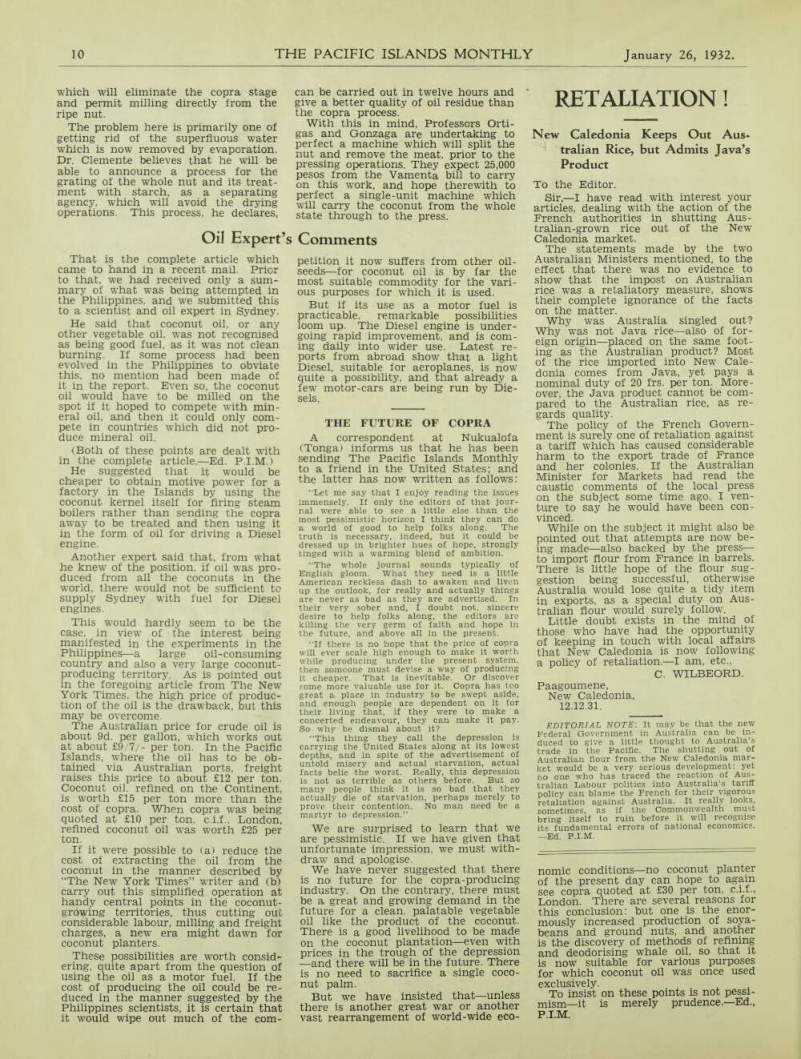
The President-General of the Methodist Church of Australasia (Rev. Frank Lade, M.A.), accompanied by Mrs.
R. C. G. Page (wife of the President of the Tongan Church) and Mrs. Smith (formerly a Mission Sister in Tonga) paid a visit to Western Samoa in November. The above photograph (which we publish by courtesy of The Mission Review) shows the visitors, with members of the mission staff and European residents at Apia.
which will eliminate the copra stage and permit milling directly from the ripe nut.
The problem here is primarily one of getting rid of the superfluous water which is now removed by evaporation Dr. Clemente believes that he will be able to announce a process for the grating of the whole nut and its treat ment with starch, as a separating agency, which will avoid the drying operations. This process, he declares,
can be carried out in twelve hours and give a better quality of oil residue than the copra process.
With this in mind, Professors Orti gas and Gonzaga are undertaking to perfect a machine which will split the nut and remove the meat, prior to the pressing operations. They expect 25,000 pesos from the Vamenta bill to carry on this work, and hope therewith to perfect a single-unit machine which wm carry the coconut from the whole state through to the press.
Oil Expert’s Comments
That is the complete article which came to hand in a recent mail. Prior to that, we had received only a sum mary of what was being attempted in the Philippines, and we submitted this to a scientist and oil expert in Sydney.
He said that coconut oil, or any other vegetable oil, was not recognised as being good fuel, as it was not clean burning. If some process had been evolved in the Philippines to obviate this, no mention had been made of it in the report. Even so, the coconut oil would have to be milled on the spot if it hoped to compete with min eral oil, and then it could only com pete in countries which did not pro duce mineral oil. (Both of these points are dealt with in the complete article. —Ed. P.I.M.) He suggested that it would be cheaper to obtain motive power for a factory in the Islands by using the coconut kernel itself for firing steam boilers rather than sending the copra away to be treated and then using it in the form of oil for driving a Diesel engine.
Another expert said that, from what he knew of the position, if oil was pro duced from all the coconuts in the world, there would not be sufficient to supply Sydney with fuel for Diesel engines.
This would hardly seem to be the case, in view of the interest being manifested in the experiments in the Philippines—a large oil-consuming country and also a very large coconut producing territory. As is pointed out in the foregoing article from The New York Times, the high price of produc tion of the oil is the drawback, but this may be overcome.
The Australian price for crude oil is about 9d. per gallon, which works out at about £9/7/- per ton. In the Pacific Islands, where the oil has to be ob tained via Australian ports, freight raises this price to about £12 per ton.
Coconut oil, refined on the Continent, is worth £15 per ton more than the cost of copra. When copra was being quoted at £10 per ton, c.i.f., London, refined coconut oil was worth £25 per ton.
If it were possible to (a) reduce the cost of extracting the oil from the coconut in the manner described by “The New York Times” writer and (b) carry out this simplified operation at handy central points in the coconut growing territories, thus cutting out considerable labour, milling and freight charges, a new era might dawn for coconut planters.
These possibilities are worth consid ering, quite apart from the question of using the oil as a motor fuel. If the cost of producing the oil could be re duced in the manner suggested by the Philippines scientists, it is certain that it would wipe out much of the com
petition it now suffers from other oil seeds —for coconut oil is by far the most suitable commodity for the vari ous purposes for which it is used.
But if its use as a motor fuel is practicable, remarkable possibilities loom up. The Diesel engine is under going rapid improvement, and is com ing daily into wider use. Latest re ports from abroad show that a light Diesel, suitable for aeroplanes, is now quite a possibility, and that already a few motor-cars are being run by Die sels.
The Future Of Copra
A correspondent at Nukualofa (Tonga) informs us that he has been sending The Pacific Islands Monthly to a friend in the United States; and the latter has now written as follows; “Let me say that I enjoy reading the issues immensely. If only the editors of that jour nal were able to see a little else than the most pessimistic horizon I think they can do a world of good to help folks along. The truth is necessary, indeed, but it could be dressed up in brighter hues of hope, strongly tinged with a warming blend of ambition.
“The whole journal sounds typically of English gloom. What they need is a little American reckless dash to awaken and liven up the outlook, for really and actually things are never as bad as they are advertised. In their very sober and, I doubt not, sincere desire to help folks along, the editors are killing the very germ of faith and hope in the future, and above all in the present.
“If there is no hope that the price of copra will ever scale high enough to make it worth while producing under the present system, then someone must devise a way of producing it cheaper. That is inevitable. Or discover some more valuable use for it. Copra has too great a place in industry to be swept aside, and enough people are dependent on it for their living that, if they were to make a concerted endeavour, they can make it pay.
So why be dismal about it?
“This thing they call the depression is carrying the United States along at its lowest depths, and in spite of the advertisement of untold misery and actual starvation, actual facts belie the worst. Really, this depression is not as terrible as others before. But so many people think it is so bad that they actually die of starvation, perhaps merely to prove their contention. No man need be a martyr to depression.”
We are surprised to learn that we are pessimistic. If we have given that unfortunate impression, we must with draw and apologise.
We have never suggested that there is no future for the copra-producing industry. On the contrary, there must be a great and growing demand in the future for a clean, palatable vegetable oil like the product of the coconut.
There is a good livelihood to be made on the coconut plantation—even with prices in the trough of the depression —and there will be in the future. There is no need to sacrifice a single coco nut palm.
But we have insisted that—unless there is another great war or another vast rearrangement of world-wide eco
nomic conditions —no coconut planter of the present day can hope to again see copra quoted at £30 per ton, c.i.f., London. There are several reasons for this conclusion: but one is the enor mously increased production of soya beans and ground nuts, and another is the discovery of methods of refining and deodorising whale oil, so that it is now suitable for various purposes for which coconut oil was once used exclusively.
To insist on these points is not pessi mism—it is merely prudence.—Ed.,