Pacific Administration
pp. 5-20 · Read in the full issue
New Hebrides Should Be Part of Australia’s Pacific Administration
The proposition is advanced in this article that Australia should take steps to end the New Hebrides Condominium and bring the group under Australian administration so as to protect her considerable land interests there.
It is desirable, from the points of view of administration, defence and trading that the Commonwealth’s tropical service should be extended from Papua and New Guinea over the Solomons and the New Hebrides.
Australia cannot release herself from her Pacific responsibilities. At present she is paying heavy costs of administration and shipping services while other nations are getting the cream of the trade. A rearrangement, to give Australia enough profitable trade to at least cover her Pacific costs, is long overdue.
IT is to be hoped that the new Fed eral Government will give some at tention to the deplorable conditions— from Australia’s point of view—that exist in the New Hebrides. Unless the Commonwealth does take some interest in this position an asset of much value to Australia, both actual and potential, will be lost.
The New Hebrides is one of the rich est of the Islands groups. It contains 5,700 sq. miles of land of which a great proportion is fertile and cultivable. It enjoys a comparatively pleasant clim ate, being in the same latitude as Samoa, and only slightly northwards of Fiji. The Group lies far southward of New Guinea and the Solomon Is lands, where climatic conditions are a little trying for Europeans.
The Condominium, under which the New Hebrides is administered, is unique: and a little history and ex planation are necessary. After half a century of “no-man’s” government, the British and French gradually took joint control. The British were first into the Group and, some 50 years ago, greatly outnumbered the French. But French commercial interests gradually reached up from New Caledonia and obtained a strong grip. Each country had sub stantial claims in the Group and even tually, early in this century, the posi tion was solved by the creation of a Condominium.
French and British each govern the affairs of their own nationals, and matters affecting them all in common are referred to certain joint institu
tions, at the head of which is the Joint Court, presided over by neutral judges.
In one way, the Condominium has worked quite well. There has been no friction worthy of the name between the two peoples, and the administra tion has gone on smoothly. A certain amount of give-and-take has been ne cessary; but the French, like the Brit ish, are gentlemen and sportsmen, and have met administrative and trading difficulties, as they have arisen, in an admirable spirit.
But it has become increasingly evi dent that the Condominium will not work and that sooner or later the Group must revert entirely to French or to British administration. There are two insuperable obstacles in the way of the success of the system. One is financial and the other has to do with labour.
In the period following the war, France was off the gold standard and the franc was “wild.” The British £ was more or less stabilised. The effect in the New Hebrides, where both French and British money are legal currency, can be imagined. The trad
ing difficulties were almost insuperable and, where Administration costs were brought together in a common fund, there was much confusion. Later, when the French franc was stabilised at 124 to the £ and the currency of both nations were settled on the gold basis, these difficulties disappeared. But they have appeared again in more acute form in recent months. The British £ is now off the gold standard, and fluctuating, while the French franc re mains on gold. Meanwhile, the Aus tralian £ is at a discount of 30 per cent, on sterling. All three currencies, British, French and Australian, are now in common use in the New Heb rides. The confusion that exists there at present in all matters relating to money can be better imagined than described.
So far as industrial conditions are concerned the position is lamentable.
In past years, owing to the unwilling ness of the New Hebrides natives to work, the French were allowed to in denture thousands of Tonkinese lab ourers, and by this means they oper ated their plantations profitably. For some reason the British have not been accorded the same privilege. As a result, one may see all through the New Hebrides flourishing French plantations, worked by Tonkinese lab our, alongside semi-bankrupt British plantations, languishing for lack of labour.
The effects of these disabilities need not be emphasised. They are apparent now in the population figures. Where, 50 years ago, the British predomin ated, there are now in the Group 930 French planters and traders and only 420 British. A considerable proportion of the British planters and traders, driven by these unfair conditions, have abandoned British and sought French nationality.
The position is very well summarised in the following article, written for us in December last by a resident of the New Hebrides: “The grievances of the British settlers in the New Hebrides are so many that it is hard to know which to start on first. But I will say at once that we have long ago given up appealing to the British administration and realise that no help can be expected in this direc tion. It was on this account that most of the big planters were forced to sell out to the French several years ago.
Of the remaining ones, several have become naturalised French, and one of the only two large British stores in Vila has been turned into a French com pany.
“There is not the slightest doubt that if conditions remain as they are, the remaining Britishers will either be forced under the French flag or forced out of business.
“I can claim to have a good know ledge of the state of affairs in this Group, as I have been a resident for several years. In recent years things have been going from bad to worse and are likely to continue so.
“It is the general opinion here that the Group will shortly be handed over to France. For some time past there have been rumours that Burns, Philp and Co. Ltd. are considering the ques tion of forming a French company, as they are likely to lose most of their French clients owing to the operation of the Credit Nationale. This is a loan of 42,000,000 francs from the French Government to French settlers in the New Hebrides, to assist them over the depression.
“Trade is at a standstill and we have derived no benefit from the rate of exchange. Recently the price offered locally for copra was only £4/5/- per ton, and it is at present £6. The natives refuse to make it for these prices and, on some islands, are going back to their old native costumes and standard of living. In fact, they still have the impression that the fall in prices of produce is due to a huge conspiracy on the part of the white man to rob them. In one part of the Group colour is lent to this theory by the actions of a certain missionary who listens on his wireless to the weekly broadcast of the price of copra in London and then re-broadcasts this news to the natives, forgetting to explain the difference be tween London and local prices.
“For many years the shortage of lab our has been a serious problem. The French solved their difficulties in 1922 by the introduction of Indo-Chinese coolies, and there are now several thousand employed. This has been the salvation of the French interests here.
British settlers are refused the privi lege of imported labour. In 1927 a Royal Commission, consisting of rep resentatives of Great Britain, Australia and New Zealand, visited the Group to inquire into this matter. After hearing evidence from most of the British planters they steamed away, and there the matter has ended, in profound ob scurity. Up to the present day no report of the decision of this Commis sion has ever been made public, but it is understood that it was decidedly un favourable to us.
“On top of all this, British settlers have for years had the annoyance of a campaign of irritation conducted against them by a certain section of
missionaries who seem to consider themselves unofficial agents of police and are ever ready to report any story or complaints the natives make to them without first trying to ascertain the true facts of the case. The result has been that persons concerned are put to the inconvenience and expense of going to Vila with witnesses, etc., and if the charges are found to be ground less —as has happened in most cases — they have no redress, but have just got to grin and bear it, as many know to their sorrow.
“Recently, one missionary made such grave charges against a planter that he was convicted in the British court of criminal libel. Yet, although this case was the subject of a special Com mission, appointed direct from London, the planter was not allowed damages, or anything towards his expenses, which were heavy.
“Commonwealth Government has large interests in the Group in the form of land claims, and ever since the formation of the Joint Court, about 20 years ago, has kept a solicitor resi dent in Vila, to watch over Australian interests. Owing to the extremely slow methods of the Joint Court, nothing was done about granting land titles until quite recently, and if the Condo minium continues to function it is doubtful if any of the present resi dents will see the land question settled in their lifetime.
“In the meantime the French com pany—which claims more land than actually exists in the Group—has been selling and leasing to Frenchmen some of this land which is claimed by the Commonwealth Government, and as there are no titles, possession seems to be nine points of the law. In one ins tance, a party of Frenchmen had been for 2 years clearing and planting one of these claims before the British offi cial heard of it. They have been in possession over 5 years now and have already made a fine plantation.”
So much for the general situation.
Now we come to the Commonwealth’s connection with the New Hebrides. The interests of Australia are as definite as
(Continued On Page 17)
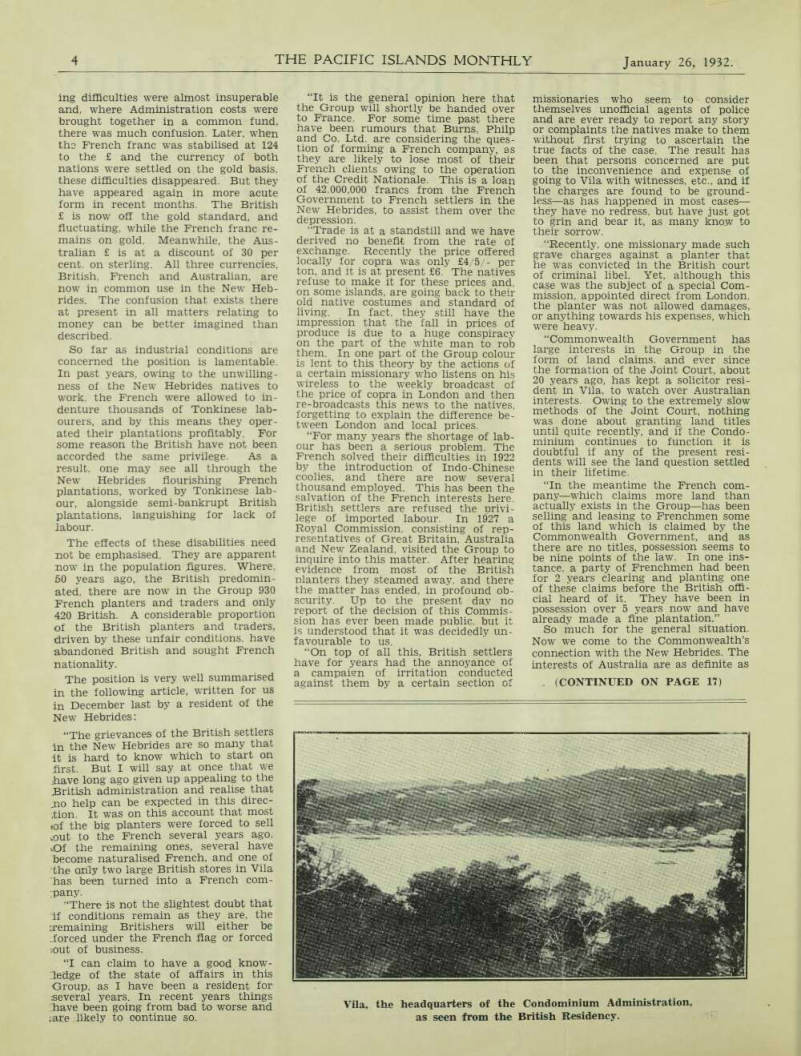
Vila, the headquarters of the Condominium Administration, as seen from the British Residency.
they are remarkable. It is necessary again to recount a little history.
If there is one man. more than an other, to whom honour is due for hav ing brought essential Pacific Islands interests to Australia, that man is the late Sir James Burns, founder of Messrs. Burns, Philp and Co. Ltd., and associated companies. He was not only a merchant and shipowner of great ability—he was also a wide-visioned imperialist. He extended the influence of his firm all over the western and southern Pacific Islands; but, wherever he went, he allowed his fervent patri otism to have full play, and he saw to it that, above all his enterprises the Union Jack was flying.
Some 50 years ago, Sir James Burns was impressed by the fact that unless someone displayed some enterprise and energy the large and potentially valu able New Hebrides Group would be lost to Britain. It is a fact that in the Pacific the flag has usually followed the trade; and Sir James Burns saw that the trade of the New Hebrides, unless prompt measures were taken, would not make British connections.
Therefore, he interviewed some of the leading men of Sydney and Melbourne and urged his patriotic viewpoint am ong them, with the result that they came together and formed the original Australasian and New Hebrides Co. Ltd.
This company, in close association with Sir James Burns’s own concerns, commenced trading and planting in the New Hebrides. Incidentally, its first manager was Mr. J. G. Laing, now a leading executive in Messrs. D. and W. Murray. He was in those early days a partner in Messrs. Prescott and Co., who were the Sydney agents of the New Hebrides Company. Another early manager was Mr. Joseph Mit chell, now General Manager of Messrs.
Burn, Philp (South Sea) Co. Ltd., and one of the Directors of the Burns, Philp group.
The Australasian and New Hebrides Co. Ltd. had a chequered career and did not flourish. It was reconstructed two or three times and was finally taken over by Messrs. Burns, Philp and Co. Ltd., and carried on for a few years. Finally, it was wound up al together and its trading interests taken over by Messrs. Burns, Philp and Co.
When the Australasian and New Hebrides Co. Ltd. was wound up it was owner of very large areas of land in practically all the islands of the New Hebrides. As soon as the com pany commenced operations it definitely set out to acquire good plantation land which it purchased from the native owners. As a matter of fact, it was the need for finding so much cash for this purpose that caused the financial crippling of the company. The land was obtained in various ways, but the transactions were all open and above board and the Company’s titles to the
various areas were as clean as was pos sible under the conditions which ruled in those days.
When the Company was wound up and its affairs taken over by Messrs.
Burns, Philp and Co., Sir James Burns —being a wise man of long vision— handed the whole of the Company’s land over to the Australian Common wealth Government. This fact is not generally known—but it is a fact. The Commonwealth Government is the owner of a very large proportion of the best land in the New Hebrides—and its claim to that land is as good as the claim of anyone else.
Sir James Burns literally gave the land to Australia. What his motive was exactly, it is hard to say. Prob ably he knew that an established Gov ernment of some kind was coming and he felt that when that central author ity proceeded to issue land titles the Australian Government would have a better chance of establishing its claim to the land than any private firm. At any rate, the gift was made and it was free from all conditions. All that Messrs. Burns. Philp and Co. have re ceived from the arrangement is the
continuance of the subsidy paid by the Commonwealth for the maintenance of the Pacific Islands services, of which the service to the New Hebrides forms a part.
The Condominium Government be gan to function in the New Hebrides on December 2, 1907, and for the last 20 years the Joint Court has been slowly and painfully scrutinising land claims and issuing titles. It is a colossal task and, so far, it has only been scratched at. An enormous amount of work yet remains to be done. If it has taken 24 years to issue titles to the land al ready dealt with, it will take at least another 100 years to deal with land claims covering the remainder of the Group. The slow-moving Joint Court, as a matter of fact, has reduced the whole position to absurdity.
The Commonwealth Government maintains in Vila a solicitor, Mr. F. E Wallace, whose duty it is to advance before the Joint Court the claims of the Commonwealth Government to the various areas of land taken over ori ginally from the Australasian and New Hebrides Co. Ltd. Mr. Wallace has been a resident of Port Villa for many years. Probably not 20 people in Aus tralia know that he is an official of the Commonwealth Government, or what he is doing. Probably, not 50 Australians, outside of the Government Department concerned, know that Aus tralia is the virtual owner of huge areas of valuable land in this Group.
It is the opinion of competent and experienced observers that Australia cannot afford to let the New Hebrides go by default. That appears to have been the policy of Federal Govern ments of the past. Matters relating to the New Hebrides have just drifted along, with the result that the enter prising French have slowly but steadily advanced their commercial hold on the Group.
The Group is of very little use to Bri tain —yet Britain continues to pay large sums annually to maintain the British Administration there. The Group is now of very little value to Australia, in a trade sense, yet Australia con tinues to pay a large sum annually to Messrs. Burns, Philp and Co. Ltd., by way of subsidy, so as to maintain a steamer service between Australia and the New Hebrides. The Group must be of comparatively little value to Messrs. Bums, Philp and Co., yet the big firm hangs on grimly in the face of the greatest difficulties, probably be cause it hopes that sometime, sooner or later, something will be done to secure this valuable territory for Aus tralia. Probably, Messrs. Burns. Philp and Co.’s reasons for retaining their New Hebrides connection are more sen timental than commercial. Even with the Commonwealth subsidy, there can not be much profit in this trade; and on account of the confused and jumpy exchanges, it is a very risky trade.
Why, then, should the present posi tion be allowed to continue? It seems certain that if the position was prop erly represented to France, a reason able solution could be found. Although French interests have poured money into the Group, so that they consider ably exceed British interests, the Group is of no more value to France than it is at present to Britain or Australia.
As a matter of fact, the French Gov ernment have subsidised French in
terests in the New Hebrides so heavily that it is now practically impossible for them ever to make any profit out of the Colony.
Developments since the Armistice have been remarkable. Australia has created an efficient tropical service and made a very good job of the Adminis tration of Papua and New Guinea; but, owing to extraordinary official indif ference, Australia has lost much of the Pacific Islands trade, won for her in the beginning by her merchants and shipowners and driven away in the past 15 years by bureaucratic stupidity and indifference. At one time, Aus tralia’s trade with New Caledonia, New Hebrides, Fiji, Tonga and Samoa was worth very many hundreds of thous ands of pounds more than it is to-day.
It has been literally driven away from Australia by certain political creeds and governmental policies. It is not possible to give details here, but it is a dismal story.
For nearly 20 years Australia has ig nored her responsibilities and oppor tunities in the Pacific. Prior to the war, owing to the enterprise of her merchants and the fine pioneering spirit of the late Sir James Burns and his associates, Australia acquired great trading interests in the Islands, ex tending from the Mariana and Caro line Group, in the north, to Samoa and Tahiti in the east. German aggrand isement forced Australia to take over Papua; the outbreak of war compelled the Commonwealth further to protect its interests by seizing New Guinea, the Bismarck Archipelago and the Northern Solomons (now grouped to gether as the Territory of New Guinea).
From that point onwards Australia should have become the dominant nower in the South Pacific. Instead of that, the Commonwealth seemed to spend most of its natural energy on class and political warfare and indus trial brawls, and its national heritage (the Pacific trade) was whittled away by other countries. Lunatics disguised as Harbour Trust officials drove the copra traffic out of Sydney Harbour; short-sighted tariffites gave grave of fence to Fiji and New Caledonia: in different bureaucrafts allowed the trade of Tonga and Samoa to drift away to New Zealand.
But Australia, in a trade sense, is now experiencing a change of heart. A decade’s orgy of spending—the result of easy loans and phenomenal prices for primary products—has ended. The nation is getting back to sanity and work: and. among other things, it will strive to regain as much as possible of the £6,000,000 of trade which is annu ally available in the Pacific Groups and territories.
Australia must either abandon her Pacific interests, or proceed to develop them. Two years ago the politicians would have said “abandon them.” To day, a new Government, eager to im prove the economic position and do something worth while for Australia, probably will take the other view. The new Ministers will have plenty of op portunities, so far as the Pacific is con cerned.
The New Hebrides represents one, which cries aloud for attention. The British Solomon Islands is another.
Nearly all the trade of this huge and potentially valuable group is done with Sydney: and there is a general belief that it would be for the convenience and benefit of all concerned if the
administration of the Solomons were removed from the British Colonial Office (operating through Suva) and given to Australia.
Here are the outlines of a plan that is being discussed and that is based on the facts dealt with in the foregoing article: 1. Extend the Commonwealth’s Is lands Administration (now suc cessfully functioning in Papua, New Guinea and Nauru) to other Islands Groups in which Aus tralia has important interests. 2. Make application for the trans fer of the Solomon Islands Ad ministration from Britain to Aus tralia. 3. Open negotiations with France, through London, for the transfer of the New Hebrides administra tion from the Condominium to Australia, compensating France for the loss of her interests there by either a monetary payment or a grant of Territory elsewhere. 4. Inaugurate, at the same time, a policy of vigorously developing these Islands territories, so that Australia may regain some of the trade that belongs to her by geo graphical right, and so that she may get some return for the huge sums she has already invested in grants and subsidies in the vari ous Pacific territories. 5. The tariffs of New Guinea and Papua should be examined, with a view to giving preference to Australia, which undertakes the costly responsibility of their Ad ministration.