Products Of The South Seas
p. 47 · Read in the full issue
Copra Holds To Fair Price Level
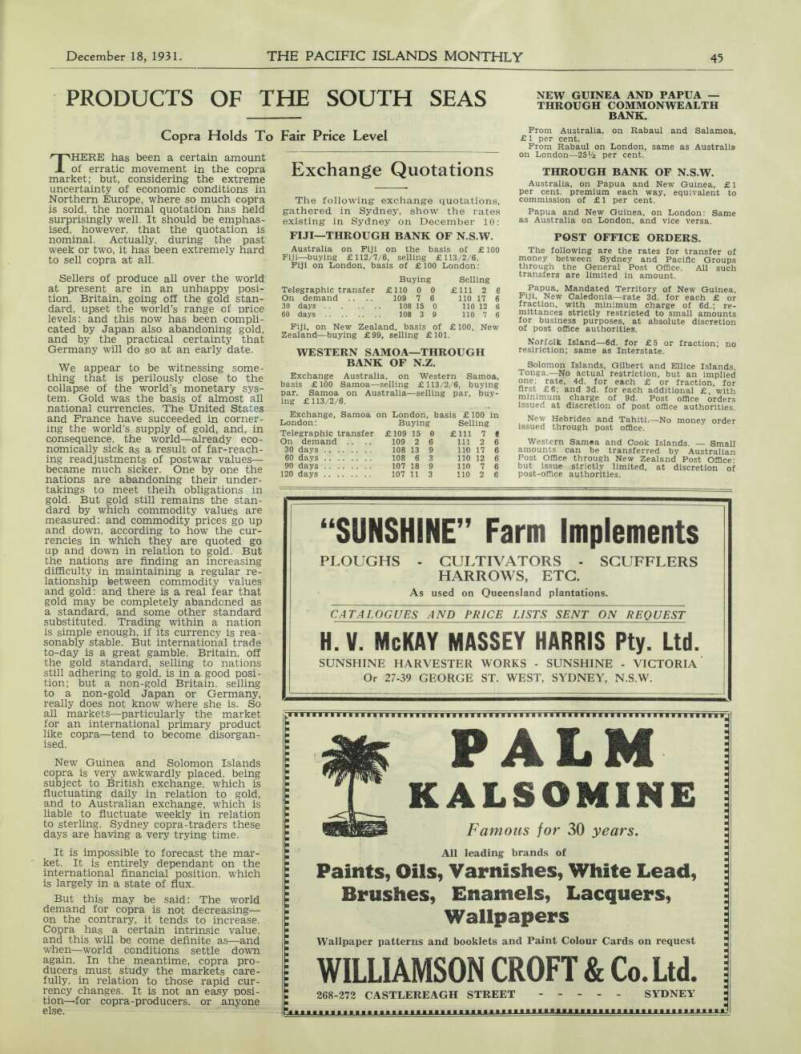
THERE has been a certain amount of erratic movement in the copra market; but, considering the extreme uncertainty of economic conditions in Northern Europe, where so much copra is sold, the normal quotation has held surprisingly well. It should be emphas ised, however, that the quotation is nominal. Actually, during the past week or two, it has been extremely hard to sell copra at all.
Sellers of produce all over the world at present are in an unhappy posi tion. Britain, going off the gold stan dard, upset the world’s range of price levels: and this now has been compli cated by Japan also abandoning gold, and by the practical certainty that Germany will do so at an early date.
We appear to be witnessing some thing that is perilously close to the collapse of the world’s monetary sys tem. Gold was the basis of almost all national currencies. The United States and France have succeeded in corner ing the world’s supply of gold, and, in consequence, the world —already eco nomically sick as a result of far-reach ing readjustments of postwar values — became much sicker. One by one the nations are abandoning their under takings to meet theih obligations in gold. But gold still remains the stan dard by which commodity values are measured: and commodity prices go up and down, according to how the cur rencies in which they are quoted go up and down in relation to gold. But the nations are finding an increasing difficulty in maintaining a regular re lationship between commodity values and gold: and there is a real fear that gold may be completely abandoned as a standard, and some other standard substituted. Trading within a nation is simple enough, if its currency is rea sonably stable. But international trade to-day is a great gamble. Britain, off the gold standard, selling to nations still adhering to gold, is in a good posi tion; but a non-gold Britain, selling to a non-gold Japan or Germany, really does not know where she is. So all markets —particularly the market for an international primary product like copra—tend to become disorgan ised.
New Guinea and Solomon Islands copra is very awkwardly placed, being subject to British exchange, which is fluctuating daily in relation to gold, and to Australian exchange, which is liable to fluctuate weekly in relation to sterling. Sydney copra-traders these days are having a very trying time.
It is impossible to forecast the mar ket. It is entirely dependant on the international financial position, which is largely in a state of flux.
But this may be said: The world demand for copra is not decreasing— on the contrary, it tends to increase.
Copra has a certain intrinsic value, and this will be come definite as —and when—world conditions settle down again. In the meantime, copra pro ducers must study the markets care fully, in relation to those rapid cur rency changes. It is not an easy posi tion—for copra-producers, or anyone else.