Samoan Finance
p. 38 · Read in the full issue
Search for Economy Administrator Reviews Situation From Our Own Correspondent
APIA, November 20.
THE axe of economy has been brought into operation in Samoa at last.
The Commissioner of Labour, Cap tain Carter, has resigned his position, after having held the office for 16 years. The crown prosecutor, Mr. A.
MacCarthy, will take over the duties of Commissioner of Labour, whereby a saving of about £100 per year will be made.
Captain Carter had also been Gov ernment Tourist Agent and Commis sioner of the Supreme Court of Samoa, besides acting as Coroner. The Plant ers’ Association of Samoa has sent a letter of appreciation of Caotain Car ter’s services, and will give him a send off before his departure in December.
There is much apprehension in offi cial circles regarding further develop ments of the economy campaign.
Administrator’S Summary
On October 29 the Administrator (General Hart) called and addressed a meeting of the Legislative Councillors on the economic situ ation of Samoa.
His Excellency is to be commended on the sten he took to inform the community of the views of the Administration, and the hope may be expressed that his action will lead to a discussion of ways to meet the extraordinary situation.
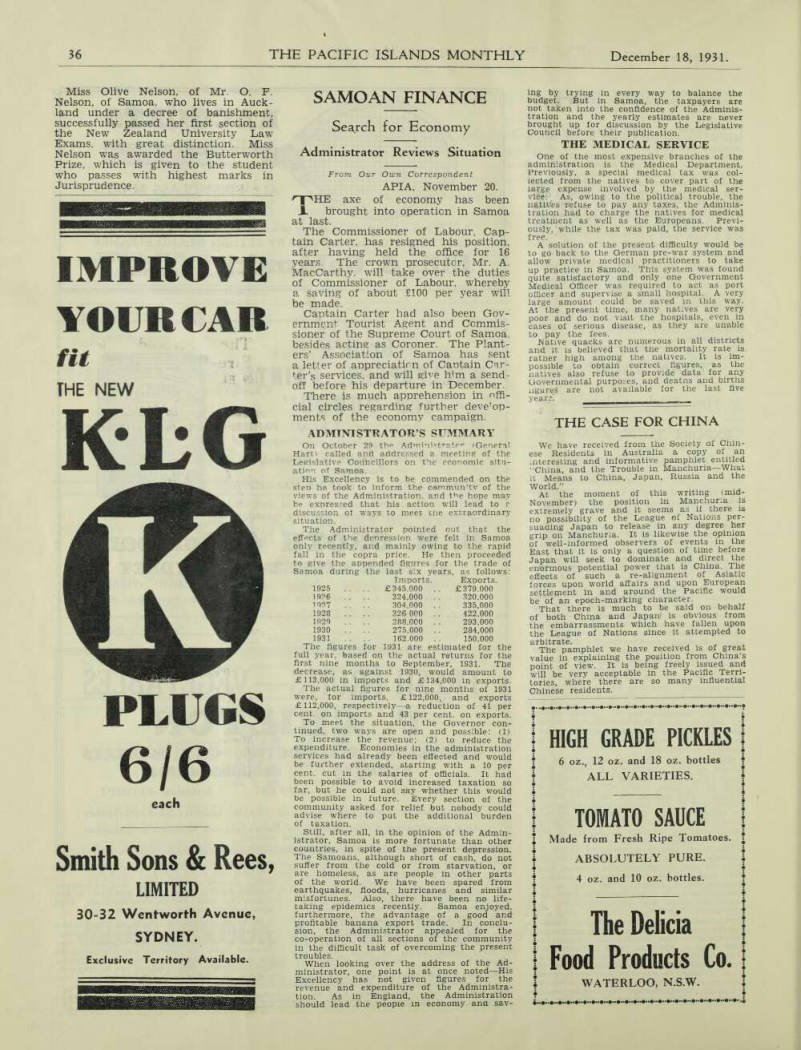
The Administrator pointed out that the effects of the denression were felt in Samoa only recently, and mainly owing to the rapid fall in the copra price. He then proceeded to give the appended figures for the trade of Samoa during the last six years, as follows:
The figures for 1931 are estimated for the full year, based on the actual returns for the first nine months to September, 1931. The decrease, as against 1930, would amount to £113,000 in imports and £134,000 in exports.
The actual figures for nine months of 1931 were, for imports, £122,000, and exports £112,000, respectively—a reduction of 41 per cent, on imports and 43 per cent, on exports.
To meet the situation, the Governor con tinued, two ways are open and possible: (1) To increase the revenue; (2) to reduce the expenditure. Economies in the administration services had already been effected and would be further extended, starting with a 10 per cent, cut in the salaries of officials. It had been possible to avoid increased taxation so far, but he could not say whether this would be possible in future. Every section of the community asked for relief but nobody could advise where to put the additional burden of taxation.
Still, after all, in the opinion of the Admin istrator, Samoa is more fortunate than other countries, in spite of the present depression.
The Samoans, although short of cash, do not suffer from the cold or from starvation, or are homeless, as are people in other parts of the world. We have been spared from earthquakes, floods, hurricanes and similar misfortunes. Also, there have been no life taking epidemics recently. Samoa enjoyed, furthermore, the advantage of a good and profitable banana export trade. In conclu sion, the Administrator appealed for the co-operation of all sections of the community in the difficult task of overcoming the present troubles.
When looking over the address of the Ad ministrator, one point is at once noted—His Excellency has not given figures for the revenue and expenditure of the Administra tion. As in England, the Administration should lead the people in economy and sav
ing by trying in every way to balance the budget. But in Samoa, the taxpayers are not taken into the confidence of the Adminis tration and the yearly estimates are never brought up for discussion by the Legislative Council before their publication.
The Medical Service
One of the most expensive branches of the administration is the Medical Department.
Previously, a special medical tax was col lected from the natives to cover part of the large expense involved by the medical ser vice. As, owing to the political trouble, the natives refuse to pay any taxes, the Adminis tration had to charge the natives for medical treatment as well as the Europeans. Previ ously, while the tax was paid, the service was free.
A solution of the present difficulty would be to go back to the German pre-war system and allow private medical practitioners to take up practice in Samoa. This system was found quite satisfactory and only one Government Medical Officer was required to act as port officer and supervise a small hospital. A very large amount could be saved in this way.
At the present time, many natives are very poor and do not visit the hospitals, even in cases of serious disease, as they are unable to pay the fees.
Native quacks are numerous in all districts and it is believed that the mortality rate is rather high among the natives. It is im possible to obtain correct figures, as the natives also refuse to provide data for any Governmental purposes, and deatns and births figures are not available for the last five years.
Imports. Exports. 1925 .. .. £345,000 .. £379,000 1926 .. .. 324,000 .. 320,000 1927 .. .. 304,000 .. 335,000 1928 . . . . 326,000 . . 422,000 1929 . . . . 288,000 . . 293,000 1930 . . . . 275,000 . . 284,000 1931 . . . . 162,000 . . 150,000