Nukualofa to Vavau
pp. 18-19 · Read in the full issue
Interesting Sidelights
From Our Tonga Correspondent FROM far off to the eastward, in the direction of the Island Pagaimotu, came the mournful dirge from a conch shell.
Away to the south-west on the mainland someone was beating the “lali” (drum), summoning worshippers to morning prayer. The booming of the shell, held to the lips of some all-night fisherman, was conveying glad news to his friends on shore, and they, I knew were hastening about somewhere at the back of those distant palms, preparing the red-hot stones to receive the catch.
Searching along the horizon and back to the long stretch of palm-fringed beach, my vision alighted on no living thing to mar this perfect prospect— a morning in the Tongan Islands in early Spring.
The captain’s voice from the other end of the bridge, suggesting a cup of coffee, brought me back to earth and the seething mass of humanity that we had between decks down below. As
I had watched these brown-faced islanders, men, women and children, coming aboard at the Nukualofa wharf I had not then realised that even a 60-ton despatch vessel had its limit in deck space.
On the captain’s assurance that he
had many times carried “half as many again,” and that, before we reached the outer reef, “they would all be snug,” I followed him down to the cup of coffee.
True enough, when we emerged from the depths, they had apparently sorted themselves into some sort of order, for I discovered quite an appreciable amount of deck space to move around in.
We are now passing the revolving light on little Malinoa Island and, with the aid of glasses, I could see the six white mounds that mark the resting place of those poor misguided wretches who, 43 years ago, made a nearly successful attempt to assassinate their European Premier, Shirley Baker. Were those men the “tools” of someone “higher-up”? Just rumour, probably! If true, they went to the Flying Squad with sealed lips.
An Old Cannon.
At four o’clock we dropped anchor close to the reef at the Island of No muka, and, within the hour, a sturdy boat’s crew had got us through the breakers to the sandy beach. Strolling up to high water mark my attention was directed to the cannon, half buried in the soil, which the natives claim, was left there by Captain Cook.
I doubt this claim.
For what reason would Cook feel justified in leaving a part of his armament on this island? Or Tasman? Or Bligh? Of what earthly use to the native, anyway? They couldn’t make nails or spears out of it; if they could have done so, it is palpable that there would be no cannon there to-day.
Furthermore, there is no ground to suppose that one of those old-time captains was that deficient in common sense that he would thoughtlessly leave with such a people, a weapon which, with the theft of a little powder, might, at some future date, make his landing troublesome. No! I think that cannon dates farther back; a relic of some vessel that touched at the savage island and never sailed away. The design of the rusted old piece favours my theory!
The “Bounty” Mutiny.
Late at night, I sat under that traditional two-century-old knarled stump, which marks the landing place on Nomuka’s sands, awaiting the ship’s boat. Did I [doze]? Is it possible! Mr.
Sandys, the uncrowned king of No-||
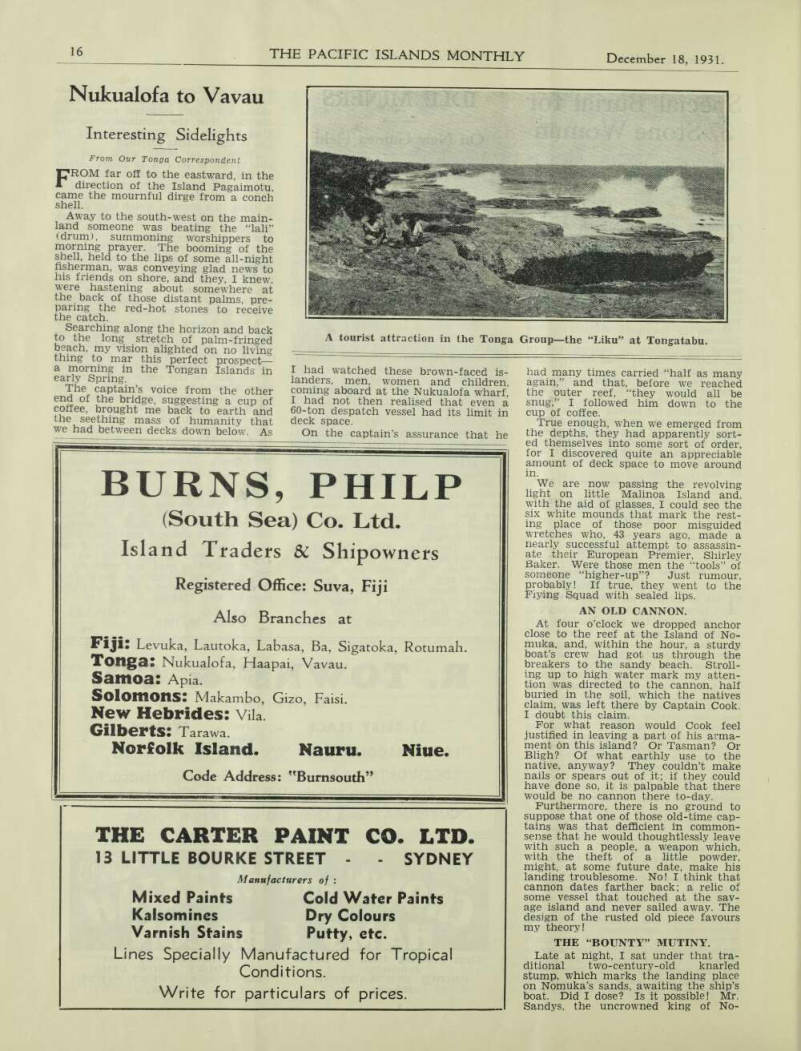
A tourist attraction in the Tonga Group—the “Liku” at Tongatabu.
muka, had given me a wonderful time, and I have never tasted better liquor —never any with just that bouquet . . .
I know this, that, under that tree, I suddenly felt that in some distant past a fearful compact had been made here.
I cannot explain the feeling, except to say that it was numbing.
Then, in a flash, my brain seemed to function —I must have [dozed]—to hear my voice say in a detached sort of way “Fletcher Christian.” Shivering, I moved quickly down to the water’s edge and hailed the incoming boat.
Did Fletcher Christian hatch his mutiny under that tree. We know the ship called here and that, a few days later, the mutineers of the Bounty set their captain (Bligh) and his loyal followers off in an open boat; but I wasn’t thinking of Christian that night on Nomuka beach. No, sir! He just “grew” under that old tree!
At daylight, we sailed northward through intricate reefs and past coral islets of exquisite beauty. The luxuriance of the foliage in the Tongan Islands is not surpassed. At noon, we dropped in alongside the jetty at Lifuka, in the Haapai Group. This island, a century and a quarter ago, was the stronghold of the redoubtable warrior chief Finau, and, from this base, he was wont to raid both Tongatabu in the south, and Vavau in the north.
Buried Treasure?
At four o’clock in the afternoon, we are on our way again. We are promised that daylight will disclose something new; that the beauty of waterline verdure will fade from our memories when gorgeous Vavau looms ahead with the rising sun.
Off to starboard we are shown an ugly patch of coral awash with the breaking sea. This is called Mariner’s Patch, and Tongan history tells us that between here and the mainland, is where the ill-fated Port-au-Prince was raided and burnt by Finau and his men.
Somewhere, deep down, the coral, with a century’s growth, has completely covered her remains. And what of the bar gold and silver, and Church plate and precious stones, which Mr. Mariner tells candidly she had “privateered” on her voyage?
This treasure, too, must lay below there, under perhaps eight or ten feet of mounting coral, and will probably remain there for all time.
As we go chugging northwards in the sunset glow, we see away off to the nor’-west Tofua, the smoking table mountain and, seemingly close, the clear-cut cone of Kau, its tapering peak buried now in a hovering cloud.
At daybreak, we are up betimes, and discover that already the little vessel is entering the harbour. Away to the left, the undulating land rises higher and higher to the distant plateau known as the Logamapu Plains. In front and to starboard are numerous islands, richly endowed with exquisite tropical foliage and, towering over all, the stately coconut palms bow to the rising sun.
With all their attractions, the islands we have passed in our journey north cannot compare with this. Deep Water on every hand, the little boat dodges in and out and through this kaleidoscopic setting of wondrous natural beauty to drop anchor at last in the inner haven.
I have seen Vavau—that one perfect harbour in the Pacific. . . . ===