The Lali of Ancient Fiji
p. 16 · Read in the full issue
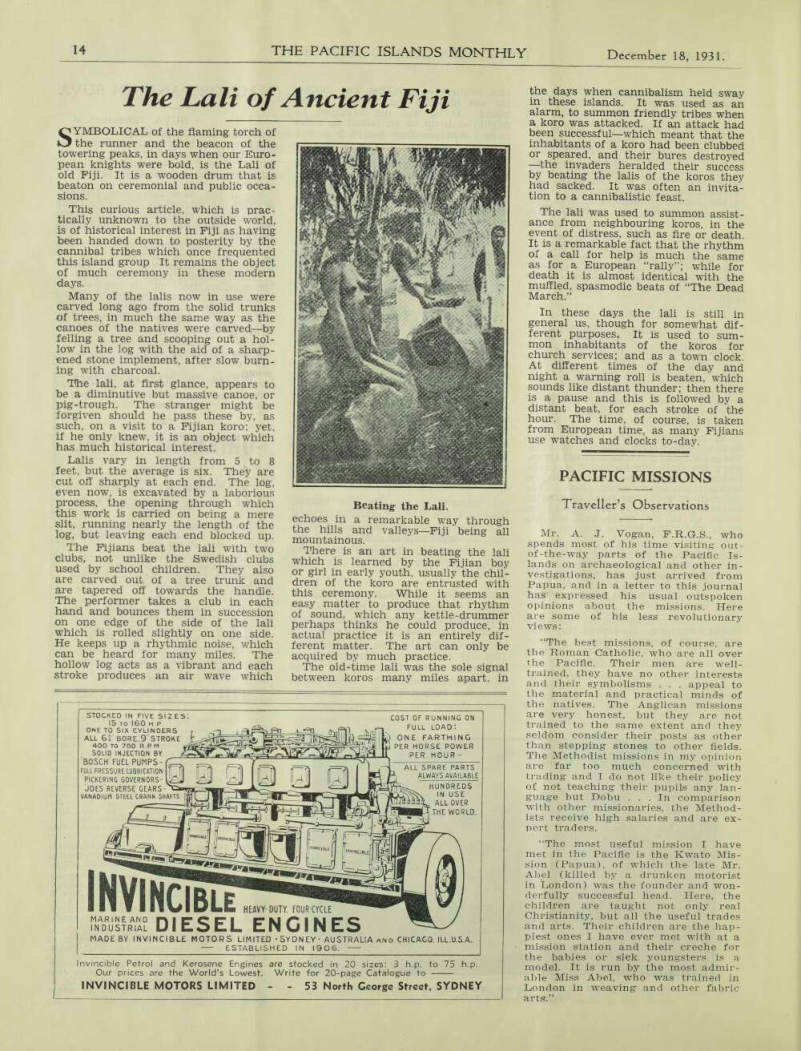
SYMBOLICAL of the flaming torch of the runner and the beacon of the towering peaks, in days when our European knights were bold, is the Lali of old Fiji. It is a wooden drum that is beaten on ceremonial and public occasions.
This curious article, which is practically unknown to the outside world, is of historical interest in Fiji as having been handed down to posterity by the cannibal tribes which once frequented this island group. It remains the object of much ceremony in these modern days.
Many of the lalis now in use were carved long ago from the solid trunks of trees, in much the same way as the canoes of the natives were carved—by felling a tree and scooping out a hollow in the log with the aid of a sharpened stone implement, after slow burning with charcoal.
The lali, at first glance, appears to be a diminutive but massive canoe, or pig-trough. The stranger might be forgiven should he pass these by, as such, on a visit to a Fijian koro; yet, if he only knew, it is an object which has much historical interest.
Lalis vary in length from 5 to 8 feet, but the average is six. They are cut off sharply at each end. The log, even now, is excavated by a laborious process, the opening through which this work is carried on being a mere slit, running nearly the length of the log, but leaving each end blocked up.
The Fijians beat the lali with two clubs, not unlike the Swedish clubs used by school children. They also are carved out of a tree trunk and are tapered off towards the handle.
The performer takes a club in each hand and bounces them in succession on one edge of the side of the lali which is rolled slightly on one side.
He keeps up a rhythmic noise, which can be heard for many miles. The hollow log acts as a vibrant and each stroke produces an air wave which Beating the Lali.
echoes in a remarkable way through the hills and valleys—Fiji being all mountainous.
There is an art in beating the lali which is learned by the Fijian boy or girl in early youth, usually the children of the koro are entrusted with this ceremony. While it seems an easy matter to produce that rhythm of sound, which any kettle-drummer perhaps thinks he could produce, in actual practice it is an entirely different matter. The art can only be acquired by much practice.
The old-time lali was the sole signal between koros many miles apart, in
the days when cannibalism held sway in these islands. It was used as an alarm, to summon friendly tribes when a koro was attacked. If an attack had been successful—which meant that the inhabitants of a koro had been clubbed or speared, and their bures destroyed —the invaders heralded their success by beating the lalis of the koros they had sacked. It was often an invitation to a cannibalistic feast.
The lali was used to summon assistance from neighbouring koros, in the event of distress, such as fire or death.
It is a remarkable fact that the rhythm of a call for help is much the same as for a European “rally”; while for death it is almost identical with the muffled, spasmodic beats of “The Dead March.”
In these days the lali is still in general us, though for somewhat different purposes. It is used to summon inhabitants of the koros for church services; and as a town clock.
At different times of the day and night a warning roll is beaten, which sounds like distant thunder; then there is a pause and this is followed by a distant beat, for each stroke of the hour. The time, of course, is taken from European time, as many Fijians use watches and clocks to-day. ... ===