Missions—Good And Bad
pp. 14-15 · Read in the full issue
Interesting Comments on Missionary Activity and Influence in the South Seas
Written for The Pacific Islands Monthly by G. E. L. Westbrook, Samoa.
I AM not against the Pacific Islands Missions—but neither am I for them.
Man and boy, I have lived for long over half-a-century in the South Seas —the last 40 years in Samoa. I have seen, on the one hand, natives assisted and educated by the missionaries: and on the other hand I have seen sectarian jealousy cause cruel wars and religious fanaticism manifest itself in monstrous oppression of native communities. I give the mission system full credit: and, also, it must take the discredit of many shortcomings and much injustice.
Everyone must respect and admire those earnest Christian men and women, of all denominations, who have spent much of their lives in efforts to convert and educate the heathen.
Many of them have suffered martyrdom.
It is now more than 100 years since the Samoans welcomed the mission aries and all became Christians. The missionaries have not only translated and given to this primitive race the whole of the Bible, but also a written language. There is now not one per cent, of the Samoans who cannot read or write in their own language. There are over 220 churches and schools in the Group, all built, paid for and main tained by the natives.
But I will not say that this has been altogether for the good of the natives. The church is too powerful in many places. The life of the native has changed. The church really rules and governs everything. The native has lost all that he knew formerly of the arts and crafts which made him self-reliant. He now has a literature but it is practically all on one subject —religion. He, therefore, tends to be come fanatical and narrow minded.
It is a difficult problem to say where the good of the missionary effort ends and the evil commences. During my long residence in Samoa I have known and admired most of the men of the London Missionary Society. No one can fail to recognise their good work.
But is their great influence, nowadays, being used for the real advancement of these Pacific Territories?
More than 50 years ago I lived on South Seas Islands where natives were governed entirely by their own chiefs, without interference by European na tions or missionaries. They kept to their own manners and customs and were happy and prosperous. Then came the missionaries, who under mined the power of the chiefs, destroyer the ancient communal life, and opened the way for the vices and hypocrisies of the white man.
I know that missionaries blame the traders for the things I have mentioned. I tell only of what I have seen.
Rotuma’S Sectarian War
In the year 1880-1881 I was on the island of Rotuma. trading for a New Zealand firm. While I was there, Rotuma was annexed to Fiji by Governor de Vouex. I attended the flag raising at Matusa, the warship Miranda
having brought the Governor of Fiji for that express purpose. This is what led up to the annexation: On Rotuma there were Methodists and Catholics. The Methodists had established themselves first. Some years afterwards the Catholics landed some priests and, out of a population of 2,500, 500 became Catholics. Being anxious to gain converts—if it was possible to get a convert in a Protestant village—the Catholics would build a little chapel, even if it consisted only of a few coconut leaves and sticks.
On the roof a cross would be erected.
A fanatical native Melholist pastor, upon returning from wild pig shooting, passed a number of villages where these small chapels were. He deliberately took pot-shots at the crosses. This was reported to the priests, who indignantly protested to the Rev. Mr. Moore, head of the Methodist mission. He, however, had no control over the fanatical native pastor.
A priest then wrote directly to the pastor himself. The native sent back a very insulting reply, accusing the priest of certain misdemeanours. This led to a war, which lasted about 8 months, and it was said about 80 people were killed.
The traders on the island, most of whom were German, persuaded the natives to petition to come under the protection of Fiji, and that was why the island was annexed to Fiji while I was there.
Sunday In Funafuti
I afterwards left for the Ellice group and, for some years, was stationed on the island of Funafuti. Funafuti, like
many of the other islands in the Ellice group was sparsely populated, most of the inhabitants having been kidnapped by Peruvian slavers in the later ’sixties.
The natives lived in one big village and mustered a little over 200. The czar and controller of almost every thing, both state and church, was a Samoan native pastor. The leading men of the island were under his control, as deacons in his church.
There were some most absurd laws in operation.
One law was that it was a sin and a punishable offence to either bathe or cook on the sabbath day—punishable by fine, and worse still to the simple islanders, by being turned out of church membership. To miss going to church on Sundays, unless one could prove severe illness, was also a fineable offence. On Sundays, I did my own bit of cooking.
The Ellice Islands, in those days, were governed by the natives them selves; they had not then come under the sphere of the High Commissioner for the Western Pacific. I was fined regularly for breaches of their laws and, because I would neither acknowledge their laws or pay my fines, they christened me “O le Papalangi super” (the whiteman who was gone in the upper storey). They were not in a position to boycott my business, as I was the only trader who had goods to suit their requirements. It was not till some time afterwards that the annoyance I was subject to was fixed up by Captain (afterwards Admiral) Cyprian Bridge, of H.H.S. Espiogle, giving them a severe reprimand.
Wallis Island’S War
My next experience of missionaries was on Wallis Island. The natives were all Catholics. In fact, no opposition mission would have been tolerated on that island. The Mission was conducted by French Marists. On account of my not being a Catholic I was called all kinds of names by a French priest whom I clashed with—heretic.
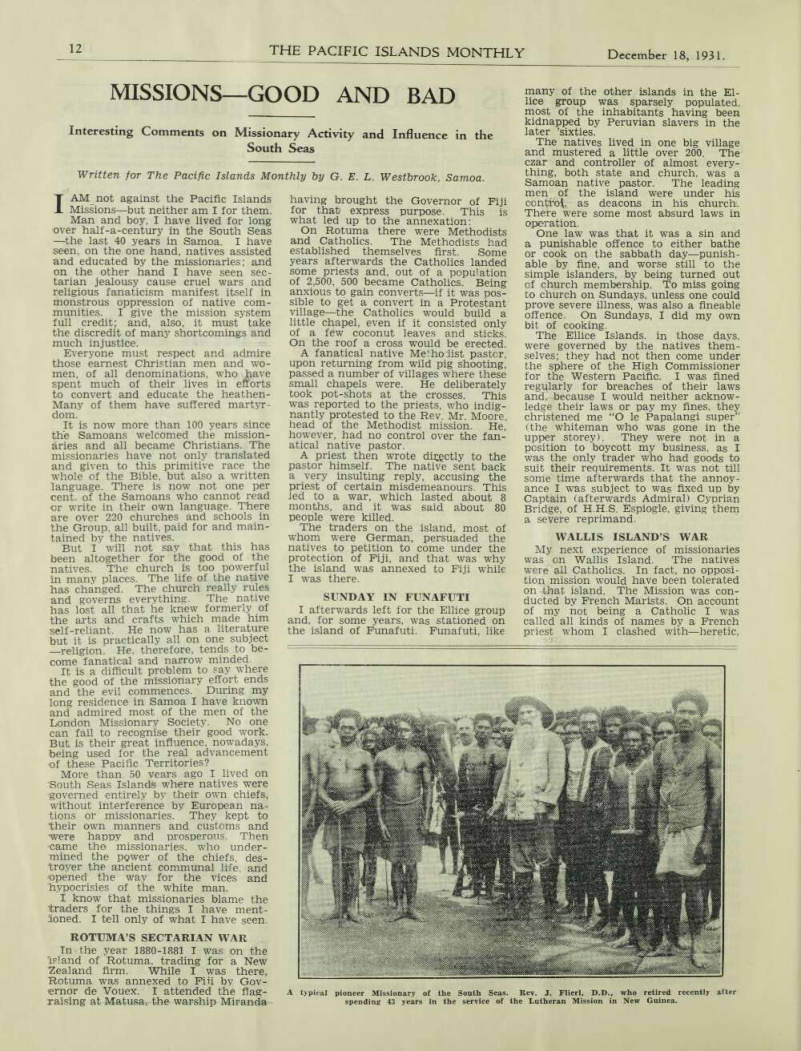
A typical pioneer Missionary of the South Seas. Rev. J. Flierl, D.D., who retired recently after spending 43 years in the service of the Lutheran Mission in New Guinea.
pagan and Freemason —as if that was something dreadful. (I am a Protestant, but not a Freemason.) The first missionaries on Wallis Island were Tongan Methodists. Afterwards the Catholic priests arrived and most of the natives became Catholics.
A war started, the Protestant native pastor was killed, and his adherents defeated. Some of them went to Vavau in the Tongan Islands, and many of their descendants are there to this day.
Those islands that came under the sway of the American Board of Methodist Missions, north of the Equator, also came under some drastic restrictions. For instance, smoking was strictly prohibited, as a device of the devil.
Fanticism
Religious organisations preaching the same doctrine will sometimes split amongst themselves, to the great bewilderment of the natives. Take the case of the split in the Tongan Islands, between ithe Methodists and the Free Church. There was, and probably is still, a lot of bitterness between those two branches of the same denomination.
On an island where I lived, there was an old native who claimed he was a Catholic, a remnant of old times, when the Catholics had tried to get a footing on the island by sending a Samoan native catechist there. This old man, over 75, was fined repeatedly for not going to church, although he would sit in his house and tell his beads while the service was on.
On one occasion, all his coconuts, both ripe and green, were thrown off the trees and his taro plantation rooted up and consumed by the islanders. The consequence was that his whole family were against him, as they suffered more than he did.
I met him going to Church one Sunday morning. He looked very miserable and sheepish when I greeted him. In the native dialect he said to me, “My legs go, but not my belly.”
On another occasion the natives ordered him to leave the island in a canoe and got the canoe ready. His provisions were to be a few coconuts, old
and young, for drinking and eating.
He was to leave the lee side of the island. If he was not swamped he might fetch up at an island 60 miles away. Whether they meant it or not I do not know.
The next evening, both the old man and the canoe were missing. I chided them and told them the matter was very serious and when the white missionary arrived upon his annual visit in the missionary ship he would be very angry when he heard of it. The natives became very perturbed, a reaction having set in in the old mans favour.
They were all out for days, searching every distant island in the lagoon.
Neither the canoe or the old man were found.
What became of the canoe I do not know, after I set it adrift. The old man I kept safely stowed away in my loft. Everything afterwards turned out alright. They were all religious fanatics.
Missionaries live in a kind of exalted atmosphere of their own. They some times discredit and look down on the trader, who is as much an ambassador of commerce as they are of religion.
Both of them make their living out of the native.
In Samoa
It appears to me that the Roman Catholics are steadily gaining ground in Samoa, at the expense of the other mission organisations. Marist schools have educated as Catholics very many young half-castes born of Protestant parents.
Then the Protestant missionaries, keeping to the letter of their rule that they must be non-political, have held aloof from the Mau and all its troubles —even during the riot of December, 1929. It was a young American Catholic priest who on that occasion visited the wounded and dying. These things have not helped the Protestant missions among the Mau supporters.
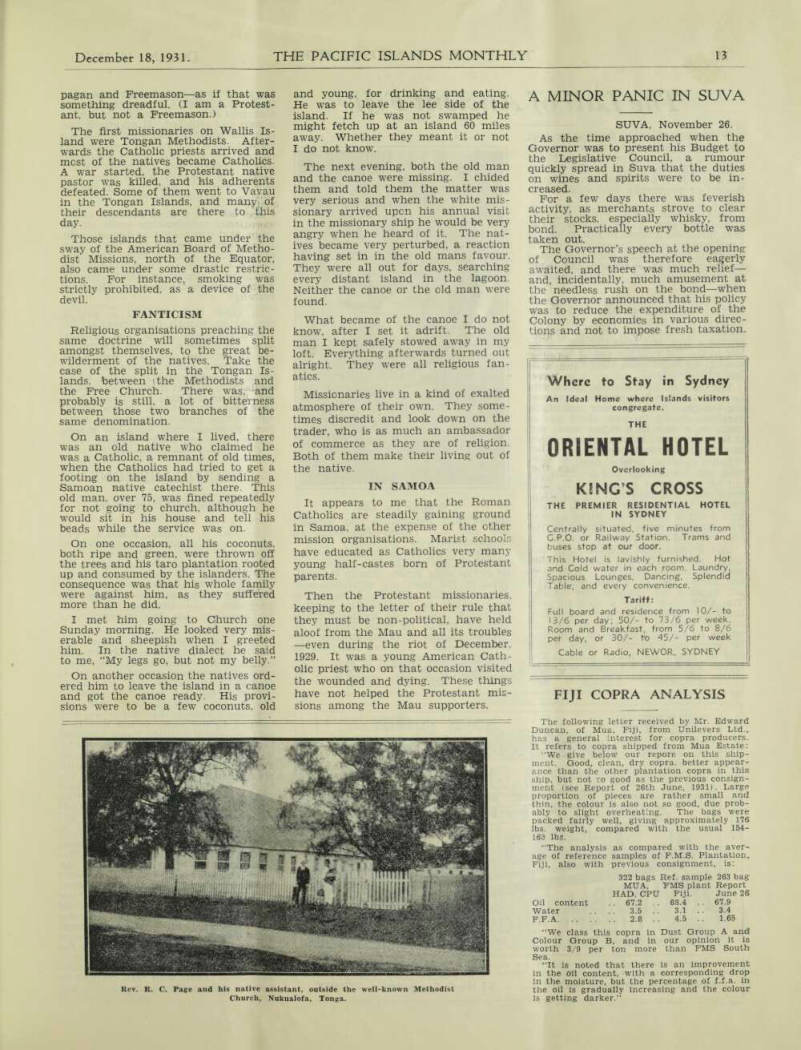
Rev. R. C. Page and his native assistant, outside the well-known Methodist Church, Nukualofa, Tonga. ———