"Daddas” Who Seek Elusive
pp. 11-12 · Read in the full issue
Romance In Coral Islands
By Robert Slade
STRANGE, the call that the Pacific Islands have for elderly super-civilised men of ardent temperament!
The years may harden their arteries, but their hearts—and their heads —stay soft. A remarkable number of them throw off the family and business responsibilities of middle age and disappear among the coral isles, following the beckoning finger of Romance—and a lively imagination.
I met one of these rebels some years ago, when travelling on a small steamer from Auckland to Eastern Polynesia.
We were following an unusual course: and he had taken passage with us because we were calling at a somewhat isolated island where he had made himself a home.
He was a lively little grey-headed man; and, because he was panting with eagerness to see his island again and I was a sympathetic cabin-mate, he told me the story of his life. He had been a warehouseman and a softgoods traveller in Dunedin, with a large wife, a small suburban garden, and a brood of lusty youngsters. For a quartercentury he had remained on his selfmade treadmill. Then, somehow, his chance had come. His wife was well provided for, his children were selfsupporting. The starved, romantic soul of him burst its bonds and Charles Green —that was not his name, but it will serve—cleared out. He, so to speak, crawled into a hole in the Pacific and pulled it in after him.
Charles told me that he wandered about the Cook and Society groups until he found a small, very beautiful island, where he settled down as a trader and planter. He had started life all over again. A charming Polynesian girl, said Charles, superintended his modest bungalow, soothed his loneliness and presented him with two half caste babies. I gathered that he was soaking himself in sunshine, beauty and tropical romance, and the greying years had lost their terrors.
Frankly, I was very pleased with Charles. I had partaken lavishly of Louis Beck and Herman Melville and. almost before Rangitoto was out of sight I was looking ahead for Rarotonga’s peaks, and for dusky belles with frangipanni flowers behind their ears.
Charles, with his passionate Islands wife and his fervid descriptions of crooning palm trees and sparkling lagoons, fitted into the picture.
Charles was pleased with me. I listened eagerly, for hours, to his stories about his Polynesian girl’s warmth and devotion, and her loveliness and charm.
He told me all sorts of stirring, intimate things. Seeing his ardour, one forgot his bald head and forgave him the wrinkles on his leathery old neck.
Romeo and Strephon and all the lovers of ancient Romance were not a circumstance to my yearning and impatient Charles. He was ready to get out and push the ship along. . . .
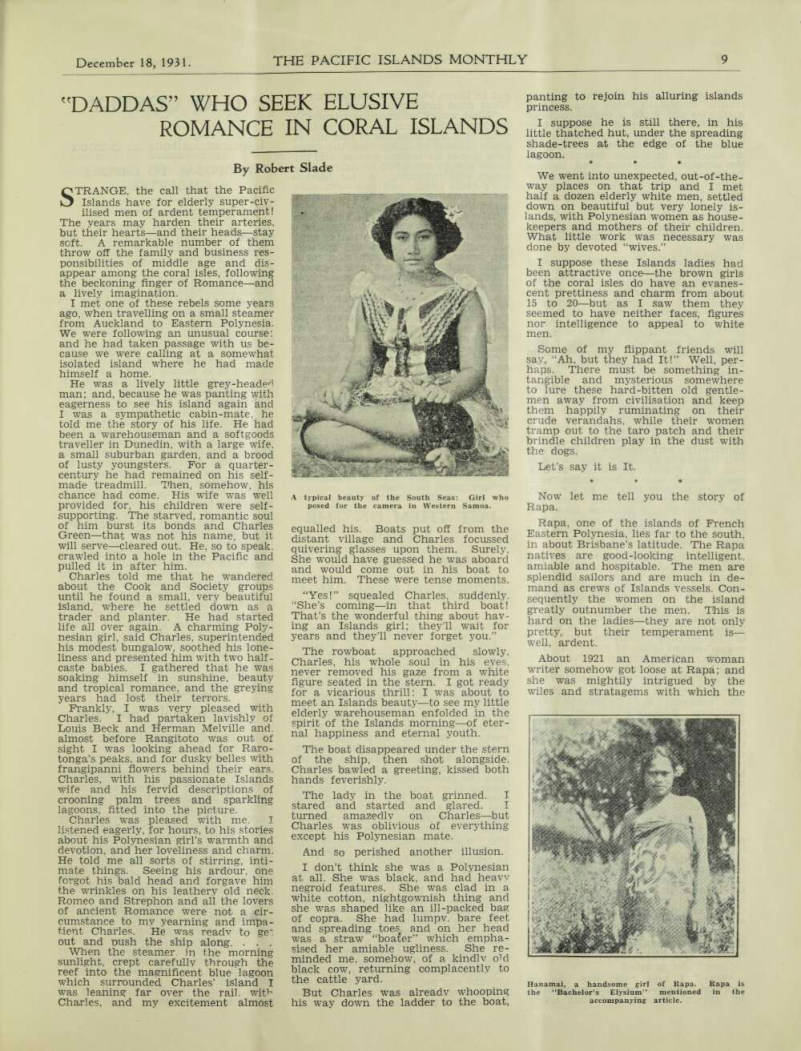
When the steamer, in the morning sunlight, crept carefully through the reef into the magnificent blue lagoon which surrounded Charles’ island I was leaning far over the rail, with Charles, and my excitement almost A typical beauty of the South Seas: Girl who posed for the camera in Western Samoa.
equalled his. Boats put off from the distant village and Charles focussed quivering glasses upon them. Surely, She would have guessed he was aboard and would come out in his boat to meet him. These were tense moments.
“Yes!” squealed Charles, suddenly.
“She’s coming—in that third boat!
That’s the wonderful thing about having an Islands girl; they’ll wait for years and they’ll never forget you.”
The rowboat approached slowly.
Charles, his whole soul in his eyes, never removed his gaze from a white figure seated in the stern. I got ready for a vicarious thrill: I was about to meet an Islands beauty—to see my little elderly warehouseman enfolded in the spirit of the Islands morning—of eternal happiness and eternal youth.
The boat disappeared under the stern of the ship, then shot alongside.
Charles bawled a greeting, kissed both hands feverishly.
The lady in the boat grinned. I stared and started and glared. I turned amazedly on Charles —but Charles was oblivious of everything except his Polynesian mate.
And so perished another illusion.
I don’t think she was a Polynesian at all. She was black, and had heavy negroid features. She was clad in a white cotton, nightgownish thing and she was shaped like an ill-packed bag of copra. She had lumpy, bare feet and spreading toes and on her head was a straw “boater” which emphasised her amiable ugliness. She reminded me, somehow, of a kindly old black cow, returning complacently to the cattle yard.
But Charles was already whooping his way down the ladder to the boat,
panting to rejoin his alluring islands princess.
I suppose he is still there, in his little thatched hut, under the spreading shade-trees at the edge of the blue lagoon. * * * We went into unexpected, out-of-the way places on that trip and I met half a dozen elderly white men, settled down on beautiful but very lonely islands, with Polynesian women as housekeepers and mothers of their children.
What little work was necessary was done by devoted “wives.”
I suppose these Islands ladies had been attractive once—the brown girls of the coral isles do have an evanescent prettiness and charm from about 15 to 20—but as I saw them they seemed to have neither faces, figures nor intelligence to appeal to white men.
Some of my flippant friends will say, “Ah, but they had It!” Well, perhaps. There must be something intangible and mysterious somewhere to lure these hard-bitten old gentlemen away from civilisation and keep them happily ruminating on their crude verandahs, while their women tramp out to the taro patch and their brindle children play in the dust with the dogs.
Let’s say it is It. * * * Now let me tell you the story of Rapa.
Rapa, one of the islands of French Eastern Polynesia, lies far to the south, in about Brisbane’s latitude. The Rapa natives are good-looking intelligent, amiable and hospitable. The men are splendid sailors and are much in demand as crews of Islands vessels. Consequently the women on the island greatly outnumber the men. This is hard on the ladies—they are not only pretty, but their temperament is— well, ardent.
About 1921 an American woman writer somehow got loose at Rapa; and she was mightily intrigued by the wiles and stratagems with which the
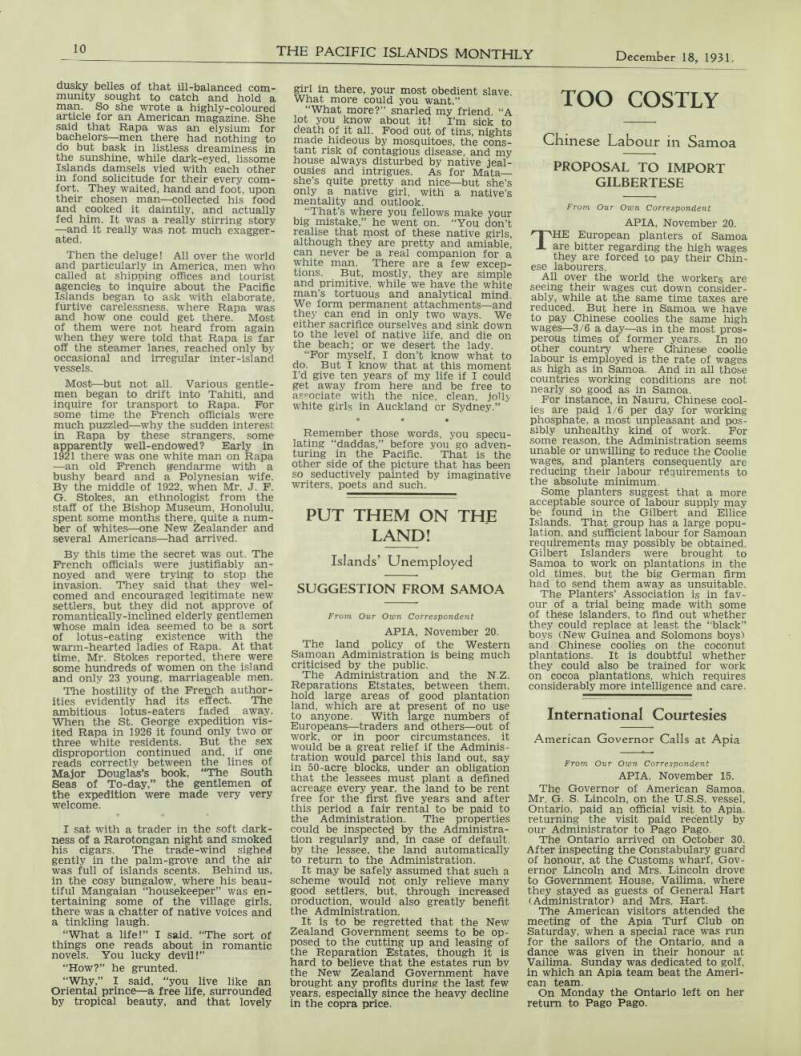
Hanamai, a handsome girl of Rapa. Rapa is the “Bachelor’s Elysium” mentioned in the accompanying article.
dusky belles of that ill-balanced community sought to catch and hold a man. So she wrote a highly-coloured article for an American magazine. She said that Rapa was an elysium for bachelors—men there had nothing to do but bask in listless dreaminess in the sunshine, while dark-eyed, lissome Islands damsels vied with each other in fond solicitude for their every comfort. They waited, hand and foot, upon their chosen man—collected his food and cooked it daintily, and actually fed him. It was a really stirring story —and it really was not much exaggerated.
Then the deluge! All over the world and particularly in America, men who called at shipping offices and tourist agencies to inquire about the Pacific Islands began to ask with elaborate, furtive carelessness, where Rapa was and how one could get there. Most of them were not heard from again when they were told that Rapa is far off the steamer lanes, reached only by occasional and irregular inter-island vessels.
Most—but not all. Various gentlemen began to drift into Tahiti, and inquire for transport to Rapa. For some time the French officials were much puzzled—why the sudden interest in Rapa by these strangers, some apparently well-endowed? Early in 1921 there was one white man on Rapa —an old French gendarme with a bushy beard and a Polynesian wife.
By the middle of 1922, when Mr. J. F.
G. Stokes, an ethnologist from the staff of the Bishop Museum, Honolulu, spent some months there, quite a number of whites —one New Zealander and several Americans —had arrived.
By this time the secret was out. The French officials were justifiably annoyed and were trying to stop the invasion. They said that they welcomed and encouraged legitimate new settlers, but they did not approve of romantically-inclined elderly gentlemen whose main idea seemed to be a sort of lotus-eating existence with the warm-hearted ladies of Rapa. At that time, Mr. Stokes reported, there were some hundreds of women on the island and only 23 young, marriageable men.
The hostility of the French authorities evidently had its effect. The ambitious lotus-eaters faded away.
When the St. George expedition visited Rapa in 1926 it found only two or three white residents. But the sex disproportion continued and, if one reads correctly between the lines of Major Douglas’s book, “The South Seas of To-day,” the gentlemen of the expedition were made very very welcome. * * * I sat with a trader in the soft darkness of a Rarotongan night and smoked his cigars. The trade-wind sighed gently in the palm-grove and the air was full of islands scents. Behind us, in the cosy bungalow, where his beautiful Mangaian “housekeeper” was entertaining some of the village girls, there was a chatter of native voices and a tinkling laugh, “What a life!” I said. “The sort of things one reads about in romantic novels. You lucky devil!”
“How?” he grunted.
“Why,” I said, “you live like an Oriental prince—a free life, surrounded by tropical beauty, and that lovely
girl in there, your most obedient slave.
What more could you want.”
“What more?” snarled my friend. “A lot you know about it! I’m sick to death of it all. Food out of tins, nights made hideous by mosquitoes, the constant risk of contagious disease, and my house always disturbed by native jealousies and intrigues. As for Mata— she’s quite pretty and nice—but she’s only a native girl, with a native’s mentality and outlook.
“That’s where you fellows make your big mistake,” he went on. “You don’t realise that most of these native girls, although they are pretty and amiable, can never be a real companion for a white man. There are a few exceptions. But, mostly, they are simple and primitive, while we have the white man’s tortuous and analytical mind.
We form permanent attachments—and they can end in only two ways. We either sacrifice ourselves and sink down to the level of native life, and die on the beach ; or we desert the lady.
“For myself, I don’t know what to do. But I know that at this moment I’d give ten years of my life if I could get away from here and be free to associate with the nice, clean, jolly white girls in Auckland or Sydney.” * * * Remember those words, you speculating “daddas,” before you go adventuring in the Pacific. That is the other side of the picture that has been so seductively painted by imaginative writers, poets and such. ... ===