Entomoligcal Triumph
December 18, 1931.
How Malayan Fly Destroyed Fijian Pest and Restored Coconut Industry December 18, 1931.
From Our Own Correspondent SUVA, November 26.
The story of how the destructive moth, Levuana irridescens, was swept out of Fiji, and coconut plantations restored to the great island of Viti Levu, has been briefly sketched in The Pacific Islands Monthly.
But it is worth re-telling—particularly the later developments. It reads almost like a fairy tale. Full credit for the remarkable achievement must go to our live-wire Department of Agriculture, of which Hon. A. C. Barnes is Director.
AFTER years of investigation, it was discovered that a natural enemy of the purple moth, Levuana, was a fly with the unpronouncable name of Ptychomyia remote, found in Malaya and the East Indies. There is a moth in Malaya which is very similar to Levuana and it attacks coconuts.
Entomologists observed that, whenever the Malayan moth appeared in any numbers it was promptly wiped out by the fly, which laid its eggs in the cocoon of the moth. The entomologists said that, if this fly could be introduced to Fiji it might destroy the Levuana pest, which had appeared mysteriously in Viti Levu about 1860, and prevented the cultivation of the coconut for more than half a century.
A number of the flies were captured and an endeavour was made to bring them to Fiji, via Sydney. However, a cold snap in transit wiped them out.
All sorts of plans were then mooted for bringing in another consignment.
It was even suggested that Fiji might utilise the services of the ubiquitous navy.
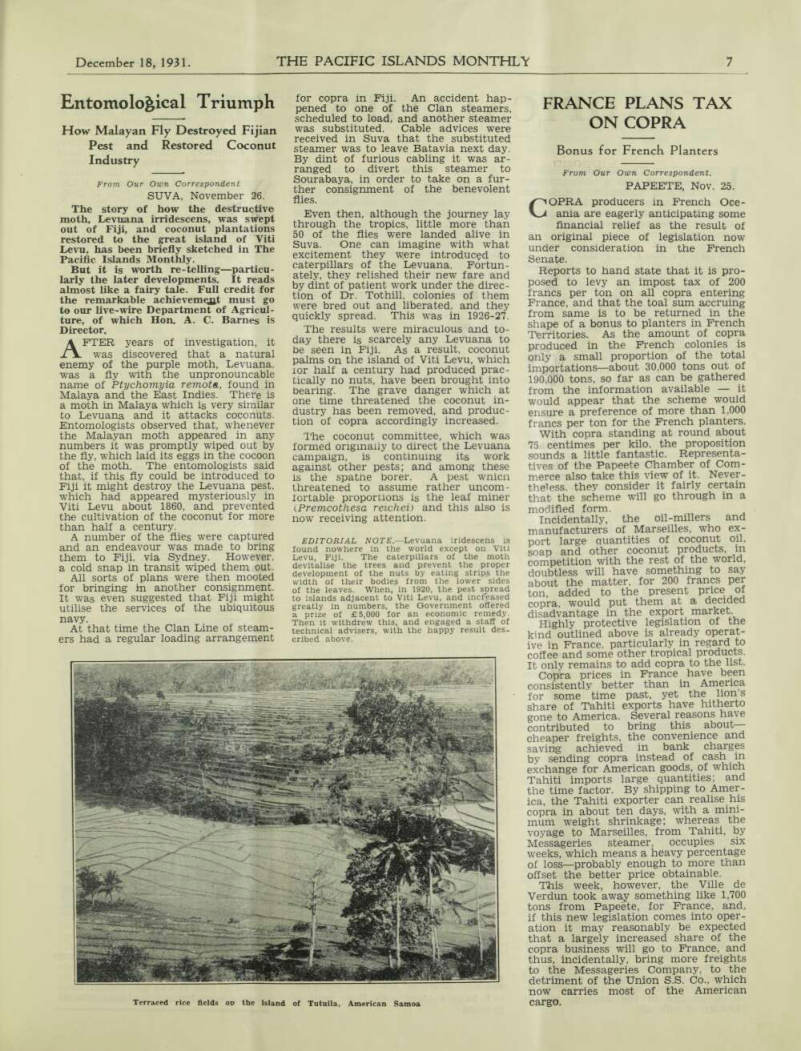
At that time the Clan Line of steamers had a regular loading arrangement Terraced rice fields op the island of Tutuila, American Samoa
for copra in Fiji. An accident happened to one of the clan steamers, scheduled to load, and another steamer was substituted. Cable advices were received in Suva that the substituted steamer was to leave Batavia next day.
By dint of furious cabling it was arranged to divert this steamer to Sourabaya, in order to take on a further consignment of the benevolent flies.
Even then, although the journey lay through the tropics, little more than 50 of the flies were landed alive in Suva. One can imagine with what excitement they were introduced to caterpillars of the Levuana. Fortunately, they relished their new fare and by dint of patient work under the direction of Dr. Tothill, colonies of them were bred out and liberated, and they quickly spread. This was in 1926-27.
The results were miraculous and to day there is scarcely any Levuana to be seen in Fiji. As a result, coconut palms on the island of Viti Levu, which for half a century had produced practically no nuts, have been brought into bearing. The grave danger which at one time threatened thc coconut instry has been removed, and production of copra accordingly increased.
The coconut committee, which was formed originally to direct the Levuana campaign, is continuing its work against other pests; and among these is the spathe borer. A pest which threatened to assume rather uncomfortable proportions is the leaf miner (Premcothesa reichei) and this also is now receiving attention.
Editorial Note. —Levuana iridescens is found nowhere in the world except on Viti Levu, Fiji. The caterpillars of the moth devitalise the trees and prevent the proper development of the nuts by eating strips the width of their bodies from the lower sides of the leaves. When, in 1920, the pest spread to islands adjacent to Viti Levu, and increased greatly in numbers, the Government offered a prize of £5,000 for an economic remedy.
Then it withdrew this, and engaged a staff of technical advisers, with the happy result described above. ===