Papuan Gold
Tauri Field’s Prospects
Mr. Dunstan Impressed
From Our Own Correspondent PORT MORESBY, October 6.
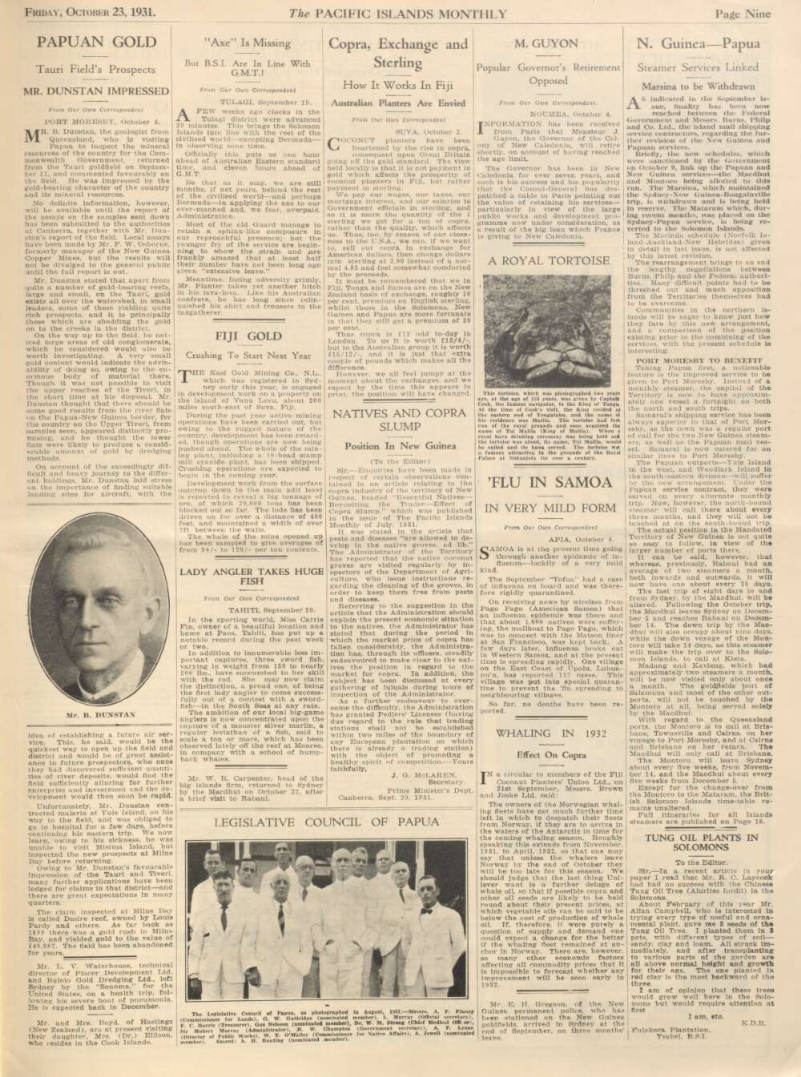
MR. B. Dunstan, the geologist from Queensland, who is visiting Papua to inspect the mineral resources of the country for the Com monwealth Government, returned from the Tauri goldfield on Septem ber 11, and commented favourably on the field. He was impressed by the gold-bearing character of the country and its mineral resources.
No definite information, however, will be available until the report of the assays on the samples sent down has been submitted to the authorities at Canberra, together with Mr. Dun stan’s report of the field. Local assays have been made by Mr. F. W. Osborne, formerly manager of the New Guinea Copper Mines, but the results will not be divulged to the general public until the full report is out.
Mr. Dunstan stated that apart from quite a number of gold-bearing reefs, large and small, on the Tauri, gold exists all over the watershed, in small leaders, some of these yielding quite rich prospects, and it is principally these which are shedding the gold on to the creeks in the district.
On the way up to the field, he not iced large areas of old conglomerate, which he considered would also be worth investigating. A very small gold content would indicate the advis ability of doing so, owing to the en ormous body of material there.
Though it was not possible to visit the upper reaches of the Tiveri, in the short time at his disposal, Mr.
Dunstan thought that there should be some good results from the river flats on the Papua-New Guinea border, for the country on the Upper Tiveri, from samples seen, appeared distinctly pro mising, and he thought the lower flats were likely to produce a consid erable amount of gold by dredging methods.
On account of the exceedingly dif ficult and heavy journey to the differ ent holdings, Mr. Dunstan laid stress on the importance of finding suitable landing sites for aircraft, with the
idea of establishing a future air ser vice. This, he said, would be the quickest way to open up the field and district and would be of great assist ance to future prospectors, who once they had discovered sufficient quanti ties of river deposits, would find the field sufficiently alluring for further enterprise and investment and the de velopment would then soon be rapid.
Unfortunately, Mr. Dunstan con tracted malaria at Yule Island, on his way to the field, and was obliged to go to hospital for a few days, before continuing his eastern trip. We now learn, owing to his sickness, he was unable to visit Misima Island, but inspected the new prospects at Milne Bay before returning.
Owing to Mr. Dunstan’s favourable impression of the Tauri and Tiveri, many further applications have been lodged for claims in that district —and there are great expectations In many quarters.
The claim inspected at Milne Bay is called Desire reef, owned by Louis Pardy and others. As far back as 1899 there was a gold rush in Milne Bay, and yielded gold to the value of £49,987. The field has been abandoned for years.
Mr. L. V. Waterhouse, technical director of Placer Development Ltd. and Bulolo Gold Dredging Ltd., left Sydney by the “Sonoma.” for the United States, on a health trip, fol lowing his severe bout of pneumonia.
He is expected back in December.
Mr. and Mrs. Boyd, of Hastings (New Zealand), are at present visiting their daughter, Mrs. (Dr.) Ellison, who resides in the Cook Islands.