Conditions In Tonga
Need For Constructive Policy
From Our Own Correspondent.
Nukualofa, Sept. 14.
I RAISE my hat to Mr. M. T.
Greene, much travelled foreign correspondent who, after a lengthy stay in the Friendly Islands, states in your July issue that, “If New Zealand wants an example to follow, it could take some points from the Crown Pro tectorate of Tonga—I have never seen a happier native people.”
This is certainly heartening stuff to read, having finished perusing the doleful effusions of three residents in the same number.
After wading through a heap of irrelevant matter, wholly inter-con tradictory statements and figures, the efforts of the three (Veracity, Ikai kaka, Toga maa Toga) anent local conditions in the Group, leave me cold.
TmT would like us to look upon the world’s pessimists as the world’s saviours. He may be right, but I am of the opinion that, with the excep tion of three, the whole of the King dom’s inhabitants will concur in the belief that Tonga is a prosperous little place to be in just now.
Surely these three critics are not in earnest when they more or less
demand that the Tongan with his free 12 acres of land —free education — free medicine —free medical attend ance and free dental treatment is oppressed when the Government asks him for £2 per annum in taxation.
Surely these three absorb the news that comes to us in the Australian and New Zealand papers; I commend to their notice particularly the last lot dealing with taxation figures in those countries.
The National Income.
Veracity, in his article, by an in teresting system of elimination, shows that the wretched Government glut tonously grabs half the Kingdom’s income, the while Ikaikaka, not quite so drastic in his method, concludes that the Government gets about one third. Neither tells us what happens to the money that the Government gets. Neither explains that this money, after passing through the Treasury chest, is again circulated to the inhabitants and the trading com munity, excepting only the quota of the national income that goes into foreign investment and oversea share holders’ dividends.
One can picture the plight of Veracity, though. He had pruned down the national income to £145,000 for 1930, and then, after giving the Government their £70,000 “cut” (dis posed of that alright), it must have struck him that it was about time to call a halt, otherwise he would be at a loss to account for the disposal of trading stocks. (I cannot discover that any contributor has questioned my statement in the February issue that, during the period 1926-29, the natives bought annually over the counter at least £200,000 in merchan dise.) Even supposing the 1930 sales dropped by half. Veracity had already got well below the hundred thousand mark and he could not reasonably go on in this wholesale fashion any lon ger. Still, being reluctant to drop the pruning knife he says, “Some further deduction should perhaps be made for benzine and wear and tear of vehicles and boats, but we will leave this in.”
Now, I ask, why leave anything in that shouldn’t be in? He could, in time, surely have arrived at the irre ducible minimum and then, having got there, he should immediately have made some attempt to explain away those trading stocks. In an exasperat ing manner he cuts his article short and leaves us all in the middle of his dilemma.
By the way, all, or some, of these critics, seem to wish readers to be lieve that I had some dark motive in quoting figures up to and including the year 1929. Nothing of the kind!
I only used available figures. The 1930 figures were gazetted in Tonga on February 19, exactly one month after my article was written. (In fact, it appears from the dates that
The P.I.M. was leaving the press in Sydney on the day the Gazette was making its appearance in Tonga.) These critics are also guilty of at least a “terminological inexactitude” when they try to coerce readers to believe that my tentative statement of transactions in Tonga’s “eternal economic circle” represented an esti mate of the national income. After setting out those figures in the Feb ruary P.I.M., as a possible foundation from which one might arrive at the probable income, I distinctly stated, “Anyone can make an attempt from the figures to fix the income to suit himself.”
It is pleasing to note that some of the critics have made the attempt, but it is neither pleasing nor justifi able to accuse me of making the at tempt.
I will welcome honest criticism al ways, preferably criticism that carries with it the embryo of some construc tive policy for the advancement of Tonga, but I object to any hits below the belt. And speaking of a construc tive policy as regards Tonga, is it not high time some or all of these contributors made some sort of an
endeavour to propound a scheme for their own betterment, and inciden tally the betterment of the nation that gives them domicile?
There is no country so prosperous that it cannot be helped to further prosperity. I have scanned their articles from end to end with a lin gering hope that perhaps some little sunshine is somewhere tucked away in the gloomy mass.
Curtailment Of Government
Expenditure.
Ikaikaka naively informs us that the trading community is doing its best when it urges the Government, through the Chamber of Commerce, to curtail expenditure. In effect, then, he urges us to believe that the trad ing community resents the expendi ture of money which, after passing through the Treasury coffers, mainly reaches that self-same trading com munity.
The motive for this extraordinary state of affairs is, to say the least of it, obscure. It seems to me that the curtailment of Government ex penditure could not by any stretch of imagination increase the national in come, but it would increase the Treasury surplus for further foreign investment, and thus react adversely on the trading community as a whole.
I am sure that the Chamber of Com merce appreciates this point fully.
Notwithstanding Toga man Toga’s dislike for slogans, I am still of the opinion that “Intensive (and extens ive) Cultivation,” even if it means nothing to the Tongan, is the only remedy for the trading sickness. We must remember that the native is on the box seat all the time —he is pros perous while the foreigner feels the pinch. We have a glut of trading sta tions erected in those “inflated years,” and if those stations want to do more than just exist, the trading community must keep on pressing for more production till it gets it. The problem to-day is not the native-born, but the European trader, who has sunk his capital in stock-in-trade. If any of my critics can evolve a better scheme than “Cultivation,” then out with it and remedy the ills of this congested trading community.
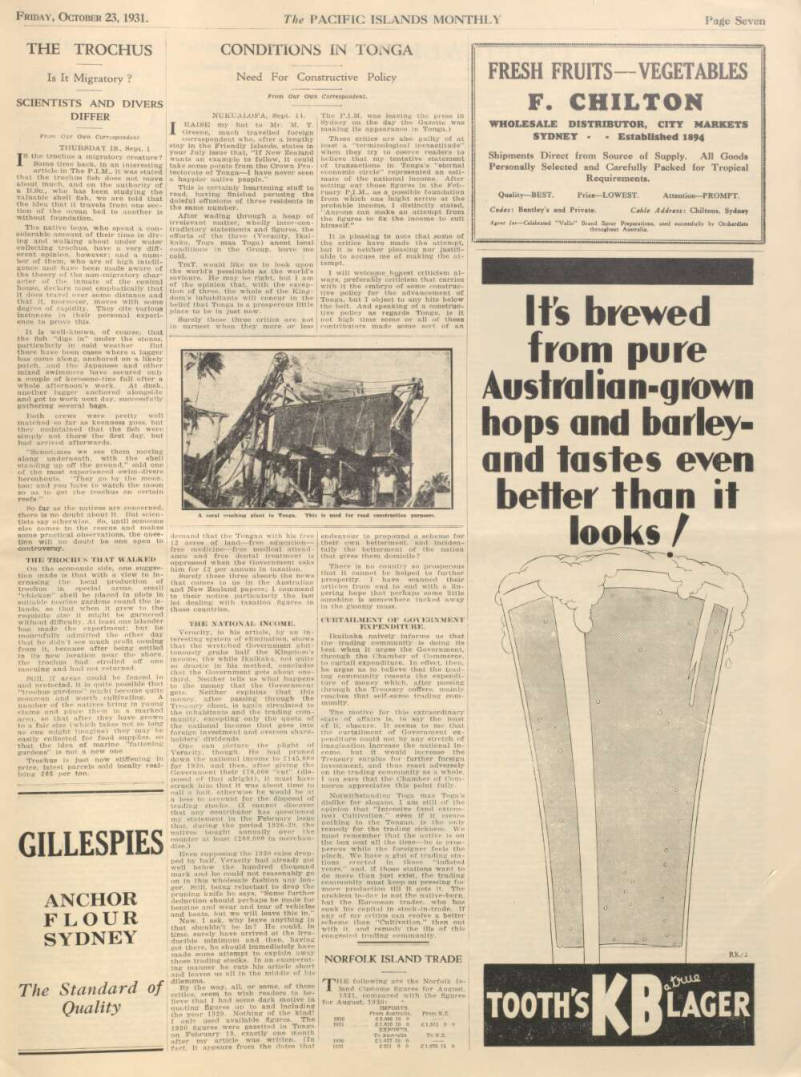
A coral crushing plant in Tonga. This is used for road construction purposes.