Undisciplined Natives
pp. 1-3 · Read in the full issue
A Growing Menace In New Guinea Planter’s Protest Against Official Mollycoddling of Plantation Labour
PERSONS interested in the future of New Guinea are asking, with increasing frequency, whether the present policy of the Administration, in regard to the treatment of native labourers and of natives generally, is working out in the best interests of all concerned.
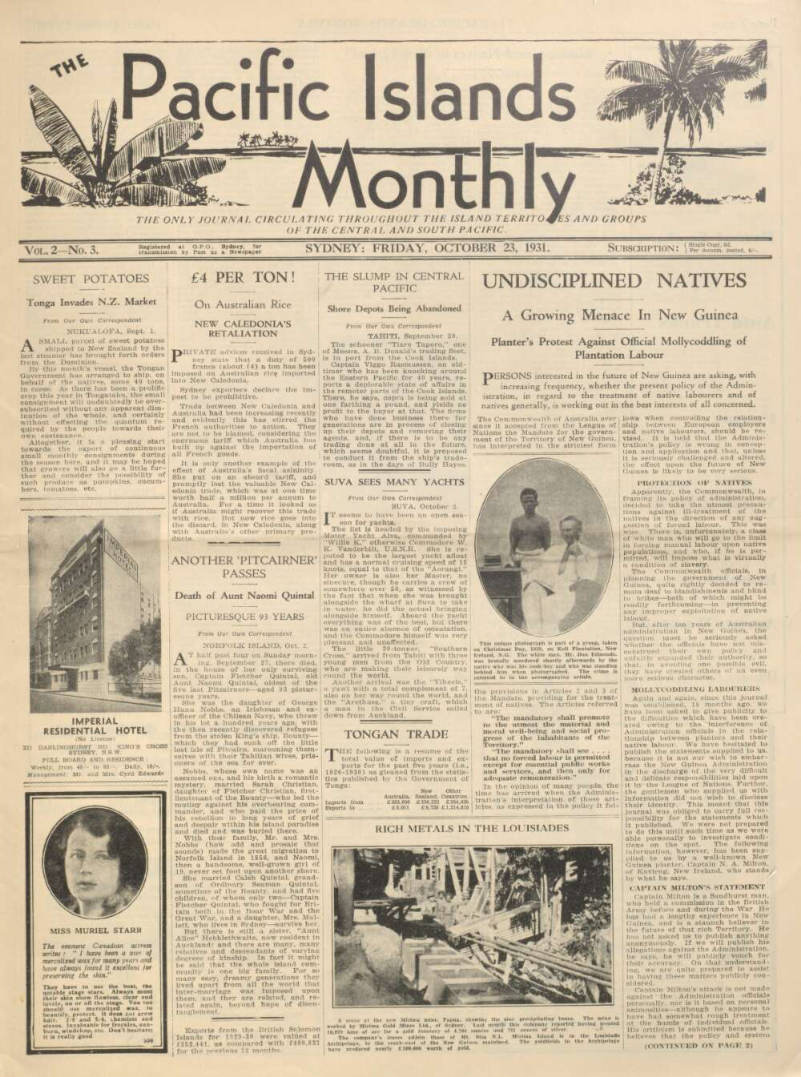
The Commonwealth of Australia ever since it accepted from the League of Nations the Mandate for the government of the Territory of New Guinea, has interpreted in the strictest form This unique photograph is part of a group, taken on Christmas Day, 1929, on Koli Plantation, New Ireland, N.G. The white man. Mr. Don Edmonds, was brutally murdered shortly afterwards by the native who was his cook-boy and who was standing behind him when photographed. The crime is referred to in the accompanying article.
the provisions in Articles 2 and 3 of the Mandate, providing for the treatment of natives. The Articles referred to are: ‘“The mandatory shall promote to the utmost the material and moral well-being and social progress of the Inhabitants of the Territory.”
“The mandatory shall see ... that no forced labour is permitted except for essential public works and services, and then only for adequate remuneration.”
In the opinion of many people, the time has arrived when the Administration’s interpretation of those articles, as expressed in the policy it fol-
lows when controlling the relation ship between European employers and native labourers, should be revised. It is held that the Administration’s policy is wrong in conception and application and that, unless it is seriously challenged and altered, the effect upon the future of New Guinea is likely to be very serious.
Protection Of Natives
Apparently, the Commonwealth, in framing its policy of administration, decided to take the utmost precautions against ill-treatment of the natives in the direction of any suggestion of forced labour. This was wise. There is, unfortunately, a class of white man who will go to the limit in forcing manual labour upon native populations, and who, if he is permitted, will impose what is virtually a condition of slavery.
The Commonwealth officials, in planning the government of New Guinea, quite rightly decided to remain deaf to blandishments and blind to bribes —both of which might be readily forthcoming—in preventing any improper exploitation of native labour.
But, after ten years of Australian administration in New Guinea, the question must be seriously asked whether the officials have not misconstrued their own policy and unfairly expanded their authority, so that, in avoiding one possible evil, they have created others of an even more serious character.
Mollyycoddling Labourers
Again and again, since this journal was established, 18 months ago, we have been asked to give publicity to the difficulties which have been created owing to the interference of Administration officials in the relationship between planters and their native labour. We have hesitated to publish the statements supplied to us, because it is not our wish to embarrass the New Guinea Administration in the discharge of the very difficult and delicate responsibilities laid upon it by the League of Nations. Further, the gentlemen who supplied us with information did not wish to disclose their identity. This meant that this journal was obliged to carry full responsibility for the statements which it published. We were not prepared to do this until such time as we were able personally to investigate conditions on the spot. The following information, however, has been supplied to us by a well-known New Guinea planter, Captain N. A. Milton, of Kavieng, New Ireland, who stands by what he says.
Captain Milton’S Statement
Captain Milton is a Sandhurst man, who held a commission in the British Army before and during the War. He has had a lengthy experience in New Guinea, and is a staunch believer in the future of that rich Territory. He has not asked us to publish anything anonymously. If we will publish his allegations against the Administration, he says, he will publicly vouch for their accuracy. On that understanding, we are quite prepared to assist in having these matters publicly considered.
Captain Milton’s attack is not made against the Administration officials personally, nor is it based on personal animosities —although he appears to have had somewhat rough treatment at the hands of individual officials.
His criticism is submitted because he believes that the policy and system
(Continued On Page 2)
entirely wrong; and that their review is urgently necessary if the Territory is to make satisfactory progress in the future.
Captain Milton’s statements support the criticism of the system published in the last issue, in a letter written by “Mandateite.” That correspondent made very strong comment upon the fact that the Administration had permitted Siken, the native murderer of John Scott, of Bougainville, to return to his native village after serving only five years’ imprisonment. He said : “The policy forced upon the Administration by the League of Nations, to spoon-feed a race of natives who are only just emerging, comparatively, from the cannabalistic, blood-lusting stage, is so dangerous to the white residents that little faith or respect can be maintained towards the local Administration when they allow such conditions to exist.
“It surely behoves someone to take up the cudgels on behalf of the isolated white residents, who live amongst a race of spoilt, indolent and arrogant natives who can ‘get away’ even with such offences as brutal murder, as in the case of the one-armed Scott.”
Treatment Of Murderers
Captain Milton reminds us that about 18 months ago, a man named Don Edmonds, an Englishman who had a good record in the Territory, was brutally murdered on his plantation by his cook-boy. This boy was brought to trial. Only the evidence of natives was taken and it was to the effect that the wife of the cook boy had been seduced by Edmonds, who had been in the habit of interfering with native women.
White planters, who had known Edmonds personally for a long time, were prepared to give evidence that he was a moral type of man and that even those most closely associated with him had seen no evidence of relationships with native women.
They were prepared to swear that Edmonds was a good type of resident who had conscientiously supported his mother and sister in Australia.
The evidence of the white men, however, was not accepted and the natives’ plea of justification apparently weighed with the New Guinea court, because this native received only five years’ imprisonment.
A native who was a mission catechist in Rabaul murdered his son on Tabar Island. He was tried and sentenced to death. On the representations of the missionaries this sentence was commuted to life imprisonment and he was sent to Kavieng gaol.
There he declared he had beriberi and could not walk. The District Officer recommended that this prisoner be supplied with a bath chair; but the Rabaul authorities —evidently having a sense of humour —did not supply the equipment.
Last July, this prisoner arose in the night and chopped off the head of a fellow-prisoner with a bush-knife.
It was then found that he could walk quite easily and had evidently been shamming beriberi. He was taken to Rabaul Court and sentenced to death, and returned to Kavieng for execution. For some unexplained reason, he had not been hanged and was still in Kavieng gaol in September. It was reported that certain officials in Kavieng had point-blank refused to carry out the execution.
Appeals To The Kiap
“My own experiences with the District Officer at Kavieng may be recounted as an illustration of the irritation policy followed by some of the officials,” said Captain Milton “I treat my native labour firmly, but justly. My men are well fed and well
cared for, but I insist that they shall carry out the work for which they are engaged and paid—and it is impossible to profitably conduct a plantation under any other conditions.
“One day, I found a ‘boy’ asleep in the plantation with his allotted task uncompleted. When I aroused him he was insolent and belligerent; and I took stern measures to instil in him respect towards his master and to make him complete his work before he knocked off that evening. The following morning this ‘boy’ and two others had disappeared they had gone, of course, to Kavieng to tell a sob-story to the kiap (District Officer).
They had taken away with them their knives, axes and copra bags, which were my property.
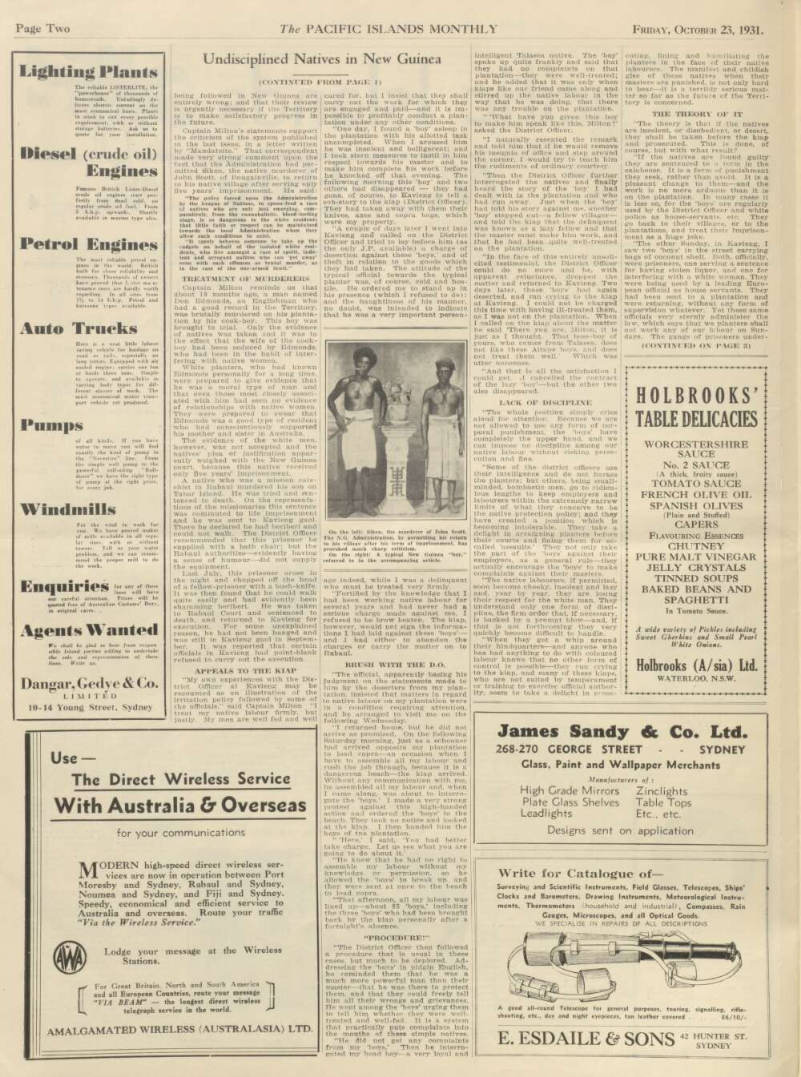
“A couple of days later I went into Kavieng and called on the District Officer and tried to lay before him (as the only J.P. available) a charge of desertion against these ‘boys,’ and of theft in relation to the goods which they had taken. The attitude of the typical official towards the typical planter was, of course, cold and hostile. He ordered me to stand up in his presence (which I refused to do); and the haughtiness of his manner, no doubt, was intended to indicate that he was a very important person- On the left: Siken, the murderer of John Scott.
The N.G. Administration, by permitting his return to his village after his term of imprisonment, has provoked much sharp criticism.
On the right: A typical New Guinea “boy,” referred to in the accompanying article.
age indeed, while I was a delinquent who must be treated very firmly.
“Fortified by the knowledge that I had been working native labour for several years and had never had a serious charge made against me, I refused to be brow beaten. The kiap, however, would not sign the informations I had laid against these ‘boys’— and I had either to abandon the charges or carry the matter on to Rabaul.
Brush With The D.O.
“The official, apparently basing his judgment on the statements made to him by the deserters from my plantation, insisted that matters in regard to native labour on my plantation were in a condition requiring attention, and he arranged to visit me on the following Wednesday.
“I returned home, but he did not arrive as promised. On the following Saturday morning, just as a schooner had arrived opposite my plantation to load copra—an occasion when I have to assemble all my labour and rush the job through, because it is a dangerous beach—the kiap arrived.
Without any communication with me, he assembled all my labour and, when I came along, was about to interrogate the ‘boys.’ I made a very strong protest against this high-handed action and ordered the ‘boys’ to the beach. They took no notice and looked at the kiap. I then handed him the keys of the plantation.
“ ‘Here,’ I said, ‘You had better take charge. Let us see what you are going to do about it.’
“He knew that he had no right to assemble my labour without my knowledge or permission, so he allowed the ‘boys’ to break up and they were sent at once to the beach to load copra.
“That afternoon, all my labour was lined up—about 85 ‘boys,’ including the three ‘boys’ who had been brought back by the kiap personally after a fortnight’s absence.
“Procedure!”
“The District Officer then followed a procedure that is usual in these cases, but much to be deplored. Addressing the ‘boys’ in pidgin English, he reminded them that he was a much more powerful man than their master—that he was there to protect them, and that they could freely tell him all their wrongs and grievances.
He went among the ‘boys’ urging them to tell him whether they were welltreated and well-fed. It is a system that practically puts complaints into the mouths of these simple natives.
“He did not get any complaints from my ‘boys.’ Then he interrogated my head boy—a very loyal and
intelligent Talasea native. The ‘boy’ spoke up quite frankly and said that they had no complaints on that plantation —they were well-treated; and he added that it was only when kiaps like our friend came along and stirred up the native labour in the way that he was doing, that there was any trouble on the plantation.
“ ‘What have you given this boy to make him speak like this, Milton?’ asked the District Officer.
“I naturally resented the remark and told him that if he would remove his insignia of office and step around the corner, I would try to teach him the rudiments of ordinary courtesy.
“Then the District Officer further interrogated the natives and finally heard the story of the ‘boy’ I had dealt with in the plantation and who had run away. Just when the ‘boy’ had told his story against me, another ‘boy’ stepped out —a fellow villager— and told the kiap that the delinquent was known as a lazy fellow and that the master must make him work, and that he had been quite well-treated on the plantation.
“In the face of this entirely unsolicited testimonial, the District Officer could do no more and he, with apparent reluctance, dropped the matter and returned to Kavieng. Two days later, those ‘boys’ had again deserted, and ran crying to the kiap at Kavieng. I could not be charged this time with having ill-treated them, as I was not on the plantation. When I called on the kiap about the matter he said ‘There you are, Milton, it is just as I thought. That boss-boy of yours, who comes from Talasea, does not like these Aitape boys, and does not treat them well.’ Which was utter nonsense.
“And that is all the satisfaction I could get. I cancelled the contract of the lazy ‘boy’—but the other two also disappeared.
Lack Of Discipline
“The whole position simply cries aloud for attention. Because we are not allowed to use any form of corporal punishment, the ‘boys’ have completely the upper hand, and we can impose no discipline among our native labour without risking persecution and fine.
“Some of the district officers use their intelligence and do not harass the planters; but others, being small minded, bombastic men, go to ridiculous lengths to keep employers and labourers within the extremely narrow limits of what they conceive to be the native protection policy; and they have created a position which is becoming intolerable. They take a delight in arraigning planters before their courts and fining them for so called ‘assaults.’ They not only take the part of the ‘boys’ against their employers, as a general rule—they actually encourage the ‘boys’ to make complaints against their masters.
“The native labourers, if permitted, soon become cheeky, insolent and lazy and, year by year, they are losing their respect for the white man. They understand only one form of discipline, the firm order that, if necessary, is backed by a prompt blow —and, if that is not forthcoming they very quickly become difficult to handle.
“When they get a whip around their hindquarters—and anyone who has had anything to do with coloured labour knows that no other form of control is possible—they run crying to the kiap, and many of these kiaps, who are not suited by temperament or training to exercise official authority, seem to take a delight in prose-
cuting, fining and humiliating the planters in the face of their native labourers. The manifest and childish glee of these natives when their masters are punished, is not only hard to bear —it is a terribly serious matter so far as the future of the Territory is concerned.
The Theory Of It
“The theory is that if the natives are insolent, or disobedient, or desert, they shall be taken before the kiap and prosecuted. This is done, of course, but with what result?
“If the natives are found guilty they are sentenced to a term in the calaboose. It is a form of punishment they seek, rather than avoid. It is a pleasant change to them—and the work is no more arduous than it is on the plantation. In many cases it is less so, for the ‘boys’ are regularly used by the District Officer and white police as house-servants, etc. They go back to their villages, or to the plantations, and treat their imprisonment as a huge joke.
“The other Sunday, in Kavieng, I saw two ‘boys’ in the street carrying bags of coconut shell. Both, officially, were prisoners, one serving a sentence for having stolen liquor, and one for interfering with a white woman. They were being used by a leading European official as house servants. They had been sent to a plantation and were returning, without any form of supervision whatever. Yet these same officials very sternly administer the law, which says that we planters shall not work any of our labour on Sundays. The gangs of prisoners under
(Continued On Page 3)
FRIDAY, OCTOBER 23, 1931 . . . . . The PACIFIC ISLANDS MONTHLY . . . . . .Page Three ——— Undisciplined Natives
(Continued From Page 2.)
going ' punishment,' who work on the roads, are absolutely unescorted. The whole thing is a farce.
The Germans’ Discipline
“The Germans did not make the mistake of treating ‘boys’ in this manner—they understood that there can be no control over this low type of native unless he maintains completely his respect for the white man.
“When a German patrol official was approaching a native village, for instance, he would halt his party, make everything snappy and tidy, and would himself don an imposing uniform and sword. But a great many of our patrol officers and kiaps go about in singlets and shorts. I travelled for some weeks with one, who did not shave or bath or change his shirt during that period. When the luluais from one village came for a talk, they ignored him and approached me as No. 1 kiap, presumably because I shaved daily and tried to maintain the usual appearance of a white man in an uncivilised country.
“The Germans were strict, and used corporal punishment freely. But they were just and were generally respected.
“Only recently, some of the natives with whom I was in conversation made this comparison between the present Administration and the Germans: “ ‘Bulaminski (former German Governor in New Ireland) big fellow master too much. He strong—he white
man true. You fellow belong Sydney come behind. You liklik master —you white man—that all.’
“It is humiliating. We can handle natives quite as successfully as the Germans—if we are allowed.
“I am not exaggerating when I say that the planters in some parts of New Guinea go definitely in fear of their lives. The natives, spoon-fed in this way by the Administration, encouraged in their lack of respect for their employers by administrative officials who lack any real knowledge of the principles underlying the government of natives, are steadily becoming not only a nuisance, but a serious menace to our safety.
“Leaving aside their growing cheekiness towards white women, I would point out that murders of white men by natives have been too frequent; and the circumstances surrounding the punishment of the murderers do not, indicate a sufficient appreciation by the Administration of the serious issues at stake.
Demand For Policy Revision
“The net result of it all is that, so far from the Australian Administration improving the condition of the natives, it is definitely making it worse. It is surely better to have a primitive population, which can be handled in its untamed state, than a
mass of half-civilised ‘boys,’ who are insolent, cunning and dangerous.
“In so many words, the native population of New Guinea is being utterly spoiled by the Administration’s policy, and, as the future development of this country depends on a reliable supply of native labour, it follows that New Guinea’s future is being prejudiced by the present policy.
“A review of the whole situation is urgently called for. The trouble is, who is going to do the revising. It appears to me to be a job for officials with sound experience of native administration. Most of the trouble in New Guinea can be traced to the fact that Australia has had no experience of this kind of responsibility, and is incapable of appreciating the need for sending to New Guinea officials who are endowed with the necessary education and training and some under standing of the native mind. Some of the district officers and assistants are first-class men in their jobs. Very many, unfortunately, are not.” ... === Among recent visitors to Tahiti, Patsy Ruth Miller and Lilah Lee, Hollywood cinema queens, who have been staying with Mrs. Gouverneur Morris, at Paea. ... ===