Papuan Undertakings
Sisal Hemp
Early Extension At Tavai
PREPARATIONS are being made by the Commonwealth Hemp Cor poration Ltd. to undertake vigor ous and extensive developments on its plantations in Papua, at a fairly early date.
This Corporation, early in 1930, took over the Papuan sisal hemp plantations from Australian-Papuan Investments Ltd. The latter had established two plantations 28 miles south-east of Port Moresby—namely, Tavai, which com prises 57 acres of freehold at the mouth of Tavai Creek, planted with coconuts, and 738 acres on a 99 years’ lease, of which 500 acres are planted with sisal hemp; and Kiana Plantation, of about 1,638 acres, on a 99 years’ lease. The latter property adjoins Tavai Estate and is described as eminently suited for growing sisal hemp.
The Commonwealth Hemp Corpora tion Ltd. has an authorised capital of £35,000 and it proposes to develop these properties by the usual kind of bond issue. In this case it proposes to sell 10,000 bonds for £10 each.
Up to the present, these bonds have not been offered for sale and the com pany states that it will not sell any bonds until the company’s capitalisa tion has been arranged to the com plete satisfaction of the Directors.
The vendors have accepted full pay ment for the assets of the old company in shares in the new company, and the remaining shares are now being sold for cash. It is expected that at an early date capitalisation will be completed and that the whole of the company’s authorised capital will be issued. When that is done developments in Papua will be commenced.
The old company was not very wise in its operations. Instead of planting extensively, it spent a great deal of money on a hemp decorticating plant, a kapok or cotton ginning plant, neces sary power equipment and gear, and a very extensive range of bungalows, stores, factory buildings, etc.
The new company obtained all this property at a remarkably small por
tion of its original cost. The new company, therefore, is in a very good position to commence profitable pro duction as soon as planting is pro ceeded with on an extensive scale.
The new company has spent about £7,000 in maintaining the plant, build ings and plantations, and further clear ing; and there are already about 500 acres planted in sisal hemp. A much larger! area of ground has been pre pared for planting. There appear to have been some difficulties in connec tion with management and control in Papua, since the new company took over, but we are informed that all these troubles are now overcome.
The market value of sisal hemp fibre, like everything else, has fallen consid erably. Early in 1930 it was quoted at about £40 per ton, and sisal hemp pro duced in Papua and brought to Aus tralia carried a bounty of £6 per ton.
The market price to-day, however, is down to £23 per ton, and the bounty is rather less than £6 per ton. Even at this price, however, it is considered that the production of sisal hemp in Papua would be a profitable under taking.
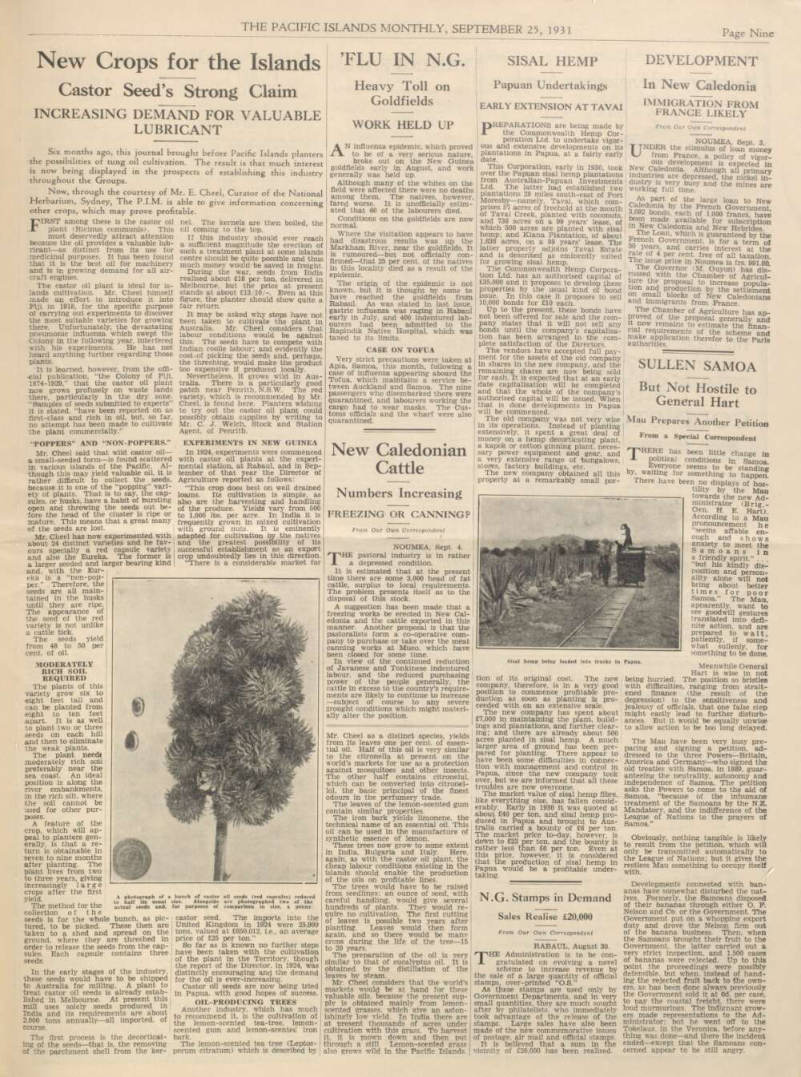
Sisal hemp being: loaded into trucks in Papua.