New Crops for the Islands
Castor Seed’s Strong Claim
Increasing Demand For Valuable
Lubricant
Six months ago, this journal brought before Pacific Islands planters the possibilities of tung oil cultivation. The result is that much interest is now being displayed in the prospects of establishing this industry throughout the Groups.
Now, through the courtesy of Mr. E. Cheel, Curator of the National Herbarium, Sydney, The P.I.M. is able to give information concerning other crops, which may prove profitable.
FIRST among these is the castor oil plant (Ricinus communis). This must deservedly attract attention because the oil provides a valuable lub ricant—as distinct from its use for medicinal purposes. It has been found that it is the best oil for machinery and is in growing demand for all air craft engines.
The castor oil plant is ideal for is lands cultivation. Mr. Cheel himself made an effort to introduce it into Fiji in 1918, for the specific purpose of carrying out experiments to discover the most suitable varieties for growing there. Unfortunately, the devastating pneumonic influenza which swept the Colony in the following year, interfered with his experiments. He has not heard anything further regarding those plants.
It is learned, however, from the offi cial publication, “the Colony of Fiji, 1874-1929,” that the castor oil plant now grows profusely on waste lands there, particularly in the dry zone.
“Samples of seeds submitted to experts” it is stated, “have been reported on as first-class and rich in oil, but, so far, no attempt has been made to cultivate the plant commercially.”
“Poppers” And “Non-Poppers.”
Mr. Cheel said that wild castor oil— a small-seeded form —is found scattered in various islands of the Pacific. Al though this may yield valuable oil, it is rather difficult to collect the seeds, because it is one of the “popping” vari ety of plants. That is to say, the cap sules, or husks, have a habit of bursting open and throwing the seeds out be fore the head of the cluster is ripe or mature. This means that a great many of the seeds are lost.
Mr. Cheel has now experimented with about 24 distinct varieties and he fav ours specially a red capsule variety and also the Eureka. The former is a larger seeded and larger bearing kind
and, with the Eur eka is a “non-pop per.” Therefore, the seeds are all main tained in the husks until they are ripe.
The appearance of the seed of the red variety is not unlike a cattle tick.
The seeds yield from 48 to 50 per cent, of oil.
Moderately
Rich Soil
Required
The plants of this variety grow six to eight feet tall and can be planted from eight to ten feet apart. It is as well to plant two or three seeds on each hill and then to eliminate the weak plants.
The plant needs moderately rich soil preferably near the sea coast. An ideal position is along the river embankments, in the rich silt, where the soil cannot be used for other pur poses.
A feature of the crop, which will ap peal to planters gen erally, is that a re turn is obtainable in seven to nine months after planting. The plant lives from two to three years, giving increasingly large crops after the first yield.
The method for the collection of the
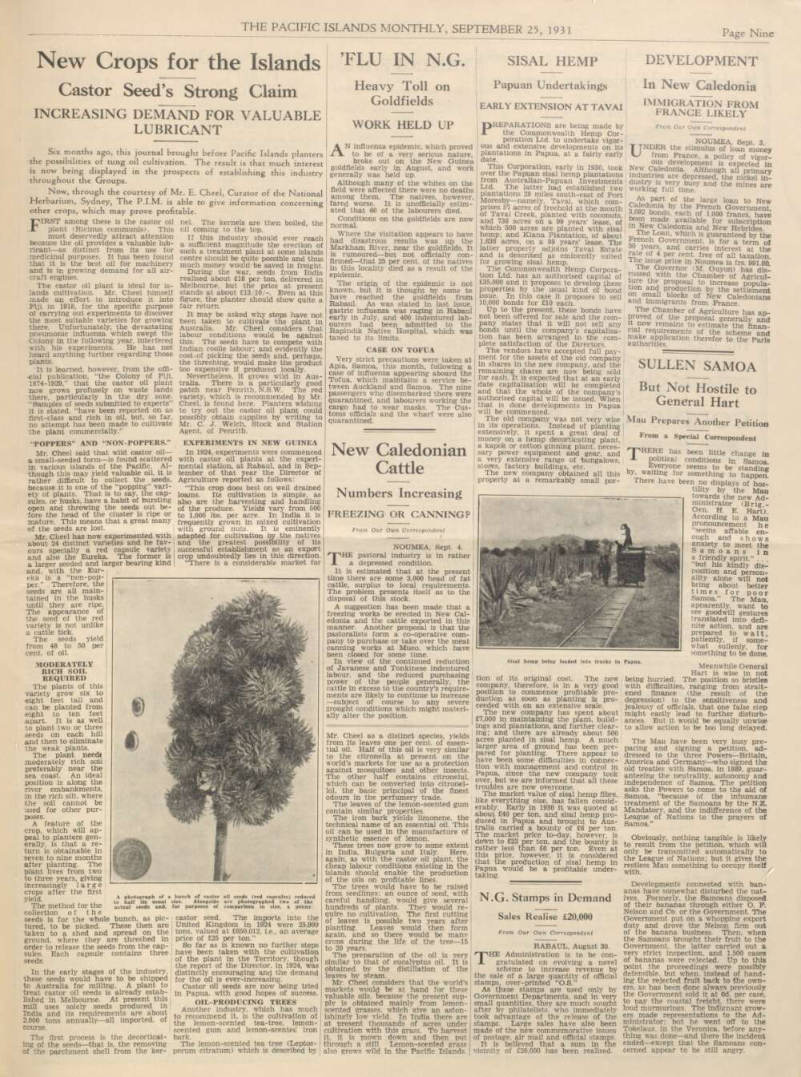
seeds is for the whole bunch, as pic tured, to be nicked. These then are taken to a shed and spread on the ground, where they are threshed in order to release the seeds from the cap sules. Each capsule contains three seeds.
In the early stages of the industry, these seeds would have to be shipped to Australia for milling. A plant to treat castor oil seeds is already estab lished in Melbourne. At present this mill uses solely seeds produced in India and its requirements are about 2,000 tons annually—all imported, of course.
The first process is the decorticat ing of the seeds—that is, the removing of the parchment shell from the ker
nel. The kernels are then boiled, the oil coming to the top.
If this industry should ever reach a sufficient magnitude the erection of such a treatment plant at some islands centre should be quite possible and thus much money would be saved in freight.
During the war, seeds from India realised about £18 per ton, delivered in Melbourne, but the price at present stands at about £13/10/-. Even at this figure, the planter should show quite a fair return.
It may be asked why steps have not been taken to cultivate the plant in Australia. Mr. Cheel considers that labour conditions would be against this. The seeds have to compete with Indian coolie labour; and evidently the cost-of picking the seeds and, perhaps, the threshing, would make the product too expensive if produced locally.
Nevertheless, it grows wild in Aus tralia. There is a particularly good patch near Penrith, N.S.W. The red variety, which is recommended by Mr.
Cheel, is found here. Planters wishing to try out the castor oil plant could possibly obtain supplies by writing to Mr. C. J. Welch, Stock and Station Agent, of Penrith.
Experiments In New Guinea
In 1924, experiments were commenced with castor oil plants at the experi mental station, at Rabaul, and in Sep tember of that year the Director of Agriculture reported as follows: “This crop does best on well drained loams. Its cultivation is simple, as also are the harvesting and handling of the produce. Yields vary from 500 to 1,000 lbs. per acre. In India it is frequently grown in mixed cultivation with ground nuts. It is eminently adapted for cultivation by the natives and the greatest possibility of its successful establishment as an export crop undoubtedly lies in this direction.
“There is a considerable market for
castor seed. The imports into the United Kingdom in 1924 were 25,999 tons, valued at £650,012, i.e., an average price of £25 per ton.”
So far as is known no further steps have been taken with the cultivation of the plant in the Territory, though the report of the Director, in 1924, was distinctly encouraging and the demand for the oil is ever-increasing.
Castor oil seeds are now being tried in Papua, with good hopes of success.
Oil-Producing Trees
Another industry, which has much to recommend it, is the cultivation of the lemon-scented tea-tree, lemon scented gum and lemon-scentet iron bark.
The lemon-scented tea tree (Leptos perum citratum) which is described by
Mr. Cheel as a distinct species, yields from its leaves one per cent, of essen tial oil. Half of this oil is very similar to the citronella at present on the world’s markets for use as a protection against mosquitoes and other insects.
The other half contains citronelul, which can be converted into citronel lol, the basic principal of the finest odours in the perfumery trade.
The leaves of the lemon-scented gum contain similar properties.
The iron bark yields limonene, the technical name of an essential oil. This oil can be used in the manufacture of synthetic essence of lemon.
These trees now grow to some extent in India, Bulgaria and Italy. Here, again, as with the castor oil plant, the cheap labour conditions existing in the islands should enable the production of the oils on profitable lines.
The trees would have to be raised from seedlings; an ounce of seed, with careful handling, would give several hundreds of plants. They would re quire no cultivation. The first cutting of leaves is possible two years after planting. Leaves would then form again, and so there would be many crons during the life of the tree —15 to 20 years.
The preparation of the oil is very similar to that of eucalyptus oil. It is obtained by the distillation of the leaves by steam.
Mr. Cheel considers that the world’s markets would be at hand for these valuable oils, because the present sup ply is obtained mainly from lemon scented grasses, which give an aston ishingly low yield. In India there are at present thousands of acres under cultivation with this grass. To harvest it, it is mown down and then put through a still. Lemon-scented grass also grows wild in the Pacific Islands.
A photograph of a bunch of castor oil seeds (red capsules) reduced to half its usual size. Alongside are photographed two of the actual seeds and, for purposes of comparison in size, a penny.