Markham Valley
Rich Undeveloped Agricultural Region in New Guinea
Written for The Pacific Islands Monthly, By Henry G. Eekhoff, of Lae, N.G.
THE sleeping giant of the Pacific is the mainland of New Guinea, which stretches for 1,200 miles from tip to tip, shaped like some gig antic monster of past ages, with a corrugated backbone of range.
Whatever mineral riches may be found on the slopes of these gabled mountains, they are as a drop in a bucket, by comparison with the agri cultural possibilities of this mighty country.
Several great rivers flow into the ocean in the British Division—the two largest of which are the Fly and the Sepik, both of which are navigable for hundreds of miles. But the most significant river is the Markham, so called to perpetuate the name of the late Sir Clement Markham, the fam
ous President of the Royal Geograph ical Society, whose geographical ex ploits were of benefit to the whole world.
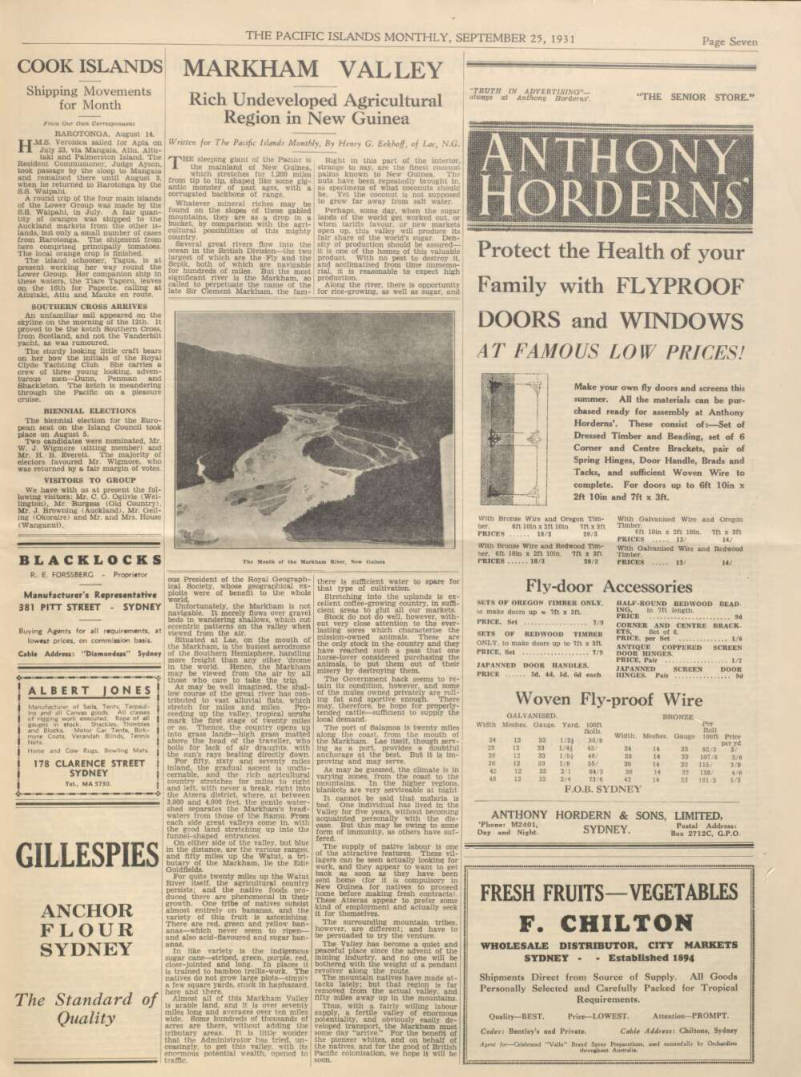
Unfortunately, the Markham is not navigable. It merely flows over gravel beds in wandering shallows, which cut eccentric patterns on the valley when viewed from the air.
Situated at Lae, on the mouth of the Markham, is the busiest aerodrome of the Southern Hemisphere, handling more freight than any other ’drome in the world. Hence, the Markham may be viewed from the air by all those who care to take the trip.
As may be well imagined, the shal low course of the great river has con tributed to vast alluvial flats, which stretch for miles and miles. Pro ceeding up the valley, tropical scrubs mark the first stage of twenty miles or so. Thence, the country opens up into grass lands —high grass matted above the head of the traveller, who boils for lack of air draughts, with the sun’s rays beating directly down.
For fifty, sixty and seventy miles inland, the gradual ascent is undis cernable, and the rich agricultural country stretches for miles to right and left, with never a break, right into the Atzera district, where, at between 3,000 and 4,000 feet, the gentle water shed separates the Markham’s head waters from those of the Ramu. From each side great valleys come in, with the good land stretching up into the funnel-shaped entrances.
On either side of the valley, but blue in the distance, are the various ranges, and fifty miles up the Watut, a tri butary of the Markham, lie the Edie Goldfields.
For quite twenty miles up the Watut River itself, the agricultural country persists: and the native foods pro duced there are phenomenal in their growth. One tribe of natives subsist almost entirely on bananas, and the variety of this fruit is astonishing.
There are red, green and yellow ban anas—which never seem to ripen— and also acid-flavoured and sugar ban anas.
In like variety is the indigenous sugar cane—striped, green, purple, red, close-jointed and long. In places it is trained to bamboo trellis-work. The natives do not grow large plots—simply a few square yards, stuck in haphazard, here and there.
Almost all of this Markham Valley is arable land, and it is over seventy miles long and averages over ten miles wide. Some hundreds of thousands of acres are there, without adding the tributary areas. It is little wonder that the Administrator has tried, un ceasingly, to get this valley, with its enormous potential wealth, opened to traffic.
Right in this part of the interior, strange to say, are the finest coconut palms known to New Guinea. The nuts have been repeatedly brought in, as specimens of what coconuts should be. Yet the coconut is not supposed to grow far away from salt water.
Perhaps, some day, when the sugar lands of the world get worked out, or when tariffs favour, or new markets open up, this valley will produce its fair share of the world’s sugar. Den sity of production should be assured — it is one of the homes of this valuable product. With no pest to destroy it, and acclimatised from time immemo rial, it is reasonable to expect high production.
Along the river, there is opportunity for rice-growing, as well as sugar, and
there is sufficient water to spare for that type of cultivation.
Stretching into the uplands is ex cellent coffee-growing country, in suffi cient areas to glut all our markets.
Stock do not do well, however, with out very close attention to the ever lasting sores which characterise the mission-owned animals. These are the only stock in the country and they have reached such a pass that one horse-lover considered purchasing the animals, to put them out of their misery by destroying them.
The Government hack seems to re tain its condition, however, and some of the mules owned privately are roll ing fat and sportive enough. There may, therefore, be hope for properly tended cattle —sufficient to supply the local demand.
The port of Salamoa is twenty miles along the coast, from the mouth of the Markham. Lae itself, though serv ing as a port, provides a doubtful anchorage at the best. But it is im proving and may serve.
As may be guessed, the climate is in varying zones, from the coast to the mountains. In the higher regions, blankets are very serviceable at night It cannot be said that malaria is bad. One individual has lived in the Valley for five years, without becoming acquainted personally with the dis ease. But this may be owing to some form of immunity, as others have suf fered.
The supply of native labour is one of the attractive features. These vil lagers can be seen actually looking for work, and they appear to want to get back as soon as they have been sent home (for it is compulsory in New Guinea for natives to proceed home before making fresh contracts).
These Atzeras appear to prefer some kind of employment and actually seek it for themselves.
The surrounding mountain tribes, however, are different; and have to be persuaded to try the venture.
The Valley has become a quiet and peaceful place since the advent of the mining industry, and no one will be bothered with the weight of a pendant revolver along the route.
The mountain natives have made at tacks lately; but that region is far removed from the actual valley, and fifty miles away up in the mountains.
Thus, with a fairly willing labour supply, a fertile valley of enormous potentiality, and obviously easily de veloped transport, the Markham must some day “arrive.” For the benefit of the pioneer whites, and on behalf of the natives, and for the good of British Pacific colonisation, we hope it will be soon.
The Mouth of the Markham River, New Guinea