M. V. Macdhui
p. 13 · Read in the full issue
How Passengers are Provided For
Tropic Travel In Comfort
THE M.V. Macdhui, the new Burns, Philp vessel, which has replaced the Montoro on the Sydney-New Guinea service, represents the last word in comfort. Special attention has been paid to Islands requirements, and many appointments have been in cluded which will be appreciated by passengers.
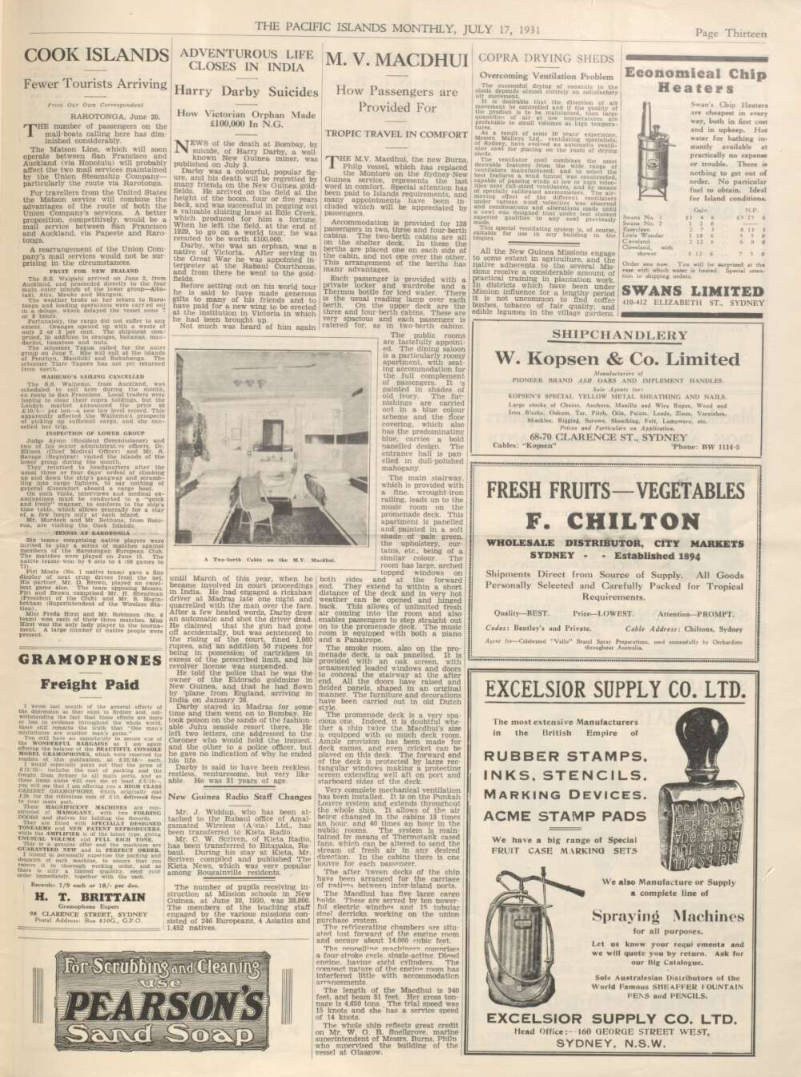
Accommodation is provided for 138 passengers in two, three and four-berth cabins. The two-berth cabins are all on the shelter deck. In these the berths are placed one on each side of the cabin, and not one over the other.
This arrangement of the berths has many advantages.
Each passenger is provided with a private locker and wardrobe and a Thermos bottle for iced water. There is the usual reading lamp over each berth. On the upper deck are the three and four-berth cabins. These are very spacious and each passenger is catered for, as in two-berth cabins.
The public rooms are tastefully appoint ed. The dining saloon is a particularly roomy apartment, with seat ing accommodation for the full complement of passengers. It ’s painted in shades of old ivory. The fur nishings are carried out in a blue colour scheme and the floor covering, which also has the predominating blue, carries a bold panelled design. The entrance hall is pan elled in dull-polished mahogany.
The main stairway, which is provided with a fine, wrought-iron railing, leads up to the music room on the promenade deck. This apartment is panelled and painted in a soft shade of pale green, the upholstery, cur tains, etc., being of a similar colour. The room has large, arched topped windows on
both sides and at the forward end. They extend to within a short distance of the deck and in very hot weather can be opened and hinged back. This allows of unlimited fresh air coming into the room and also enables passengers to step straight out on to the promenade deck. The music room is equipped with both a piano and a Panatrope.
The smoke room, also on the pro menade deck, is oak panelled. It is provided with an oak screen, with ornamented leaded windows and doors to conceal the stairway at the after end. All the doors have raised and fielded panels, shaped in an original manner. The furniture and decorations have been carried out in old Dutch style.
The promenade deck is a very spa cious one. Indeed, it is doubtful whe ther a ship twice the Macdhui’s size is equipped with so much deck room.
Ample provision has been made for deck games, and even cricket can be played on this deck. The forward end of the deck is protected by large rec tangular windows making a protecting screen extending well aft on port and starboard sides of the deck.
Very complete mechanical ventilation has been installed. It is on the Punkah Louvre system and extends throughout the whole ship. It allows of the air being changed in the cabins 18 times an hour, and 40 times an hour in the nublic rooms. The system is main tained by means of Thermotank cased fans, which can be altered to send the stream of fresh air in any desired direction. In the cabins there is one louvre for each passenger.
The after ’tween decks of the ship have been arranged for the carriage of native between inter-island ports.
The Macdhui has five large cargo holds. These are served by ten power ful electric winches and 15 tubular steel derricks, working on the union purchase system.
The refrigerating chambers are situ ated just forward of the engine room and occupy about 14.000 cubic feet.
The propelling machinery comprises a four-stroke cycle, single-acting Diesel engine, having eight cylinders. The compact nature of the engine room has interfered little with accommodation arrangements.
The length of the Macdhui is 340 feet, and beam 51 feet. Her gross ton nage is 4,650 tons.. The trial speed was 15 knots and she has a service speed of 14 knots.
The whole ship reflects great credit on Mr. W. G. R. Snellgrove, marine superintendent of Messrs. Bums, Philp who supervised the building of the vessel at Glasgow.