THE Pacific Islands Monthly
THE ONLY JOURNAL CIRCULATING THROUGHOUT THE ISLAND TERRITORIES AND GROUPS
Of The Central And South Pacific.
Vol 1 —No. 12
Registered at G.P.O., Sydney, for transmission by Post as a Newspaper
Sydney: Friday, July 17, 1931
Single Copy, 6d, Per Annum, posted, 6/-. ———
Money Orders
In Mandated New Guinea To the Editor
Sir,—One naturally hesitates, in these “hard times,” to agitate for any innovation where public service is concerned, that might require expenditure from the Administration’s coffers. Yet there is the small matter of extending the Money Order system to post offices in the Mandated Territory that would require but slight expenditure and still be a boon to many hundreds of the residents who are not domiciled in Rabaul.
As the position is at present, all Money Orders or Postal Notes received by residents may be cashed only through the Rabaul post office, as Rabaul is the only Money Order Office in the Territory. This naturally occasions considerable delay where often communication from outstations to Rabaul is every four or five weeks.
Should residents in outlying districts desire to remit money to Australia, then drafts may be obtained on the New Guinea Trade Agent, Sydney. Still, this is not an altogether satisfactory procedure where remittances are required to be made to places other than Sydney, or the amount is too small to warrant the issuing of a draft.
In July of last year I communicated with the Chief Postmaster in Rabaul on the subject and he replied: “Approval has been given for the extension of the Money Order to outstations. Some little time will elapse, however, before the latter approval can be given effect to.”
A “little time” has already elapsed: surely eleven months is sufficient to set the machinery in motion, considering that the approval has already been given for this public convenience to become operative.—I am, etc.
Gordon Thomas
Buka, June 3, 1931. ... ===
New Guinea’S Half
Million
The annual report for 1929-1930 of the Territory of New Guinea shows the following native population; New Britain, 93,637.
New Ireland, 38,416.
Bougainville, 56,087.
Mainland, New Guinea. 289,048.
Admiralty and North-western Islands, 14,067.
Indentured labourers, all districts, 30,130.
Grand total, 521,385.
Big Fiji Fish
... === This shark, weighing 3541b., and the cod, weighing 1661b., were caught at Levuka recently by a local resident.
The shark put up a great fight for an hour, on a thin line, but was eventually conquered. ... ===
Revision Necessary
Labour Costs In
New Caledonia
Commission To Inquire
From Our Own Correspondent.
Noumea, June 18.
IN connection with the Javanese and Indo-Chinese labourers at present working in New Caledonia under contract, a commission has been appointed to go into the question of the possible re-adjustment of their contracts. It is realised that conditions of production and economic affairs generally, have changed radically during the last few months; and it is considered that such a review has now become necessary.
The commission has been constituted with the Secretary-General of the Colony as President, the other members to consist of the Chief of the Health Department, President of the Chamber of Agriculture, President of the Labour Commission, three representatives of the mining industries, and the head of the Immigration service. Monsieur M.
Lapelerie is Secretary.
The Department of Native Affairs has recently fixed lower minimum wage rates for local coloured labour, as follows, in view of the changed economic conditions: ... New ... Old ... Rate ... Rate ... per ... per ... Month ... Month ... Francs ... Francs Men, 18 years and over ... 110 ... 150 Women. 18 years and over 75 ... 75 Boys, up to 18 ... 90 ... — Girls, up to 18 ... 60 ... — In addition, employees must be fed clothed, lodged and supplied with medical necessaries. ... ===
During the year 1929-30, 84 oversea vessels called at the Territory of New Guinea, the total tonnage of the ships being 161,738. British vessels numbered 52, French 12, German 6. Dutch 4 American and Japanese 3, Danish and Norwegian 2. ... ===
New Fokker
For Pacific Transport Co.
From Our Own Correspondent
Port Moresby, July 7.
MR. Ray Parer is expecting another Fokker plane for the Pacific Aerial Transport Co. by the July “Le Maire,” due to arrive here shortly. He is expected to come over from the New Guinea goldfields to meet the incoming machine, and will assist in assembling it in conjunction with engineers of Port Moresby, and later on will fly across to Salamoa. ... ===
Malolo To Visit Papua
From Our Own Correspondent
Port Moresby, July 7.
THE luxury liner, Malolo, carrying American tourists, is to call in at Port Moresby on November 19, on her world cruise, and will spend one day here in the capital.
Preparations are being made to welcome and please the visitors. Native dances, canoe races, sporting events and even aeroplane flights are being arranged, besides the usual sight seeing tours, all in the attempt to captivate and convince the tourists of the beauty and splendour of the surroundings we so nonchalantly live in day by day. ... ===
New Ship for Phosphate
Trade Triona’s Wireless Telephone
THE Triona, which was built in the United Kingdom for the British Phosphate Commission, has taken up her running between Ocean Island, Nauru and Melbourne.
The vessel has been equipped by Amalgamated Wireless (A/sia.) Ltd. with a complete wireless installation.
This includes an AW.A. 1½ kilowatt marine transmitter, employing C.W. and I.C.W. on both long and short waves, and speech on long waves (600 to 800 metres).
The telephony transmitter is used by the master of the vessel to speak to the British Phosphate Commission officials through their wireless telephone stations at Nauru and Ocean Island. ===
Dangerous
New Guinea Natives
Series of Attacks in Goldfields Region
Unconfirmed Report That Lost
Airman Was Killed
THE natives in the hinterland of the New Guinea goldfields, who have been known to be of a truculent and hostile nature, have been very treacherous of late.
The unrest seems to have commenced with the massacre in the Upper Watut district, of Hellmuth Baum, a well-known prospector, and nine of his natives.
About the same time, Messrs. Mick and Paddy Leahy, who were also prospecting in that region, were attacked and wounded.
A Papuan patrol officer, with a party of native police and carriers, who passed through this area on the way to the coast, also found the natives very hostile.
There was a rumour that Pilot Trist, of Guinea Airways’ staff, who has been missing since May 22, landed his ’plane safely near Zenag aerodrome and was killed and eaten by the natives there. The report was investigated by the Administration officials and pronounced quite baseless.
The area between the Papuan border and the main dividing range of the Mandated Territory is how officially described as highly dangerous country.
Much of the trouble has been attributed to the Kukukukus, an untamed, nomadic people, who have drifted over from the Papuan border.
BAUM met his death near Surprise Creek, in the Upper Watut, only three days’ walk from the main camp at Watut. The three natives, who were the only survivors from the massacre of this well known prospector and his party, took nearly a month to get through the bush to the camp at Watut, as they had to lie low to escape capture by the searching bushmen.
They arrived thin and ill, from hunger and exposure. They said that Baum was drinking his morning coffee, just at daylight, when the natives attacked without warning. They crawled under the tent flap very silently and pinned Baum’s arms down to his sides, whilst other waiting natives killed him.
Baum was one of the most respected men in New Guinea. No one had a better knowledge of the Morobe dis trict, as he had spent many years in those parts. He used often to say that he could travel through New Guinea with a walking stick. He would never believe the natives guilty of treachery
and he seldom carried firearms. It was known that he was always very kind to his natives.
Recently, Baum was believed to have been on very good gold, and he had told some of his friends that he was going to Germany to visit his mother during the coming year.
Leahy Bros.’ Desperate Fight
Two other prospectors, the Leahy brothers, had a desperate fight for their lives at the hands of natives in this vicinity. At about the same time as Baum was killed, Messrs. Mick and Paddy Leahy were at Laggamah, also only three days’ journey from Watut.
They were recrossing an old trail when the natives, without warning of any kind, and for no known reason, suddenly appeared at the usual hour of attack —near dawn —and made a brutal onset. A warning cry from the native carriers aroused the white men.
The Leahy brothers never kept any kind of watch in their camps, so the
(Continued On Page 2)
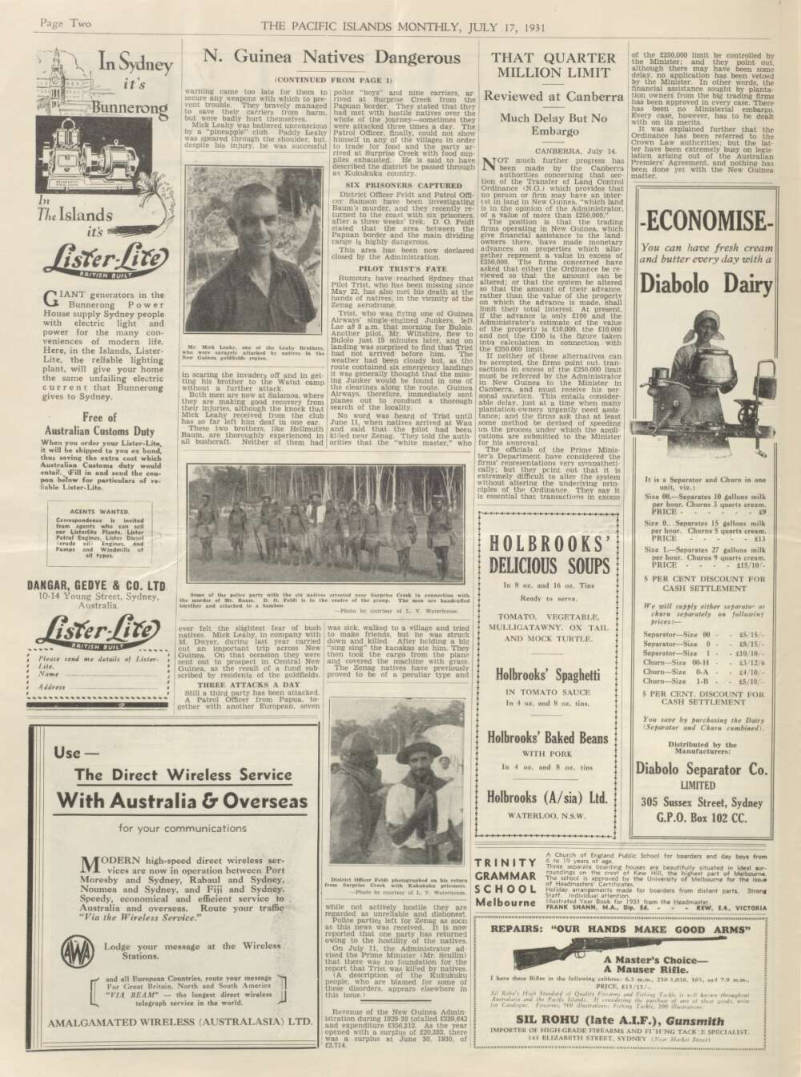
Three of the Kukukuku natives arrested and brought in by District Officer Peldt, near Surprise Creek, in connection with the murder of Hellmuth Baum. The three are handcuffed together. On D. O. Feldt’s return from this region he reported that the area between the Papuan border and the main dividing range was highly dangerous. —Photo by courtesy of L. V. Waterhouse. ===
secure any weapons with which to prevent trouble. They bravely managed to save their carriers from harm, but were badly hurt themselves.
Mick Leahy was battered unconscious by a “pineapple” club. Paddy Leahy was speared through the shoulder, but despite his injury, he was successful Mr. Mick Leahy, one of the Leahy Brothers, who were savagely attacked by natives in the New Guinea goldfields region.||
in scaring the invaders off and in getting his brother to the Watut camp without a further attack.
Both men are now at Salamoa, where they are making good recovery from their injuries, although the knock that Mick Leahy received from the club has so far left him deaf in one ear.
These two brothers, like Hellmuth Baum, are thoroughly experienced in all bushcraft. Neither of them had Some of the police party with the six natives arrested near Surprise Creek in connection with the murder of Mr. Baum. D. O. Feldt is in the centre of the group. The men are handcuffed togethcr and attached to a bamboo. —Photo by courtesy of L. V. Waterhouse. ever felt the slightest fear of bush natives. Mick Leahy, in company with M. Dwyer, during last year carried out an important trip across New Guinea. On that occasion they were sent out to prospect in Central New Guinea, as the result of a fund subscribed by residents of the goldfields.
Three Attacks A Day
Still a third party has been attacked.
A Patrol Officer from Papua, to gether with another European, seven
police “boys” and nine carriers, arrived at Surprise Creek from the Papuan border. They stated that they had met with hostile natives over the whole of the journey—sometimes they were attacked three times a day. The Patrol Officer, finally, could not show himself in any of the villages in order to trade for food and the party arrived at Surprise Creek with food supplies exhausted. He is said to have described the district he passed through as Kukukuku country.
Six Prisoners Captured
District Officer Feldt and Patrol Officer Samson have been investigating Baum’s murder, and they recently returned to the coast with six prisoners, after a three weeks’ trek. D. O. Feldt stated that the area between the Papuan border and the main dividing range is highly dangerous.
This area has been now declared closed by the Administration.
Pilot Trist’S Fate
Rumours have reached Sydney that Pilot Trist, who has been missing since May 22, has also met his death at the hands of natives, in the vicinity of the Zenag aerodrome.
Trist, who was flying one of Guinea Airways’ single-engined Junkers, left Lae at 8 a.m. that morning for Bulolo.
Another pilot, Mr. Wiltshire, flew to Bulolo just 15 minutes later, and on landing was surprised to find that Trist had not arrived before him. The weather had been cloudy but, as the route contained six emergency landings it was generally thought that the missing Junker would be found in one of the clearings along the route. Guinea Airways, therefore, immediately sent planes out to conduct a thorough search of the locality.
No word was heard of Trist until June 11, when natives arrived at Wau and said that the pilot had been killed near Zenag. They told the authorities that the “white master,” who
was sick, walked to a village and tried to make friends, but he was struck down and killed. After holding a big “sing sing” the kanakas ate him. They then took the cargo from the plane and covered the machine with grass.
The Zenag natives have previously proved to be of a peculiar type and District Officer Feldt photographed on his return from Surprise Creek with Kukukuku prisoners. —Photo by courtesy of L. V. Waterhouse.
while not actively hostile they are regarded as unreliable and dishonest.
Police parties left for Zenag as soon as this news was received. It is now reported that one party has returned owing to the hostility of the natives.
On July 11, the Administrator advised the Prime Minister (Mr. Scullin) that there was no foundation for the report that Trist was killed by natives. (A description of the Kukukuku people, who are blamed for some of these disorders, appears elsewhere in this issue.) ... === Revenue of the New Guinea Administration during 1929-30 totalled £339,642 and expenditure £356,312. As the year opened with a surplus of £20,383, there was a surplus at June 30, 1930, of £3,714. ... ===
Advertisements & other items, p. 1 (1 item)
Miss Muriel Starr
The eminent Canadian actress writes : “ I have been a user of mercolized wax for many years and
have always found it excellent for
preserving the skin."
They have to use the best, the notable stage stars. Always must their skin show flawless, clear and lovely, on or off the stage. You too should use mercolized wax, to beautify, protect. It does not grow hair. 2/6 and 5/6, chemists and stores. Invaluable for freckles, sunburn, windchap, etc. Don’t hesitate; it is really good
That Quarter
Million Limit
Reviewed at Canberra Much Delay But No Embargo
Canberra, July 14.
NOT much further progress has been made by the Canberra authorities concerning that section of the Transfer of Land Control Ordinance (N.G.) which provides that no person or firm may have an interest in land in New Guinea, “which land is in the opinion of the Administrator, of a value of more than £250,000.”
The position is that the trading firms operating in New Guinea, which give financial assistance to the landowners there, have made monetary advances on properties which altogether represent a value in excess of £250,000. The firms concerned have asked that either the Ordinance be reviewed so that the amount can be altered: or that the system be altered so that the amount of their advance, rather than the value of the property on which the advance is made, shall limit their total interest. At present, if the advance is only £100 and the Administrator’s estimate of the value of the property is £10,000, the £10,000 and not the £100 is the figure taken into calculation in connection with the £250,000 limit.
If neither of these alternatives can be accepted, the firms point out, transactions in excess of the £250,000 limit must be referred by the Administrator in New Guinea to the Minister in Canberra, and must receive his personal sanction. This entails considerable delay, just at a time when many plantation-owners urgently need assistance; and the firms ask that at least some method be devised of speeding up the process under which the applications are submitted to the Minister for his approval.
The officials of the Prime Minister’s Department have considered the firms’ representations very sympathetically; but they point out that it is extremely difficult to alter the system without altering the underlying principles of the Ordinance. They say it is essential that transactions in excess
of the £250,000 limit be controlled by the Minister; and they point out, although there may have been some delay, no application has been vetoed by the Minister. In other words, the financial assistance sought by plantation owners from the big trading firms has been approved in every case. There has been no Ministerial embargo.
Every case, however, has to be dealt with on its merits.
It was explained further that the Ordinance has been referred to the Crown Law authorities; but the latter have been extremely busy on legislation arising out of the Australian Premiers’ Agreement, and nothing has been done yet with the New Guinea matter.
Advertisements & other items, p. 2 (2 items)
Lister-Lite
In Sydney
it's
Bunnerong
In
The Islands
it's
Lister-Lite
GIANT generators in the Bunnerong Power House supply Sydney people with electric light and power for the many conveniences of modern life.
Here, in the Islands, Lister- Lite, the reliable lighting plant, will give your home the same unfailing electric current that Bunnerong gives to Sydney.
Free of
Australian Customs Duty
When you order your Lister-Lite, it will be shipped to you ex bond, thus saving the extra coat which Australian Customs duty would entail. Fill in and send the coupon below for particulars of reliable Lister-Lite.
AGENTS WANTED.
Correspondence is invited from agents who can sell our Listerlite Plants, Lister Petrol Engines, Lister Diesel (crude oil) Engines, and Pumps and Windmills of all types.
DANGAR, GEDYE & CO. LTD
10-14 Young Street, Sydney, Australia.
Lister-Lite
BRITISH BUILT
Please send me details of Lister- Lite.
Name ...
Address ... ... ===
Use
The Direct Wireless Service
With Australia & Overseas
for your communications MODERN high-speed direct wireless services are now in operation between Port Moresby and Sydney, Rabaul and Sydney, Noumea and Sydney, and Fiji and Sydney.
Speedy, economical and efficient service to Australia and overseas. Route your traffic “Via the Wireless Service ”
Lodge your message at the Wireless Stations. and all European Countries, route your message For Great Britain, North and South America ”VIA BEAM” the longest dire-ct wireless telegraph service in the world.
AMALGAMATED WIRELESS (AUSTRALASIA) LTD.
Diabolo Dairy
-ECONOMISE-
You can have fresh cream
and butter every day with a
Diabolo Dairy
It is a Separator and Churn in one unit, viz.: Size 00.—Separates 10 gallons milk per hour. Churns 3 quarts cream.
PRICE £9
Size 0.. .Separates 15 gallons milk per hour. Churns 5 quarts cream.
PRICE £l3
Size 1.—Separates 27 gallons milk per hour. Churns 9 quarts cream.
PRICE ... £l5/10/-
5 PER CENT DISCOUNT FOR
CASH SETTLEMENT
We will supply either separator or churn separately on following prices :— Separator—Size 00 - - £5/15/- Separator—Size 0 - - £8/15/- Separator—Size 1 - - £10/10/- Churn—Size 00-H - - £3/12/6 Churn—Size 0-A - - £4/10/- Churn—Size 1-B - - £5/10/-
5 PER CENT. DISCOUNT FOR
CASH SETTLEMENT
You save by purchasing the Dairy (Separator and Churn combined) .
Distributed by the Manufacturers:
Diabolo Separator Co.
LIMITED
305 Sussex Street, Sydney
G.P.O. Box 102 CC.
HOLBROOKS’
DELICIOUS SOUPS
In 8 oz. and 16 oz. Tins Ready to serve.
TOMATO, VEGETABLE,
MULLIGATAWNY, OX TAIL
AND MOCK TURTLE.
Holbrooks’ Spaghetti
IN TOMATO SAUCE
In 4 oz. and 8 oz. tins.
Holbrooks’ Baked Beans
WITH PORK
In 4 oz. and 8 oz. tins
Holbrooks (A/sia) Ltd.
WATERLOO, N.S.W.
TRINITY
GRAMMAR
SCHOOL
Melbourne
A Church of England Public School for boarders and day boys from 6 to 19 years of age.
Three separate boarding houses are beautifully situated in ideal surroundings on the crest of Kcw Hill, the highest part of Melbourne.
The school is approved by the University of Melbourne for the issue of Headmasters’ Certificates.
Holiday arrangements made for boarders from distant parts. Strong Staff. Individual attention.
Illustrated Year Book for 1931 from the Headmaster.
FRANK SHANN, M.A., Dip. Ed. - KEW, E. 4., VICTORIA ... ===
REPAIRS: “OUR HANDS MAKE GOOD ARMS"
A Master's choice
Mauser Rifle.
I have these Rifles in the following calibres: 6.5 m.m., 250 3,000, 303, and 7.9 m.m.
PRICE, £15/15/-.
Sil Rohu s High Standard of Quality Firearms and Fishing Tackle is well known throughout Australasia and the Pacific Islands. If considering the purchase of any of these goods, write for Catalogue. Firearms, 500 illustrations; Fishing Tackle , 200 illustrations.
SIL ROHU (late A.I.F.), Gunsmith
IMPORTER OF HIGH-GRADE FIREARMS AND FISHING TACKLE SPECIALIST. 143 ELIZABETH STREET, SYDNEY (Near Market Street)
The Kukukuku
Natives Who Are Disturbing Goldfields Wild Papuan Tribes
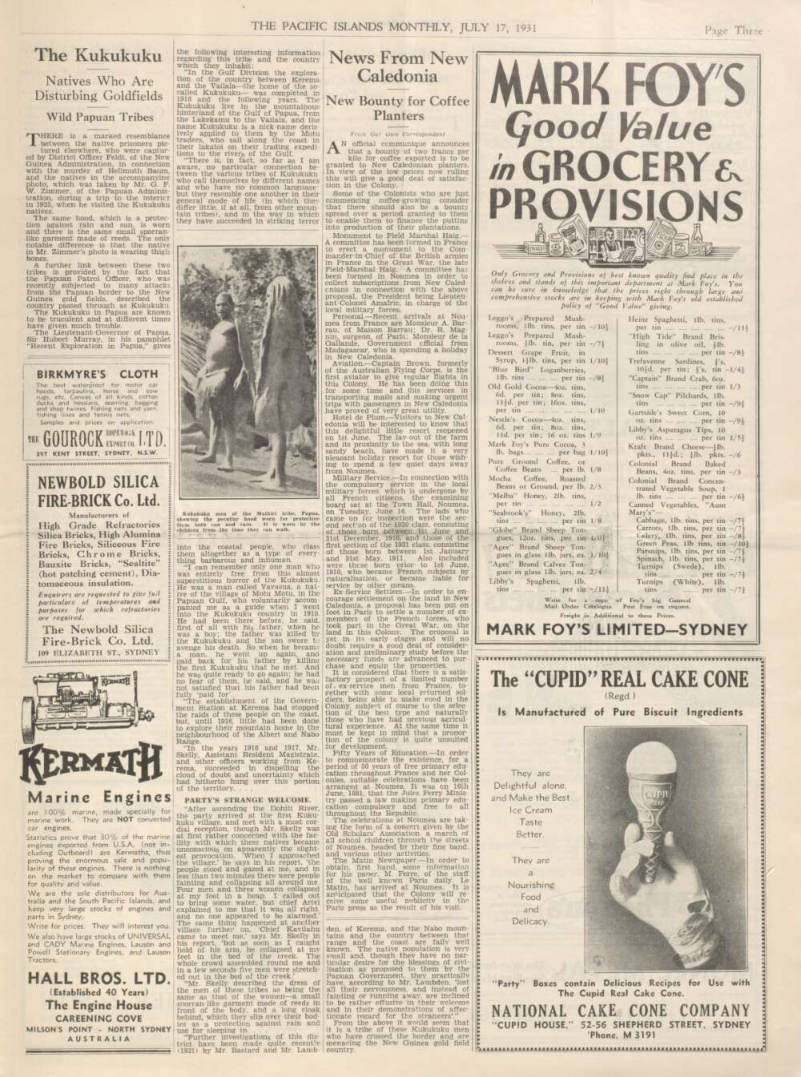
THERE is a marked resemblance between the native prisoners pic tured elsewhere, -who were captur ed by District Officer Feldt, of the New Guinea Administration, in connection with the murder of Hellmuth Baum, and the natives in the accompanying photo, which was taken by Mr. G. F.
W. Zimmer, of the Papuan Adminis tration, during a trip to the interior in 1925, when he visited the Kukukuku natives.
The same hood, which is a protec tion against rain and sun, is worn and there is the same small sporran like garment made of reeds. The only notable difference is that the native in Mr. Zimmer’s photo is wearing thigh bones.
A further link between these two tribes is provided by the fact that the Papuan Patrol Officer, who was recently subjected to many attacks from the Papuan border to the New Guinea gold fields, described the country passed through as Kukukuku.
The Kukukuku in Papua are known to be truculent and at different times have given much trouble.
The Lieutenant-Governor of Papua, Sir Hubert Murray, in his pamphlet “Recent Exploration in Papua,” gives
the following interesting information regarding this tribe and the country which they inhabit: “In the Gulf Division the explora tion of the country between Kerema and the Vailala—the home of the so called Kukukuku— was completed in 1916 and the following years. The Kukukuku live in the mountainous hinterland of the Gulf of Papua, from the Lakekamu to the Vailala, and the name Kukukuku is a nick-name deris ively applied to them by the Motu traders, who sail along the coast in their lakatoi on their trading expedi tions to the rivers of the Gulf.
“There is, in fact, so far as I am aware, no particular connection be tween the various tribes of Kukukuku who call themselves by different names and who have no common language but they resemble one another in their general mode of life (in which they differ little, if at all, from other moun tain tribes), and in the way in which they have succeeded in striking terror
into the coastal people, who class them altogether as a type of every thing barbarous and inhuman.
“I can remember only one man who was entirely free from this almost superstitious horror of the Kukukuku.
He was a man called Vavasua, a nat ive of the village of Motu Motu, in the Papuan Gulf, who voluntarily accom panied me as a guide when I went into the Kukukuku country in 1910.
He had been there before, he said, first of all with his father, when he was a boy; the father was killed by the Kukukuku and the son swore to avenge his death. So when he became a man, he went up again, and paid back for his father by killing the first Kukukuku that he met. And he was quite ready to go again; he had no fear of them, he said, and he was not satisfied that his father had been fully ‘paid for’.
“The establishment of the Govern ment Station at Kerema had stopped the raids of these people on the coast, but, until 1916, little had been done to explore their mountain home in the neighbourhood of the Albert and Nabo Range.
“In the years 1916 and 1917, Mr.
Skelly, Assistant Resident Magistrate, and other officers working from Ke rema, succeeded in dispelling the cloud of doubt and uncertainty which had hitherto hung over this portion of the territory. . . .
Party’S Strange Welcome.
“After ascending the Dohiti River, the party arrived at the first Kuku kuku village, and met with a most cor dial reception, though Mr. Skelly was at first rather concerned with the fac ility with which these natives became unconscious on apoarently the slight est provocation. ‘When I approached the village,’ he says in his report, ‘the people stood and gazed at me, and in less than two minutes there were people fainting and collapsing all around me.
Four men and three women collapsed at my feet in a heap. I called out to bring some water, but chief Arivi explained to me that it was all right, and no one appeared to be alarmed.’
The same thing happened at another village further on, ‘Chief Kavilahu came to meet me,’ says Mr. Skelly in his report, ‘but as soon as I caught hold of his arm, he collapsed at my feet in the bed of the creek. The whole crowd assembled round me and in a few seconds five men were stretch ed out in the bed of the creek.’
“Mr. Skelly described the dress of the men of these tribes as being the same as that of the women —a small sporran-like garment made of reeds in front of the body, and a long cloak behind, which they slip over their bod ies as a protection against rain and use for sleeping in. . . .
“Further investigations of this dis trict have been made quite recently (1921) by Mr. Bastard and Mr. Lamb
den, of Kerema, and the Nabo moun tains and the country between that range and the coast are fairly well known. The native population is very small and. though they have no par ticular desire for the blessings of civi lisation as proposed tn them by the Papuan Government, they practically have, according to Mr. Lambden, ‘lost all their nervousness, and instead of fainting or running away, are inclined to be rather effusive in their welcome and in their demonstrations of affec tionate regard for the strangers’.”
From the above it would seem that it is a tribe of these Kukukuku men who have crossed the border and are menacing the New Guinea gold field country.
Kukukuku men of the Maihiri tribe. Papua, showing the peculiar hood worn for protection from both sun and rain. It is worn by the children from the time they can walk.
Caledonia
News From New Caledonia New Bounty for Coffee Planters
From Our Own Correspondent AN official communique announces that a bounty of two francs per kilo for coffee exported is to be granted to New Caledonian planters.
In view of the low prices now ruling this will give a good deal of satisfac tion in the Colony.
Some of the Colonists who are just commencing coffee-growing consider that there should also be a bounty spread over a period granted to them to enable them to finance the putting into production of their plantations.
Monument to Field Marshal Haig.— A committee has been formed in France to erect a monument to the Com mander-in-Chief of the British armies in France in the Great War, the late Field-Marshal Haig. A committee has been formed in Noumea in order to collect subscriptions from New Caled onians in connection with the above proposal, the President being Lieuten ant-Colonel Amalric, in charge of the local military forces.
Personal.—Recent arrivals at Nou mea from France are Monsieur A. Bar rau, of Maison Barrau; Dr. R. Mag nin, surgeon, of Paris; Monsieur de la Gallande, Government official from Madagascar, who is spending a holiday in New Caledonia.
Aviation. —Captain Brown, formerly of the Australian Flying Corps, is the first aviator to give regular flights in this Colony. He has been doing this far some time and (his services in transporting mails and making urgent trips with passengers in New Caledonia have proved of very great utility.
Hotel de Plum. —Visitors to New Cal edonia will be interested to know that this delightful little resort reopened on 1st June. The lay-out of the farm and its proximity to the sea, with long sandy beach, have made it a very pleasant holiday resort for those wish ing to spend a few quiet days away from Noumea.
Military Service.—ln connection with the compulsory service in the local military forces, which is undergone by all French citizens, the examining board sat at the Town Hall, Noumea, on Tuesday, June 16. The lads who came up for inspection were the sec ond section of the 1930 class, consisting of those born between Ist June and 31st December. 1910, and those of the first section of the 1931 class, consisting of those born between Ist January and 31st May, 1911. Also included were these born prior to 1st June, 1910, who became French subjects by naturalisation, or became liable for service by other means.
Ex-Service Settlers. —In order to en courage settlement on the land in New Caledonia, a proposal has been put on foot in Paris to settle a number of ex members of the French forces, who took part in the Great War, on the land in this Colony. The proposal is yet in its early stages and will no doubt require a good deal of consider ation and preliminary study before the necessary funds are advanced to pur chase and equip the properties.
It is considered that there is a satis factory prospect of a limited number of ex-service men from France, to gether with some local returned sol diers, being able to make good in the Colony, subject of course to the selec tion of the best type and naturally those who have had previous agricul tural experience. At the same time it must be kept in mind that a propor tion of the colony is quite unsuited for development.
Fifty Years of Education. —In order to commemorate the existence, for a period of 50 years of free primary edu cation throughout France and her Col onies, suitable celebrations have been arranged at Noumea. It was on 16th June, 1881, that the Jules Ferry Minis try passed a law making primary edu cation compulsory and free to all throughout the Republic.
The celebrations at Noumea are tak ing the form of a concert given by the Old Scholars’ Association, a march of all school children through the streets of Noumea, headed by their fine band, and various other activities.
The Matin Newspaper.—In order to obtain, first hand, some information for his paner. M. Ferre, of the staff of the well known Paris daily. Le Matin, has arrived at Noumea. It is anticipated that the Colony will re ceive some useful publicity in the Paris press as the result of his visit.
Advertisements & other items, pp. 3-4 (2 items)
Mark Foy's
Good Value in Grocery &
Provisions
Only Grocery and Provisions of best known quality find place in the shelves and stands of this important department at Mark Foy’s. You can be sure in knowledge that the prices right through large and comprehensive stocks are in keeping with Mark Foy’s old established policy of "Good Value” giving.
Leggo’s Prepared Mushrooms, lib. tins, per tin -/10} Leggo’s Prepared Mushrooms, jib. tin, per tin ~/7j Dessert Grape Fruit, in Syrup, Ijlb. tins, per tin l/10j "Blue Bird” Loganberries, lib. tins per tin -/8j Old Gold Cocoa—4oz. tins, 6d. per tin; Boz. tins, lljd. per tin; l6oz. tins, per tin 1/10 Nestle’s Cocoa—4oz. tins, 6d. per tin; Boz. tins, lid. per tin; 16 oz. tins 1/9 Mark Foy’s Pure Cocoa, 3 lb. bags per bag 1/10} Pure Ground Coffee, or Coffee Beans ... per lb. 1/8 Mocha Coffee, Roasted Beans or Ground, per lb. 2/3 "Melba” Honey, 2lb. tins, per tin 1/2 "Seabrook’s” Honey, 2lb. tins per tin 1/8 "Globe” Brand Sheep Tongues, 12oz. tins, per tin 1/0} "Agee” Brand Sheep Tongues in glass lib. jars, ea. 1/10} "Agee” Brand Calves Tongues in glass lib. jars, ea, 2/4 Libby’s Spaghetti, lib. tins per tin -/'ll} Heinz Spaghetti, lib. tins, per tin -/ll} "High Tide” Brand Brisling in olive oil, jib. tins per tin -/8j Trefavenne Sardines, j’s, lOjd. per tin; j’s, tin -l/4j "Captain” Brand Crab, 6oz. tins per tin 1/3 "Snow Cap” Pilchards, lib. tins per tin -/9j Gartside’s Sweet Corn, 10 oz. tins per tin -/9j Libby’s Asparagus Tips, 10 oz. tins per tin l/5j Kraft Brand Cheese—jib. pkts., lljd.; jib. pkts. —/6 Colonial Brand Baked Beans, 4oz. tins, per tin -/3 Colonial Brand Concentrated Vegetable Soup, 1 lb. tins per tin -/6j Canned Vegetables, "Aunt Mary’s”— Cabbage, lib. tins, per tin -/7j Carrots, lib. tins, per tin -/7j Celery, lib. tins, per tin -/8j Green Peas, lib tins, tin -/10j Parsnips, lib. tins, per tin -/7j Spinach, lib. tins, per tin —/7j Turnips (Swede), lib. tins per tin -/7j Turnips (White), lib. tins per tin -/7j Write for a copy of Foy’s big General Mail Order Catalogue. Post Free on request.
Freight is Additional to these Prices.
MARK FOY’S LIMITED-SYDNEY
The “CUPID” REAL CAKE CONE
(Regd.) Is Manufactured of Pure Biscuit Ingredients They are Delightful alone, and Make the Best Ice Cream Taste Better.
They are a Nourishing Food and Delicacy.
“Party” Boxes contain Delicious Recipes for Use with The Cupid Real Cake Cone.
NATIONAL CAKE CONE COMPANY
“CUPID HOUSE,” 52-56 SHEPHERD STREET, SYDNEY
’Phone, M 3191
Australia’s Gift
to Humanity
in Pain!
Vincent’s A.P.C.
STOPS
PAIN
SAFELY
Prepared on the scientific formula now in use in the argest hospitals in Australia. Recom mended with safety by your Doctor, Chemist, Dentist Nurse.
Headache, Neuralgia, Neuritis, Sciatica, Rheumatism, Backache, Sleeplessness, Influenza, All Chemists and Stores, or direct from Vincent Chemical Co.
Sydney.
Abdominal Pains in Women Beware of Imitations
genuine
ink Powders and Tablets, 1/6 & 2/6
DO NOT AFFECT THE
HEART OR NERVES
LARS HALVORSEN
Designer and Builder
SCHOONERS KETCHES YACHTS
LAUNCHES, Etc.
Quotations Free.
Hayes St., Neutral Bay, Sydney, N.S.W.
KveMillion-f
n HOLDING together the colossal fabric of the Sydney Harbour Bridge are 5,000,000 rivets, varying in size up to 6j lbs. weight, 15 inches long, and weighing altogether 3,500 tons. Upon their quality depends the safety of the structure. It is significant that every one of those rivets will be a “MACSON” Rivet—every one made in Australia by McPherson’s Pty. Ltd.
Established in the year 1860, McPherson’s have now been supplying the needs of Engineers and tradesmen throughout the Commonwealth with DEPENDABLE GOODS for 71 years.
WE STOCK:—
Shovels, Picks, Tools of all kinds, Mining Drill Steel, Pulleys, Shafting, Belting, Lubricating Supplies, Bolts, Nuts and Rivets, Tubes and Fittings, Lathes, Machine Tools, Hoists, Grinding Wheels, Steam Fittings, Air Compressors, Barrows, etc.
Write 51-65 Bathurst St.
SYDNEY
for a copy of our fully illustrated Catalogues. Post free anywhere.
Proprietary Limited
Also at
MELBOURNE,
ADELAIDE,
and PERTH.
& m kI ri tj CTT I The Wonderful Alloy of Nickel tr Copper t L IVI C I AVL The Best Metal for Propeller Shafts, etc.
Strong as Steel. - Is not affected by salt water. - Stocks include Sheets, Rods, Bars, Wire, Tubes, etc.
Australian Distributors:
FERRIER & DICKINSON LTD.
26 CLARENCE STREET - - SYDNEY - - N.S.W. - - AGENTS
»Gourock
BIRKMYRE’S CLOTH
The best waterproof for motor car hoods, tarpaulins, horse and cow rugs, etc. Canvas of all kinds, cotfon ducks and hessians, seaming, bagging and shop twines. Fishing nets and yarn, fishing lines and tennis nets.
Samples and prices on application,
»GOUROCK
ROPE WO ilk
EXTORT CO.
LTD.
397 KENT STREET, SYDNEY, N.S.W.
NEWBOLD SILICA
FIRE-BRICK Co. Ltd.
Manufacturers of High Grade Refractories Silica Bricks, High Alumina Fire Bricks, Siliceous Fire Bricks, Chrome Bricks, Bauxite Bricks, “Sealtite” (hot patching cement), Diatomaceous insulation.
Enquirers are requested to give fud particulars of temperatures and purposes for which refractories are required.
The Newbold Silica Fire-Brick Co. Ltd.
109 ELIZABETH ST., SYDNEY
Marine Engines
are 100% marine, made specially for marine work. They are NOT converted car engines.
Statistics prove that 30% of the marine engines exported from U.S.A. (not including Outboard) are Kermaths, thus proving the enormous sale and popularity of these engines. There is nothing on the market to compare with them for quality and value.
We are the sole distributors for Australia and the South Pacific Islands, and keep very large stocks of engines and parts in Sydney.
Write for prices. They will interest you.
We also have large stocks of UNIVERSAL and CADY Marine Engines, Lauson and Powell Stationary Engines, and Lauson Tractors.
HALL BROS. LTD.
(Established 40 Years)
The Engine House
CAREENING COVE
MILSON’S POINT - NORTH SYDNEY
AUSTRALIA
“Maweena”
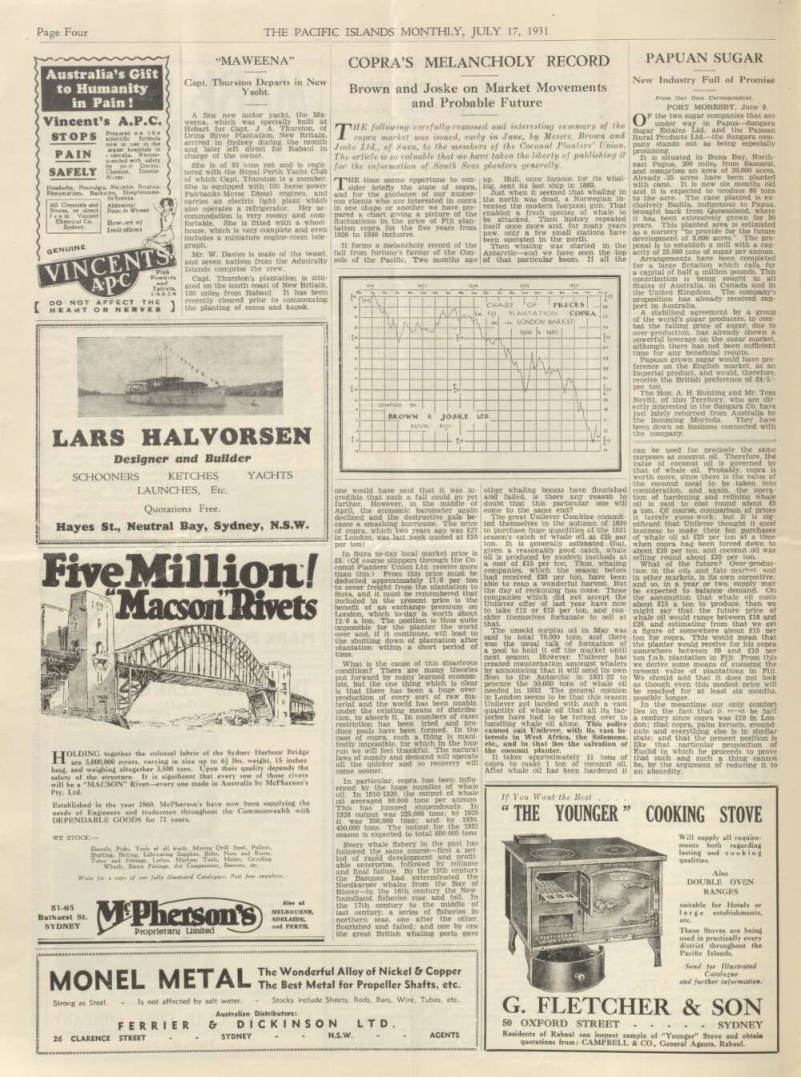
Gapt. Thurston Departs in New Yacht.
A fine new motor yacht, the Ma weena, which was specially built at Hobart for Capt. J. A. Thurston, of Drina River Plantation, New Britain, arrived in Sydney during the month and later left direct for Rabaul in charge of the owner.
She is of 83 tons net and is regis tered with the Royal Perth Yacht Club of which Capt. Thurston is a member.
She is equipped with 100 horse power Fairbanks-Morse Diesel engines, and carries an electric light plant which also operates a refrigerator. Her commodation is very roomy and com fortable. She is fitted with a wheel house, which is very complete and even includes a miniature engine-room tele graph.
Mr. W. Davies is mate of the vessel, and seven natives from the Admiralty Islands comprise the crew.
Capt. Thurston’s plantation is situ ated on the south coast of New Britain, 130 miles from Rabaul. It has been recently cleared prior to commencing the planting of cocoa and kapok.
Copra’S Melancholy Record
Brown and Joske on Market Movements and Probable Future
THE following carefully-reasoned and interesting summary of the copra market was issued, early in June, by Messrs. Brown and Joske Ltd., of Suva, to the members of the Coconut Planters’ Union.
The article is so valuable that we have taken the liberty of publishing it for the information of South Seas planters generally.
THE time seems opportune to con sider briefly the state of copra, and for the guidance of our numer ous clients who are interested in copra in one shape or another we have pre pared a chart giving a picture of the fluctuations in the price of Fiji plan tation copra for the five years from 1926 to 1930 inclusive.
It forms a melancholy record of the fall from fortune’s favour of the Con sols of the Pacific. Two months ago
up. Hull, once famous for its whal ing, sent its last ship in 1869.
Just when it seemed that whaling in the north was dead, a Norwegian in vented the modern harpoon gun. That enabled a fresh species of whale to be attacked. Then history repeated itself once more and, for many years now, only a few small stations have been operated in the north.
Then whaling was started in the Antarctic —and we have seen the top of that particular boom. If all the
one would have said that it was in credible that such a fall could go yet further. However, in the middle of April, the economic barometer again declined and the destructive gale be came a smashing hurricane. The price of copra, which two years ago was £27 in London, was last week quoted at £10 per ton!
In Suva to-day local market price is £6. (Of course shippers through the Co conut Planters’ Union Ltd. receive more than this.) From this price must be deducted approximately 17/6 per ton to cover freight from the plantation to Suva, and it must be remembered that included in the present price is the benefit of an exchange premium on London, which to-day is worth about 12/6 a ton. The position is thus quite impossible for the planter the world over and, if it continues, will lead to the shutting down of plantation after plantation within a short period of time.
What is the cause of this disastrous condition? There are many theories put forward by many learned econom ists, but the one thing which is clear is that there has been a huge over production of every sort of raw ma terial and the world has been unable under the existing means of distribu tion, to absorb it. In numbers of cases restriction has been tried and pro duce pools have been formed. In the case of copra, such a thing is mani festly impossible, for which in the long run we will feel thankful. The natural laws of supply and demand will operate all the quicker and so recovery will come sooner.
In particular, copra has been influ enced by the huge supplies of whale oil. In 1910-1920, the output of whale oil averaged 90,000 tons per annum This has jumped stupendously. In 1928 output was 225,000 tons; by 1929 it was 300,000 tons; and by 1930. 450,000 tons. The output for the 1931 season is expected to total 600 000 tons Every whale fishery in the past has followed the same course—first a per iod of rapid development and profit able enterprise, followed by collapse and final failure. By the 15th century the Basques had exterminated the Nordkarper whales from the Bay of Biscay—in the 16th century the New foundland fisheries rose and fell. In the 17th century to the middle of last century, a series of fisheries in northern seas, one after the other, flourished and failed; and one by one the great British whaling ports gave
other whaling booms have flourished and failed, is there any reason to doubt that this particular one will come to the same end?
The great Unilever Combine commit ted themselves in the autumn of 1930 to purchase huge quantities of the 1931 season’s catch of whale oil at £25 per ton. It is generally estimated that, given a reasonably good catch, whale oil is produced by modern methods at a cost of £15 per ton, Thus, whaling companies, which the season before had received £30 per ton, have been able to reap a wonderful harvest. But the day of reckoning has come. Those companies which did not accept the Unilever offer of last year have now to take £12 or £13 per ton, and con sider themselves fortunate to sell at that.
The unsold surplus oil in May was said to total 70,000 tons, and there was the usual talk of formation of a pool to hold it off the market until next season. However, Unilever has created consternation amongst whalers by announcing that it will send its own fleet to the Antarctic in 1931-32 to procure the 50,000 tons of whale oil needed in 1932. The general opinion in London seems to be that this season Unilever got landed with such a vast quantity of whale oil that all its fac tories have had to be turned over to handling whale oil alone. This policy cannot suit Unilever, with its vast in terests in West Africa, the Solomons, etc., and in that lies the salvation of the coconut planter.
It takes approximately 1½ tons of copra to make 1 ton of coconut oil.
After whale oil has been hardened it
can be used for precisely the same purposes as coconut oil. Therefore, the value of coconut oil is governed by that of whale oil. Probably, copra is worth more, since there is the value of the coconut meal to be taken into consideration, and again, the opera tion of hardening and refining whale oil is said to cost round about £5 a ton. Of course, comparison of prices is largely guess-work; but it is sig nificant that Unilever thought it good business to make their big purchases of whale oil at £25 per ton at a time when copra had been forced down to about £20 per ton, and coconut oil was selling round about £30 per ton.
What of the future? Over-produc tion in the oils and fats market and in other markets, is its own corrective: and so, in a year or two, supply mav be expected to balance demand. On the assumption that whale oil costs about £15 a ton to produce, then we might say that the future price of whale oil would range between £18 and £20, and estimating from that we get a figure of somewhere about £15 per ton for copra. This would mean that the planter would receive for his copra somewhere between £9 and £10 per ton f.o.b. plantation in Fiji. From this we derive some means of guessing the present value of plantations in Fiji.
We should add that it does not look as though even this modest price will be reached for at least six months, possibly longer.
In the meantime our only comfort lies in the fact that it must be half a century since copra was £10 in Lon don; that copra, palm kernels, ground nuts and everything else is in similar state; and that the present position is like that particular proposition of Euclid in which he proceeds to prove that such and such a thing cannot be, by the argument of reducing it to an absurdity.
Papuan Sugar
New Industry Full of Promise
From Our Own Correspondent.
Port Moresby, June 9.
OF the two sugar companies that are under way in Papua—Sangara Sugar Estates Ltd. and the Papuan Rural Products Ltd. —the Sangara com pany stands out as being especially promising.
It is situated in Buna Bay, North east Papua, 200 miles from Samarai, and comprises an area of 20,000 acres.
Already -25 acres have been planted with cane. It is now six months old and it is expected to nroduce 60 tons to the acre. The cane planted is ex clusively Badila, indigenous to Papua, brought back from Queensland, where it has been extensively grown for 30 years. This planted area is estimated as a nursery “to provide for the future development of 3,000 acres.” The pro posal is to establish a mill with a cap acity of 25,000 tons of sugar per annum.
Arrangements have been completed for a large flotation which calls for a capital of half a million pounds. This contribution is being sought in all States of Australia, in Canada and in the United Kingdom. The company’s proposition has already received sup port in Australia.
A stabilised agreement by a group of the world’s sugar producers, to com bat the falling price of sugar, due to over-production, has already shown a powerful leverage on the sugar market, although there has not been sufficient time for any beneficial results.
Papuan grown sugar would have pre ference on the English market, as an Imperial product, and would, therefore, receive the British preference of £4/5/per ton.
The Hon. A. H. Bunting and Mr. Tom Nevitt, of this Territory, who are dir ectly interested in the Sangara Co. have just lately returned from Australia by the incoming Morinda. They have been down on business connected with the company.
Advertisements & other items, p. 4 (1 item)
“The Younger” Cooking Stove
If You Want the Best ...
Will supply all requirements both regarding lasting and cooking qualities.
Also
DOUBLE OVEN
RANGES
suitable for Hotels or large estabishments, etc.
These Stoves are being used in practically every district throughout the Pacific Islands.
Send for Illustrated Catalogue and further information.
G. FLETCHER & SON
50 OXFORD STREET SYDNEY
Residents of Rabaul can inspect sample of “Younger” Stove and obtain quotations from; CAMPBELL & CO., General Agents, Rabaul.
Bounty Memories
The Pitcairners’
Anniversary
Celebrated On
Norfolk Island
From Our Own Correspondent
Norfolk Is., June 20.
JUNE 8 was a great day on our is land. For the first time for 26 years we celebrated Anniversary Day that is, the anniversary of the land ing of the Pitcairn Islanders on Nor folk 75 years ago.
For many years after their arrival the Islanders made a special celebra tion of the event and acted a pageant which embodied the outstanding inci dents of the famous mutiny on the King’s ship Bounty, in which their forefathers participated. But with an increasing influx of “outsiders” as we are still called when the kindlier name “mainlanders” is withheld —the custom fell into disuse; and those of us interested in old things of the past had to be content with stories told by the elders of the community.
This year, however, convinced at last, we hope, of our real interest and sympathy, the leading Islanders con sented to re-enact their historic play, and did so before a thronged and ap preciative audience, which gathered in Kingston at an early hour, ready for every entertainment the day might offer.
The quarter deck of the Bounty had been reconstructed, and it was walked by Commander Bligh and his First Lieutenant Christian, who led the mutiny 150 years ago. Scenes also took place within the big courtyard that surrounds our administrative offices.
Remarkable costumes were improvised and no one took part who was not an actual descendant of the original mu tineers. They were reviewed by Col onel Bennett, our present administra tor, who was accompanied by Mrs.
Bennett and Captain Stopp, acting private secretary, while the rest of us stood around or accompanied them from place to place as the exigencies of the play demanded.
The official proceedings terminated with a visit to our cenotaph and the laying of a wreath by “Commander Bligh” in memory of those who left this peaceful little land to fight and die far overseas in the Great war.
While the Islanders played the main landers at cricket on the village green the womenfolk were busy assembling a feast that will long live in the memories of those lucky enough to take part in it. On acres of table cloths laid end to end beneath the old grey prison walls every delicacy the island could furnish was laid out.
There were turkeys and ducks and geese and sucking pigs and growmup pork and whole hams and every kind of vegetable, including the island dish, “pilhai,” which is composed of ban anas, green or ripe, or else sweet potato mashed and packed and baked just like a Yorkshire pudding in a big dish and cut and served in slices, with hot or cold meat. And there were plum puddings, rich with fruit, reeking with brandy and served with cream or custard; tarts and jellies and pies; all washed down with cups of strong, sweet tea.
And we sat in rows and rows upon the ground Islanders and settlers side by side, with visitors and the lone stranger sandwiched in between.
For if there is anything the Islander understands, it is hospitality and the art of making everybody at home and one with the rest. No one was forgot ten, no one was neglected; all were welcome, and all were at ease.
The day came to a close with an old-time dance, held in the Rawson Hall, where all our public entertain ments take place.
Sullen Spirit In Samoa
Visiting Journalist Says Gesture of Conciliation is Called For
THE following summary of the position in Samoa appeared in The Auckland Star on June 17. The article —because it came apparently from a source completely with out bias —caused much comment in New Zealand.
A MUCH-TRAVELLED journalist, Mr. Marc T. Greene, foreign correspondent of The Christian Science Monitor, The New York Sun. and other American journals, has just passed through New Zealand after four weeks’ residence, in Samoa. Mr.
Greene has personally investigated conditions in Russia under the Soviet, he knows first hand the story of the Chinese Republic, and his special work for journalism relates to happenings of international importance. He pro poses shortly to renew acquaintance with some of the leaders in the modern Chinese movement.
Mr. Greene’s impressions of Samoan conditions are not altogether palat able to New Zealanders, but his ex perience of many forms of government, and a close knowledge of Polynesia give his opinions some weight.
“The first impression one gets in the place,” said Mr. Greene, “is that there is too much militarism. With all due respect to the present administrator, for whom I have high regard, and who is doing his best under the policy laid down, I think it would have been wiser had the New Zealand Government ap pointed a civil administrator. Instead of talking of sedition and discipline and disloyalty in Samoa, there should be more references for sympathy, and an attempt to understand the psy chology of the people.
“Release Political
Offenders.”
“There has been no end of talk and your people are hoping that things will calm down. I am convinced that they have not calmed down. Something more than a passive attitude is now needed to make things right in Samoa.
A definite gesture of conciliation is called for. Go beyond words, and re lease all the political prisoners.”
Mr. Greene explained that, apart from the few deportees, there are many scores of political offenders im prisoned in Samoa. “I saw fifty of them in one group, working in the plantations, and the bananas you en joy in New Zealand —some of them — have been produced by this kind of convict labour.”
It was suggested to the critic that a general release of offenders would be regarded by Samoans as a sign of weakness, but Mr. Greene strongly dis sented. Such an idea might, he re marked, be created in the mind of, say, the Chinese people, but it was quite different with the Samoan, who had a different psychology.
“And it is also quite a wrong idea that conditions are improving. They are getting worse. Things are quiet, but it is a passive resistance, which becomes more sullen. The Samoans are following the advice given in the last words of Tamasese: ‘Do not do more to bring about bloodshed,’
Nevertheless, when such a strained position exists, something may break out.”
Representation Wanted.
When he was asked to suggest an alternative to the present policy, Mr Greene said that the principal com plaint of the Samoan people should be considered, that they have no voice in the government of their country.
A reminder of the Council of Fai pules provoked the criticism that these 35 Samoans are to all intents and purposes subsidised by the Gov ernment.
Mr. Greene declared that a more re presentative constitution was needed,
somewhat on the lines of that pro posed for American Samoa. There is a Bill before Congress, with every prospect of adoption this year, provid ing for autonomy for this territory.
The naval governor is to be displaced by a civilian, and American Samoa given a Parliament elected by the people. This will follow the lines adop ted in the Philippines, excepting that in the latter country there is a mili tary governor. (This Bill already has been passed and is shortly coming into operation.
Ed. P.I.M.)
Example Of Tonga.
“New Zealand has made a success of its administration of Rarotonga,” continued Mr. Greene, “and I know from personal knowledge of that group that the Administrator, Mr. Ayson, has won not only the respect, but the affec tion of the people. You have suggest ed that under Samoan rule the health, education and economic conditions of the natives might go back, but they are an exceedingly cleanly race, and I would have no fear on that score. Such a Government would have to be under the direction of a European governor with power of veto.
“If New Zealand wants an example to follow, it could take some points from the Crown protectorate of Tonga.
I have never seen a happier native people. They are ruled by a Queen and a Parliament which supports a Cabinet, including a New Zealander, as Minister of Finance. European con trol over finances would be essential.
“I became friendly with some of the Samoan chiefs,” concluded the Ameri can journalist. “At first —so bad is the atmosphere of suspicion—they took me for a spy, but I eventually got far enough into their confidence to know that they would receive such a practi cal gesture from your Government as I have indicated, with real gratitude and appreciation.
“General Hart, the new Adminis trator, has shown every desire for con ciliation. but in the absence of a tang ible indication, his efforts are bound to fail. No amount of further talk will be convincing.”
Nauru’S Trade
Although Nauru is a somewhat iso lated territory, without a regular steam ship service with Australia, it is a pur chaser of large quantities of Australian goods.
There are on the island, in addition to 1,400 Nauruan natives, about 150 Europeans and 1,100 Chinese engaged in working the phosphate deposits.
This community imports each year goods to the value of about £150,000 and exports anything from £300,000 to £400,000 worth of phosphates. Much of the import trade is with Australia and the official report for last year shows that the imports included the following:
Nauru is one of the most prosperous communities in the Pacific. Its revenue is generally considerably in excess of its public expenditure and its annual statement of accounts shows that it always has a substantial cash balance in hand.
Miscellaneous foodstuffs . £33,135 Motor vehicles 2,118 Timber 3,958 Tobacco 3,418 Cigarettes 1,281 Liquors 2,600 Drapery and footwear 5,309
Advertisements & other items, pp. 5-6 (1 item)
Island Customers
ANTHONY HORDERNS’
(Established Over 100 Years)
SPECIAL PRICES FOR
ISLAND CUSTOMERS
Swedish Safety Matches 6/- gross Rice, 561 b. Bags 11/9 bag Tea, Blb. Cartons 9/- carton Tea, Half Chests, about 50 lbs. Bd. lb.
Campbell’s Boz. Soups 8/9 doz. tins Dates, by box, about 70 lbs. lb.
Nestles Condensed Milk, 4 dozen in case 39/- case Sugar-Coy. Golden Syrup, 56 x 2 lb. tins 30/- case Sugar, 70 lb. Bag Coy., IA. 16/- bag Write for Monthly Food News.
COUGH MIXTURE—2/- Bottle.
Anthony Horderns’ specially prepared Cough Mixture, for children up to the age of 12 years. It will soothe the most troublesome cough.
A few doses will suffice.
In two sizes 4oz. Boz. bottles Anthony Horderns’ Price—Bottle 1/3 2/- SKINTOX—1/6 Per Jar.
Anthony Horderns’ famous Skintox, the Family Ointment! A prompt and effective remedy for Eczema, Erysipelas, Burns, Scalds, Ringworm, Piles and all 'eruptions of the skin.
Anthony Horderns’ Price, per Jar 1/6
FRENCH CORN CURE—I/- Tin
Anthony Horderns’ celebrated French Corn Cure. It is without doubt one of the best corn cures manufactured. In two s'zes.
Anthony Horderns’ Price Small Tin, 1/-; Large Tin, 1/6
CASCARA TABLETS—I/3 Bottle
Anthony Horderns’ pharmaceutical standard Cascara Tablets. 100 in bottle.
Anthony Horderns’ Price 3-grain, 1/3 bottle; 5-grain, 1/9 bottle
LAXATIVE VEGETABLE TABLETS—I/9
Anthony Horderns’ pharmaceutical • standard Laxative Tablets. 100 tablets in bottle.
Anthony Horderns’ Price, bottle 1/9
A.P.C. TABLETS—I/- Packet.
Anthony Horderns’ A.P.C. Powders, for Headaches, Influenza, Rheumatism, etc. 12 powders in packet.
Anthony Horderns’ Price, Packet 1/-
8-oz, PHOSPHORISED QUININE AND IRON TONIC—2/-
Anthony Horderns’ Phosphorised Quinine and Iron Tonic, for nervous debility, brain fag, loss of appetite, loss of vitality, sleeplessness, weariness, etc. Boz. bottles.
Anthony Horderns’ Price, Bottle 2/-
INFLUENZA MIXTURE—2/- Bottle
Anthony Horderns’ Influenza Mixture. Quickly relieves Influenza, Colds, Colds in the head, etc. Boz. bottle.
Anthony Horderns’ Price, per Bottle 2/-
INDIGESTION MIXTURE—2/6
Anthony Horderns’ Bismuthated Indigestion Mixture. A quick and effective remedy for the immediate relief of Indigestion, Heartburn, Acidity, etc. Boz. bottles.
Anthony Horderns’ Price, per Bottle 2/6 (Chemistry—Second Floor—Free Delivery City and Suburbs only) Write for Spring and Summer Fashion Catalogue. Now in preparation.
ANTHONY HORDERN & SONS LIMITED
Brickfield Hill
PITT, GOULBURN AND GEORGE STREETS, SYDNEY
BOX 2712 C, G.P.0., SYDNEY
CHALMERS & O’LEARY, 73 Liverpool St., Sydney IMPORTERS AND EXPORTERS OF OILS, COLOURS, BRUSHWARE AND
PAINTING MATERIALS OF EVERY DESCRIPTION.
Special attention to ISLAND ORDERS and inquiries.
CABLE ADDRESS ... "CHARMOL,” SYDNEY
Head Office
19-21 O’CONNELL STREET, SYDNEY
W. R. CARPENTER & CO. LTD.
Buyers and Shippers of: Copra, Trocas, and all classes of Islands Produce.
Agents for Australian, European and American Manu Sacturers, and Distributors o£ Every Description o£ Merchandise. Full and complete range of all stocks carried.
Agents for: Ford Gars, Trucks and Fordson Tractors, Dodge Brothers Gars, Graham Dodge Trucks, Bolinder Marine and Stationary Engines, Coates’ Plymouth Gin, McGallums Perfection Whisky, Rimmel’s Perfumes, Houbigant’s Perfumes and Powders, Carlton V.B. Beer, Goodyear Tyres.
Branches at LONDON, RABAUL (New Britain), KAVIENG (New Ireland), MADANG (New Guinea), SALAMOA (New Guinea), TULAGI (Solomon Islands) and Other Pacific Islands WE SPECIALISE IN SUPPLYING THE REQUIREMENTS OF ISLANDS RESIDENTS, PLANTERS and TRADERS.
SELLING AGENTS
WANTED
COMMISSION AGENTS, with connection in South Pacific Islands, required, calling on Mills, Factories, Stores, Docks, etc. No samples to carry. Commission ranging from 3 3/- to £10/10/per article sold. Steady income for active salesman.
Reply in first case to BOX 467 U, T. B. BROWNE LTD., 163 Queen Victoria Street, London. E.C.4, England.
Riverstone Canned Meats
Corned, Boiled and Roast Beef; Assorted Meats; Assorted Sausages; Sheep Tongues, Asstd. Mutton Manufactured by
Riverstone Meat Co. Ltd.
HAY STREET - - SYDNEY
Cable Address: "Riversmeat” Tel., M 4031
THE IDEAL COOLING APPARATUS FOR
COLD STORE SAFE
4. Bottom of door-cloth always in water. 5. Door and side cloths instantly removabh for washing. 6. Safe fitted with Patent Valves and adjust able float, guaranteeing no drying of side o front cloths; no overflow. 7. Uses 50 per cent, less water.
PRICE, Complete, packed in case: No. 1, 16} xl5 x 17}in. high . . £4 5 ( No. 2, 20} x 16 x 17}in. high £5 0 ( No. 3, 22 xl7 x 27|in. high £6 0 ( No. 1 packed weighs 461bs. Cubic Measure 3}ft. No. 2 packed weighs 561bs. Cubic Measure 4}ft. No. 3 packed weighs 901bs. Cubic Measure 6}ft. C I.F. delivered port of call. If not obtainable from your local storekeeper write to us direct. Spare parts for this cooling chest always kept on hand. Illustrated Catalogue on request.
CHOWN BROS. & MULHOLLAND LTD.
TROPICAL
CLIMATES
9. Lacquered green outside.
8. ONCE FILLED WITH WATER, SAFI
WILL RUN FOR THREE DAYS WITHOLfi
ATTENTION.
1. Collapsible—saves freight. 2. Water supply is absolutely dust-proof. 3. No cloth to move or taps to shut off whei opening door.
Special Advantages:
WATTLE STREET - - SYDNEY
Cable Address: Chowns, Sydney.
TEXROPE DRIVE
160 h.p. drive. Note short centre distance and ratios.
A short centre endless transmission for loads from \ to 2,000 h.p., reductions from 1 : 1 to 7 : 1. No slip, no vibration, always silent, with a sustained efficiency of 98 per cent. No belt dressing required; impervious to water or steam.
The drive consists of a driven and driver sheave and Texropes according to h.p. being transmitted. There are over 100,000 Texrope units in use to-day.
Get particulars from :
H. P. GREGORY & CO. LTD.
ENGINEERS AND GENERAL MACHINERY MERCHANTS
74 CLARENCE STREET - - - SYDNEY Sole Agents for Australasia and Pacific Islands. Cables, "Gregory,” Sydney, Box 446 F., G.P.O.
Good Gold At Misima
Mount Sisa Gold Fields (Papua) N.L., has received advice from the mine manager at Misima (Louisade Islands Eastern Papua) that he had deposited gold valued at £150, which had been won from 50 tons.
He added that the mill, which was working well, was treating good ore from the No. 4 tunnel. He advised in creasing the plant.
Patrol Attacked
In New Guinea Hinterland
Native Sergeant’S
Good Work
From Our Own Correspondent
Rabaul, June 1.
RECENTLY a Patrol Officer and his party were attacked by the in habitants of Indipi Village, in the Bombita area. This area is in the hinterland of Wewak, a sub-district of Aitape.
During the attack, two native police and one of the local tribesmen were wounded.
As soon as the news was received by the District Officer at Aitape, he dispatched native police reinforce ments to the patrol officer and made preparations to visit the scene himself.
The patrol officer, being hampered with his wounded, and having only a small party of native police with him, decided to return to his base at Aitape with the wounded. Meanwhile, the native police reinforcements, in charge of an Acting-sergeant, dispatched by the District Officer, had missed the patrol officer’s party, so they decided to remain in the district and camped in a friendly village close to Indipi.
The patrol officer, upon arrival at Aitape, ascertained that the reinforce ments had missed him, and after mak ing his report and discussing the mat ter with the District Officer, returned to the hostile district to pick up his reinforcements and continue his pat rol.
The Acting-sergeant of native police took things into his own hands and did not wait the return of the patrol officer. He ascertained that the at tack was not intended against the patrol officer’s Government party, but that spears were thrown at one of the carriers. It appears that this carrier, who had been picked up at a neighbouring village, had married a woman of Indipi against the wishes of her step-father, hence the attack.
The sergeant and his party arrested all the persons involved and returned them to Aitape for trial by the District Officer. This was accomplished with out violence of any kind. This native sergeant displayed a remarkable am ount of intelligence, patience and tact.
On the return journey to Aitape a fight was stopped between the natives of Yakamul and Ulau, over a question of some stolen food. The combatants were separated and arrested before any real damage had been done. The new prisoners were added to the party and all brought into Aitape for trial.
The prisoners have all been dealt with and the wounded are progressing satis factorily.
Meantime, the patrol officer has again gone on his way. continuing his patrol in unknown and uncontrolled areas.
Sesame Oil
Might Be Islands Product
A correspondent has asked for infor mation about sesame oil.
Sesame (sesamum indicum) is a hardy annual plant, 2 to 3 feet high and is extensively grown in India Ceylon, Africa, Jamaica, Japan and Asia Minor. From the seeds which it produces there is pressed one of the finest cooking oils known, worth about £25 per ton. The oil is clear and lim pid, varying in colour from a pale yellow to a dark amber. It has no smell and is not liable to become ran cid. Sfesame oil is much in demand— -8,000 tons were produced in 1926. Mar seilles is the centre of the pressing trade. The seed goes straight into the press, without preparation, and it yields 45 to 55 per cent, of oil and a very valuable cattle fodder.
In India, where over 4,000,000 are planted with sesame, the oil is used for culinary purposes, soap manufac ture, medicine, and the manufacture of perfume. The seed is sown broadcast on ploughed ground and harrowed in.
The crop is harvested in three or four months after planting. It is often grown as a catch crop. There are two varieties, one producing white and the other black seeds —the latter is more largely grown and yields the bet ter oil.
In India it is planted in warm, tem perate or sub-tropical regions, being cultivated as an autumn or winter crop in the warm parts and as a sum mer crop in the colder. It requires a moderate rainfall. The best soil is a well drained alluvial loam, although it can be grown on poor land, but with a reduced yield. When the plants are cut they are tied in bundles or thrown into heaps to dry. The pods then burst and release the seeds.
Much of the “best olive oil” is really sesame oil. and it is used freely in the best quality of margarine. About 20 bushels of seed from an acre may be obtained, which will yield approxim ately 60 gallons of oil.
The sesame shrubs are being culti vated in New Caledonia, among other places.
Notes From Tonga
Government “Fleet” Laid Up—Trouble With Native Police
From Our Own Correspondent
Nukualofa, June 1.
THE two Government despatch ves sels — “Hifofua” and “Tokaga” are still out of commission, the one lying at anchor and the other sareen ed at the samll island of Pagaimotu.
In the case of the “Hifofua” her trouble may be summarised in the words “semi-Diesel engines.” It would seem that what engineers don’t know about these engines would fill a fair sized volume. Soon after she was put in commission the motors started giv ing trouble, and it was then said that it was not a marine engine at all, but a stationary converted type. A little later, they were condemned altogether, but, after reconditioning, were passed as conforming with all marine re quirements. Subsequently, they were again condemned and taken out of the hull, but it is now said that an other expert has stated there is no thing the matter with them. It is not surprising to hear that the Govern ment is simply “fed up” with conflict ing expert opinions.
At latest, we learn that the engines are to be once more cleaned up and stuck back in the ship’s vitals. If, when installed, they still refuse to function satisfactorily, I’d hate to pre dict the kind of death in store for the next expert that carelessly advances his solution. Incidentally, whilst one expert is pulling the engines out and another putting them back, the “Hi fofua” is uselss for anything but an ornament on our waterfront.
The “Tokaga,” on the other hand, appears to be a “rotten” investment only insofar as her timbers are con cerned. Allegedly purchased as a new ship two years ago, shipwrights, who are now recoppering her, state that the amount of decayed wood in her hull tends to indicate that “she must have been a very old boat when she was built.” If this is true, the Govern ment was undoubtedly “sold a pun.”
The vicissitudes in connection with these two boats may appear humorous to most, but it is a matter of con siderable inconvenience to the inter island traveller, and he cannot but view the policy of the Government in laying up all its “fleet” at the one time as inimical to the taxpayers’ re quirements and the country’s needs.
Dishonesty Among Police.
The native police system in Tonga has for some time past given cause for serious complaint. From the nat ive point of view particularly the “bush native”—the sight of the uni form is said to be a portent of com ing disaster, and apparently his fears are not unfounded. The dismissal of four rogues in uniform has recently thrown a light—to an extent dimmed by the authorities in an endeavour to “keep it dark” on police methods, when dealing with Her Majesty’s sub jects.
It seems that these champions of law and order were instructed to col lect moneys from certain natives to satisfy a number of claimants who had successfully proceeded through the Civil Courts in the Kingdom. The police collected the money all right, but as the debtors were “bush” and astonishingly ignorant of such things as receipts, they were offered no cer tificates of discharge. The opportun ity was too good to be missed. The police pocketed the money. In due course, further distress warrants were issued against the poor chaps and strange to relate, so cowed were most of them bv “Majesty of law,” that they actually paid up again. Luckily however, one man did resist, and his lamentations forced the Government into an inquiry, which eventually re duced the police force by four.
Unfortunately, the whole sorry busi ness has now shown the native popu lation that a uniform can cover flag rant dishonesty and, what is more to the point, that the administration of the police is, to say the least of it, casual and dilatory in the extreme.
For the prestige of the force, the Executive Council must surely now make an earnest endeavour to clean things up in such a manner that the nolice tunic may in time regain its lost lustre.
Death Of British Vice-Consul.
It is with regret that we have to chronicle the death of Mr. J. M. Mas
terton, British Vice-Consul and an old resident of Tonga. Some two months ago, although Mr. Masterton had been ailing for a time, every hope was en tertained that he was on the road to recovery. The malady, however, was only temporarily arrested, and he pass ed away on the morning of May 4. A journalist of outstanding merit in the South Seas in his younger days, Mr.
Masterton had contributed many articles of absorbing interest to readers of oversea journals. I do not think I am divulging a secret when I say that his output for many years of prose and poetry, which was accepted and published in leading Australian peri odicals, was written under the pseu donym of “Talafekau.” Of a genial and pleasing personality, Mr. Master ton will live long in the memory of his wide circle of friends. He leaves a widow and one son to mourn their loss.
Bishop Of Polynesia
Visits Tonga
The Right Rev. Bishop Kempthorne of Polynesia, and Mrs. Kempthorne, sailed for Suva by the last “Tofua.”
During their short stay in Nukualofa, they were the guests of Chief Justice C. Murray-Aynsley.
On May 6 Mrs. J. S. Neill enter tained at the British Residency, where ladies of the Anglican Church were invited to meet Mrs. Kemp thorne. A most delightful afternoon was spent owinsr. undoubtedly, to the beautiful appointments, and the pleas ure derived from those indoor frater nal competitions which were set on foot and kept going by an excellent hostess.
Consecration Of St. Paul’S
Church.
Thursday, May 14 (Ascension Day) saw the consecration of St. Paul’s Church at Nukualofa. Probably the finest church in the Kingdom, the op portunity was well taken during the visit of the Bishop of Polynesia to publicly declare its opening. The grounds were thronged with both na tives and Europeans.
The ceremony itself occupied two hours, following which an excellent repast (native fashion) was served at the Vicarage, under the patronage of the Vicar, Mr. H. A. Favell.
Advertisements & other items, p. 6 (1 item)
Islands-Bred
Cattle
For Sale
The New Caledonian Meat Co.
Ltd., Mueo, New Caledonia, invites applications for the purchase of Fat Cattle, on the hoof.
These Cattle, bred from New Caledonian herds, by stud bulls specially imported from Australia, are thoroughly acclimatised to Pacific Islands conditions. They are of medium size and provide high quality beef. They are eminently suitable for stocking plantations or pastoral areas in the South Sea Islands.
LIGHT HORSES
of good quality, suitable as
hacks, also For Sale.
For full particulars, apply to ;
W. Bruce Rainsford & Co.
Chartered Accountants (Aust.)
350 GEORGE STREET,
SYDNEY
Or to F. Russell, Noumea, N. Caledonia.
FOR BETTER VALUE IN ROPES AND CORDAGE
J. SCOTT LIMITED
Manufacturers of all classes of MANILA FLAX AND COIR ROPES, BINDER TWINES, SISAL TWINES, LASHINGS & ALL CLASSES OF CORDAGE Head Office and Stores ;
163 CLARENCE STREET - - SYDNEY
Box 251 DD. C.P.O. ’Phone B 2861.
Works, Robey St., Mascot. Trade Mark. “Renown.”
Cable address; Ropeyard. Codes: Bentley’s, A.B.C. sth Edition
Fiji Hurricanes
American Students Observations Visitations Discussed
IT is commonly thought that hurri canes are frequent in Fiji, but this is by no means true, according to a report made by an American student of Pacific hurricanes. Samoa and Tonga are much more often visited by destructive storms.
In America, in an area equal to Fiji, an average of 10 tornadoes annu ally take toll of 50 lives.
The real Fijian hurricane is distinct from the mere Pacific cyclonic gale. Oc curring most frequently in March, it ravages a belt of sometimes 100 miles, which comprises a great part of the colony.
They have been “explored” by ships caught in their path, and it has been found that the core or centre is from five to 25 miles in diameter, accord ing to the magnitude of the storm.
Their rate of approach is remarkably slow, often no more than 10 miles an hour, thus allowing steamers plenty of time to sail out of their path. Two inches of rain have been known to accompany a hurricane. The wind, blowing at a tremendous speed, con verges towards the core in a clock wise fashion.
Fiji has had only three first-class hurricanes in the last 60 years. A dozen storms of secondary magnitude have occurred in the half century, but have not extensively damaged the agricultural lands. Of the 40 remain ing “cyclonic gales,” none were worse than the frequent winter gale of nor thern Europe. The many flimsy build ings in Fiji prove the rarity of major hurricanes.
The islands are visited by tempests in the months of December, January February, March and April. Most of the storms enter the group from the north-east, often recurving within the islands, as a rule close to Levuka, and pass out at the south-east.
Interesting Figures
Taxation In Tonga
The National Income
(To the Editor.) Sir, —In your issue of February, an article appears under the heading “The Overtaxed Tongan,” by your correspondent, to which I would request sufficient space in your paper to make some allusion.
The general tone of, and opinions expressed in, the article, are of such a nature as to call for no serious comment. But to his fig ures grave exception must be taken. All of them are out of date and have no bearing whatsoever on the economic situation of the Kingdom to-day, or in the immediate future.
They are also wrong.
He takes the copra figures over a period of four years, 1926-9, and produces a tenta tive statement, by which he shows the King dom to receive and spend £330,000. To do this he estimates the copra produced at a valuation of £210,000, to which he adds sev eral thousands of pounds of taxation, etc., which should in reality be deducted from it.
It Is on the money produced by the copra that the entire Kingdom lives—viz., the Gov ernment, the missions, the trading commun ity and the people. Your correspondent is in precisely the same position as a man who, having £1,000 in the bank, draws out £500 and then makes himself out to have £ 1,500.
While admitting that the national income of an industrial, agricultural and mining country may be a difficult thing to estimate, there should be no great difficulty in the case of an agrarian country like Tonga, whose sole practical source of wealth at pre sent is copra, and whose population is com posed in the main of small peasant proprie tors.
The following are the official figures of the copra exports;
or an average value of £253,798 f.o.b. per annum. Even if we take this last sum as the national income of the Kingdom (there being no export of value except copra, and no other source of income), where does your corres pondent get the remaining £76,000 to make up his £330,000? Prom his fertile imagina tion? As a matter of fact the national in come is much less than the f.o.b. value of the exports.
The average number of tons over the four years was, say, 14,500, so we must at once deduct from £25,793 £1 per ton export tax included in the f.o.b. value, i.e., £14,500, leaving £239,298. Prom this latter sum we must further deduct the value of 239,250 empty bags in which the copra exported is bagged, these bags being imported from over seas and paid for by the copra merchants, and, not being produced in Tonga, can form no part of its national income. Their value would be abput £9,968 which, deducted from the £239,298 the leaves £229,330. This last fig ure is, as nearly as can be computed to with in a few pounds, the national income of Tonga, on the average, for the years 1926-9, and compares very poorly with the fictitious £330,000 of your correspondent, who is about £100,000 out! So much, then, for 1926-9.
But what of 1930? It was at the latter end of the period chosen by your correspon dent that the great fall in the price of copra occurred, which has changed the economic basis entirely, reduced trade to stagnation and the people to poverty. The only thing not changed is the prodigal expenditure by the Government of Tonga.
The total value of copra exported during the year 1930, as given in The Government Gazette, was £169,610 f.0.b., and the quantity 14,134 tons. This value includes £1 per ton export tax—£14,l34 —to be deducted from it, i.e., £155,476. The value of the bags in which the copra was exported must also be deducted, i.e., 233,211 empty bags valued at £9,717, leaving £145,759.
Some further deduction should perhaps be made for benzine and wear and tear of ve hicles and boats used in the transport of copra from varying distances up to 20 miles of shipping point, but we will leave this in and take the national income for the year 1930 at £145,759. The Government requires £84,555, but as they have got £14,134, above referred to, already deducted, there is a fur ther £70,421. This comes out of the £145,759, national income, leaving for the entire popu lation of 27,370 the sum of £75,338, or £2/15/1 per head per annum (excluding Gov ernment officials).
In other words one half of the entire in come of the Kingdom is taken by the Gov ernment of Tonga in taxation, a condition of affairs which does not obtain in any other country of the globe.
I am, etc.,
Veracity.
Nukualofa, April 28.
An item of interest to philatelists is the withdrawal from sale of the Raro tonga and Niue 1½d. stamps. The Raro tonga 1½d. stamp, however, reappeared in the guise of a 2d. stamp. The words “Twopence” have been im nrinted in red at the foot of the stamp.
It looks as if the overprint 2d. stamp is a temporary issue, pending the cut ting of a set of dies for a straightout new 2d. stamp.
Tons Value f.o.b. 1926 . . .. 13.992 £255,156 1927 . . .. . . 11.252 £225.044 1928 . . 15.671 £282,083 1929 . . . . 16,860 £252,911 Total. £1,015,194
ness in Native Communities
Need For Checking Sectarian Bitter ness in Native Communities
Specially written for The Pacific Islands Monthly by Gordon Thomas.
DIFFERENCE of opinion between white people, in regard to sec tarian matters, can usually be argued out more or less logically on lines of doctrine, with the invariable result that both parties retain their original opinions and either end up by sipping a cup of tea together or wishing each other “Good luck, any way,” over the rim of a glass of beer — with the inevitable remark that the more you delve into such matters the more complicated do they become.
Not so, however, with the grandsons of cannibal chiefs, whose religious edu cation has extended possibly (for a decade or so. The finer rudiments of consubstantiation, the Confession of Augsburg, Papal Infallibility, and the Act of Uniformity are tenets of which they are blissfully ignorant.
To the mind of the native, who is comparatively but a new “brand snatched from the burning,” there is only one true Lotu, and that is the particular sect from which he obtained his education. And with the same ardour as he would have upheld his old native customs and rites, so does he defend the sacredness of the parti cular brand of Christianity which has given him a God to worship.
The success of his own Lotu becomes an obsession. To him his savage on slaughts against the inroads of another Lotu are justified as a means to the glorious uplift of his own denomination.
There are no half-way measures in his religious convictions. God, to him, is contained in the doctrine of the Metho dist, Lutheran, or whichever church happened to show him the light of Christianity. All others are false, are interlopers deserving of quick and cer tain annihilation.
Christian ethics, as expounded by the several religious denominations in this Territory of New Guinea, have taken or are taking, the place of the old established native customs and tribal rites—which is exactly what the reli gious denominations ultimately aim to accomplish.
There is, however, the possibility of a danger of this religious ardour getting beyond the control of the responsible leaders of the various denominations if, and when, the ardent native fol lower becomes so intent on the propa gation of his own particular form of Christianity that he concentrates his savage instincts in a feud against other Lotus which, to him, are detrimental to the advancement of his own denom ination.
There have been several instances of this religious ardour getting beyond control. Although it would be unfair to suggest that the denominational leaders have encouraged such a danger —even by a policy of silent acquies ence —still it would ensure a greater degree of safety if a stricter policy of discipline were instituted by these leaders.
A case was reported recently when two Methodist Mission catechists were charged in the Central Court, Rabaul, with destroying the house of a Roman Catholic catechist in a neighbouring village. His Honour, the Chief Judge in giving his judgment, remarked that “Their act was a malicious, un-Christ ian act, committed for the purpose of destroying the property of people of another religion. They destroyed the house out of spite and ill will.”
His Honour went on to say that it was the first case in which an offence “the motive of which was sectarian bitterness.” And it is only as far back that such offences would be severely punished.
It is the first case which has come before His Honour, the Chief Judge but it is by no means the first case that has either occurred or been brought before a court.
A search through the old German court files (if they still happen to be there) would disclose several cases “the motive of which was sectarian bitterness.” And it is only as far back as March, 1929, that the Administrator appointed a committee of inquiry con sisting of a Judge of the Central Court.
“Whereas,” the appointment read, “complaints have been made to me that the activities of missionaries in the District of Kieta, in the Territory of New Guinea have caused unrest amongst the natives of that district etc., etc. . . .” and then went on to appoint a Commission to report on “The policies and activities of the Mis sions functioning in the district . . . in as far as such policies and activities affect the maintenance of peace and good order amongst the residents of the said district.” There have been several instances in Bougainville, other than those referred to in the appoint ment of the Court of Inquiry, of churches being desecrated by adher ents of another denomination.
Perhaps it is as well that these sav age acts of desecration seldom reach the Courts. They would make but poor reading in cold print and are certainly no credit to the methods em ployed by propagators of the Gospel of Him who said, “God is Love.”
But the question is net so much what has been done, as “how much will be done?” And, if there is a likelihood of repeated occurrences, what can the
Administration do in order to carry out Clause 5 of the Terms of Mandate, which reads: “Subject to the provisions of any local law for the maintenance of public order and pub lic morals, the mandatory shall ensure in the territory freedom of conscience and the free exercise of all forms of worship, and shall allow all missionaries, nationals of any State, Member of the League of Nations, to enter into, travel, and reside in the territory for the purposes of prosecuting their call ing.”
It is patent, therefore, that (any breach of “laws for the maintenance of public order and public morals” would be sufficient justification for the Ad ministration to cause the cessation of the activities of any offending denomi nation.
A less rigorous method would be for the adoption in this Territory of the system inaugurated by Sir William MacGregor, in Papua, where every re ligious denomination has its own spe cified area in which to preach the Gospel.
The pioneer Missionary, Chignell, in his “An Outpost in Papua,” writes: “The Anglican Church alone works on this North-east coast of Papua. The Roman Catholic and Protestant missions have their separate spheres in other parts of the coun try, and it is no small part of the joy of a New Guinea missionary’s life that he is not hindered, nor his people perplexed, by any of the confusions and controversies by which the ‘seamless Robe of Christ’ is elsewhere stained and marred.”
It is not yet too late for many of these areas to be defined and for legis lation to be introduced which will obvi ate this overlapping of Christianising the heathen which, with natives in their present state of mentality, is fraught with so many dangers.
The little kiddy dropping his penny in the box (and what a lot those kid dies’ pennies do ) and the wealthy philanthropist deeding £10,000 to foreign missions, are prompted by a desire for the Christianising of the heathen. They do not care a two-penny dump how the heathen are branded, so long as they are branded. The gift is one for Peace and Love —not for religious rivalry and the furtherance of “sectarian bitterness.”
In short: If the responsible white leaders of the five different religious denominations in this Territory are in capable of spreading the Gospel of Love and Peace on Earth, Good-will to All Men, without their native adherents destroying the property and disregard ing the sacredness of other sects, then it is time the Administration stepped in and took action “for the mainten ance of public order and public mor als.”
Advertisements & other items, p. 7 (2 items)
Middlebrook & Stone Ltd.
5 SYMPTOMS
Tropic
Ringworm
REDNESS
TINY
ITCHING
BLISTERS
INFLAMMATION
EXAMINE
WHITE
THICK
SKIN
YOUR
\ TOES
Perhaps you have inflammation, redness, or skin cracks between the toes, tiny itching blisters, white thick skin which is always moist, or dry skin which becomes scaly, accompanied by an unpleasant and characteristic odour. These are ail definite symptoms of
•TINEA” or TROPIC RING-
WORM. This disease is very prevalent in Tropical or Semi-Tropical climates.
DRY SKIN
WHICH
BECOMES
SCALY
Highly Contagious
This disease is highly contagious and may spread to other parts of the body—scalp, cars, arms, hands, legs, etc.—if immediate steps are not taken to check same. To the many thousands who are suffering from these irri tating skin diseases, “ANTINEA,” the definite cure, will come as a blessing.
For Dhobie Itch
Use “Antinca”
“ANTINEA” is a specific preparation for Tinea or ringworm infections. The penetrative power of "ANTINEA” rapidly destroys the “Tinea” fungi, relieves discomfort, restores skin whole ness and ensures normal condition. “AN TINEA” also relieves “DHOBIE ITCH,” Ring worm, Perionychia, Ringworm of the Nails and other similar skin troubles. “ANTINEA” will not harm the living tissues.
Obtainable from all Burns, Philp & Co. Ltd.
Stores.
Or direct from
ANTINEA DRUG CO.
WINCELLO HOUSE,
ANGEL PLACE, SYDNEY
Postage, 3d. extra.
GUARANTEED M&S PRODUCTS
FISH PASTES in tin and glass jars ILLAWARRA PRAWNS packed as required CURRIED PRAWNS in Boz. food tumblers ALL KINDS OF FRESH AND SMOKED FISH
“EXCELSIOR” MEAT AND BONE MEALS
MIDDLEBROOK & STONE LTD.
Merchants and Manufacturers 38-40 Mountain St. 6? 6 Cunningham St.,SYDNEY
Vitality and Health are the
Main Factors in Every-day Life
Put yourself in the hands of Specialists who have made an intelligent study of your re quirements; it is vital to your health.
We are known everywhere as the Suppliers of the Right Goods and which put the VITAL into VITALITY. 35 years is our record of supplying Fresh Fruit, Vegetables and Pro duce to the leading Houses throughout the world.
GET FULLY ACQUAINTED WITH US
Tel: MA 4799; FX 4350 Private Cable Address: PIGS, SYDNEY. Code: BENTLEYS
C. G. PIGGOTT
WHOLESALE FRUIT AND PRODUCE MERCHANTS
DIRECT IMPORTERS AND EXPORTERS. '
SYDNEY.
Office, Bulk Stores & Packing House: Fruit Exchange, Sydney Sales Dept.: Fruit Exchange and City Markets, Sydney Bank of N.S.W. Bankers.
Cartridges
Water-Resisting
that assure reliability under all conditions, describes both
“Ely” Gastigbt and
“Nobel” Sporting
Ballistite Cartridges
and both loading and case are particularly suited to Islands use Smokeless Diamond and Sporting Ballistite Powders are used, and their combination of precision, velocity and pattern is remarkable.
The name “NOBEL” is your Guarantee of
Satisfaction.
made.
If a cartridge case is not stamp'd Nobel, Eley or Kynoch, it is NOT British
rNOBEU
Have Teeth by Post
If you are unable to visit Sydney, I can make you comfortable, natural and long lasting teeth by means of my well known method of “Self Taken Impressions.” Cut out this advertisement, attach your name and address and post to me for full particulars. fillings. Cold crowns and com- SPENCER NOLAN, Dentist fortabte and lasting plate work. 28 OXFORD ST., over Winns; 177 OXFORD ST., opposite Mcllraths; 139 ELIZABETH ST., two doors from Market St., Sydney.
Beam Wireless and Cable Address: “Fastplate,” Sydney. P I M -
Pacific Islands Monthly
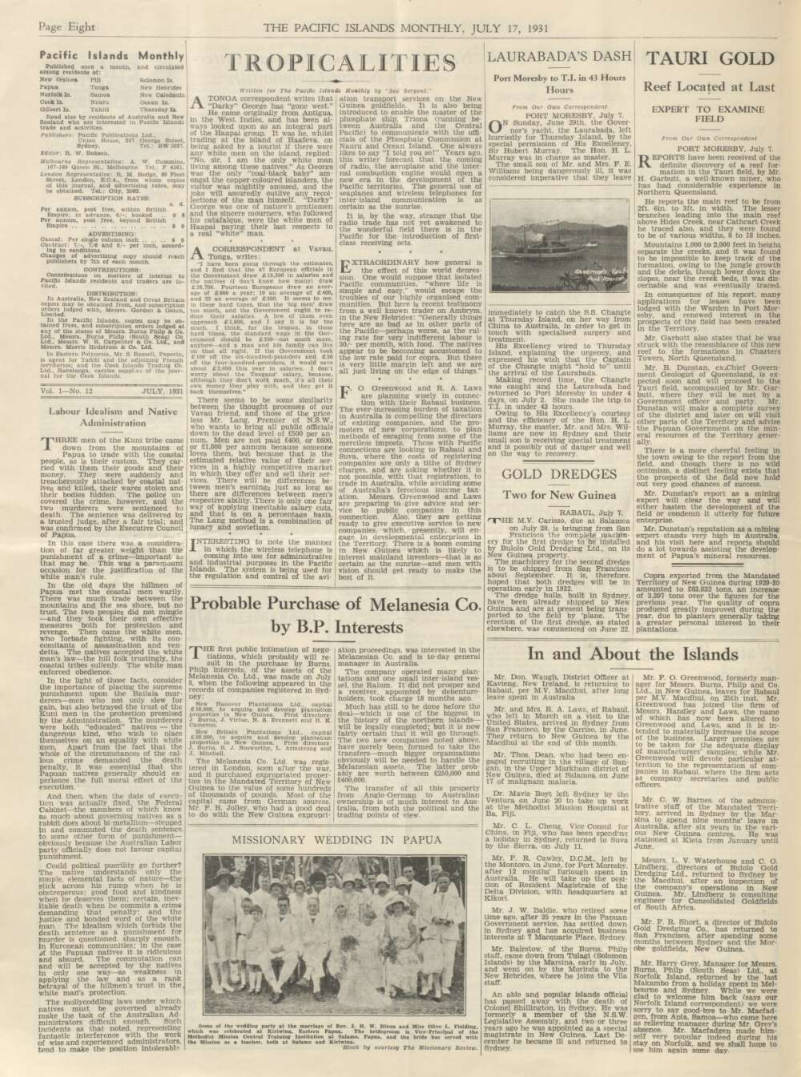
Published once a month, and circulated among residents of: New Guinea Fiji Solomon Is.
Papua Tonga New Hebrides Norfolk Is. Samoa New Caledonia Cook Is. Nauru Ocean Is.
Gilbert Is. Tahiti Thursday Is.
Read also by residents of Australia and New Zealand who are interested in Pacific Islands trade and activities.
Publishers: Pacific Publications Ltd., Union House, 247 George Street, Sydney. Tel.: BW 5037.
Editor: R. W. Robson.
Melbourne Representative: A. W. Cummins, 167-169 Queen St., Melbourne. Tel.; F 4161.
London Representative: R. M. Hodge, 80 Fleet Street, London, E.C.4., from whom copies of this journal, and advertising rates, may be obtained. Tel.: City, 2062.
Subscription Rates;
s. d.
Per annum, post free, within British Empire; in advance, 6/-; booked .. 6 6 Per annum, post free, beyond British Empire 8 0
Advertising:
Casual; Per single column inch 9 0 Contract: 7/-, 7/6 and 8/- per inch, accord ing to conditions.
Changes of advertising copy should reach publishers by 7th of each month.
Contributions:
Contributions on matters of interest to Pacific Islands residents and traders are in vited.
Distribution;
In Australia, New Zealand and Great Britain copies may be obtained from, and subscription orders lodged with, Messrs. Gordon & Gotch, Limited.
In the Pacific Islands, copies may be ob tained from, and subscription orders lodged at any of the stores of Messrs. Burns Philp & Co.
Ltd., Messrs. Burns Philp (South SeasJ Co Ltd., Messrs. W. R. Carpenter & Co. Ltd., and Messrs. Morris Hedstrom & Co. Ltd.
In Eastern Polynesia, Mr. S. Russell, Papeete, is agent for Tahiti and the adjoining French territories: and the Cook Islands Trading Co.
Ltd., Rarotonga, carries supplies of the jour nal for the Cook Islands.
Vol. 1—No. 12
July, 1931
punishment.
Labour Idealism and Native Administration
THREE men of the Kuni tribe came down from the mountains of Papua to trade with the coastal people, as is their custom. They car ried with them their goods and their money. They were suddenly and treacherously attacked by coastal nat ives and killed, their wares stolen and their bodies hidden. The police un covered the crime, however, and the two murderers were sentenced to death. The sentence was delivered by a trusted judge, after a fair trial; and was confirmed by the Executive Council of Papua.
In this case there was a considera tion of far greater weight than the punishment of a crime—important as that may be. This was a paramount occasion for the justification of the white man’s rule.
In the old days the hillmen of Papua met the coastal men warily.
There was much trade between the mountains and the sea shore, but no trust. The two peoples did not mingle —and they took their own effective measures both for protection and revenge. Then came the white men, who forbade fighting, with its con comitants of assassination and ven detta. The natives accepted the white man’s law —the hill folk trustingly, the coastal tribes sullenly. The white man enforced obedience.
In the light of those facts, consider the importance of placing the supreme punishment upon the Bailala mur derers—men who not only slew for gain, but also betrayed the trust of the Kuni men in the protection promised by the Administration. The murderers were both “educated” natives the dangerous kind, who wish to place themselves on an equality with white men. Apart from the fact that the whole of the circumstances of the cal lous crime demanded the death penalty, it was essential that the Papuan natives generally should ex perience the full moral effect of the execution.
And then, when the date of execu tion was actually fixed, the Federal Cabinet —the members of which know as much about governing natives as a rabbit does about bi-metallism —stepped in and commuted the death sentence, to some other form of punishment— obviously because the Australian Labor party officially does not favour capital
punishment.
Could political puerility go further?
The native understands only the simple, elemental facts of nature —the stick across his rump when he is obstreperous; good food and kindness when he deserves them; certain, inev itable death when be commits a crime demanding that penalty; and the justice and bonded word of the white man. The idealism which forbids the death sentence as a punishment for murder is questioned, sharply enough, in European communities; in the case of the Papuan natives it is ridiculous and absurd. The commutation can and will be accepted by the natives in only one way—as weakness in applying the law and as a rank betrayal of the hillmen’s trust in the white mail’s protection.
The mollycoddling laws under which natives must be governed already make the task of the Australian Ad ministrators difficult enough. Such incidents as that noted, representing fantastic interference with the work of wise and experienced administrators, tend to make the position intolerable
Tropicalities
Written for The Pacific Islands Monthly hy “Sea Serpent.”
A TONGA correspondent writes that “Darky” George has “gone west.”
He came originally from Antigua, in the West Indies, and has been al ways looked upon as an integral part of the Haapai group. It was he, whilst trading at the island of Haafeva, on being asked by a tourist if there were any white men on the island, replied: “No, sir, I am the only white man living among these natives.” As George was the only “coal-black baby” am ongst the copper-coloured islanders, the visitor was mightily amused, and the joke will assuredly outlive any recol lections of the man himself. “Darky”
George was one of nature’s gentlemen and the sincere mourners, who followed his catafalque, were the white men of Haapai paying their last respects to a real “white” man.
A Correspondent At Vavau,
Tonga, writes: “I have been going through the estimates, and I find that the 47 European officials in the Government draw £ 19,300 in salaries and the natives (I don’t know how many) draw £26,700. Fourteen Europeans draw an aver age of £600 a year; 10 an average of £400, and 23 an average of £300. It seems to me, in these hard times, that the ‘big men’ draw too much, and the Government ought to re duce their salaries. A few of them even approach £1,000, and I say it is far too much. I think, for the tropics, in these hard times, the standard wage in the Gov ernment should be £350—not much more, anyhow—and a man and his family can live on that all right. If the Government took £100 off the six-hundred-pounders and £50 off the four-hundred-pounders, it would save about £2,000 this year in salaries. I don’t worry about the Tongans’ salary, because, although they don’t work much, it’s all their own money they play with, and they get it back themselves.”
There seems to be some similarity between the thought processes of our Vavau friend, and those of the price less Mr. Lang, Premier of N.S.W., who wants to bring all public officials down to the dead level of £500 per an num. Men are not paid £400, or £600, or £1,000 per annum because someone loves them, but because that is the estimated relative value of their ser vices in a highly competitive market in which they offer and sell their ser vices. There wil be differences be tween men’s earnings just as long as there are differences between men’s respective ability. There is only one fair way of applying inevitable salary cuts, and that is on a percentage basis.
The Lang method is a combination of lunacy and sovietism. * * * INTERESTING to note the manner in which the wireless telephone is coming into use for administrative and industrial purposes in the Pacific Islands. The system is being used for the regulation and control of the avi
ation transport services on the New Guinea goldfields. It is also being introduced to enable the master of the phosphate ship, Triona (running be tween Australia and the Central Pacific) to communicate with the offi cials of the Phosphate Commission at Nauru and Ocean Island. One always likes to say “I told you so!” Years ago, this writer forecast that the coming of radio, the aeroplane and the inter nal combustion engine would open a new era in the development of the Pacific territories. The general use of seaplanes and wireless telephones for inter-island communication is as certain as the sunrise.
It is, by the way, strange that the radio trade has not yet awakened to the wonderful field there is in the Pacific for the introduction of first class receiving sets. * * * Extraordinary how general is the effect of this world depres sion. One would suppose that isolated Pacific communities, “where life is simple and easy,” would escape the troubles of our highly organised com munities. But here is recent testimony from a well known trader on Ambrym, in the New Hebrides: “Generally things here are as bad as in other parts of the Pacific —perhaps worse, as the rul ing rate for very indifferent labour is 30/- per month, with food. The natives appear to be becoming accustomed to the low rate paid for copra. But there is very little margin left and we are all just living on the edge of things.” * * * F. O. Greenwood and R. A. Laws are planning wisely in connec tion with their Rabaul business.
The ever-increasing burden of taxation in Australia is compelling the directors of existing companies, and the pro moters of new corporations, to plan methods of escaping from some of the merciless imposts. Those with Pacific connections are looking to Rabaul and Suva, where the costs of registering companies are only a tithe of Sydney charges, and are asking whether it is not possible, with that registration, to trade in Australia, while avoiding some of Australia’s ferocious income tax ation. Messrs. Greenwood and Laws are preparing to give advice and ser vice to public companies in this connection. Also, they are getting ready to give executive service to new companies, which, presently, will en gage in developmental enterprises in the Territory. There is a boom coming in New Guinea which is likely to interest mainland investors—that is as certain as the sunrise—and men with vision should get ready to make the best of it.
by B.P. Interests
Probable Purchase of Melanesia Co. by B.P. Interests
THE first public intimation of nego tiations, which probably will re sult in the purchase by Burns, Philp interests, of the assets of the Melanesia Co. Ltd., was made on July 8, when the following appeared in the records of companies registered in Syd ney: New Hanover Plantations Ltd., capital £50,000, to acquire and develop plantation properties in New Guinea. First directors: J Burns, J. Virtue, N. S. Evennett and H. K.
Cameron.
New Britain Plantations Ltd., capital £50,000, to acquire and develop plantation properties in New Guinea. First directors’
J. Burns, R. J. Nosworthy, L. Armstrong and J. Mitchell.
The Melanesia Co. Ltd. was regis tered in London, soon after the war, and it purchased expropriated proper ties in the Mandated Territory of New Guinea to the value of some hundreds of thousands of pounds. Most of the capital came from German sources.
Mr. F. R. Jolley, who had a good deal to do with the New Guinea expropri
ation proceedings, was interested in the Melanesian Co. and is to-day general manager in Australia.
The company operated many plan tations and one small inter-island ves sel, the Ralum. It did not prosper and a receiver, appointed by debenture holders, took charge 18 months ago.
Much has still to be done before the deal—which is one of the biggest in the history of the northern islands— will be legally completed; but it is now fairly certain that it will go through.
The two new companies noted above, have merely been formed to take the transfers—much bigger organisations obviously will be needed to handle the Melanesian assets. The latter prob ably are worth between £250,000 and £400,000.
The transfer of all this property from Anglo-German to Australian ownership is of much interest to Aus tralia, from both the political and the trading points of view.
Missionary Wedding In Papua
Some of the wedding party at the marriage of Rev. J. H. W. Dixon and Miss Olive L. Fielding, which was celebrated at Kiriwina, Eastern Papua. The bridegroom is Vice-Principal of the Methodist Mission Central Training Institution at Salamo, Papua, and the bride has served with the Mission as a teacher, both at Salamo and Kiriwina.
Block by courtesy The Missionary Review.
Laurabada’S Dash
Port Moresby to T.I. in 43 Hours Hours
From Our Own Correspondent
Port Moresby, July 7.
ON Sunday, June 29th, the Gover nor’s yacht, the Laurabada, left hurriedly for Thursday Island, by the special permission of His Excellency, Sir Hubert Murray. The Hon. H. L.
Murray was in charge as master.
The small son of Mr. and Mrs. F. E.
Williams being dangerously ill, it was considered imperative that they leave
immediately to catch the S.S. Changte at Thursday Island, on her way from China to Australia, in order to get in touch with specialised surgery and treatment.
His Excellency wired to Thursday Island, explaining the urgency, and expressed his wish that the Captain of the Changte might “hold to” until the arrival of the Laurabada.
Making record time, the Changte was caught and the Laurabada had returned to Port Moresby in under 4 days, on July 2. She made the trip to T.I. in under 43 hours.
Owing to His Excellency’s courtesy and the efficiency of the Hon. H. L.
Murray, the master, Mr. and Mrs. Wil liams are now in Sydney and their small son is receiving special treatment and is possibly out of danger and well on the way to recovery.
Gold Dredges
Two for New Guinea
Rabaul, July 7.
M.V. Carisso, due at Salamoa on July 20. is bringing from San Francisco the complete machin ery for the first dredge to be installed by Bulolo Gold Dredging Ltd., on its New Guinea property.
The machinery for the second dredge is to be shipped from San Francisco about September. It is, therefore, hoped that both dredges will be in operation early in 1932.
The dredge hulls, built in Sydney, have been already shipped to New Guinea and are at present being trans ported to the field by ’plane. The erection of the first dredge, as stated elsewhere, was commenced on June 22.
Tauri Gold
Reef Located at Last
Expert To Examine
Field
From Our Own Correspondent
Port Moresby, July 7.
REPORTS have been received of the definite discovery of a reef for mation in the Tauri field, by Mr.
H. Garbutt, a well-known miner, who has had considerable experience in Northern Queensland.
He reports the main reef to be from 2ft. 6in. to 3ft. in width. The lesser branches leading into the main reef above Hides Creek, near Cathcart Creek he traced also, and they were found to be of various widths, 8 to 18 inches.
Mountains 1,000 to 2,000 feet in height separate the creeks, and it was found to be impossible to keep track of the formation, owing to the jungle growth and the debris, though lower down the slopes, near the creek beds, it was dis cernable and was eventually traced.
In consequence of his report, many applications for leases have been lodged with the Warden in Port Mor esby, and renewed interest in the prospects of the field has been created in the Territory.
Mr. Garbutt also states that he was struck with the resemblance of this new reef to the formations in Charters Towers, North Queensland.
Mr. B. Dunstan, ex-Chief Govern ment Geologist of Queensland, is ex pected soon and will proceed to the Tauri field, accompanied by Mr. Gar butt, where they will be met by a Government officer and party. Mr.
Dunstan will make a complete survey of the district and later on will visit other parts of the Territory and advise the Papuan Government on the min eral resources of the Territory gener ally.
There is a more cheerful feeling in the town owing to the report from the field, and though there is no wild ontimism, a distinct feeling exists that the prospects of the field now hold out very good chances of success.
Mr. Dunstan’s report as a mining expert will clear the way and will either hasten the development of the field or condemn it utterly for future enterprise.
Mr. Dunstan’s reputation as a mining expert stands very high in Australia, and his visit here and reports should do a lot towards assisting the develop ment of Papua’s mineral resources.
Copra exported from the Mandated Territory of New Guinea during 1929-30 amounted to £63,832 tons, an increase of 3,397 tons over the figures for the previous year. The quality of copra produced greatly improved during the year, due to planters generally taking a greater personal interest in their plantations.
In and About the Islands
Mr. Don. Waugh, District Officer at Kavieng, New Ireland, is returning to Rabaul, per M.V. Macdhui, after long leave spent in Australia Mr. and Mrs. R. A. Laws, of Rabaul, who left in March on a visit to the United States, arrived in Sydney from San Francisco, by the Carriso, in June.
They return to New Guinea by the Macdhui at the end of this month.
Mr. Thos. Dean, who had been en gaged recruiting in the village of San gan, in the Upper Markham district of New Guinea, died at Salamoa on June 17 of malignant malaria.
Dr. Mavis Boyt left Sydney by the Ventura on June 20 to take up work at the Methodist Mission Hospital at Ba, Fiji.
Mr. C. L. Cheng, Vice Consul for China, in Fiji, who has been spending a holiday in Sydney, returned to Suva by the Sierra, on July 11.
Mr. F. R. Cawley, D.C.M., left by the Montoro, in June, for Port Moresby, after 12 months’ furlough spent in Australia. He will take up the posi tion of Resident Magistrate of the Delta Division, with headquarters at Kikori.
Mr. J. W. Baldie. who retired some time ago, after 25 years in the Papuan Government service, has settled down in Sydney and has acquired business interests at 7 Macquarie Place, Sydney.
Mr. Bairstow, of the Burns, Philp staff, came down from Tulagi (Solomon Islands) by the Marsina, early in July, and went on by the Morinda to the New Hebrides, where he joins the Vila staff.
An able and popular islands official has passed away with the death of Colonel Shillington, in Sydney. He was formerly a member of the N.S.W.
Legislative Assembly, and two or three years ago he was appointed as a special magistrate in New Guinea. Last De cember he became ill and returned to Sydney.
Mr. P. O. Greenwood, formerly man ager for Messrs. Burns, Philp and Co.
Ltd., in New Guinea, leaves for Rabaul per M.V. Macdhui, on 25th inst. Mr.
Greenwood has joined the firm of Messrs. Handley and Laws, the name of which has now been altered to Greenwood and Laws, and it is in tended to materially increase the scope of the business. Larger premises are to be taken for the adequate display of manufacturers’ samples; while Mr.
Greenwood will devote particular at tention to the representation of com panies in Rabaul, where the firm acts as company secretaries and public officers.
Mr. C. W. Barnes, of the adminis trative staff of the Mandated Terri tory, arrived in Sydney by the Mar sina to spend nine months’ leave in Australia, after six years in the vari ous New Guinea centres. He was stationed at Kieta from January until June.
Messrs. L. V. Waterhouse and C. O.
Lindberg, directors of Bulolo Gold Dredging Ltd., returned to Sydney by the Macdhui, after an inspection of the company’s operations in New Guinea. Mr. Lindberg is consulting engineer for Consolidated Goldfields of South Africa.
Mr. F. R. Short, a director of Bulolo Gold Dredging Co., has returned to San Francisco, after spending some months between Sydney and the Mor obe goldfields, New Guinea.
Mr. Harry Grey, Manager for Messrs.
Burns, Philp (South Seas) Ltd., at Norfolk Island, returned by the last Makambo from a holiday spent in Mel bourne and Sydney. While we were glad to welcome him back (says our Norfolk Island correspondent) we were sorry to say good-bye to Mr. Macfad gen, from Apia, Samoa—who came here as relieving manager during Mr. Grey’s absence. Mr. Macfadgen made him self very ponular indeed during his stay on Norfolk, and we shall hope to see him again some day.
Tin-Can Mail
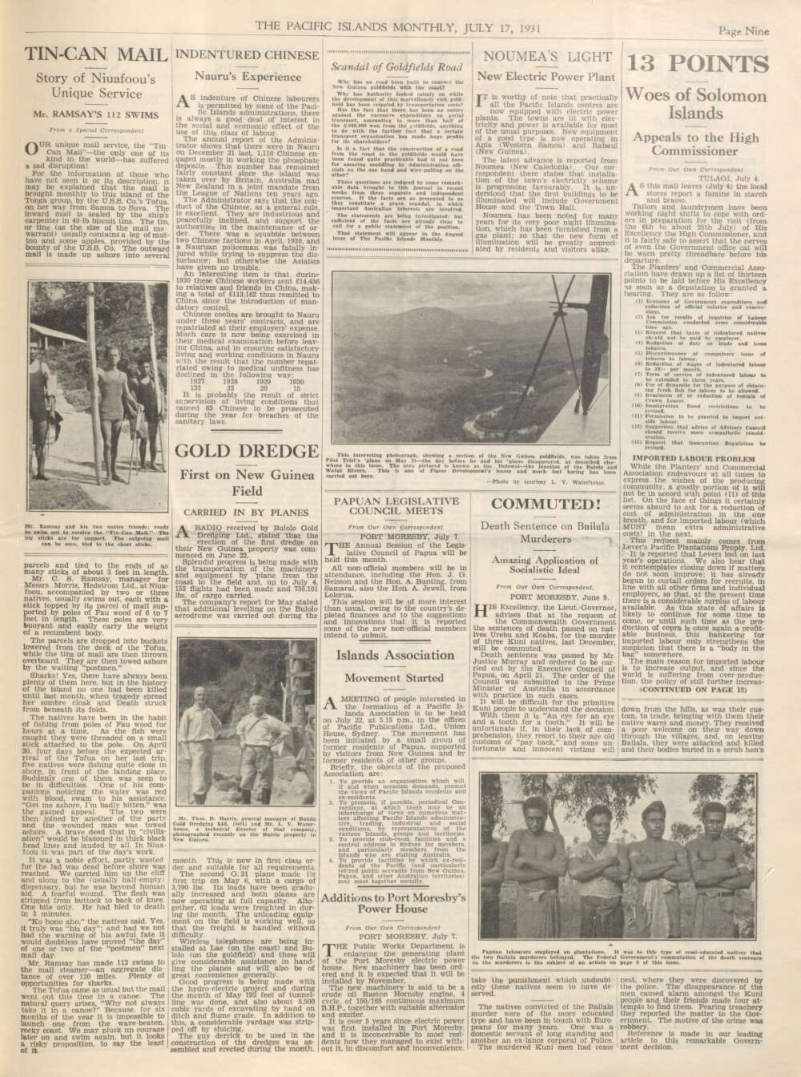
Story of Niuafoou’s Unique Service
Mr. Ramsay’S 112 Swims
From a Special Correspondent OUR unique mail service, the “Tin- Can Mail”—the only one of its kind in the world—has suffered a sad disruption!
For the information of those who have not seen it or its description, it may be explained that the mail is brought monthly to this island of the Tonga group, by the U.S.S. Co.’s Tofua, on her way from Samoa to Suva. The inward mail is sealed by the ship’s carpenter in 40-lb biscuit tins. The tin, or tins (as the size of the mail may warrant) usually contains a leg of mut ton and some apples, provided by the bounty of the U.S.S. Co. The outward mail is made up ashore into several
parcels and tied to the ends of as many sticks of about 3 feet in length.
Mr. C. S. Ramsay, manager for Messrs. Morris, Hedstrom Ltd., at Niua foou, accompanied by two or three natives, usually swims out, each with a stick topped by its parcel of mail sup ported by poles of Fau wood of 6 to 7 feet in length. These poles are very buoyant and easily carry the weight of a recumbent body.
The parcels are dropped into buckets lowered from the deck of the Tofua, while the tins of mail are then thrown overboard. They are then towed ashore by the waiting “postmen.”
Sharks! Yes, there have always been plenty of them here, but in the history of the island no one had been killed until last month, when tragedy spread her sombre cloak and Death struck from beneath its folds.
The natives have been in the habit of fishing from poles of Fau wood for hours at a time. As the fish were caught they were threaded on a small stick attached to the pole. On April 30, four days before the expected ar rival of the Tofua on her last trip, five natives were fishing quite close in shore, in front of the landing place.
Suddenly one of them was seen to be in difficulties. One of his com panions noticing the water was red with blood, swam to his assistance.
“Get me ashore, I’m badly bitten,” was the gasped appeal. The two were then joined by another of the party and the wounded man was towed ashore. A brave deed that in “civilis ation” would be blazoned in thick black head lines and lauded by all. In Niua foou it was part of the day’s work.
It was a noble effort, partly wasted for the lad was dead before shore was reached. We carried him up the cliff and along to the (usually half-empty) dispensary, but he was beyond human aid. A fearful wound. The flesh was stripped from buttock to back of knee.
One bite only. He had bled to death in 3 minutes.
“Ko hono aho,” the natives said. Yes, it truly was “his day”; and had we not had the warning of his awful fate it would doubtless have proved “the day” of one or two of the “postmen” next mail day.
Mr. Ramsay has made 112 swims to the mail steamer —an aggregate dis tance of over 120 miles. Plenty of opportunities for sharks.
The Tofua came as usual but the mail went out this time in a canoe. The natural query arises, “Why not always take it in a canoe?” Because, for six months of the year it is impossible to launch one from the wave-beaten, rocky coast. We may pluck up courage later on and swim again, but it looks a risky proposition, to say the least of it.
Mr. Ramsay and his two native friends; ready to swim out to receive the “Tin-Can Mail.’’ The big sticks are for support. The outgoing mail can be seen, tied to the short sticks.
Nauru’s Experience
Indentured Chinese
AS indenture of Chinese labourers is permitted by some of the Paci fic Islands administrations, there is always a good deal of interest in the social and economic effect of the use of this class of labour.
The annual report of the Adminis trator shows that there were in Nauru on December 31 last, 1,110 Chinese en gaged mostly in working the phosphate deposits. This number has remained fairly constant since the island was taken over by Britain, Australia nad New Zealand in a joint mandate from the League of Nations ten years ago.
The Administrator says that the con duct of the Chinese, as a general rule, is excellent. They are industrious and peacefully inclined, and support the authorities in the maintenance of or der. There was a squabble between two Chinese factions in April, 1930, and a Nauruan policeman was fatally in jured while trying to suppress the dis turbance; but otherwise the Asiatics have given no trouble.
An interesting item is that, during 1930 these Chinese workers sent £14,436 to relatives and friends in China, mak ing a total of £113,162 thus remitted to China since the introduction of man datory control.
Chinese coolies are brought to Nauru under three years’ contracts, and are repatriated at their employers’ expense.
Much care is now being exercised in their medical examination before leav ing China, and in ensuring satisfactory living and working conditions in Nauru with the result that the number repat riated owing to medical unfitness has declined in the following way: 1927 1928 1929 1930 131 33 20 15 It is probably the result of strict supervision of living conditions that caused 83 Chinese to be prosecuted during the year for breaches of the sanitary laws.
Gold Dredge
First on New Guinea Field
Carried In By Planes
A RADIO received by Bulolo Gold Dredgihg Ltd., stated that the erection of the first dredge on their New Guinea property was com menced on June 22.
Splendid progress is being made with the transportation of the machinery and equipment by ’plane from the coast to the field and, up to July 4, 153 flights had been made and 755,101 lbs. of cargo carried.
The company’s report for May stated that additional levelling on the Bulolo aerodrome was carried out during the
month. This is now in first class or der and suitable for all requirements.
The second G. 31 plane made its first trip on May 6, with a cargo of 3,790 lbs. Its loads have been gradu ally increased and both planes are now operating at full capacity. Alto gether, 62 loads were freighted in dur ing the month. The unloading equip ment on the field is working well, so that the freight is handled without difficulty.
Wireless telephones are being in stalled at Lae (on the coast) and Bu lolo (on the goldfield) and these will give considerable assistance in hand ling the planes and will also be of great convenience generally.
Good progress is being made with the hydro-electric project and during the month of May 192 feet of tunnel ling was done, and also about 5,500 cubic yards of excavating by hand on ditch and flume grade. In addition to this, a considerable yardage was strip ped off by sluicing.
The guy derrick to be used in the construction of the dredges was as sembled and erected during the month.
Mr. Thus. D. Harris, general manager of Bulolo Gold Dredging Ltd. (left) and Mr. L. V. Water house, a technical director of that company, photographed recently on the Bulolo property in New Guinea.
Scandal of Goldfields Road
Why has no road been built to connect the New Guinea goldfields with the coast?
Why has Authority looked calmly on while the development of this marvellously rich gold field has been crippled by transportation costs?
Has the fact that there has been no outcry against the excessive expenditure on aerial transport, amounting to more than half of the £900,000 won from the goldfields, anything to do with the further fact that a certain transport organisation has made huge profits for its shareholders?
Is it a fact that the construction of a road from the coast to the goldfields would have been found quite practicable had it not been for amazing muddling by Administration offi cials on the one hand and wire-pulling on the other?
These questions are induced by some remark able data brought to this journal in recent weeks from three separate and independent sources. If the facts are as presented to us they constitute a grave scandal, in which important Australian interests are involved.
The statements are being investigated: but sufficient of the facts are already clear to call for a public statement of the position.
That statement will appear in the August issue of The Pacific Islands Monthly.
Papuan Legislative
Council Meets
From Our Own Correspondent
Port Moresby, July 7.
THE Annual Session of the Legis lative Council of Papua will be held this month.
All non-official members will be in attendance, including the Hon. J. G.
Nelsson and the Hon. A. Bunting, from Samarai, also the Hon. A. Jewell, from Lolorua.
This session will be of more interest than usual, owing to the country’s de pleted finances and to the suggestions and innovations that it is reported some of the new non-official members intend to submit.
Islands Association
Movement Started
A MEETING of people interested in
the formation of a Pacific Is lands Association is to be held on July 22, at 5.15 p.m., in the offices
of Pacific Publications Ltd., Union
House, Sydney. The movement has been initiated by a small group of former residents of Papua, supported by visitors from New Guinea and by former residents of other groups.
Briefly, the objects of the proposed
Association are:
1. To provide an organisation which will, if and when occasion demands, present the views of Pacific Islands residents and ex-residents. 2. To promote, if possible, periodical Con ventions, at which there may be an interchange of views on numerous mat ters affecting Pacific Islands administra tive, trading, industrial and social conditions, by representatives of the various Islands, groups and territories. 3. To provide club-room facilities and a central address in Sydney for members, and particularly members from the Islands who are visiting Australia. 4. To provide facilities by which ex-resi dents of the Pacific land particularly retired public servants from New Guinea, Papua, and other Australian territories) may meet together socially.
Additions to Port Moresby’s
Power House
From Our Own Correspondent
Port Moresby, July 7.
THE Public Works Department is enlarging the generating plant of the Port Moresby electric power house. New machinery has been ord ered and it is expected that it will be installed by November.
The new machinery is said to be a crude oil Raston Hornsby engine, 4 cycle, of 150/165 continuous maximum 8.H.P., together with suitable alternator and exciter.
It is over 5 years since electric power was first installed in Port Moresby, and it is inconceivable to most resi dents how they managed to exist with out it, in discomfort and inconvenience.
Noumea’S Light
New Electric Power Plant
IT is worthy of note that practically all the Pacific Islands centres are now equipped with electric power plants. The towns are lit with elec tricity and power is available for most of the usual purposes. New equipment of a good type is now operating in Apia (Western Samoa) and Rabaul (New Guinea).
The latest advance is reported from Noumea (New Caledonia). Our cor respondent there states that installa tion of the town’s electricity scheme is progressing favourably, it is un derstood that the first buildings to be illuminated will include Government House and the Town Hall.
Noumea has been noted for many years for its very poor night illumina tion, which has been furnished from a gas plant; so that the new form of illumination will be greatly appreci ated by residents and visitors alike.
This interesting photograph, showing a section of the New Guinea goldfields, was taken from Pilot Trist’s ’plane on May 21—the day before he and his ’plane disappeared, as described else where in this issue. The area pictured is known as the Bulowat —the junction of the Bulolo and Watut Rivers. This is one of Placer Development’s leases and much test boring has been carried out here. —Photo by courtesy L. V. Waterhouse.
Commuted!
Death Sentence on Bailala Murderers Amazing Application of Socialistic Ideal
From Our Own Correspondent.
Port Moresby, June 9.
HIS Excellency, the Lieut.-Governor, advises that at the request of the Commonwealth Government the sentences of death passed on nat ives Urebu and Koaba, for the murder of three Kuni natives, last December, will be commuted.
Death sentence was passed by Mr.
Justice Murray and ordered to be car ried out by the Executive Council of Papua, on April 21. The order of the Council was submitted to the Prime Minister of Australia in accordance with practice in such cases.
It will be difficult for the primitive Kuni people to understand the decision.
With them it is “An eye for an eye and a tooth for a tooth.” It will be unfortunate if, in their lack of com prehension, they resort to their age old customs of “pay back,” and some un fortunate and innocent victims will
down from the hills, as was their cus tom, to trade, bringing with them their native wares and money. They received a poor welcome on their way down through the villages, and, on leaving Bailala, they were attacked and killed and their bodies buried in a scrub hen's
take the punishment which undoubt edly these natives seem to have de served.
The natives convicted of the Bailala murder were of the more educated type and have been in touch with Euro peans for many years. One was a domestic servant of long standing and another an ex-lance corporal of Police, The murdered Kuni men had come
nest, where they were discovered by the police. The disappearance of the men caused alarm amongst the Kuni people and their friends made four at tempts to find them. Fearing treachery they reported the matter to the Gov ernment. The motive of the crime was robbery.
Reference is made in our leading article to this remarkable Govern ment decision.
Papuan labourers employed on plantations. It was to this type of semi-educated natives that the two Bailala murderers belonged. The Federal Government’s commutation of the death sentence on the murderers is the subject of an article on page 8 of this issue.
13 Points

Woes of Solomon Islands Appeals to the High Commissioner
From Our Own Correspondent
Tulagi, July 4.
AS this mail leaves (July 4) the local stores report a famine in starch and brasso.
Tailors and laundrymen have been working night shifts to cope with ord ers in preparation for the visit (from the 6th to about 25th July) of His Excellency the High Commissioner, and it is fairly safe to assert that the nerves of even the Government office cat will be worn pretty threadbare before his departure.
The Planters’ and Commercial Asso ciation have drawn up a list of thirteen points to be laid before His Excellency as soon as a deputation is granted a hearing. They are as follow: (1) Economy of Government expenditure and reduction of official salaries and conces sions. (2) Ask for results of inquiries of Labour Commission conducted some considerable time ago. (3) Request that taxes of indentured natives should not be paid by employer. (4) Reduction of duty on trade and issue tobacco. (5) Discontinuance of compulsory issue of tobacco to labour. (6) Reduction of wages of indentured labour to 10/- per month. (7) Term of service of indentured labour to be extended to three years. (8) Use of dynamite for the purpose of obtain ing fresh fish for labour to be allowed. (9) Remission of or reduction of rentals of Crown Leases. (10) Immigration Bond restrictions to be revised. (11) Permission to be granted to import out side labour. (12) Suggestion that advice of Advisory Council should receive more sympathetic consid eration. (13) Request that Quarantine Regulation be revised.
Imported Labour Problem
While the Planters’ and Commercial Association endeavours at all times to express the wishes of the producing community, a goodly portion of it will not be in accord with point (11) of this list. On the face of things it certainly seems absurd to ask for a reduction of cost of administration in the one breath, and for imported labour (which MUST mean extra administrative costs) in the next.
This request mainly comes from Lever’s Pacific Plantations Propty. Ltd.
It is reported that Levers lost on last year’s operations. We also hear that it contemplates closing down if matters do not soon improve: it has already begun to curtail orders for recruits, in line with all other firms and individual employers, so that, at the present time there is a considerable surplus of labour available. As this state of affairs is likely to continue for some time to come, or until such time as the pro duction of copra is once again a profit able business, this hankering for imported labour only strengthens the suspicion that there is a “body in the bag” somewhere.
The main reason for imported labour is to increase output, and since the world is suffering from over-produc tion, the policy of still further increas
(Continued On Page 12)
ing the supply looks foolish. It is little short of a certainty that imported labour will increase the cost of pro duction to those employing it; and, in a lesser measure, all others by way of extra administrative costs. Why then bother about it until absolutely neces sary?
Point (1) in the list will at least find universal backing outside Government circles. While planters and traders have been reduced to a state of bank ruptcy or are drifting closer to it every day, and their employees (with perhaps the exception of Levers) have had to bear reduction and retrench ment, Government officials (in the words of one of them) “are really bet ter off now than they were in boom times, insofar as the cost of living has been somewhat reduced.”
It goes without saying that if the producer has to go out of business, the Government personnel will automatic ally be reduced to “One man and a dog,” as it was in the days before pro duction started; and, as it is plain that the world is not going to get over a 40 years’ drunk after a 24 hours’ head ache, the sooner reduction and re trenchment is brought about the better.
Reducing Native Wages
Point (6) howls for the relief of a staggering industry. Some few years ago the wage was increased from 10/to £1 per month, and a return to 10/would entail little or no hardship inso far as the labourer is “all found” and the extra 10/- mostly goes in gambling or some other luxury which he can well do without.
Natives are already complaining that if they are paid-off and are unable to find further employment, they will not be able to pay their taxes, which is quite a reasonable assertion, and one that the Government will soon be com pelled to sit up and take notice of.
Very few firms or individual planters are fortunate enough to be able to go on indefinitely producing copra at a loss, as they are doing at present, and although it is the policy of the finan cing firms to keep the wheels of industry turning, there must come a time when clients must be asked to reduce their accounts or take the con sequences.
Anyhow you look at it, both labourer and producer are on a very sticky wicket, and any assistance that can possibly be given should be passed along without delay.
A Plea For Mercy
Here let me say that Islanders gen erally are of the opinion that the financing firms could, if they wished, ease the situation somewhat. Pacts and figures (or balance-sheets) sug gest that they have not suffered nearly so much as the producer, and as the producer is their life-blood —their meal ticket, so to speak—it is not unreason able of him to expect a little more consideration.
Commodity prices and interest charges could easily be pared, to say nothing of freights and fares. It hits the Islander clean below the belt to be charged £18 for a seven days’ trip to or from Sydney, while the tourist gets a whole round-trip of about 31 days for £41. It completes the knock out when he learns that both Govern ment officials and Lever’s employees get concessions in fares.
The anomaly of the whole business is that the unfortunate producer, who is not financial, is asked to pay a higher rate for the purpose of enabling those who are to obtain cheaner fares Surely the justice of this point of view must soon be borne upon the minds of those responsible, when steps will be taken that will go far to create a better feeling between the parties con cerned than exists at the present time
Quarantine Restrictions
Point (13) touches mostly on the rhinoceros beetle scare, which has sud denly begun to worry the authorities Quite recently a shipment of house hold furniture and effects from Rabaul was refused admittance at Tulagi and it had to be transhipped back again to be fumigated. We now hear that Rabaul has no means of doing this and that our own particular species of beetle is far more destructive than their own anyhow (though it is cer tain that ours does very little damage) so it looks as though the unfortunate person who owns the furniture is faced with considerable loss. It is on the cards that he will have to sell it in Rabaul at any old price at all and then import a new lot from Sydney; but perhaps ere that eventuates there will be anew set of fumigation regulations out against Langism. or some other such pest, and he will be exposed to further loss.
A copra tramp, coming from ports where the destructive type of beetle resides, may enter and load in day light: but before sundown she must “up anchor” and put to sea. What evidence there is to prove that Mr.
Beetle could not possibly get ashore in daylight has yet to be put forward; but, as such a restriction will effect ively bar any boat from coming here from such ports, on the score of im practicability, the regulation might just as well have been so worded in the first instance. The whole thing will most likely mean increased freights overseas.
While on the subject of regulations, anew Poll Tax of £1 per head, per
annum, on whites and Chinamen has been inflicted. Also, where 10/- for one or more guns has been charged, we now pay a licence of 10/- per gun.
Other niggling little enactments have also been unearthed.
It is bewildering to try and follow the line of reasoning which bids that, when one might reasonably expect some relaxation in these matters to meet the frightful existing state of affairs, the opposite is the fact. It has been often enough said that “A fool defends himself at law,” and it can be said with equal truth that “An ignor amus sticks to the letter of it.” Let me hasten to add that the blame is not entirely confined to the Solomons.
Sorrowful islanders are unanimously hoping that the visit of His Excellency who will be able to gain first-hand information, will result in a straight ening out of most, if not all, these points.
Papuan News
Drop in Revenue —Prospectors Persevere with Tauri Field —Gold Return from Misima Mine
From Our Own Correspondent
Port Moresby, June 9.
PAPUAN finances are in line with what seems to be the general con dition of the world of to-day—a shortage of money.
The Treasury statements for the nine months ended on March 31 con tinue to show a decrease in receipts.
Customs returns show the greatest fall, a drop of £14,588 as compared with the same period for last year.
Other decreases include port and wharfage dues, mining, native labour fees and sale of produce.
Expenditure for the nine months is down £12,289, as compared with the corresponding period of the previous year.
As regards exports, copra is at its lowest price, £10/17/6 in London, and rubber has varied within the last months from 2 13/16d. to the present price of 3 1/8d. per lb.
Coffee is being sold locally and is taking the place of imported coffee, if not within the Territory, at least in
Port Moresby itself to quite a con siderable extent.
Stores Attempting To
Regain Trade.
One of the principal stores in Port Moresby is advertising important re ductions in the price of foodstuffs, and the announcement is welcomed by many residents, who have been for long forced to endure the inconveni ence of ordering their goods for direct shipment from Sydney and of handl ing and clearing them on arrival.
It is to be hoped, for the good of the Territory, that the local store will be successful in its endeavour to re gain the larger volume of business which has been diverted to Sydney during the last two years; but the task will not be simple, as there is also a project on foot to form an agency for the purpose of indenting monthly shipments from South, clear ing the goods and delivering them to local buyers for a small commission and fixed terms for payment.
However, both are innovations and will be welcome to the average eco nomical householder, who, for a long time, has rebelled against the high prices in Port Moresby.
Mining Activity.
The Tauri and Tiveri field, in the old Lakekamu bounds, still holds no promise to prospectors and miners.
The Mahony’s Gold Syndicate, a party of young men, are still trying their luck, and from a report lately received, though they have no results, they intend prospecting new country.
They have found the natives friendly on the whole, but, owing to the nat ure of the country, they had rough treking, and food supplies are run ning short.
Mr. Whitbourne, one of the pros pectors, concludes his report that he hopes later to have the pleasure of re porting a good find, as the new coun try looks good and there are great chances of finding something in that district.
In the report of the new Misima Gold Mine for the month of April, 370 tons of ore were put through the mill —430 tons of sand and 140 of slime, also 500 tons of crude ore were treat ed, making a total of 1,070 tons hand led. for gold bullion valued at £979/7/3.
In addition five bars of silver bullion accumulated were shipped, valued ap proximately at £58.
The prospects of silver lead, beyond Yule Island, on the Ononge Road, have held no promise and up to date there have been no further negotia tions in that direction.
Mail Contract Arrange
Ments.
The residents of Port Moresby were pleased to learn that the Common wealth Government had definitely de cided against the proposal of the con tractors of a combined shipping ser vice between Australia, Papua and New Guinea. m Burns, Philp now advise that, fol lowing the present trip of the S.S.
Morinda, the suggested timetable for the monthly service to Papua provides for the Montoro to do one trip, fol lowed thereafter by the Mataram, leaving Sydney on July 22nd.
There will be many here who will be sorry to see the last of the Mor inda, which weathered many a cyclone and storm that might easily have foun dered a more luxurious vessel.
Record Copra Shipment.
Besides the Morinda, the Le Maire and the Inverbank visited this port last month. The Le Maire, of the Royal Dutch Packet, was on her usual threemonthly visit, and the Inverbank, a vessel of 5,000 tons, came for the pur baas of copra (1.026 tons), the largest of Burns, Philp, for European pouts.
The Inverbank took from here 14,733 bags of copra (1,026 tons), the largest single shipment of copra ever loaded from this port.
Personal Items.
His Excellency Sir Hubert Murray, the Lieutenant-Governor, does not in tend visiting England, as was previous ly announced, to attend as the repre sentative of the Australian Association, the Centenary Meeting of the British Association for the Advancement of Science to be held in London in Sep tember next.
His Honour Mr. Justice Gore re turned from leave by this Morinda.
The Hon. A. P. and Mrs. Lyons, who were on short leave from the Territory, also returned. Mr. Lyons has taken over his duties as Director of Public Works. In his absence he was relieved by Mr. G. M. Turnbull, the Govern ment Architect.
Among the passengers from South by this Morinda were the Hon. A. H.
Bunting. Mr. Tom Nevitt, Mr. Lewis Lett and Mr. A. J. Vogan, the well known archaeologist, who is visiting Papua and the Trobriands in the in terests of his studies and writings.
Resentful
Natives
Boycotting the Trader
Effect Of Copra
Slump
Written for The Pacific Islands Monthly hy Gordon Thomas “The quantity of copra exported was 4,850 tons less than in 1927-1928. The decrease was due mainly to the fact that the quantity of trade copra offered by the natives was consid erably less than in the previous year. The price of copra fell during the year; and the natives were disinclined to sell their produce at the reduced price that was offered to them.”
THUS the wording of paragraph 203 in the Annual Report of the Mandated Territory of New Guinea for 1928-29. And, although the report for the following period has not yet been put into public circulation, the betting is a pound to a peanut that a further decrease in trade copra will be reported for that period for, in the Buka district alone, there are scores of native-owned coconut groves from which not a pound of copra is, or has been, produced for the past nine months.
The reason is apparent. When copra prices ranged from £12 to £15 per ton on the beach, competition was so keen amongst the traders that absurdly high prices were paid to the native produc ers; as high, in seme cases, as 10-121b. of smoke-dried copra for 1/-. The mar gin of profit was negligible, the argu ment being that a one-way profit on turnover of goods was sufficient, and that copra shipments must be made to satisfy the big firms.
The Puzzled Natives.
Came the depression, however, with the drop in copra and the increased price on trade lines; such as 5/10 per lb. for trade tobacco that used to be 5/3, which naturally compelled the trader to reduce his buying price from the native. Such things as world de pression, over-production and under consumption are merely figures of speech, past the comprehension of the stolid and one-time affluent Buka. He can put but one construction on the decreased value of his product and that is: The white man has launched an intensive campaign of exploitation; and no argument or explanation by the trader will induce him to think otherwise.
The result is that in his determina tion to avoid “exploitation” he has re fused to make copra; allowing the nuts to mature on the ground where they fall; planting up small areas of native tobacco as a substitute for the trade article and depending on “casual lab our” payments and the wages from “time-finished” labourers to furnish him with the few necessities of life.
And it is surprising how few these “necessities” can be amongst natives whom Nature has so generously en dowed.
From an agricultural point of view the situation presents the danger of the neighbouring European plantations becoming infested with pests and dis eases, which are allowed to develop in the native groves ad lib.
Should The Administration
Explain?
From an economic viewpoint it is altogether disastrous, both for the Ad ministration and the individual plan ter and trader. For the former, it means a considerable decrease in re venue from export duties, and also in the revenue derived from trading licences. For the latter, it is a direct loss of revenue which, in many cases, spells ruin, where the individual’s activities are alone confined to trad ing. It curtails his purchasing power for trade goods and that, incidentally reflects a decrease in the turnover arid the imports of the larger firms.
What better step, therefore, could the Administration take than to ex plain the existence of the world depres sion to the natives, through its district and patrol officers, and the need for co-operation amongst all sections of the community in order that the effects of this world depression may be combated as much as possible?
Such a step surely could not be in terpreted, by even the most conscien tious member of the Permanent Man dates Commission, as being a desecra tion of the “sacred trust” towards “peoples not yet able by themselves to stand under the strenuous condi tions of the modern world.” Rather would it be putting into practice the
ultimate paragraph of Article 2 of the Terms of Mandate by promoting “to the utmost the material and moral well-being and social progress of the inhabitants of the territory.”
Copra
Storing Coco
Nuts
“Beautiful’’ Quality of Copra
But Too Expensive
A subscriber in Samarai, Papua, has written to us as follows; “If coconuts are husked and stacked in sheds, away from light and rain, will they eventually turn into copra, after a period of 4 months or longer?
“It is said that, in Tonga and New Caledonia, coconuts have been stacked for many months, at times, in native built houses, and, alter a period, they can be shelled and the meat is as good as sun-dried or Chulla-dried copra, and almost ready to bag for export. Such copra is said to be far superior to that produced from other methods of dry ing.
“I would be obliged if your paper could gather any information in the matter, as same will be of great help to the coconut-growers at present, ow ing to the low figure offering for copra in the Islands.”
A representative of P.I.M. referred this inquiry to a copra-producer, with many years’ experience in the Pacific, who controls many plantations. He replied as follows: It is possible to make copra in the way described. I have seen it made by this method in the Gilbert and Ellice Islands, where the nuts are husked and then stacked in houses. After some months the moisture in the nuts evaporates and the meat turns into a beautiful quality of copra. But it would be almost impracticable to adopt such a method on the large plantations, because of the heavy expense involved in husking and stacking, with no pros pect of an eatrly return. I cannot say just how manv months it takes to make copra by this method.
Advertisements & other items, p. 10 (2 items)
William Cooper & Nephews (Australia)
BEING SPECIALISTS IN THE
SUPPLY OF
MOTOR ACCESSORIES
MOTOR ENGINEERING
REQUISITES
and
GARAGE TOOLS
We will welcome any enquiries from
ISLAND BUYERS.
SMITH, SONS & REES
LIMITED
30-32 WENTWORTH AVE., SYDNEY
Cable Address: "Speedomet,” Sydney.
Ships’ Barometers.
E. Esdaile & Sons
Schutz Binoculars: 8 magnification; exceptionally large field, suitable for field and marine, £9.
Meteorological Instruments, Baromet ers, Rain Gauges, etc., Ships’ Clocks, Compasses, Logs, Marine and Field Glasses. Repairs of all descriptions.
Opticians and Scientific Instrument Makers for over 40 years
42 HUNTER ST., SYDNEY
Write for Catalogue
What Are Your Needs?
We have the following high
grade products, carrying the
reputation of this old-established English Firm: —
POWDER SHEEP DIP.—
For the destruction parasites on sheep. of external rATTT T 7 DTP For die destruction of Cattle Ticks. Also for Lice and Mange on Cattle and Horses.
MILK OIL FLUID.—
For general disinfection of Shins, Launches, etc. premises,
HEALING OIL.—
For the antiseptic treatment of cuts, wounds, etc. on humans and animals.
ARSINETTE.—
For the destruction of all leaf-eating insects infesting trees and plants.
KATAKILLA.—
For the destruction of all sucking insects infesting trees and plants.
ALBOLEUM.—
For the destruction of all Scale insects infesting trees and plants.
A non-poisonous dusting Powder for the destruction PUL VEX.— of Fleas, Lice and other parasites on Dogs, Cats, Poultry, etc.
KUR-MANGE.—
For curing parasitic Mange and Skin diseases in Dogs, Horses, etc.
FLY KILLER.— For killing House Flies and Mosquitos.
For removing and preventing rust, BOILER COMPOUND.— scale and corrosion in boiler pipes, etc.
Enquiries In respect o£ the above are Invited from Planters, Cattle Owners, Storekeepers and all Island Residents.
William Cooper & Nephews (Australia)
Limited
4 O’CONNELL STREET - • SYDNEY
Mcilrath’S Ltd.
SIMPLEX
You need this quick Fire Extinguisher when away from Fire Brigades. You must depend on chemicals. They are more potent than water, yet non-damaging.
The "SIMPLEX” is just one of our port able chemical extinguishers which are recom mended for your conditions. They are all guaranteed to pass all requirements and are used throughout by the Australian Govern ment.
Send for a "Simplex” now and let us then post you full details to suit your own conditions.
Wormald Bros. Ltd.
Young Street, Waterloo,
Sydney
FIRE
EXTINGUISHERS
Established 1889.
McILRATH’S Ltd.
EXPORTERS OF GROCERIES, PROVISIONS AND
GENERAL STORES
“OUR PRICES GIVE EXTRA POCKET HELP”
Write for Export Price List and Quotations Ma|T I! A IPV&’S - 202 PITT STREET .
SYDNEY. AUSTRALIA
Conditions In Tonga
Residents Challenge Our Correspondent’s Views
THE following two letters have been received from readers in Tonga and follow up those previously written by them—published in the November issue and our correspondent’s reply, which appeared in the February number
To the Editor.
Sir, —It was not my intention to follow up my letter which appeared In your issue of November 20, but several of the remarks in your correspondent’s article, published in the issue of February 20, compel me to do so.
He states I apparently want him to classify and tabulate such things as duties, etc. I want nothing of the sort. But why does he have a cheap jibe at the Government Printer at the way the Government Gazette is bound, when it is done in a manner comparable favourably with this class of document pub lished elsewhere.
He takes exception to my inference that the Kingdom is not prosperous and he states there is no unemployment. The Kingdom may be prosperous from his point of view, but as to unemployment, although there are no Europeans unemployed the place is full of natives seeking work.
Your correspondent states I make a sweep ing and aggravating statement that hun dreds of taxpayers do not possess land. Non sense. I do not wish to refer to native mechanics or taxi drivers for information on this point. My authority for making the statement is the Queen’s speech at the opening of Parliament last year, at which time it was well known there were considerably over 1,000 taxpayers not only without land but were dependent upon their friends and rela tions for their tax money and indeed for their very existence. And does not your cor respondent know there are new applications for land every year. I am aware there is plenty of land, but is it available? The Gov ernment controls a portion only. Probably a revision of the entire land system is re quired.
I am not a seer, therefore cannot prophesy future values of copra, but in view of the world’s supply of edible oils an increase is unlikely. I have been watching those bananas grow and I find they are not doing too well.
It is pleasing to learn that at least one newspaper correspondent appreciates the good work the Missions are doing, but basing his estimate of present day contributions to the Missions on an incident which happened 54 years back, leads me to the opinion his refer ence to Sir Charles Mitchell’s report, Issued in 1887, was for some other purpose. I state and I am prepared to settle the point in a sportsman’s way, that in not one year of the past six years have the Missions received in the aggregate contributions to the sum of £20,000, let alone the £30,000 sug gested. Further, contributions are voluntary and one is not prosecuted if he fails to contribute.
Is the Tongan just taxed, or overtaxed?
Your correspondent states the income of a nation seems to elude all attempts at meas urement. Tongan conditions do not place any difficulty in arriving at a fairly accurate figure. Beyond the salaries he receives from his Government and earnings from European traders and a small sum he reeeives for rents of land, the Tongan’s income is derived from copra, and with few exceptions he does not receive one penny piece over and above what he gets from his land.
The statement in your correspondent’s art icle, notwithstanding the swollen receipts, shows the native pays to his Government 25 per cent, of his income. Is not this figure high?
Some months back a local controversy took place regarding the iniquitous copra export tax of 20/- per ton. Competent authorities asserted the tax was borne by the native.
Your correspondent, summarising his article on the question in your issue of December 16 last said “And now we have the position clearly defined. It is the poor buyer and not old ‘Dummy’ who is swelling the Government
coffers to the extent of £16,000 per annum.”
In his article in your issue of February 20 he admits the native does pay it. These Yes-No statements tend to throw suspicions on a correspondent’s bona-fides.
Mr. Editor, with your permission I will endeavour to give your readers the true posi tion of the Tongan to-day, as regards pay ments to his Government. Figures for 1926- 1929 are useless in view of the financial position of to-day. I will base my value of copra on the price paid on Tongatabu—I am not concerned with “beach” figures, as every one knows the native at outlying Islands does not get “beach” prices, for instance, to-day’s figure at Niuas is 50/- per ton less than “beach” prices—and refer to Treasurer’s fig ures, as far as I am able, other figures I will base on careful and liberal computations.
The position is:
About 24 per cent, of his income.
Of the imports, nine-tenths are consumed by the native, and on which he pays the Government, through the trader, a further 12½ per cent., making in all 36½ per cent, of his income the Government gets. A small percentage may be allowed for unsold im ports.
The London Nineteenth Century Review, of June, 1930, says: “The Chancellor of the Exchequer, Mr.
Snowden, broadcasted, ‘The people of Great Britain are the most heavily taxed in the world.’ ”
The same journal, commenting upon the British budget, says: “Before the war it was estimated that the part of the national in come taken in taxation was 11 per cent.; at the present time it is variously estimated at 20 to 25 per cent.’’
I trust your correspondent will not feel embarrassed on reading the above, and also that he will file and docket the figures as Exhibit 3, as presumably he has docketed his own as Exhibit 2.
“Intensive Cultivation.”
Is your correspondent serious, or does he mean, “extensive cultivation.”.. Of the 30 in habited islands of the group, comprising 138,000 acres of good, bad and indifferent land 18 of a total area of 8,747 acres maintain a population of 5,151 people. (Government fig ures) .
Apparently there is some cultivation going on of which your correspondent does not know of. However, the Government have a highly paid Agricultural Department whose function is to attend to this matter.
Your correspondent suggests that if the native will not take up land the Govern ment should be persuaded to grant better facilities to Europeans to obtain leases, etc.
What better facilities could they obtain than those enjoyed by present European holders who, almost without exception, are willing to dispose of their holdings at any figure almost.
Has experience not taught your corres pondent that “railing” at Governments, who after all are the servants of the people, is the only way people desiring a betterment of their condition can obtain redress.
The trading community of Tonga, through their Chamber of Commerce, are doing their
bit towards giving the native real service, as is evidenced by the resolution recently passed by that body relative to Government expenditure.
The glowing reports of the prosperity of Tonga, made from time to time, may attract readers to consider an idea of migrating to these parts. My advice to them is to “hasten slowly” and make other and fuller enquiries before arriving at a decision.
I am, etc..
Ikai Kaka.
To the Editor.
Sir, A cheering apophthegm states that “Those who are dissatisfied are the sole benefactors of the world.”
The question between your correspondent and the writer is not whether an individual Tongan is satisfied with his lot, or the felicity of his conjugal relations, and mean derings into irrelevant matters must be re garded as camouflage Indulged in for the purpose of confusing the real issue.
Why I imagined that intelligent readers would infer the only logical and possible inference from what your correspondent wrote was, because I believe your readers are really intelligent, and could not possibly infer other wise. As the inference is disclaimed we must agree to leave the matter to the opinion of your intelligent readers.
Unemployment implies Industrialism. The statement that “Tonga is definitely one of the very few countries in the world at the present time that has no unemployment” only invites ridicule. Tonga is not and cannot possibly become an industrial country. In common with other South Sea Islanders, Tongans are practically without exception self-employing, and the word unemployment is a misnomer. There is nothing singular or unique in Tonga’s position, the Pacific and Indian Oceans are studded with countries many of whose inhabitants reach into mil lions, equally as fortunate as Tonga in having no unemployed, and far more so that they have escaped the spoliation which built up the £ 140,000 —the much vaunted surplus—the bane of Tonga, an Insuperable barrier to any suggestion of Government economy.
Your correspondent insists upon the pros perity of the Kingdom. Paradoxical as it may seem, there are more unemployed than at any previous time in the Kingdom’s history—that they might be employed on their own “abi” or that of someone else, is ad mitted, but the stern fact is that they are asking daily for work, if only for a few days.
And in direct contradiction to the insistence that Tonga Is prosperous is the fact that at the present time nearly a half of the king dom’s inhabitants are subsisting on Govern ment rations. As showing the progressive ness of the country we are told that copra exports for 1928-29 far exceed 1926-27. The fact that the two former years were intensely drought-stricken was discreetly withheld.
Mission Collections
I trust that the custodians of the particular Mission will fully appreciate the faint praise which prefaces the “Ad captandum” refer ence to happenings over half a century ago.
I cannot be accused of holding a brief for Missions, either in the abstract or for any particular type. In my opinion Tonga is intensely Church-and-Priest ridden, but “Let justice be done, though the heavens fall.”
The Church is poor, voluntary, intensely national and popular, and is surely entitled to such voluntary offerings as the Tongans gladly give. Now for my considered opinion on Church collections, at the present time and for the past several years, they have not exceeded the half of your correspondent’s estimate.
Picture Shows
There are four picture shows in the King dom and I am able to certify that last year’s returns for one of them only just reaches £30 per month gross, a liberal estimate for the premier show would be double that sum. To the best of my belief one has been closed for some time past, owing to hard times, and at the fourth it is only possible to obtain an audience when a brutal and degrading fight is staged. I unhesitatingly affirm that the whole four do not obtain more than one fourth of the sum estimated. I am quite disinterested and have not been to a show for the past five years.
There is no “extraordinary coincidence” in the figures showing that “the average tax payer seems to pull in £55 a year.” It would be very “extraordinary” if they did not seem to show this result. Serious dis agreement has already been shown with two of the conjectural estimates. European rent als are open to the same charge of over estimation, but your readers will be able to assess the value of the remaining figures for themselves.
“Intensive Cultivation”
May I ask what precisely is meant by this catch-phrase? I am fairly acquainted, theor etically, with the methods employed by French gardeners, who use 80 tons of manure per acre, but intensive cultivation in the South Seas is bizarre in the extreme. If we tried to make two coconut trees grow where only one grew before, would be to invite prosecution for the intensive cultivator. If there is available data relating to any commercial commodity—which would prove remunerative —adaptable to Intensive cultivation in Tonga, why not disseminate it?
The slogan “Grow More Wheat,” has been a materially contributing factor in producing the present Australian situation. I think it would be wise to eschew slogans. If there are possibilities in this direction why should the trading community be advised to “im press the Government?” Have they met with sufficient rebuffs from this source in the past and, any way, what is the Agricultural De partment doing?
Watch These Bananas Grow
This would be a very relevant observation now, but at the time it was penned “watch them die” would have been far less ironical.
At that time the poor devils who are trying to grow them were at great expense carting water in order to keep them alive. Growing bananas is not all beer and skittles. Are you, Mr. Correspondent, doing anything to help a cargo of bananas to materialise?
The value of your correspondent’s articles can be best appraised by those resident here, and my efforts constitute an honest attempt to exhibit the other side of the shield.
“You write,” said a popular novelist of the Victorian era to one of his compeers, “as if you believed everything to be bad.” “Nay,” said the other, “but I do believe that every thing might be better.”
Such a belief naturally breeds a spirit which the easy-goers of the world resent, and one is taxed with being ungenial, dis contented, etc.
It is then that the apophthegm at the head of this “effusion” ministers comfort and im parts courage.
Tonga-Maa-Tonga.
Receipts.
16,000 tons copra £132,000 Salaries from Government Rent of Land to Europeans by 24,000 Nobles and others 2,000 Earnings from traders, ships, etc. 12,000 £ 170,000 Government requires £84,555 Of which £19,000 is received from sources other than native 19,000 Deduct Duty and Wharfage on £65,555 Im ports 24,900 Payable by native £40,655
Mandates Commission
New Guinea and Nauru Reports
From Our Canberra Correspondent The Permanent Mandates Commis sion of the League of Nations met at Geneva on June 9—three or four weeks earlier than is customary — and the re ports relating to the Mandated Terri tory of New Guinea for the year 1929- 30 (that is, up to June 30 of last year) and of Nauru for the calendar year 1930 were examined by the Commis sion.
Mr. J. R. Collins, C.M.G., C.B.E., fin ancial adviser and official secretary of the Commonwealth in London, is the accredited representative of the Gov ernment in connection with the exam ination of the reports.
The estimated non-indigenous popu lation of the Mandated Territory of New Guinea, at June 30, 1930, was 4,155 persons, representing an increase of 227 over the number at the end of the preceding year.
The external trade of the Mandated Territory of New Guinea for the year 1929-30 amounted to £1,875,785, a de crease of £139,841 from the figures of the previous year. Imports amounted to £878,450 and exports £997,335.
The output of dry rubber from the plantation of Koitaki Para Rubber Estates Ltd., Papua, during June, was 25,7021 b.
Advertisements & other items, pp. 11-12 (2 items)
Food Products Co.
HIGH GRADE PICKLES
6 oz., 12 oz. and 18 oz. bottles
ALL VARIETIES.
TOMATO SAUCE
Made from Fresh Ripe Tomatoes.
ABSOLUTELY PURE.
4 oz. and 10 oz. bottles.
The Delicia
Food Products Co.
WATERLOO, N.S.W.
The MALLEY “SUNRISE”
Always on Duty.
Works while you sleep.
No running Costs.
Last Word in Natural Ventilation.
Patent applied for, 931/31.
Manufactured by- Write for our Illustrated Leaflet.
MALLEYS LIMITED
Ventilating Engineers, Sheet Metal Workers, Porcelain Enamellers, Calvanisers, Sherardisers and Tinners.
Also Manufacturers of the Famous SUNRISE DAIRY UTENSILS.
Postal .Address : Cable Address: Malleys, Sydney.
BOX No. 2 P.O. GEORGE STREET WEST - - - SYDNEY
ALADDIN VASE LAMPS
Old legends
may amuse you,
but their magic
enthralls.
New
Aladdin models
are equally
enthralling,
and the story
the modern
Aladdin
has to tell
is true.
ALADDIN VASE LAMP No. 1241
(also obtainable in electric models)
ALADDIN INDUSTRIES LIMITED
16 Aladdin House
63 WILLIAM STREET, SYDNEY
"WANTED, position in the Islands by capable, young, educated and energetic man, with proved ability as a leader; organiser, salesman and worker. Experienced in outback conditions, sta tion life and city life. Excellent references from business leaders and churchmen of Newcastle.
Address reply to ARTHUR H. GIULIMAN, Box 50, Post Office, NEWCASTLE, New South Wales.
You needn't come to Sydney
tor Artificial Teeth
3 YEARS
GUARANTEE
Teeth Direct by Post
LOWEST CITY PRICES
You can easily take the impression yourself. Send for particulars (without obligation).
Dentist Charles I. Harris Established 4 0 Years
127 KING STREET, SYDNEY
You can take your own impres sions and have the same success that hundreds of patients have had and whose letters I’ll send you upon request.
PAINLESS
EXTRACTIONS AND
FILLINGS
I’ve been established 40 years and have twelve surgeries. My reputation for painless work and reasonable fees is known throughout Australia. Every patient is given a signed legal guarantee for three years.
And if you visit Sydney A SET OF TEETH CAN BE MADE IN A DAY.
Dentist CHARLES I. HARRIS
Head Office: Cnr. KING AND PITT STREETS, SYDNEY.
Branches ; 244 KING STREET, NEWTOWN (next Govt. Savings Bank) BONDI JUNCTION (over Joe Gardiner’s Boot Store).
FERRODOR PAINT
Anti-corrosive and Elastic Affords Perfect Protection for Iron and Wood
HAWKES-
BURY
BRIDGE
painted with Natural Steel Grey Ferrodor Paint (Made in Aus tralia) Obtainable Leading Paint Stores, or
WILLIAM ADAMS & COMPANY LIMITED
175 CLARENCE STREET, SYDNEY
’Phones: B 7961, 5 Lines.
SPRINGS!
Bumpers, Forgings, etc.
We can fill your order immediately from large stocks of
SPRINGS, SHACKLES, U-BOLTS
for every standard make of car and truck
GAR AND TRUCK AXLES OF
EVERY KIND.
MINERS’ PICKS, EYE-BOLTS, and
All Glasses of
STOREKEEPERS’ HARDWARE
Send your orders direct or through any Islands storekeeper, enclosing exact particulars, and the goods will be sent by the next return steamer.
Our Catalogue sent on request Quality Goods since 1892
Henderson’s Federal Spring Works
Proprietary Limited
6 HUNT STREET, SYDNEY
Telegraphic Address: Springs, Sydney Head Office and Factory;
ALFRED STREET, NORTH MELBOURNE
W. Holmes
A. E. LUEN 51 Day St., Sydney
(Bottom of King Street)
’Phone: MA 4574 Codes used: Bentley’s and A.8.C., 6th Ed.
Tarpaulins & Tents
Made and Hired
Sails of all descriptions by expert workmen.
COOLA VERANDAH BLINDS
of all descriptions made from a large selection of multi coloured canvas.
Cable Address ‘Alune,’ Sydney
W. Holmes
Ship, Launch and Boat* Builder McMahon's Point - Sydney Cable Address: “HOLMAC.” SYDNEY.
French Ships
May Cease Dunkirk- Noumea Service
Protest From Tahiti
From Our Own Correspondent
Papeete, June 8.
Telegraphic news from Paris indicates the probable discontinu ance at the expiration of the pre sent contract, of the subsidised steam ship service between France and New Caledonia, via Panama and Tahiti, car ried on at present by the Messageries Maritimes Company. Financial con siderations are given as the reason for this decision.
The exact terms of the contract do not appear to be available here, but the local public have always under stood that any monetary losses result ing to the company from the operation of this service would be borne by the French Government. No doubt the deficiency between income and expen diture has been considerable, and in all probability shows a constant tendency to increase, owing to downward trend of copra values, which means decreased imports and therefore less freights for the Messageries Maritimes.
Needless to say, the community in general is greatly perturbed over this situation, for the ships of the Messag eries Maritimes have provided Tahiti with a regular means of sending copra to Marseilles, an alternative market, where prices are generally somewhat better than in San Francisco.
In addition to this, they have afforded for through passengers to Europe a very much cheaper route than the alternative one across the United States.
It is to be hoped that the represen tations which are being made to the French Government by the Tahiti Chamber of Commerce will meet with success, and that it may be yet pos sible to make some arrangement whereby this valuable means of com munication will be preserved for the Colony, even though in a modified form.
Advertisements & other items, p. 12 (2 items)
12
Solomon Islands’ 13 Points
(CONTINUED FROM PAGE 9)
THE PACIFIC ISLANDS MONTHLY, JULY 17, 1931
Harry West
EVINRUDE OUTBOARD
MOTORS
EVINRUDE made the first out board.
EVINRUDES still lead for all purposes —Racing, Utility and Recreation.
SPECIAL OFFER.—To open sell ing campaign in Pacific Islands, we offer: 3 only 16 h.p. "Speeditwin” Early 1929 Models, will give up to 35 m.p.h. or can be used for utility work. £40 each f.o.b. under Bond, Sydney. (Sydney price is £85).
Catalogue and full particulars from Distributors
Duval Trading Co. Ltd.
KEMBLA BUILDING, SYDNEY
ALBERT JONES
Manufacturer of Sails, Tents, Tarpaul ins and all Canvas goods. All classes of rigging work executed. Rope of all gauges in stock. Shackles, Thimbles and Blocks. Motor Car Tents, Birk myre Coats, Verandah Blinds, Tennis Nets.
Horse and Cow Rugs, Bowling Mats.
178 CLARENCE STREET
SYDNEY
Tel., MA 5730.
Norfolk Island
M. B. Blake, Builder
PLANS DRAWN
Joinery and Furniture
Factory.
LAND AND COMMISSION
AGENT
Properties to suit all A visit from intending settlers would be to their advantage.
INQUIRIES PROMPTLY
ATTENDED TO.
Beecraft Engines
HEAVY DUTY
5 and 10 h.p.
MEDIUM SPEED
3-4 h.p.
W. R. BEECRAFT
THE SPIT
MOSMAN - N.S.W.
BE WISE! - - - SAVE THE RATE OF EXCHANGE.
ORDER YOUR SAILS NOW
From
HARRY WEST
SYDNEY’S SAILMAKER
Sail Makers for 26 years.
Tarpaulins specially made for tropical climates.
Let next Spring find this part of your equipment ready. Have West make your Sails, Awnings and Upholstery. Tents and every class of canvas work a speciality. If it’s in canvas, rope or wire, we make it to any specification.
FOOT DUKE STREET - - - BALMAIN EAST ’Phone W 1 105
ASK FOR IT
ESTABLISHED 1868.
Cook Islands
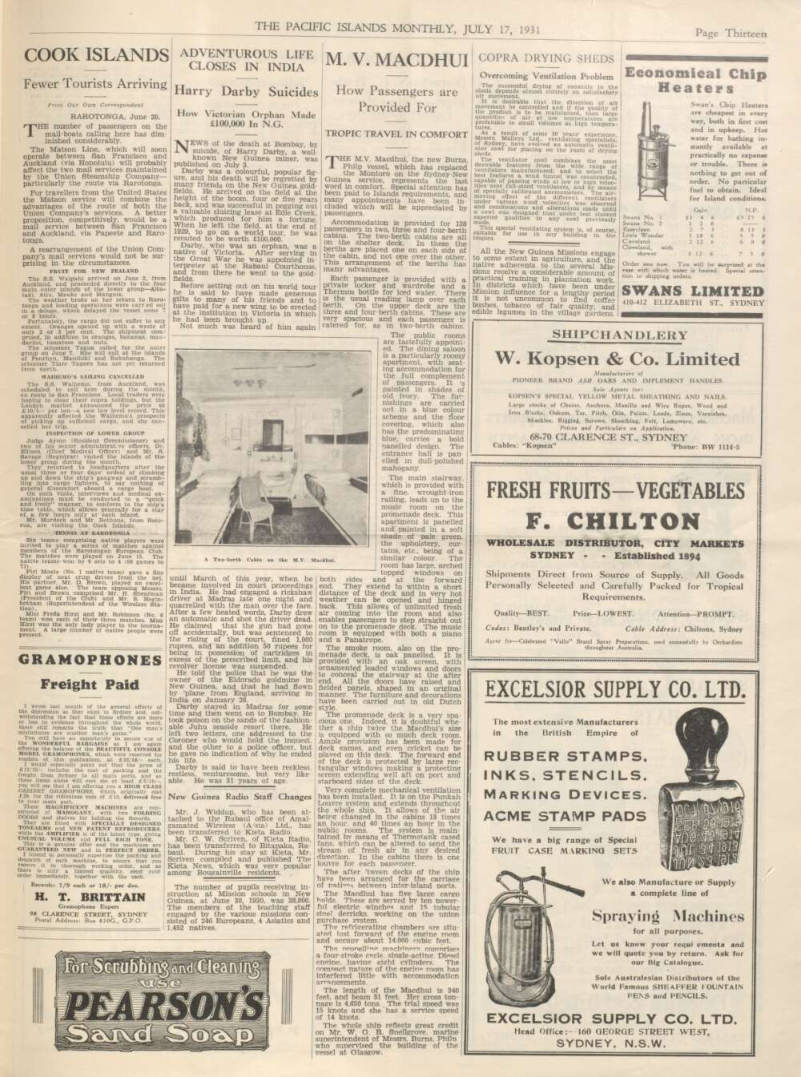
Fewer Tourists Arriving
From Our Own Correspondent
Rarotonga, June 20.
THE number of passengers on the
mail-boats calling here has dim
inished considerably.
The Matson Line, which will soon
operate between San Francisco and
Auckland (via Honolulu) will probably
affect the two mail services maintained
by the Union Steamship Company—
particularly the route via Rarotonga.
For travellers from the United States the Matson service will combine the advantages of the route of both the Union Company’s services. A better proposition, competitively, would be a mail service between San Francisco
and Auckland, via Papeete and Raro
tonga.
A rearrangement of the Union Com pany’s mail services would not be sur
prising in the circumstances.
Fruit For New Zealand
The S.S. Waipahi arrived on June 2, from Auckland, and proceeded directly to the four main outer islands of the lower group—Aitu taki, Atiu. Mauke and Mangaia.
The weather broke on her return to Raro tonga and loading operations were carried out in a deluge, which delayed the vessel some 7 or 8 hours.
Fortunately, the cargo did not suffer to any extent. Oranges opened up with a waste of only 2 or 3 per cent. The shipment com prised, in addition to oranges, bananas, man darins, tomatoes and nuts.
The schooner Tagua sailed for the outer group on June 7. She will call at the islands of Penrhyn, Manihlki and Rakahanga. The schooner Tiare Taporo has not yet returned from north.
Waihemo’S Sailing Cancelled
The S.S. Waihemo, from Auckland, was scheduled to call here during the month, on route to San Francisco. Local traders were hoping to clear their copra holdings, but the London market announced the price at £ 10/5/- per ton—a new low level record. This apparently affected the Waihemo’s prospects of picking up sufficient cargo, and she can celled her trip.
Inspection Of Lower Group
Judge Ayson (Resident Commissioner) and two of his senior administrative officers, Dr.
Ellison (Chief Medical Officer) and Mr. S.
Savage (Registrar) visited the islands of the lower group during the month.
They returned to headquarters after the usual three or four days’ ordeal of climbing up and down the ship’s gangway and scramb ling into cargo lighters, to say nothing of general discomfort aboard a cargo boat.
On such visits, interviews and medical ex aminations must be conducted in a "quick and lively” manner, to conform to the ship’s time table, which allows generally for a stay of a few hours only at each island.
Mr. Murdock and Mr. Bethune, from Roto rua, are visiting the Cook Islands.
Tennis At Rarotonga
Six teams comprising native players were Invited to play a series of matches against members of the Rarotongan European Club.
The matches were played on June 15. The native teams-won by 6 sets to 4 (96 games to 71).
Plrl Moate (No. 1 native team) gave a fine display of neat crisp drives from the net.
His partner, Mr. D. Brown, played an excel lent game also. The team opposing Messrs.
Piri and Brown comprised Mr. H. Shearman (President of the Club) and Mr. S. Hegin botham (Superintendent of the Wireless Sta tion).
Miss Freda Hirst and Mr. Robinson (No. 6 team) won each of their three matches. Miss Hirst was the only lady player In the tourna ment. A large number of native people were present.
Harry Darby Suicides
Adventurous Life
Closes In India
How Victorian Orphan Made
£100,000 In N.G.
NEWS of the death at Bombay, by suicide, of Harry Darby, a well known New Guinea miner, was published on July 3.
Darby was a colourful, popular fig ure, and his death will be regretted by many friends on the New Guinea gold fields. He arrived on the field at the height of the boom, four or five years back, and was successful in pegging out a valuable sluicing lease at Edie Creek, which produced for him a fortune.
When he left the field, at the end of 1929, to go on a world tour, he was reputed to be worth £100,000.
Darby, who was an orphan, was a native of Victoria. After serving in the Great War he was appointed in terpreter at the Rabaul Courthouse, and from there he went to the gold fields.
Before setting out on his world tour he is said to have made generous gifts to many of his friends and to have paid for a new wing to be erected at the institution in Victoria in which he had been brought up.
Not much was heard of him again
until March of this year, when he became involved in court proceedings in India. He had engaged a rickshaw driver at Madras late one night and quarrelled with the man over the fare.
After a few heated words, Darby drew an automatic and shot the driver dead.
He claimed that the gun had gone off accidentally, but was sentenced to the rising of the court, fined 1,000 rupees, and an addition 50 rupees for being in possession of cartridges in excess of the prescribed limit, and his revolver license was suspended.
He told the police that he was the owner of the Eldorado goldmine in New Guinea, and that he had flown by ’plane from England, arriving in India on January 26.
Darby stayed in Madras for some time and then went on to Bombay. He took poison on the sands of the fashion able Juhu seaside resort there. He left two letters, one addressed to the Coroner who would hold the inquest, and the other to a police officer, but he gave ho indication of why he ended his life.
Darby is said to have been reckless, restless, venturesome, but very like able. He was 31 years of age.
New Guinea Radio Staff Changes Mr. J. Widdup, who has been at tached to the Rabaul office of Amal gamated Wireless (A/sia) Ltd., has been transferred to Kieta Radio.
Mr. C. W. Scriven, of Kieta Radio, has been transferred to Bitapaka, Ra baul. During his stay at Kieta, Mr.
Scriven compiled and published The Kieta News, which was very popular among Bougainville residents.
The number of pupils receiving in struction at Mission schools in New Guinea, at June 30, 1930, was 38,800.
The members of the teaching staff engaged by the various missions con sisted of 246 Europeans, 4 Asiatics and 1,452 natives.
A Two-berth Cabin on the M.V. Macdhui.
M. V. Macdhui
How Passengers are Provided For
Tropic Travel In Comfort
THE M.V. Macdhui, the new Burns, Philp vessel, which has replaced the Montoro on the Sydney-New Guinea service, represents the last word in comfort. Special attention has been paid to Islands requirements, and many appointments have been in cluded which will be appreciated by passengers.
Accommodation is provided for 138 passengers in two, three and four-berth cabins. The two-berth cabins are all on the shelter deck. In these the berths are placed one on each side of the cabin, and not one over the other.
This arrangement of the berths has many advantages.
Each passenger is provided with a private locker and wardrobe and a Thermos bottle for iced water. There is the usual reading lamp over each berth. On the upper deck are the three and four-berth cabins. These are very spacious and each passenger is catered for, as in two-berth cabins.
The public rooms are tastefully appoint ed. The dining saloon is a particularly roomy apartment, with seat ing accommodation for the full complement of passengers. It ’s painted in shades of old ivory. The fur nishings are carried out in a blue colour scheme and the floor covering, which also has the predominating blue, carries a bold panelled design. The entrance hall is pan elled in dull-polished mahogany.
The main stairway, which is provided with a fine, wrought-iron railing, leads up to the music room on the promenade deck. This apartment is panelled and painted in a soft shade of pale green, the upholstery, cur tains, etc., being of a similar colour. The room has large, arched topped windows on
both sides and at the forward end. They extend to within a short distance of the deck and in very hot weather can be opened and hinged back. This allows of unlimited fresh air coming into the room and also enables passengers to step straight out on to the promenade deck. The music room is equipped with both a piano and a Panatrope.
The smoke room, also on the pro menade deck, is oak panelled. It is provided with an oak screen, with ornamented leaded windows and doors to conceal the stairway at the after end. All the doors have raised and fielded panels, shaped in an original manner. The furniture and decorations have been carried out in old Dutch style.
The promenade deck is a very spa cious one. Indeed, it is doubtful whe ther a ship twice the Macdhui’s size is equipped with so much deck room.
Ample provision has been made for deck games, and even cricket can be played on this deck. The forward end of the deck is protected by large rec tangular windows making a protecting screen extending well aft on port and starboard sides of the deck.
Very complete mechanical ventilation has been installed. It is on the Punkah Louvre system and extends throughout the whole ship. It allows of the air being changed in the cabins 18 times an hour, and 40 times an hour in the nublic rooms. The system is main tained by means of Thermotank cased fans, which can be altered to send the stream of fresh air in any desired direction. In the cabins there is one louvre for each passenger.
The after ’tween decks of the ship have been arranged for the carriage of native between inter-island ports.
The Macdhui has five large cargo holds. These are served by ten power ful electric winches and 15 tubular steel derricks, working on the union purchase system.
The refrigerating chambers are situ ated just forward of the engine room and occupy about 14.000 cubic feet.
The propelling machinery comprises a four-stroke cycle, single-acting Diesel engine, having eight cylinders. The compact nature of the engine room has interfered little with accommodation arrangements.
The length of the Macdhui is 340 feet, and beam 51 feet. Her gross ton nage is 4,650 tons.. The trial speed was 15 knots and she has a service speed of 14 knots.
The whole ship reflects great credit on Mr. W. G. R. Snellgrove, marine superintendent of Messrs. Bums, Philp who supervised the building of the vessel at Glasgow.
Copra Drying Sheds
Overcoming Ventilation Problem
The successful drying of coconuts in the sheds depends almost entirely on satisfactory air movement.
It is desirable that the direction of air movement be controlled and if the quality of the product is to be maintained, then large quantities of air at low temperatures are Preferable to small volumes at high tempera As a result of some 30 years’ experience, Messrs. Malleys Ltd., ventilating specialists, of Sydney, have evolved an automatic ventil ator cowl for placing on the roofs of drying sheds. J 6 The ventilator cowl combines the most desirable features from the wide range of ventilators manufactured; and to select the best features a wind tunnel was constructed capable of passing winds at low or high veloc ities over full-sized ventilators, and by means of specially calibrated anemometers. The air moving effect of the different ventilators under various wind velocities was observed and combinations and alterations made until a cowl was designed that under test showed superior qualities to any cowl previously made.
This special ventilating system is, of course, suitable for use in any building in the tropics.
All the New Guinea Missions engage to some extent in agriculture, and the native adherents to the several Mis sions receive a considerable amount of
practical training in plantation work.
In districts which have been under
Mission influence for a lengthy period
it is not uncommon to find coffee bushes, tobacco of fair quality, and
edible legumes in the village gardens.
Advertisements & other items, pp. 13-14 (2 items)
F. Chilton
Economical Chip
Heaters
Swan’s Chip Heaters are cheapest in every way, both in first cost and in upkeep. Hot water for bathing in stantly available at practically no expense or trouble. There is nothing to get out of order. No particular fuel to obtain. Ideal for Island conditions.
Galv. N.P. ease with which water is heated. Special atten tion to shipping orders.
SWANS LIMITED
410-412 ELIZABETH ST., SYDNEY
SHIPCHANDLERY
W. Kopsen & Co. Limited
Manufacturers of PIONEER BRAND ASH OARS AND IMPLEMENT HANDLES.
Sole Agents for : KOPSEN’S SPECIAL YELLOW METAL SHEATHING AND NAILS.
Large stocks of Chains, Anchors, Manilla and Wire Ropes, Wood and Iron Blocks, Oakum, Tar, Pitch, Oils, Paints, Leads, Zincs, Varnishes, Shackles, Rigging, Screws, Sheathing, Felt, Lampware, etc.
Prices and Particulars on Application.
68-70 CLARENCE ST., SYDNEY
Cables: “Kopsen” ’Phone: BW 1114-5
FRESH FRUITS—VEGETABLES
F. CHILTON
WHOLESALE DISTRIBUTOR, CITY MARKETS
SYDNEY - - Established 1894 Shipments Direct from Source of Supply. All Goods Personally Selected and Carefully Packed for Tropical Requirements.
Quality—BEST. Price—LOWEST. Attention—PROMPT.
Codes-. Bentley’s and Private. Cable Address: Chiltons, Sydney Agent for —Celebrated "Vallo” Brand Spray Preparations, used successfully by Orchardists throughout Australia.
EXCELSIOR SUPPLY CO. LTD
The most extensive Manufacturers in the [British Empire of
RUBBER STAMPS,
INKS, STENCILS.
Marking Devices.
We have a big range of Special
Spraying Machines
we will quote you by return. Ask for our Big Catalogue.
Sole Australasian Distributors of the World Famous SHEAFFER FOUNTAIN
PENS and PENCILS.
EXCELSIOR SUPPLY CO. LTD.
Head Office:- 160 GEORGE STREET WEST,
SYDNEY, N.S.W.
ACME STAMP PADS
FRUIT CASE MARKING SETS
for all purposes.
Let us know your requi ements and We also Manufacture or Supply a complete line of
BLACKLOCKS
R. E. FORSSBERG - Proprietor
Manufacturer's Representative
381 PITT STRTET - SYDNEY
Buying Agents for all requirements, at lowest prices, on commission basis.
Cable Address: “Diamondess” Sydney
John L. Feadon Ltd.
Rabaul
TERRITORY OF NEW GUINEA
Engineers and Garage Proprietors
All Classes o£ General Engineering Undertaken
CARS FOR HIRE
Territory Agents for : Goodrich Products Clyde Batteries Berger’s Lacquers B.E.S. Plugs.
Ghas. Hope Ltd., Bris. Lamson Paragon Ltd., Printers ’Phone: 20.
Machinery and Engineering Suppliers
IRON AND STEEL MERCHANTS
“Big Chief” Oil Engines Pumps of all kinds Saw Mill Requirements Motor Engineers Plant Mechanics Accessories Fittings for Boilers Bar Iron Tees, Angles, etc.
Picks, Shovels, Axes, etc.
SCRUTTONS Ltd.
161 CLARENCE ST.
SYDNEY, N.S.W.
Established 40 Years
SUITABLE FOR THE TROPICS
HATS
bearing this brand have a
special
interest for Paci fic Is lands merch ants and distributors, because They conform to the latest styles, combined with quality. They are carefully designed by expert Mil liners, who specially cater for sub-tropical requirements, parti cularly in North Queensland and the Pacific Islands.
They are modestly priced, so that, while appealing to the smartest well-dressed women, they are within the reach of people whose incomes have been depleted by the stress of the times.
This is a line which all Pacific retailers should carry. D. & H. Hats arc “Sure Sellers.’
SEND FOR A SAMPLE RANGE
Decent & Hutchison
Hat Manufacturers
52-54 BAY STREET SYDNEY
Freight Paid
GRAMOPHONES
I wrote last month of the general effects of the depression as they exist In Sydney and, notwithstanding the fact that these effects are more or less in evidence throughout the whole world, there still remains the truth that “One man’s misfortunes are another man’s gains.”
You still have an opportunity to secure one of the WONDERFUL BARGAINS as I am again offering the balance of the BEAUTIFUL CONSOLE MODEL GRAMOPHONES, which were reserved for readers of this publication, at £12/10/- each.
I would especially point out that the price of £12/10/- includes the cost of packing and the freight from Sydney to all main ports, and as these items alone will cost me at least £2/10/-, you will see that I am offering you a HIGH CLASS CABINET GRAMOPHONE, which originally cost £39, for the ridiculous sum of £lO, delivered free to your main port.
These MAGNIFICENT MACHINES are constructed of MAHOGANY, with two FOLDING DOORS and shelves for holding the Records.
They are fitted with SPECIALLY DESIGNED
TONEARMS and NEW PATENT REPRODUCERS,
while the AMPLIFIER is of the latest type, giving
UNUSUAL VOLUME and FULL RICH TONE.
This is a genuine offer and the machines are
GUARANTEED NEW and in PERFECT ORDER.
I intend to personally supervise the packing and despatch of each machine, to ensure that you receive it in thorough working order, and as there is only a limited quantity, send your order immediately, together with the cash.
Records: 1/9 each or 18/- per doz.
H. T. BRITTAIN
Gramophone Expert
98 CLARENCE STREET, SYDNEY
Postal Address: Box 830 G., G.P.O.
Figures for May
Norfolk Is. Trade
THE following comparative figures showing Norfolk Island trade for May, 1930, and May, 1931, are pro vided by courtesy of Captain Stopp, Collector of Customs:
Month.
Imports.
From Australia From N.Z.
May, 1930 £1,769 Nil May, 1931 £2,719 £1,083 Month
Exports.
To Australia
To N.Z.
May, 1930 £2,437 Nil May, 1931 £410 £1,085
Bremerhaven
Disturbs N. G. Trade Representations Made to Federal Authorities
Canberra, July 14.
THE manner in which the German steamer Bremerhaven is cutting into the business of Australiau firms trading in the Mandated Terri tory of New Guinea is now receiving the attention of the Federal authorit ies. The Bremerhaven (N.D.L.) is now running regularly between Far Eastern ports and New Guinea.
It has been represented to the Prime Minister’s Department here that the Australian companies trading in New Guinea are contemplating the reduction of their costs —more particu larly in relation to a departure from the Australian wage standards so that they may meet the Bremerhaven competition.
The Australian companies state that they do not fear the Germans so far as Rabaul is concerned. The amount which the planters receive by consign ing through the Bremerhaven is sub stantially the same as they receive by selling to the big firms in Rabaul.
With copra at £12 per ton the com panies operating in Rabaul pay £8/15/per ton to the planters, taking ex change into consideration. The amount received by the planters from the Germans, on a Rabaul basis, is approximately £8/17/- per ton, but the companies emphasise that the follow ing substantial differences may be noted: (1) The companies pay the plan ters spot cash for the copra. The Bremerhaven does not pay until the copra has gone to Europe and ac count sales have come back. (2) The companies take delivery of the copra, store it in their sheds and place it under insurance from that moment, without any charge to the planters. In the case of the Bremerhaven, the copra has to be stored by the planters at their own cost, and then delivered by them to the ship, and there is no free in surance.
It is in regard to the outports that difficulties arise. The companies have to charge the copra-producers the cost of freight from the outports to Rabaul. The Bremerhaven goes to the outports and picks up the copra there without extra charge. Those of the out port planters who can afford to wait for their money and deal with the Bremerhaven, benefit to the extent of the freight between the outports and Rabaul.
It has also been represented to the Commonwealth Government that the Bremerhaven is the centre of a vigor ous effort which is being made to cap ture the New Guinea market for Ger man goods. German commercial trav ellers have been busy in the Territory: and the Bremerhaven, manned by very cheap labour, is bringing the cheap goods at low freights, to the disad vantage of Australian manufacturing industries. The companies ask that the Germans be placed on the same basis as the Australian enterprises. If the latter are to retain their copra con nection, one of two things must occur, (a) The Australian companies must cut their wage rates and even contemplate the employment of cheap foreign labour, so that they may be able to reduce costs and themselves pay freight between the outports and Rabaul, or (b) The cheap labour advantages enjoyed by the Germans must be offset in some way, preferably by restricting oversea ships to the main Customs ports only, in the way that has been adopted recently by the British administration in the Solomon Islands.
It is pointed out by the Common wealth officials that the coastwise trad ing provisions of the Australian Navi gation Act were applied to New Guinea and Papua some ten years ago.
They did not operate at all satisfac torily and the position wag inquired into by a Royal Commission in 1925.
As a result the operation of the Act was removed from those territories.
That seemed to accord with the gen eral wish. The officials say that to place any restriction now upon the opera tions of the Bremerhaven would en tail the re-apnlication of the coastwise trading provisions of the Navigation Act and that probably, would arouse strong protests.
It is recognised, however, that Aus tralian trading interests and wage standards in the Territory are entitled to protection: and the whole position in relation to British competition is under consideration.
Union Complaint to Mr. Scullin Complaints that Australian crews have suffered by the growth of foreign shipping in the Mandated Territory are contained in a letter forwarded by the secretary of the Marine Stewards’
Union (Mr. A. H. Moate) to the Prime Minister (Mr. Scullin), (says The Syd ney Morning Herald, of July 11).
Mr. Moate asked, in his letter, that the Federal Government should pro claim the Navigation Act in the Man dated Territory, that the duty of 8/a ton imposed on Australian trade in the islands should be lifted and applied to foreign shipping, making the
duty payable by foreign companies not less than 16/- a ton. In this way, he points out, a fillip would be given to Australian shipping, and more employ ment would be created for Australian crews.
Allegations made by Mr. Moate are that the Norwegian and Chinese lines pay lower wages and carry smaller crews than Australian vessels, and that a Japanese line is considering entering the trade.
Mr. Scullin has replied that the question of proclaiming the Navigation Act in the Mandated Territory has been referred to the Administrator of the Territory and of Papua for a report.
French Oceania
Jubilee of Annexation
From Our Own Correspondent
Papeete, June 8.
THIS year marks the 50th anniver sary of an important historic event in the annals of Tahiti — namely, the formal annexation to France of King Pomare V.’s ancient kingdom and its dependencies, which embraced a considerable portion of what is now known as French Oceania.
The French flag was first hoisted in 1844 by Capt. Bruat, who thereby took possession in the name of Louis Phil lippe, King of France. From then on to 1880, when the Islands received the status of a Colony and the inhabitants were granted full citizenship, they were governed by a naval administration.
To commemorate this anniversary, a more than usually ambitious pro gramme has been projected for the customary celebrations on July 14. In addition to the usual dancing and sing ing competitions, in which all the dis tricts will compete, there is to be a fireworks display and a flower carnival.
Doubtless, the natives will turn up in force, in spite of hard times and have some money to spend on their own enjoyment—though how they do it is one of Tahiti’s outstanding mys teries.
The festivities are expected to coin cide with the arrival of H.M.S. Diomede which will add something to the at tractions and incidentally bring a few extra shekels into Papeete. The French warship, Bellatrix, is also in port, having recently returned from the home station with a new personnel, so it may be expected that the festivi ties will meet with a fair amount of success.
A Planter’S Woes
To the Editor.
Sir, —Congratulations upon the ap pearance of your excellent paper—it certainly fills a long felt want. May it have a long life and prosperity be its password.
I am extremely glad that we have at last an outlet for our Islands griev ances. At times we seem to be very much “up agin it” —with the bottom out of the copra market, also the rubber, and the next blow is a penny per lb. on our bananas by the New Zealand Government. We seem to be kicked, stamped and spat on, and well rubbed in to finish off with.
What with the world-wide depres sion and financial stringency, we are badly off and it seems absurd for some of your correspondents to boast of the comparative prosperity of Fiji, which does not exist. However, here are my best wishes for all time. —I am, etc.
N. C. Hunt.
Wainunu, Bua, Fiji.
Answers to Correspondents
D.O.M. (Victoria). —There are two
first-class hotels in Noumea—the Hotel
Grand Central and the Hotel de la Gare—where the rate is about 60 francs per day (from 12/6 to 15/-, according to the exchange). If you proposed to stay for a few weeks, you could, by
bargaining, get a much lower weekly
or monthly rate. The accommodation in these two hotels is quite good. There are three second-class hotels, where the food is very good, but the accom
modation poor, and their daily tariff
is much below the figures quoted.
N.C.H., Fiji.—The Curator of the Techno logical Museum, Ultimo, Sydney, has just re ceived some seeds of the Pordii variety of the tung oil tree, from Florida, via Kew Gardens, London. These are ready for immediate planting. The cost of the seeds is 2/6 per lb.
A pound weight consists of 14 fruits, each containing five seeds. Allowing for 50 per cent, germination, 214 lbs. would be needed for planting an acre. The young plants should be protected from cattle. As far as is known no experiments with tung oil trees have been yet carried out in Fiji. . . . Regarding husked coconuts, there is a sale in Sydney for these only during the winter months. It has been found that the milk dries too quickly in the summer. The duty on coconuts is 1/- per cwt., and an addition to this there is primage and sales tax to pay. Write to any of the wholesale fruit merchants who advertise in this journal. . . . Desiccated coconut from Fiji would not be allowed into the Common wealth, as the Federal Government, last April, prohibited its importation except from its Island territories —that Is, Papua and New Guinea.
Pacific Islands
Year-Book
(Published in October, 1931, and Annually thereafter) A valuable work of reference, filling a long felt want.
This Handbook, which comprises several hun dred pages, contains a great mass of carefully arranged and well-indexed information relating to the following Territories, Colonies, Groups and Islands of the Pacific: FIJI (British Crown Colony), NEW GUINEA (Australian Mandated Territory), PAPUA (Aus tralian Territory), HAWAII (American Territory).
NEW CALEDONIA (French Colony), DUTCH EAST INDIES, NEW HEBRIDES (Condominium), MAR SHALL and CAROLINE ISLANDS (Japanese Man dated Territory), GUAM (American Territory).
SAMOA (New Zealand Mandated Territory), SOLOMON ISLANDS (British Protectorate), PHIL IPPINES (American Territory), TONGA (British Protectorate), COOK ISLANDS (New Zealand Ter
Ritory), Society And Marquesas Islands
(French Colony), NORFOLK ISLAND (Australian Territory), GILBERT and ELLICE ISLANDS (British Crown Colony), EASTERN SAMOA (American Territory).
The available Year Books and Handbooks con tain only meagre information about these Pacific countries, most of which are growing rapidly in European populations, trade and industry, and providing an ever-widening field for new settle ment and enterprise. The Pacific Islands Year- Book has been compiled to meet a steadily in creasing demand for an annual giving all parti culars of the Groups and Territories, and which will supply the latest trade and administrative statistics. The material relating to each Terri tory, Group or Island has been arranged under the following heads and fully and carefully in dexed: Name, position and area.
History—Containing much matter of unique interest, emphasising the romantic character of these Pacific countries.
How owned and administered.
Opportunities for trade, industries and land settlement.
Description of principal tourist attractions.
Population, trade, industry, finance, communi cations, taxation, port facilities, health, education, post and telegraph facilities, religions, climate— with latest statistics, all classified and analysed Special articles on interesting aspects of Islands life.
Information and advice for planters and traders.
Lists of Administration officials, chief trading firms and financial institutions, European resi dents, etc.
Maps of all the principal Territories and Islands.
Size; Medium Octavo. Bound in stiff board, with linen backing.
Price: 8/6 Per Copy, Post Free.
SPECIAL NOTE.—It is not proposed to print more copies than are justified by orders in hand.
Therefore, to avoid disappointment, orders should be posted to reach the publishers not later than the first week in September. Cash should accom pany the order.
Publishers;
Pacific Publications Limited
Union House, 247 George Street, Sydney.
Advertisements & other items, p. 14 (1 item)
Greenwood Laws
MINING, LAND AND MANUFACTURERS’ AGENTS
COMPANY SECRETARIES AND REPRESENTATIVES. IMPORTERS
EXPORTERS.
RABAUL - - NEW GUINEA
AND
GROTH’S Wallpapers - Paints -‘‘Duco’- Etc.
Groth’s (Estd. 1852) for the Best Selection.
Wallpapers from leading English, Continental and American Manufacturers.
British Australian (BALM) Whitelead, Paints, Varnishes.
Roof and Bridge Paints. —"Pyform” for Silverfish; Glacier paper.
"Durakote,” the wonderful Super Mill White.
Varnishes, Calcimo, Kalsomines and Brushware.
Floor Stains —Enamels—"Dux” Hi-speed Enamel.
Brushing "Duco” for household purposes.
Spraying "Duco” and guns for cars, furniture, etc.
"Duco” Hood dressing, No. 7 Polish and Touch-up Black.
Picture Framing tastefully done.
GROTH’S CAN PROCURE ANYTHING FOR YOU NOT LISTED WRITE FOR SAMPLES OF WALLPAPERS, COLOUR CARDS OF PREPARED PAINTS FROM 11/6 GALLON—But, "When buying paint remember quality counts.”
H. H. GROTH & CO.
51 York Street (top of Wynyard Street) Sydney
CABLE; GROTH, SYDNEY.
Products Of The South Seas
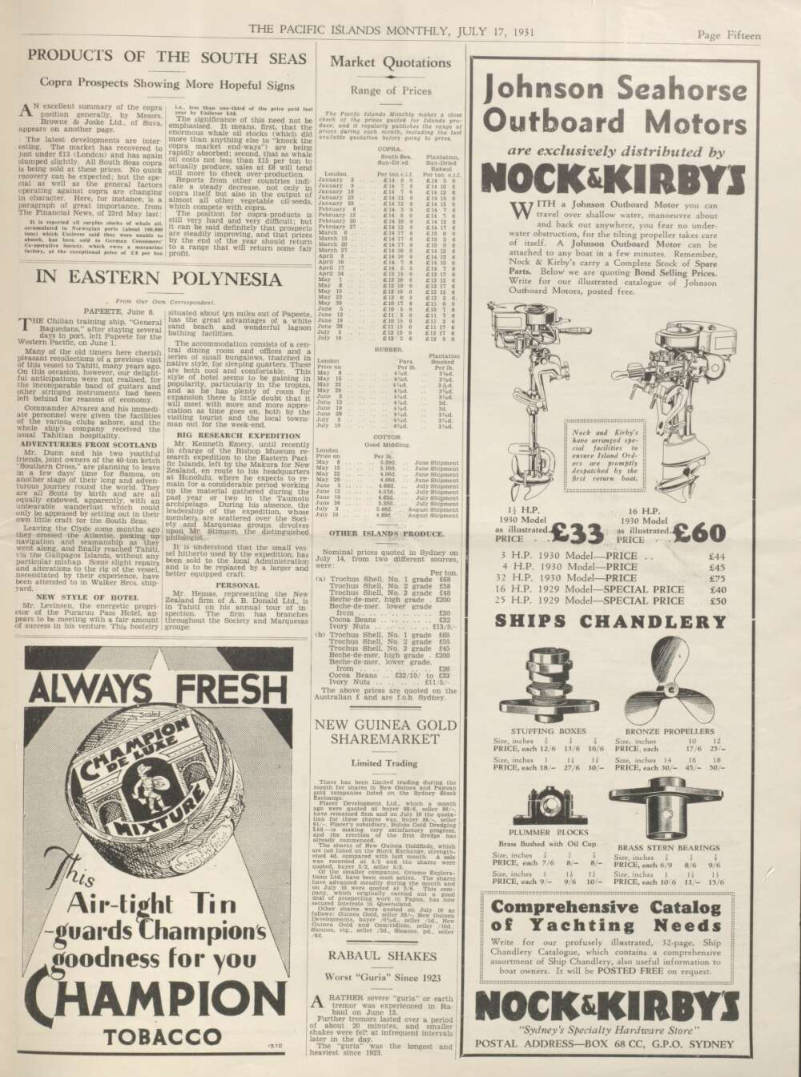
Copra Prospects Showing More Hopeful Signs
AN excellent summary of the copra position generally, by Messrs.
Browne & Joske Ltd., of Suva, appears on another page.
The latest developments are inter esting. The market has recovered to just under £13 (London) and has again slumped slightly. All South Seas copra is being sold at these prices. No quick recovery can be expected; but the spe cial as well as the general factors operating against copra are changing in character. Here, for instance, is a paragraph of great importance, from The Financial News, of 23rd May last: It is reported all surplus stocks of whale oil, accumulated in Norwegian ports (about 100.000 tons) which Unilever said they were unable to absorb, has been sold to German Consumers’
Co-operative Society, which owns a margarine factory, at the exceptional price of £8 per ton
i.e., less than one-third of the price paid last year by Unilever Ltd.
The significance of this need not be emphasised. It means, first, that the enormous whale oil stocks (which did more than anything else to “knock the copra market end-ways”) are being rapidly absorbed; second, that as whale oil costs not less than £15 per ton to actually produce, sales at £8 will tend still more to check over-production.
Reports from other countries indi cate a steady decrease, not only in copra itself but also in the output of almost all other vegetable oil-seeds, which compete with copra.
The position for copra-products is still very hard and very difficult; but it can be said definitely that prospects are steadily improving, and that prices by the end of the year should return to a range that will return some fair profit.
In Eastern Polynesia
From Our Own Correspondent.
Papeete, June 8.
THE Chilian training ship, “General Baquedans,” after staying several days in port, left Papeete for the Western Pacific, on June 1.
Many of the old timers here cherish pleasant recollections of a previous visit of this vessel to Tahiti, many years ago.
On this occasion, however, our delight ful anticipations were not realised, for the incomparable band of guitars and other stringed instruments had been left behind for reasons of economy.
Commander Alvarez and his immedi ate personnel were given the facilities of the various clubs ashore, and the whole ship’s company received the usual Tahitian hospitality.
Adventurers From Scotland
Mr. Dunn and his two youthful friends, joint owners of the 40-ton ketch “Southern Cross,” are planning to leave in a few days’ time for Samoa, on another stage of their long and adven turous journey round the world. They are all Scots by birth and are all equally endowed, apparently, with an unbearable wanderlust which could only be appeased by setting out in their own little craft for the South Seas.
Leaving the Clyde some months ago they crossed the Atlantic, picking up navigation and seamanship as they went along, and finally reached Tahiti, via the Galipagos Islands, without any particular mishap. Some slight repairs and alterations to the rig of the vessel, necessitated by their experience, have been attended to in Walker Bros, ship yard.
New Style Of Hotel
Mr. Levinsen, the energetic propri etor of the Puraruu Pass Hotel, ap pears to be meeting with a fair amount of success in his venture. This hostelry
situated about tjm miles out of Papeete, has the great advantages of a white sand beach and wonderful lagoon bathing facilities.
The accommodation consists of a cen tral dining room and offices and a series of small bungalows, thatched in native style, for sleeping quarters. These are both cool and comfortable. This style of hotel seems to be gaining in popularity, particularly in the tropics, and as he has plenty of room for expansion there is little doubt that it will meet with more and more appre ciation as time goes on, both by the visiting tourist and the local towns man out for the week-end.
Big Research Expedition
Mr. Kenneth Emery, until recently in charge of the Bishop Museum re search expedition to the Eastern Paci fic Islands, left by the Makura for New Zealand, en route to his headquarters at Honolulu, where he expects to re main for a considerable period working up the material gathered during the past year or two in the Taumotu archipelago. During his absence, the leadership of the expedition, whose members are scattered over the Soci ety and Marquesas groups, devolves upon Mr. Stimson, the distinguished philologist.
It is understood that the small ves sel hitherto used by the expedition, has been sold to the local Administration and is to be replaced by a larger and better equipped craft.
Personal
Mr. Hemas, representing the New Zealand firm of A. B. Donald Ltd., is in Tahiti on his annual tour of in spection. The firm has branches throughout the Society and Marquesas groups;
Market Quotations
Range of Prices
The Pacific Islands Monthly makes a close check of the prices quoted for Islands pro duce; and it regularly publishes the range of prices during each month, including the last available quotation before going to press.
Copra.
South Sea Plantation, Sun-Dried Sun-Dried Rabaul London.
Per ton c.i.f. Per ton c.i.f.
January 2 . . , . £14 0 0 £ 14 5 0 January 9 .. .. £14 7 6 £14 10 0 January 16 .. .. £14 7 £14 12 6 January 23 .. .. £14 12 6 £14 15 0 January 30 . . . . £14 12 6 £14 15 0 February 6 ... £ 14 5 £14 7 6 February 13 ... £14 5 £14 7 6 February 20 . . .. £14 10 £14 12 6 February 27 £ 14 12 £14 17 6 March 6 . £14 17 6 £15 0 0 March 13 £14 17 £15 2 6 March 20 . . £14 17 6 £15 0 0 March 27 . . .. £14 10 £14 12 6 April 3 £14 10 £14 12 6 April 10 .. .. £14 7 6 £14 10 0 April 17 £14 5 0 £14 7 6 April 24 . . . . £13 15 £13 17 6 May 1 £13 10 £13 12 6 May 8 .. .. £12 15 £12 17 6 May 15 . . £12 10 0 £12 12 6 May 22 .. . £12 0 £12 2 6.
May 29 . .. £10 17 £11 0 0 June 5 . . . . £ 10 5 r £10 7 6 June 12 . . . £11 5 C £11 7 6 June 19 .. .. £10 15 0 £11 2 6 June 26 .. .. £11 15 0 £11 17 6 July 3 .. ,. £12 15 0 £12 17 6 July 10 . . , . £ 12 2 6 £12 5 0
Rubber,
Plantation London Para Smoked Price on Per lb. Per lb.
May 8 4½d. 3½d.
May 15 4'/ 8 d. 3 Vsd.
May 22 4 Vsd. 3 May 29 4 Vsd. 3 Vsd.
June 5 4 Vsd. 3 Vsd.
June 12 4 Vsd. 3d.
June 19 4 Vsd. 3d.
June 26 4V»d. 3 ’Ad.
July 3 4Vid. 3V 4 d.
July 10 4Vad. 3 Vsd.
Cotton.
Good Middling.
London Price on Per lb.
May 8 . . . 5.29d June Shipment May 15 . .. 5.10d June Shipment May 22 . . . 4.96d June Shipment May 29 . . . 4.66d June Shipment June 5 . . . 4.66d.
July Shipment June 12 . . . . 4.57d.
July Shipment June 19 . . .. 4.62d.
July Shipment
June 26 . . . . 5.39d.
July Shipment July 3 . . . 5.46d. .. August Shipment July 10 . . . 4.89d. . . August Shipment
Other Islands Produce.
Nominal prices quoted in Sydney on July 14, from two different sources, were: Per ton. (a) Trochus Shell, No. 1 grade £68 Trochus Shell, No. 2 grade £58 Trochus Shell, No. 3 grade £48 Beche-de-mer, high grade . £200 Beche-de-mer, lower grade from £30 Cocoa Beans £32 Ivory Nuts £13/5/- (b) Trochus Shell, No. 1 grade £65 Trochus Shell, No. 2 grade £55 Trochus Shell, No. 3 grade £45 Beche-de-mer, high grade . £200 Beche-de-mer, lower grade, from £26 Cocoa Beans .. £32/10/ to £33 Ivory Nuts £11/5/- .
The above prices are quoted on the Australian £ and are f.o.b. Sydney.
New Guinea Gold
Sharemarket
Limited Trading
There has been limited trading during the month for shares in New Guinea and Papuan gold companies listed on the Sydney Stock Exchange.
Placer Development Ltd., which a month ago were quoted at buyer 88/6, seller 90/-, have remained firm and on July 10 the quota tion for these shares was, buyer 88/-, seller 91/-. Placer’s subsidiary, Bulolo Gold Dredging Ltd. —is making very satisfactory progress, and the erection of the first dredge has already commenced.
The shares of New Guinea Goldfieds, which are not listed on the Stock Exchange, strength ened 4d. compared with last month. A sale was recorded at 5/2 and the shares were quoted, buyer 5/2, seller 5/3.
Of the smaller companies, Oriomo Explora tions Ltd. have been most active. The shares have advanced steadily during the month and on July 10 were quoted at 3/6. This com pany, which originally carried out a good deal of prospecting work in Papua, has now secured interests in Queensland.
Other shares were quoted on July 10 as follows: Guinea Gold, seller 39/-, New Guinea Developments, buyer /0½d., seller /1d. New Guinea Gold and Osmiridium, seller /10d Sloanes, ctg., seller /3d., Sloanes, pd., seller /6d.
Rabaul Shakes
Worst “Guria” Since 1923
A RATHER severe “guria” or earth tremor was experienced in Ra baul on June 13.
Further tremors lasted over a period of about 20 minutes, and smaller shakes were felt at infrequent intervals later in the day.
The “guria” was the longest and heaviest since 1923.
Advertisements & other items, p. 15 (2 items)
Nockmdrbvi
Johnson Seahorse
Outboard Motors
are exclusively distributed by
NOCK & KIRBY'S
WITH a Johnson Outboard Motor you can travel over shallow water, manoeuvre about and back out anywhere, you fear no under water obstruction, for the tilting propeller takes care of itself. A Johnson Outboard Motor can be attached to any boat in a few minutes. Remember, Nock QC Kirby’s carry a Complete Stock of Spare Parts. Below 1 we are quoting Bond Selling Prices.
Write for our illustrated catalogue of Johnson Outboard Motors, posted free.
Nock and Kirby’s have arranged spe cial facilities to ensure Island Ord ers are promptly despatched by the first return boat.
H H.P.
1930 Model as illustrated.
PRICE - -
16 H.P. 1930 Model as illustrated.
PRICE - -
£60 3 H.P. 1930 Model —PRICE . . £44 4 H.P. 1930 Model — PRICE £45 32 H.P. 1930 Model— PRICE £75 16 H.P. 1929 Model— SPECIAL PRICE £40 25 H.P. 1929 Model— SPECIAL PRICE £50
SHIPS CHANDLERY
STUFFING BOXES
Size, inches 111 PRICE, each 12/6 13/6 16/6
BRONZE PROPELLERS
Size, inches . . . . 10 12 PRICE, each 17/6 25/- Size, inches 1 1| If Size, inches 14 16 18 PRICE, each 18/- 27/6 30/- PRICE, each 30/- 45/- 50/-
PLUMMER BLOCKS
Brass Bushed with Oil Cup Size, inches I I PRICE, each 7/6 8/- Size, inches 1 1| PRICE, each 9/ 9/6 8/u io/-
BRASS STERN BEARINGS
Size, inches 111 PRICE, each 6/9 8/6 9/6 Size, inches 1 1| 1 \ PRICE, each 10/6 11/- 15/6
Comprehensive Catalog
of Yachting Needs
Write for our profusely illustrated, 32-page, Ship
Chandlery Catalogue, which contains a comprehensive
assortment of Ship Chandlery, also useful information to boat owners. It will be POSTED FREE on request.
NOCKMdRBVI
“Sydney’s Specialty Hardware Store’’
POSTAL ADDRESS—BOX 68 CC, G.P.O. SYDNEY
Alway
FRESH
Air-tight Tin guards Champions goodness for you
CHAMPION
TOBACCO
Shipping Services in The Pacific
Sydney-New Guinea Service.
Sydney-Papua Service.
Solomon Islands Service.
Sydney —Norfolk Is. —Auckland —N. Hebrides
Noumea-New Hebrides Service.
Sydney —N.Z.—Fiji—Samoa — Hawaii
Sydney-N.Z.-Fiji-Hawaii.
Auckland-Fiji-Samoa-T onga.
Sydney-N.Z.-Cook Is.-Tahiti.
French Eastern Pacific Service.
By ships running between Dunkirk and Noumea, via West Indies and Panama Canal.
Sydney-Rabaul-Hongkong.
Saigon-J ava-Noumea Line
Singapore, Sourabaya, Lae and Salamoa will be called at only if sufficient induce ment offers.
Royal Packet Navigation Co. Ltd.,
Agents,
New Hebrides Inter-Island Service.
S.S. Malinoa (Burns, Philp (South Sea) Co.
Ltd.) connects every 6 weeks at Vila with s.s. Makambo from Sydney, then proceeds on southern trip, calling at the Islands of Efate.
Erronmanga, Tanna, Aneityum, and returns to Vila —trip occupying 7 or 8 days. After 2 to 3 days at Vila, departs on. northern trip, call ing at the islands Of Efate, Mai, Tongoa, Epi.
Paama, Ambrym, Malekula, Abba, Malo, Santo, and returns to Vila—trip occupying 25 to 28 days. Vessel extends to Banks Group every second trip, equivalent to about every three months.
Sydney-Fiji Service.
The Waiotapu will leave Sydney on August 4 for Fiji, and will call at Lautoka, Suva and Levuka.
Union S.S. Co., Agents.
N.Z.—Cook Islands Service
S.S. Waipahi leaves Auckland on her next trip on July 22 and arrives Rarotonga on July 28. She then calls at outlying islands in the Group, returning to Rarotonga on August 1, and arrives Auckland on August 8.
Union S.S. Co., Agents.
Ocean Island-Nauru Service.
British Phosphate Commission, 16 Spring St., Sydney, sends boats irregularly.
Papuan Inter-Island Services.
S.S. Papuan Chief (Steamships Trading Co. Ltd.) makes regular round trips from Port Moresby to Kapa Kapa, Abau,Baibara, Sama rai, and back by same route; then Port Mor esby to Hisiu, Yule Island, Kuklpi, Orokolo, Kikori, Daru and back via Orokolo, Yule Is., and Hisiu —full trip occupying about one month.
A. K. Matoma (Burns, Philp & Co.) makes regular round trips from Saifiarai to Puni Punl, Baniara, Cape Nelson, Buna Bay, Mam bare, and back by same route, trip occupying about 12 days.
New Guinea Inter-Island Service.
S.S. Maiwara (Burns, Philp & Co.) makes regular round trips from Rabaul to New Ire land and Bougainville ports.
S.S. Mirani (Burns, Philp & Co.) makes regular round trips from Rabaul to New Guinea mainland ports.
S.S. Duris, s.s. Durour, s.s. Wyalong (W. R.
Carpenter & Co. Ltd.) makes sailings from Rabaul every two or three weeks to various oorts in the Territory.
Solomons Inter-Island Service.
M.V. Durambah (W. R. Carpenter & Co.
Ltd.) makes regular three-weekly trip around the Group.
Fiji Inter-Island Service.
T.S.S. Makatea (Burns, Philp (South Sea Co. Ltd.) makes regular fortnightly trips, under Government contract, as follows: Long Trip, 1,050 miles, Suva to Levuka, Tavenui Coast, Buca Bay, Devo, Rabi, Rotuma and back by same route, occupying about 10 days.
Short Trip, 560 miles, Suva to Levuka, Cicia Mango, Loma Loma, Tavenui Coast. Savu Savu, Levuka, Suva, occupying about 9 days T.S.S. Malake (Burns, Philp (South Sea) Co.
Ltd.) makes frequent trips to Levuka, Labasa and Lautoka, with transhipment cargo from Suva.
A.S. Makoa (Burns, Philp (South Sea) Co.
Ltd.) makes bi-monthly trips from Levuka to Funafuti and trades with all islands in the Ellice Group. Round trip, about 1,800 miles.
S.S. Adi Keva (Fiji Shipping Co. Ltd.) makes regular trips from Suva to Levuka and Lau toka, round trip occupying three days.
M.S. Sir John Forrest (Fiji Shipping Co.
Ltd.) makes regular trips from Suva to Levuka, Savu Savu, Nabouwalu, Baulailai, Le kutu, Dreketi, Raduri, Labasa, and return by the same route, round trip occupying about 9 days.
M.S. Adi Rewa (Fiji Shipping Co. Ltd.) makes regular trips from Suva to Ba and Lautoka. round voyage occupying four days.
Marsina Macdhui Marsina Sydney . . . July 11 July 25 Aug. 19 Brisbane . . July 13 July 27 Aug. 21 T’ville (opt.) .
July 30 — Samara! . . . July 18 Aug. 1 Aug. 26 Rabaul . .
Jy. 20-21 Aug. 3-4 Aug.28-29 Lindenhafen — Aug. 5 Salamoa .
Aug. 8 Lae . . .
Aug. 8 Finschafen Namatanai Aug 6-7 Karu . . .
Ramat . .
I Jy. 22-23 Aug.30-31 Bopire . .
Kimadan .
July 24 Sept. 1 Kavieng .
July 25 Sept. 2 Lorengau .
Lombrum .
Jy. 26-27 Sept. 3-4 Tumleo Seleo . . . f Jy. 28-29 Sept. 5-6 Madang Alexishafen July 30 Ag. 9-10 Sept. 7 Witu . . . , Jy.31 Aug.2 Sep. 8-10 Kavieng . .
Aug. 12 — Rabaul . .
Aug. 3 Aug. 13 Sept. 11 Soraken . .
Aug. 4-5 Sp. 12-13 Numa . .
Teopaslno . Aug. 5-6 Sp. 13-14 Kieta . . .
Aug. 6 Sept. 14 Samarai . .
Aug. 15 — Sydney . . , Aug. 12 Aug. 20 Sept. 20 Burns, Philp & Co. Ltd., Agents.
Monowai Niagara Aorangi Honolulu . . .
July 1 July 29 Aug. 26 Suva . . .
July 10 Aug. 7 Sept. 4 Auckland . . . Jul. 13-14 Ag.10-11 Sept. 7-8 Sydney . . . July 18 Aug. 15 Sept. 12 Sydney, dep. , . tJuly 23 Aug. 20 Sept. 17 Auckland . , . Jul. 27-23 Ag.24-25 Sep.21-22 Suva . ... . . July 3 Aug. 28 Sept. 25 Honolulu . , . Aug. 7 Sep. 4 Oct. 2 Aorangi resumes at Sydney on July 23.
Union S.S. Co. Ltd., Agents.
Per s.s Montoro Sydney .
July 18 Aug. 26 Oct. 3 Brisbane .
July 20 Aug. 28 Oct. 5 Tulagal .
V Makambo Jy. 25-27 Sep. !-4 Oct. 10- 12 Gavutu .
J Su’u . .
July 28 Sep. 5 Oct. 13 Aola . . i Sep.
G Here . . s Kaukaul .
Here . .
July 29 — Oct. 14 Teneru .
July 30 Sep. 7 Oct. 15 Luuga . .
Sep. 7 Kookoom July 30 Oct. 15 Mamara .
Domma .
Sep. 3 — Lavoro .
Sep. 9 — Yandina 1 Banika .
July 31 Sep. 10 Oct. 16 Loable J Ufa ...
Falam I Sep. 30 — Y. Pepsale Kaylah . 1 July 31 Sep. 10 Oct. 16 Meringe .
Sp.ll 12 — West Bay Somata .
July 31 — Oct. 16 Marovo Aug. 1 Oct. 17 Rendova Sep. 13 Kenelo . — Hathorn S.
Vila . .
Aug. 2-3 Oct. 18 -19 Stanmore Gizo . .
Aug. 4 Sep. 14 Oct. 20 Bagga .
Aug. 4 Sep. 15 Oct. 20 Fajsl . .
Aug. 5 Oct. 21 Glzo . .
Tetlparl .
Aag. 6 Sep.
IS Oct. 22 Russell Group Aug. 7-8 Sp.17 -18 Oct.23 -24 Mamara .
Aug. 9 Oct. 25 Tulagl .
Aug. 10 Sep. 19 Oct. 26 Brisbane Aug. 15 Sep. 24 Oct. 31 Sydney .
Aug. 17 Sep. 26 Nov. 2 Burns, Philp & Co. Ltd., Agents.
Sydney . . , Per S.S. Morinda.
July IS Aug. 6 Aug. 29 Lord Howe .
July 20 Aug. 8 Aug. 3' Norfolk Is. .
Jy. 22-23 Aug. 10 Sept. 2-3 Auckland , .
Jy. 26-27 Sept. 6-7 Vila . . . . — Ag.13 -14 — Bushman's B.
Aug. 15 — Norsup . . .
Aug. 15 — Malo ... 1 Tangoa . . \ Aug. 16 Segond Ch. I Hogg Harbour Aug. 17 Vila . . . . — Aug. 18 — Norfolk Is. .
July 30 Aug. 21 Sept. 10
Lord^Howe
Aug. l Aug. 23 Sept. 12 Sydney . . .
Aug. 3 Aug. 25 Sept. 14 Burns, Philp & Co. Ltd., Agents.
Per s.s. Laperouse Sydney, dep. July 18 Aug. 15 Oct. 10 Noumea . . Jul. 22 -25 Ag. 19-22 Oct.14-17 Chepenhe . July 26 Aug. 23 Oct. 18 Vila . . . . July 27 Aug. 24 Oct. 19 Sandwich . 1 Sarmettes
. f July
28 Aug. 25 Oct. 20 Norsup . • 1 Santo . . Jul. 29 -31 Ag.26-29 Oct.21-23 Banks . . . Aug. 1 Oct. 24 EnJ . . .
Vila . . 2 Aug. 30 Oct. 25 . . Aug. ?
Aug. 31 Oct. 26 Chepenhe . . Aug. 4 Sep. 1 Oct. 27 Noumea . . . Aug. 5-8 Sep. 2 -5 Oct.28-31 Sydney, arr. . Aug. 12 Sen. 9 Nov. 4 Messageries Maritimes Co., Agents.
Sonoma Ventura Sierra Honolulu . . July 10 July 31 Aug. 21 Pago Pago .
July 17 Aug.
Aug. 28 Suva . . . . July 20 Aug. 10 Aug. 31 Auckland . July 24 Aug. 14 Sept. 4 Sydney . . . July 23 Aug. 18 Sept. 8 Sydney, dep. . Aug. 4 Aug. 25 Sept. 15 Auckland . . . Aug. 8 Aug. 29 Sept. 19 Suva . . .
Aug. 12 Eept. 2 Sept. 23 Pago Pago . . Aug. 13 Sept. 3 Sept. 24 Honolulu . . . Aug. 20 Sept. 10 Oct. 1 The Oceanic Steamship Co., Matson
Line, Agents.
From Panama Recherche Esperance Verdun Papeete . . .
June 25 Aug. 6 Sep. 11 Ralatea . . .
June 26 Aug. 7 Sep.
J2 Suva ...
July 5 Aug. 16 Sep. 21 Vila July 8 Aug. 19 Sep. 24 Noumea, arr.
July 13 Aug. 24 Sep. 29 To Panama — Noumea, dep.
July 28 Sept. 8 Oct. 14 Vila Aug. 4 Sept. 15 Oct. 21 Suva Ralatea (opt.i Aug. 15 Sept. 26 Oct. 30 Papeete . . .
Aug. 10 Sent. 27 Oct. 31
Messageries Maritimes Co., Agents.
Tan da S. Albans Nellore Hongkong . . May 30 July 3 Aug. i Manilla . . . June 2 July 6 Aug. 4 Rabaul . . . June 11 July 15 Aug. 13 Brisbane . . . June 17 July 20 Aug. 18 Sydney . . . June 19 July 22 Aug. 20 Sydney dep. July 15 Aug. 8 Sept. 12 Brisbane . . . July 17 Aug. 10 Sept. 14 Rabaul ... Aug. 2 Aug. 18 Sept. 22 Manila . . July 25 Aug. 26 Sept. 30 Hongkong . . Aug. 5 Aug. 23 Oct. 3 E. & A. Steamship Co. Ltd., Agents.
Per s.s. Le Maire Saigon . . . Jun. 26 Sep. 6 Nov. 16 Batavia . . . Jul. ! -6 Sep. 13 -16 Nv.23 -26 Samarang . . Jul. 7 Sep. 17 Nov. 27
Ft. Moresby
. Jul. 17
Sep.
27 Dec. 7 Samara! . . . Jul. 19 Sep. 29 Dec. 9 Noumea . . . Jul. 26 -30 Oct. 6 -10 Dc.16 -20 Vila ... 1 Oct. 12 Dec. 22 Rabaul . . . Aug. 6 -10 Oct. 17 -20 Dc.27 -30 Samara! . . . Aug. 13 Oct. 23 2
Ft. Moresby
• Aug. 14 Oct. 24 Jan. 3 Samarang . . Aug. 24 Nov. 3 Jan. 13 Batavia . . . A. 25- 28 Nov. 4-7 J. 14, ?.l Saigon . . .
. Sep.
2 Nov. 12 Feb. 12
Per t.s.s.
Tofu a.
Auckland dp. July 13 Aug. 10 Sept. 7 Suva . . . . Jy. 17-18 Ag.14-15 Sep. 11 -12 Nukualofa . . July 21 Aug. 18 Septt 15 Haapal . . . July 22 Aug. 19 Sept. 16 Vavau . . . . July 23 Aug. 20 Sept. 17 Apia . . . . Jy. 24-25 Ag.21-22 Sep. 18 -19 Suva . . . . Jy. 29-30 Ag.26-27 Sep.23-24 Auckland, arr. Aug. 3 Aug, 31 Sept. 28 Union S.S. Co. Ltd., Agents.
Per s.s. Mataram Sydney . . . July 22 Aug. 26 Sept. 23 Brisbane . . July 24 Aug. 28 Sept. 2L Townsville • July 27 Aug. 31 Sept. 28 Cairns . . . July 28 Sep. 1 Sept. 20 Pt. Moresby . July 30 Sep. 3 Oct. 1 Yule Island Sep. 4 Pt. Moresby . July 31 Sep.. 4 Oct.
Samarai .
Aug. 1 Sep. 5-7 Oct. 3 Woodlark Is. Aug. 2 Oct. 4 Samarai .
Aug. 3 Oct. 5 Pt. Moresby Aug. 5 Sep. 8 Oct. 7 Cairns . . . Aug. 7 Sep. 30 Oct. 9 Brisbane .
Aug. 10 Sep. 13 Oct. 12 Sydney . . . Aug. 12 Sep. 15 Oct. 14
Burns,
Philp &
Co.
Ltd.
, Agents.
Makura Maunganui Makura Papeete . . .
July 18 Aug. 15 Sept. 12 Rarotonga . .
July 21 Aug. 18 Sept. 15 Wellington . .
Jy. 27-28 Aug.24-25 Sep.21 -22 Sydney . . . .
Aug. 1 Aug. 29 Sept. 26 Sydney . . . .
Aug. 6 *Sept. 3 Oct. 1 Wellington . .
Ag.10-11 Sept. 7-3 Oct. 5-6 Rarotonga . .
Aug. 15 Sept. 12 Oct. 10 Papeete . , ..
Aug. 17 Sept. 14 Oct. 12 * Run resumed by Monowai Union S.S. Co. Ltd., Agents.
Copra Export Tax
Revision Still Under Consideration
Canberra, July 14.
EARLY in June, when the London price of copra fell to the unpre cedented figure of £10/5/- per ton, the planters of New Guinea made the most urgent application to the Aus tralian Government authorities that the export duty on copra of 15/- per ton be reduced to a merely nominal rate.
They also suggested that the Ad ministration recoup itself for this loss to revenue by imposing extra Customs duties, so that the tremendously heavy burden imposed on New Guinea by the slump in copra might be borne by the whole community, and not by the copra-producers alone. It was hoped that the Government would take prompt action to meet the extremely serious position.
The Government, however, would not be hurried. The whole matter was referred back to the Administrator of the Mandated Territory and, appar ently, left entirely in his hands. Appli cation at official headquarters in Can berra brought the reply that “the ap plication for relief from the copra ex port tax will be considered in connec tion with the Estimates from New Guinea, which have not yet been re ceived.”
It is understood that the sugges tion in regard to higher Customs dut ies will be considered at the same time.
Owing to the recovery in the price of copra, recorded in the early part of July, it is probable that the Gov ernment authorities will now try to avoid altogether any vital change in administrative policy, which would be involved in altering the source of rev enue from an export tax to a Customs tax on imports. Unless the price of copra again falls back seriously, it is likely that the Government will try to retain the export tax —although it is possible that the amount (15/- per ton) will be revised. A good deal de pends upon whether the London quo tation returns to the April level, or again shows an inclination to slump.
Acting-Administrator
Popular In Nauru
NAURU, June 20.
The motor vessel, Glenbank, left Nauru on May 21, for Australia, her only passengers from the Island being Mr. C. D. Gable and his wife. Mr.
Gable has been relieving Mr. W. A.
Newman, the Administrator, who has been on furlough for the period of three months.
During the short period that Mr.
Gable was in charge of the affairs
of this Island, he was most popular, and, with the able assistance of his charming wife, life on this Island was made most congenial. The Europeans and likewise the Nauruan community, are sorry that he had to leave us so soon. All join, especially the Returned Soldiers, in wishing them both the best of luck wherever they may roam.
Lecture On Tung Oil
Mr. A. R. Penfold, Curator of the Sydney Technological Museum, is to deliver a lecture under the auspices of the Royal Society of N.S.W., at Science House, Gloucester Street, Sydney, at 8 p.m. on August 5, on “Tung Oil and Its Cultivation.” The lecture will be illustrated by lantern slides.
A report of this will be published in the August issue of The Pacific Islands Monthly.
Advertisements & other items, p. 16 (2 items)
The Pacific Islands Monthly, July 17, 1931
16
Wholly Set up in Australia by Viles & Walker, Trade Compositors, 31 Cunningham St., Sydnev- Printed by W. Homer, 31 Cunningham St., Sydney, and Published by Pacific Publications Ltd., Union House, 247 George Street, Sydney.
Burns, Philp & Co. Ltd.
General Merchants
Shipowners,
Tourist Agents, Etc.
Head Office - 7 Bridge Street, Sydney - Australia Code Address : "BURPHIL ”
Buyers of All Classes of Island Produce.
Regular Steamer Services From Australia, to New Guinea, Papua, Solomons, Lord Howe, Norfolk Islands, New Hebrides, Java and Singapore
Burns, Philp (South Sea) Co. Ltd.
ISLAND TRADERS & SHIPOWNERS
Registered Office: Suva, Fiji Also Branches at Fiji : Levuka, Lautoka, Ba, Labasa, Rotumah.
Tonga : Nukualofa, Haapai, Vavau Samoa : Apia.
Solomons : Makambo, Gizo, Faisi.
New Hebrides : Vila.
Gilberts : Tarawa.
Norfolk Island. Nauru.
Code Address: "Burnsouth”
The
B. P. MAGAZINE
1/- Copy NOW AVAILABLE 1/- Copy
FICTION BOOK REVIEWS
TRAVEL SOCIETY
PICTURES STAGE & SCREEN
CHILDREN’S PAGES COMPETITIONS
All Newsagents and Bookstalls, or Direct from Proprietors:
BURNS, PHILP & CO. LTD.
(ALL BRANCHES)