Copra’S Melancholy Record
Brown and Joske on Market Movements and Probable Future
THE following carefully-reasoned and interesting summary of the copra market was issued, early in June, by Messrs. Brown and Joske Ltd., of Suva, to the members of the Coconut Planters’ Union.
The article is so valuable that we have taken the liberty of publishing it for the information of South Seas planters generally.
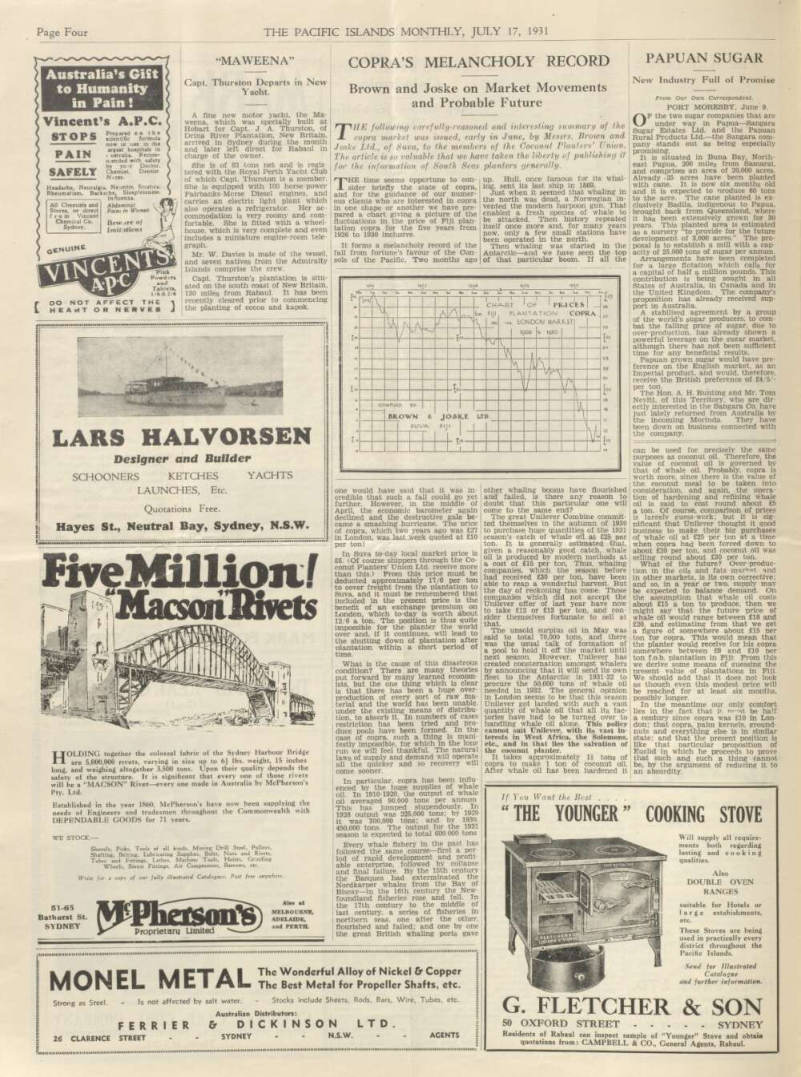
THE time seems opportune to con sider briefly the state of copra, and for the guidance of our numer ous clients who are interested in copra in one shape or another we have pre pared a chart giving a picture of the fluctuations in the price of Fiji plan tation copra for the five years from 1926 to 1930 inclusive.
It forms a melancholy record of the fall from fortune’s favour of the Con sols of the Pacific. Two months ago
up. Hull, once famous for its whal ing, sent its last ship in 1869.
Just when it seemed that whaling in the north was dead, a Norwegian in vented the modern harpoon gun. That enabled a fresh species of whale to be attacked. Then history repeated itself once more and, for many years now, only a few small stations have been operated in the north.
Then whaling was started in the Antarctic —and we have seen the top of that particular boom. If all the
one would have said that it was in credible that such a fall could go yet further. However, in the middle of April, the economic barometer again declined and the destructive gale be came a smashing hurricane. The price of copra, which two years ago was £27 in London, was last week quoted at £10 per ton!
In Suva to-day local market price is £6. (Of course shippers through the Co conut Planters’ Union Ltd. receive more than this.) From this price must be deducted approximately 17/6 per ton to cover freight from the plantation to Suva, and it must be remembered that included in the present price is the benefit of an exchange premium on London, which to-day is worth about 12/6 a ton. The position is thus quite impossible for the planter the world over and, if it continues, will lead to the shutting down of plantation after plantation within a short period of time.
What is the cause of this disastrous condition? There are many theories put forward by many learned econom ists, but the one thing which is clear is that there has been a huge over production of every sort of raw ma terial and the world has been unable under the existing means of distribu tion, to absorb it. In numbers of cases restriction has been tried and pro duce pools have been formed. In the case of copra, such a thing is mani festly impossible, for which in the long run we will feel thankful. The natural laws of supply and demand will operate all the quicker and so recovery will come sooner.
In particular, copra has been influ enced by the huge supplies of whale oil. In 1910-1920, the output of whale oil averaged 90,000 tons per annum This has jumped stupendously. In 1928 output was 225,000 tons; by 1929 it was 300,000 tons; and by 1930. 450,000 tons. The output for the 1931 season is expected to total 600 000 tons Every whale fishery in the past has followed the same course—first a per iod of rapid development and profit able enterprise, followed by collapse and final failure. By the 15th century the Basques had exterminated the Nordkarper whales from the Bay of Biscay—in the 16th century the New foundland fisheries rose and fell. In the 17th century to the middle of last century, a series of fisheries in northern seas, one after the other, flourished and failed; and one by one the great British whaling ports gave
other whaling booms have flourished and failed, is there any reason to doubt that this particular one will come to the same end?
The great Unilever Combine commit ted themselves in the autumn of 1930 to purchase huge quantities of the 1931 season’s catch of whale oil at £25 per ton. It is generally estimated that, given a reasonably good catch, whale oil is produced by modern methods at a cost of £15 per ton, Thus, whaling companies, which the season before had received £30 per ton, have been able to reap a wonderful harvest. But the day of reckoning has come. Those companies which did not accept the Unilever offer of last year have now to take £12 or £13 per ton, and con sider themselves fortunate to sell at that.
The unsold surplus oil in May was said to total 70,000 tons, and there was the usual talk of formation of a pool to hold it off the market until next season. However, Unilever has created consternation amongst whalers by announcing that it will send its own fleet to the Antarctic in 1931-32 to procure the 50,000 tons of whale oil needed in 1932. The general opinion in London seems to be that this season Unilever got landed with such a vast quantity of whale oil that all its fac tories have had to be turned over to handling whale oil alone. This policy cannot suit Unilever, with its vast in terests in West Africa, the Solomons, etc., and in that lies the salvation of the coconut planter.
It takes approximately 1½ tons of copra to make 1 ton of coconut oil.
After whale oil has been hardened it
can be used for precisely the same purposes as coconut oil. Therefore, the value of coconut oil is governed by that of whale oil. Probably, copra is worth more, since there is the value of the coconut meal to be taken into consideration, and again, the opera tion of hardening and refining whale oil is said to cost round about £5 a ton. Of course, comparison of prices is largely guess-work; but it is sig nificant that Unilever thought it good business to make their big purchases of whale oil at £25 per ton at a time when copra had been forced down to about £20 per ton, and coconut oil was selling round about £30 per ton.
What of the future? Over-produc tion in the oils and fats market and in other markets, is its own corrective: and so, in a year or two, supply mav be expected to balance demand. On the assumption that whale oil costs about £15 a ton to produce, then we might say that the future price of whale oil would range between £18 and £20, and estimating from that we get a figure of somewhere about £15 per ton for copra. This would mean that the planter would receive for his copra somewhere between £9 and £10 per ton f.o.b. plantation in Fiji. From this we derive some means of guessing the present value of plantations in Fiji.
We should add that it does not look as though even this modest price will be reached for at least six months, possibly longer.
In the meantime our only comfort lies in the fact that it must be half a century since copra was £10 in Lon don; that copra, palm kernels, ground nuts and everything else is in similar state; and that the present position is like that particular proposition of Euclid in which he proceeds to prove that such and such a thing cannot be, by the argument of reducing it to an absurdity.