The Kukukuku
Natives Who Are Disturbing Goldfields Wild Papuan Tribes
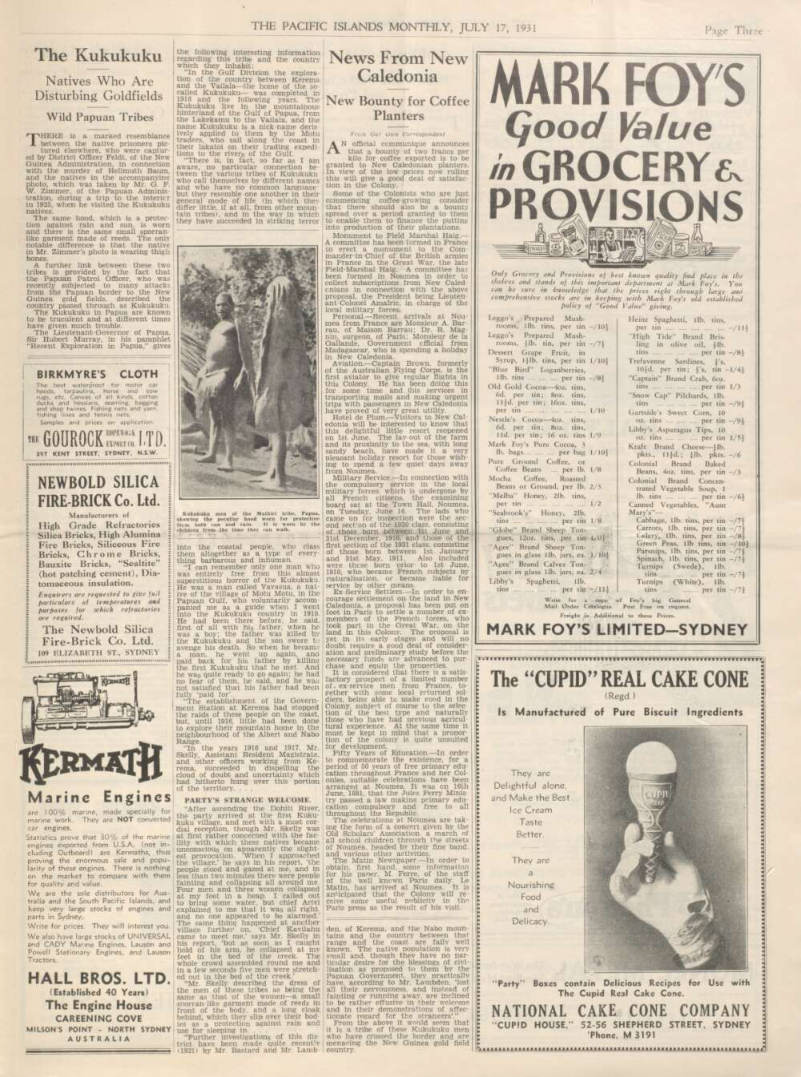
THERE is a marked resemblance between the native prisoners pic tured elsewhere, -who were captur ed by District Officer Feldt, of the New Guinea Administration, in connection with the murder of Hellmuth Baum, and the natives in the accompanying photo, which was taken by Mr. G. F.
W. Zimmer, of the Papuan Adminis tration, during a trip to the interior in 1925, when he visited the Kukukuku natives.
The same hood, which is a protec tion against rain and sun, is worn and there is the same small sporran like garment made of reeds. The only notable difference is that the native in Mr. Zimmer’s photo is wearing thigh bones.
A further link between these two tribes is provided by the fact that the Papuan Patrol Officer, who was recently subjected to many attacks from the Papuan border to the New Guinea gold fields, described the country passed through as Kukukuku.
The Kukukuku in Papua are known to be truculent and at different times have given much trouble.
The Lieutenant-Governor of Papua, Sir Hubert Murray, in his pamphlet “Recent Exploration in Papua,” gives
the following interesting information regarding this tribe and the country which they inhabit: “In the Gulf Division the explora tion of the country between Kerema and the Vailala—the home of the so called Kukukuku— was completed in 1916 and the following years. The Kukukuku live in the mountainous hinterland of the Gulf of Papua, from the Lakekamu to the Vailala, and the name Kukukuku is a nick-name deris ively applied to them by the Motu traders, who sail along the coast in their lakatoi on their trading expedi tions to the rivers of the Gulf.
“There is, in fact, so far as I am aware, no particular connection be tween the various tribes of Kukukuku who call themselves by different names and who have no common language but they resemble one another in their general mode of life (in which they differ little, if at all, from other moun tain tribes), and in the way in which they have succeeded in striking terror
into the coastal people, who class them altogether as a type of every thing barbarous and inhuman.
“I can remember only one man who was entirely free from this almost superstitious horror of the Kukukuku.
He was a man called Vavasua, a nat ive of the village of Motu Motu, in the Papuan Gulf, who voluntarily accom panied me as a guide when I went into the Kukukuku country in 1910.
He had been there before, he said, first of all with his father, when he was a boy; the father was killed by the Kukukuku and the son swore to avenge his death. So when he became a man, he went up again, and paid back for his father by killing the first Kukukuku that he met. And he was quite ready to go again; he had no fear of them, he said, and he was not satisfied that his father had been fully ‘paid for’.
“The establishment of the Govern ment Station at Kerema had stopped the raids of these people on the coast, but, until 1916, little had been done to explore their mountain home in the neighbourhood of the Albert and Nabo Range.
“In the years 1916 and 1917, Mr.
Skelly, Assistant Resident Magistrate, and other officers working from Ke rema, succeeded in dispelling the cloud of doubt and uncertainty which had hitherto hung over this portion of the territory. . . .
Party’S Strange Welcome.
“After ascending the Dohiti River, the party arrived at the first Kuku kuku village, and met with a most cor dial reception, though Mr. Skelly was at first rather concerned with the fac ility with which these natives became unconscious on apoarently the slight est provocation. ‘When I approached the village,’ he says in his report, ‘the people stood and gazed at me, and in less than two minutes there were people fainting and collapsing all around me.
Four men and three women collapsed at my feet in a heap. I called out to bring some water, but chief Arivi explained to me that it was all right, and no one appeared to be alarmed.’
The same thing happened at another village further on, ‘Chief Kavilahu came to meet me,’ says Mr. Skelly in his report, ‘but as soon as I caught hold of his arm, he collapsed at my feet in the bed of the creek. The whole crowd assembled round me and in a few seconds five men were stretch ed out in the bed of the creek.’
“Mr. Skelly described the dress of the men of these tribes as being the same as that of the women —a small sporran-like garment made of reeds in front of the body, and a long cloak behind, which they slip over their bod ies as a protection against rain and use for sleeping in. . . .
“Further investigations of this dis trict have been made quite recently (1921) by Mr. Bastard and Mr. Lamb
den, of Kerema, and the Nabo moun tains and the country between that range and the coast are fairly well known. The native population is very small and. though they have no par ticular desire for the blessings of civi lisation as proposed tn them by the Papuan Government, they practically have, according to Mr. Lambden, ‘lost all their nervousness, and instead of fainting or running away, are inclined to be rather effusive in their welcome and in their demonstrations of affec tionate regard for the strangers’.”
From the above it would seem that it is a tribe of these Kukukuku men who have crossed the border and are menacing the New Guinea gold field country.
Kukukuku men of the Maihiri tribe. Papua, showing the peculiar hood worn for protection from both sun and rain. It is worn by the children from the time they can walk.