Interesting, Incident
Saving Of Suva
Interesting, Incident of 1914 How “Dam Fool” Governor Scared off Enemy
In an article published recently in The Comhill Magazine, Mr. Malcolm Maxwell (formerly private secretary to Sir E. B. Sweet-Escott, K.C.M.G., Governor of Fiji) describes a hitherto unrevealed incident of the war.
THE Australian fleet, so long a re minder to Suva people that the war was a reality and not a de lusion, had left Fiji for New Guinea.
The exquisite harbour of Suva resum ed its tranquil appearance, its white reef glistening in the sun and inviting, so it would seem, not mighty battle ships but vessels of commerce and peaceful trade to enter its passage— that strange natural gateway so com mon to South Sea coral reefs —while the mountains which, like dark sen tinels of time, fringe the harbour shores, seemed to breathe once more of permanence and everlasting peace.
For me the absence of the fleet meant a certain respite from telegrams —telegrams to be dealt with at all hours, to be coded, decoded, recoded by day and by night. It was a pecu liarity of Fiji that the Governor was also Vice-Admiral of the Pacific waters, and as such all naval communications were addressed in the first instance to him, and on me devolved the task of decoding and recoding many a lengthy telegram from the Admiralty to Admiral Patey, the Commander-in- Chief in fact. For the Suva popula tion it meant a sense of being out of the war, the assumption being that the Scharnhorst and Gneisenau, those dread eagles of Von Spee which hov ered over the Pacific like a cloud, were
at a safe distance and occupied with other prey than us.
True, we still had the Sealark with us and her three-pounder and machine guns, but this protection, even as the trenches and barbed wire which sur rounded the Cable Station, now seem ed meaningless. The grey line of ships —Patey’s Australia, the Montcalm, fly ing the tricolor of Admiral Huguet, the Melbourne, the Encounter, and the rest were gone, and with their departure the grim picture which they had made seemed like a dream. Social life went on as before briskly in the capital, and it seemed that we read the official bulletins of war news as onlookers and no longer as actors in the drama which was being played on a stage greater than Europe, its footlights showing up such distant scenes as the Cam eroons and Cocos Islands.
A Startling Message.
It was, if I remember rightly, about 4 p.m. when I received and decoded a certain message from Apia, in Samoa.
I took it straight to the Governor’s office. I watched him closely, as I knew that its contents would —well, make him think. He read the decoded mes sage quietly, calmly—no change of ex pression showed on his face, but I no ticed that he looked tired, grey—what he read was roughly this: That at 6 a.m. that morning Von Spee had put into the harbour of Apia with Scharnhorst and Gneise nau, that their guns had been train ed on the town and the guns’ crews had taken station.
That no shot, however, was fired, the enemy cruisers weighing anchor at 7 a.m. and making for sea, there after steaming in a south-westerly direction.
The message was signed by the Ad ministrator and was for the Governor of Fiji’s “information,” as Suva lay in the course of the enemy ships.
The Governor gave his orders imme diately.
I was to ring up the wireless with instructions that they were to concen trate on receiving or “picking up” messages and that, if any was picked up in what appeared to be strange lettering, they were to send the mes sage forthwith to Government House,
noting, if possible, the approximate distance of the sender.
It was not long before an ominous message in an unfamiliar code was received, and I was busy at decoding it. The secret naval codes, the Civil codes, private codes between the flag ships—Australian, French, Japanese— not one would fit it.
I told the Governor: “This, sir, must be a German message. The wireless people report that the sender was, when the message was picked up, about 250 miles away.”
In A State Of Defence.
That night the town was in a state of defence. The Sealark’s men were at action stations, the Fiji Defence Force in the trenches, taxi-drivers did a roar ing trade and charged exhorbitant prices to drive the women and children (and less warlike of the men) to the interior and a place of safety beyond the range of German guns.
Suva was again in the war—really in it, it seemed now—but it was not till dawn that the reality would de clare itself, for Von Spee would stand off till there was sufficient light to navigate the treacherous shoals and reefs which encircle the Islands.
At 5.30 a.m. the next morning His Excellency and I “stood to.” In the grey light of coming dawn we looked towards the south, where Beqa Island stands sentry and where the first smoke of the mail steamers bringing news from home is seen by many an expectant eye, but this time we were not looking for letters and fresh faces, the telescope was sighted for a differ ent view—grim, cold, devastating.
What would the outline of two cruis ers each with four funnels silhouetted against the pink of the dawn signify?
It would mean death and worse than death: within the half-hour a peaceful town with red roofs peeping through the luxuriant green of tropic foliage, with but a handful of armed but harmless men, a crowd of weakling In dians, of laughing innocent Fijians, of refined and cultured Europeans, men of position and ladies of quality, would become a shambles, the pink of the dawn would turn to crimson, the crim son of blood, red blood, and the scar let of tongues of flame, of devastating
fire, ever swelling in volume, fanned and whipped by shrieking shell, the crash of explosives and the rumble of falling masonry. A town of almost voluptuous loveliness transformed into a spectacle of hideous ruin.
We waited anxious—more anxious as the moments passed and the grey light softened. Already the secret ciphers had been buried and their grave care fully concealed. Anxious eyes, too, be low round the cable station looked out towards the ocean, eyes of men who must be the first to feel the shock of high explosives, soldiers who must face death without a blow, without resist ance.
We waited and the grey gloom changed to pearly white with daubs of pink about the horizon. Thank God, the seas were clear! An hour passed, and then bright daylight—but no enemy was sighted, no German warship showed black against the sky line.
Suva was saved, so it seemed. But little was said. The taxi-drivers restor ed their fares of the night before to pleasant homes, dances became once more the evening pastime, once more there was calm, not again to be inter rupted by an enemy’s presence.
Some months later when Sturdee had cleared the Pacific, and the Scharnhorst and Gneisenau, with their gallant Admiral, lay at the bottom of the ocean, a German merchantman was captured, as she tried to round the Horn and slip out of the way of the British Fleet, and in the mail bag was found a letter from a young officer on board the Gneisenau. Only a para phrase of the letter can be given from memory, but this is roughly what he wrote: “At dawn we put into Apia intend ing to bombard the town, the flag of Britain now flying over Government House. We manned the guns, we trained them on the little capital— but did not fire.
“No, we thought of German hearts and German homes nestling there along the coral strand. We would strike one blow at England before the inevitable—our end. But we would not mingle our countrymen in the havoc.
Auckland, Wellington, Sydney too
dangerous a venture, they were too well protected.
“Suva, yes, Suva! there in her little outpost in the far Pacific Britain should feel the might of Germany, should hear the rumble of our Kaiser’s thunderbolt. Anchor weighed, we turn and steam S.W. towards Suva.
“Right gallantly the two ships hurry on their grim mission, when 10, a mes sage reaches us—it is in English, it is not even in code —Gott in Himmel, to the Admiral Australia! It gives us warning, the Australia is near.
“Damn fool of an English Governor he gives the show away. Yet, we thank him from the bottom of our hearts for his warning. So the British bulldog with gnashing teeth, is waiting for us round the corner—how nearly we have been bitten! Our Admiral, Von Spee, gives a merry laugh and signals his orders. Quickly we turn again and at full speed hasten to the north—to wards Honolulu and neutral waters.”
A message had indeed been prepared on that fateful afternoon and broad cast by the Governor’s orders into the winds of the night and over the face of the dark waters for whoever could, to pick up and to use as he thought best. It ran: To Admiral H.M.S. Australia.
Thanks for message. Shall expect you to-morrow at daylight.”
Governor Of Fiji.
A simple message in plain and simple English, yet not for English but for German ears, for, as His Excellency well knew, Patey with his ships was 2,000 miles away and beyond receiving range!
Von Spee might have laughed dif ferently had he known. As it is, let us hope that he died in happy ignorance of the truth, for happier were the for tunate ones in Suva, saved from a ter rible fate by an English Governor’s “damn folly”!
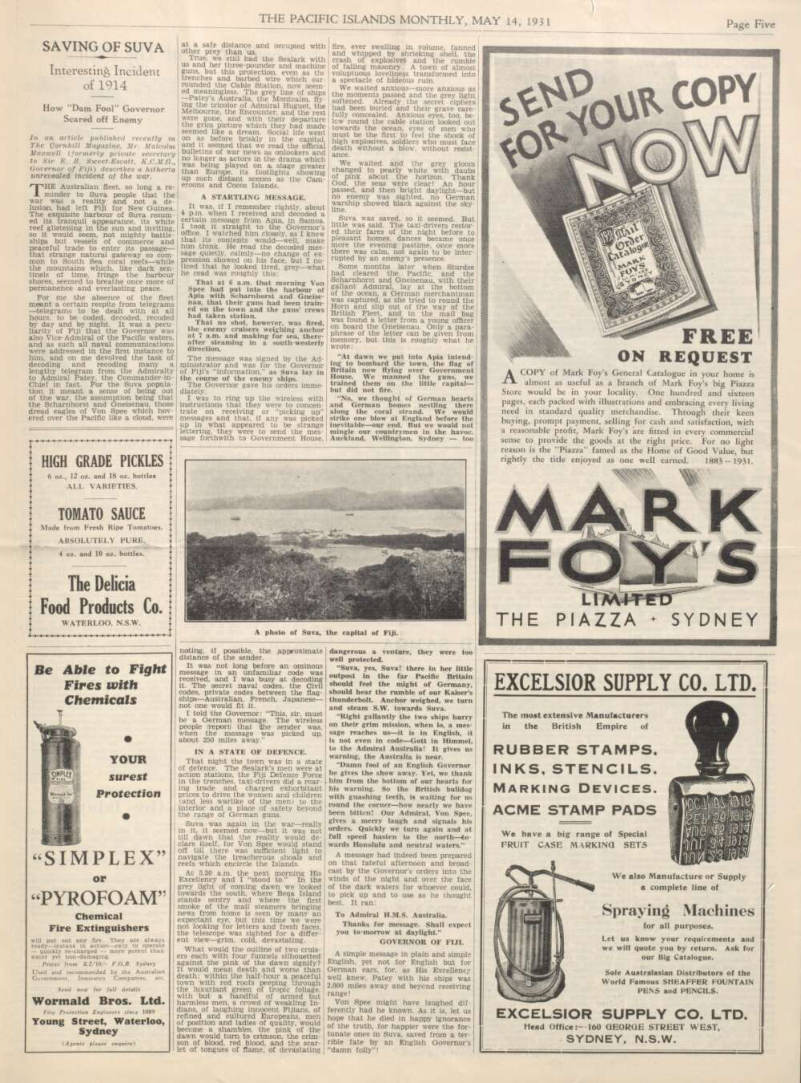
A photo of Suva, the capital of Fiji.