Caledonia
p. 10 · Read in the full issue
Beef Cattle in New
Export Trade Planned Growth of Pastoral Industry In South Seas
AN interesting development of the growing pastoral industry in the South Seas is the announce ment, made in our advertising col umns, that the New Caledonian Meat Co. Ltd. is prepared to sell cattle on the hoof to other Islands Territories.
The New Caledonian cattle provide high quality beef and they have been the basis of a considerable beef-can ning industry in New Caledonia during the past decade. It is claimed on their behalf that they have become accli matised to conditions in the South
Seas, and are comparatively free from liability to tropical diseases. The com pany believes that there is a market for these cattle in New Guinea, the Solomon Islands, New Hebrides and possibly in Fiji. The main problem is transport, and the company is pre pared to discuss this matter with pros pective purchasers.
An article published in 1929 by M.
Legras, Editor of the Bulletin du Com merce, Noumea, stated that in 1928 census showed 80,000 cattle in New Caledonia, but it was believed that there were not less than 90,000. Prob ably the number is much greater than that because the 47,000 people resi dent in New Caledonia annually consume over 14,000 head of cattle, and at least another 2,000 head are taken by the canning works. A total of over 16,000 hides were exported from New Caledonia in 1928. As the natural increase of these cattle is about 12 per cent, per annum and the herds appear to be increasing rather than decreasing it is calculated bv some that there are more than 100,000 head of cattle in the Territory. The herds are increasing rather more rapidly now than usual, because the depression and the repatri ation of Asiatic labourers have reduced the consumption of beef, while the sea sons have been very favourable to cattle-growing.
There are two canning companies operating in New Caledonia —the New Caledonia Meat Co. Ltd., an Australian concern, which has large works and an extensive area of high-class grazing country at Mueo, in the north-west, and another companv (French) which operates in the opposite direction. The Mueo factory is closed down at pre sent, but the other works are still carrying on operations. The Austra lian companv has been making efforts to improve the breed of cattle in the Territory and has imported a good class of Australian bulls. The lat ter company also is breeding on its pastoral area a very good class of light horse, suitable for racing, hack work and light carriage work.
It is interesting to note that there are now at least 15,000 head of cattle in the Solomon Islands and large num bers in the Mandated Territory of New Guinea. They are mostly in demand for grazing in coconut plantations, but in an increasing number of cases land owners are building up herds on suit able pastoral areas with a view to carrying on cattle-farming as such, in stead of merely running the cattle as an adjunct to the plantations. It has been said, for instance, that there are areas on the mainland of New Guinea particularly in the region of the Markham Valley, which are eminently suitable for cattle-farming.
The pastoral industry in Fiji has now attained large proportions and dairy ing has increased to that extent that Fiji not only supplies all her butter requirements, but now is also an im portant exporter of butter.
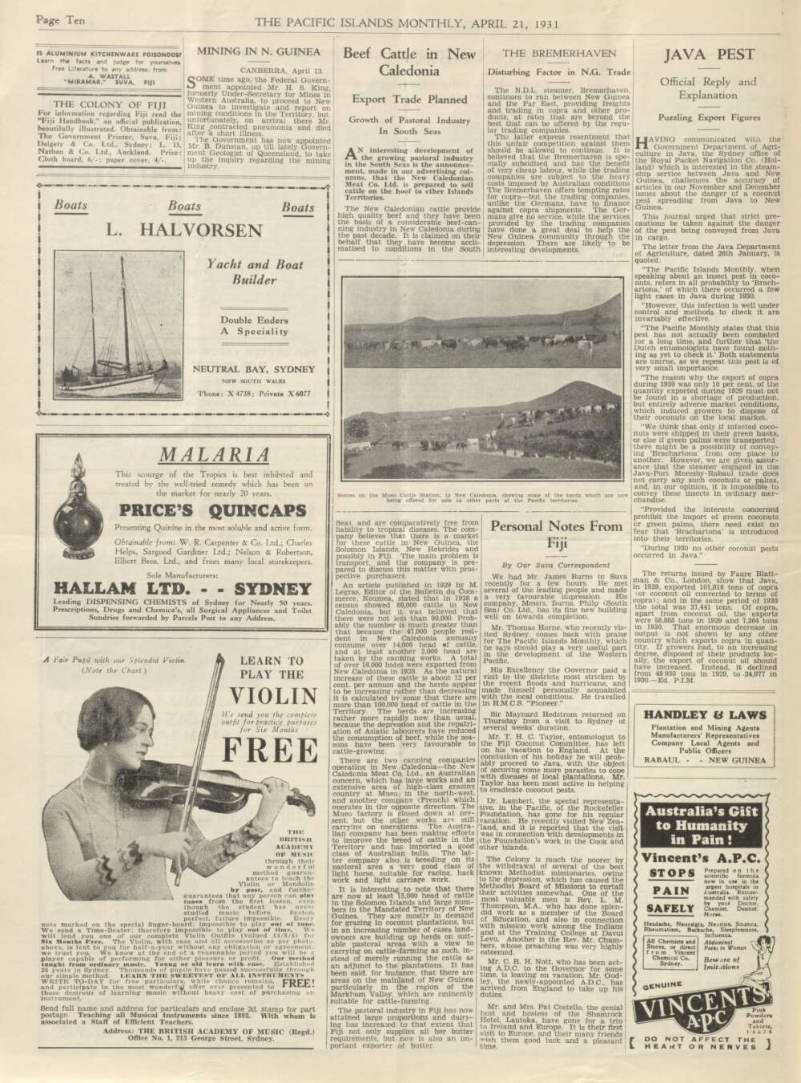
Scenes on the Mueo Cattle Station, in New Caledonia, showing some of the herds which are now being offered for sale in other parts of the Pacific territories.