Native Secrets
Anthropologist’s Work in Papua
From Our Own Correspondent.
Port Moresby, March 10.
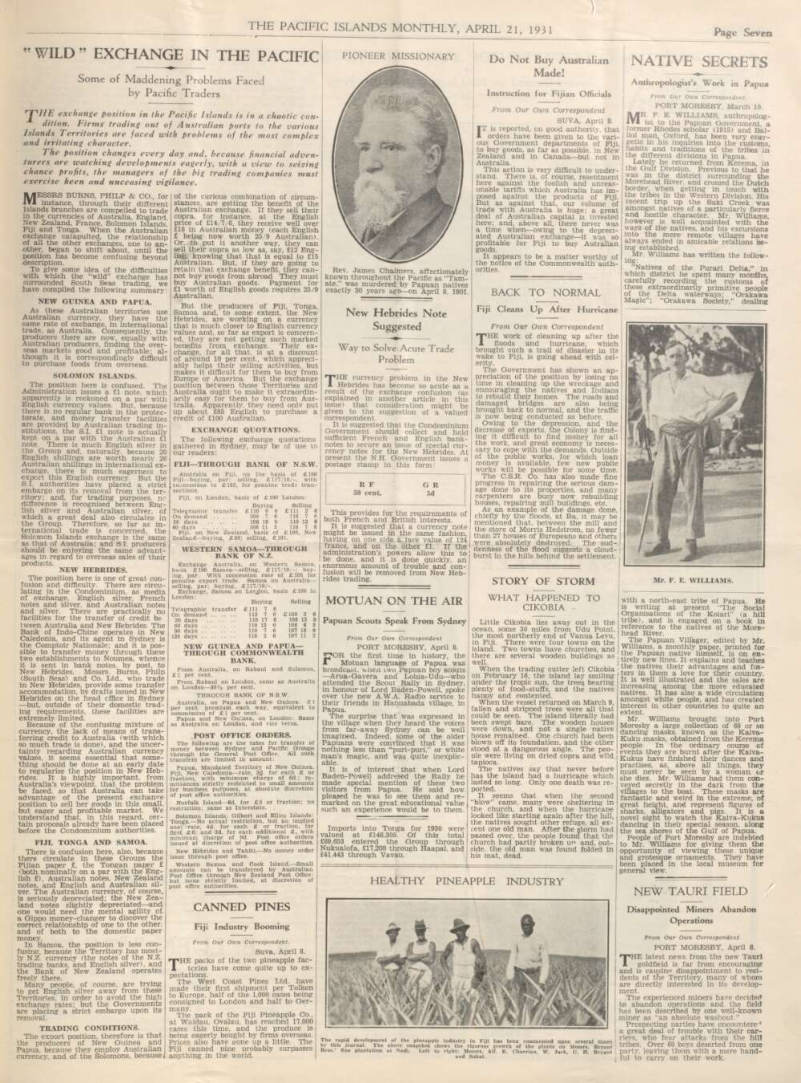
MR. F. E. WILLIAMS, anthropolog ist to the Papuan Government a former Rhodes scholar (1915) and Bal liol man, Oxford, has been very ener getic in his inquiries into the customs, habits and traditions of the tribes in the different divisions in Papua.
Lately he returned from Kerema, in the Gulf Division. Previous to that he was in the district surrounding the Morehead River, and crossed the Dutch border, when getting in touch with the tribes in the Western Division. His recent trip up the Suki Creek was amongst natives of a particularly fierce and hostile character. Mr. Williams, however is well acquainted with the ways of the natives, and his excursions into the more remote villages have always ended in amicable relations be ing established.
Mr. Williams has written the follow ing: “Natives of the Purari Delta,” in which district he spent many months, carefully recording the customs of these extraordinarily primitive people of the Delta waterways; “Orakawa Magic”; “Orakawa Society,” dealing
with a north-east tribe of Papua. He is writing at present “The Social Organisations of the Koiari” (a hill tribe), and is engaged on a book in reference to the natives of the More head River.
The Papuan Villager, edited by Mr.
Williams, a monthly paper, printed for the Papuan native himself, is on en tirely new lines. It explains and teaches the natives their advantages and fos ters in them a love for their country.
It is well illustrated and the sales are increasing among the more educated natives. It has also a wide circulation amongst white people, and has created interest in other countries to quite an extent.
Mr. Williams brought into Port Moresby a large collection of 60 or so dancing masks, known as the Kaiva- Kuku masks, obtained from the Kerema people. In the ordinary course of events they are burnt after the Kaiva- Kukus have finished their dances and practises, as, above all things, they must never be seen by a woman or she dies. Mr. Williams had them con veyed secretly in the dark from the villages to the boat. These masks are fantastic and weird in the extreme, of great height, and represent figures of sharks, alligators and pigs. It is a novel sight to watch the Kaiva-Kukus dancing in their special season, along the sea shores of the Gulf of Papua.
People of Port Moresby are indebted to Mr. Williams for giving them the opportunity of viewing these unique and grotesque ornaments. They have been placed in the local museum for general view.