Our Fijian Newsletter
A Shocking Tragedy-Extraordinary Demand for Pineapples- Trouble among Indian Community
From Our Own Correspondent
SUVA, January 29.
A SHOCKING tragedy has given the Colony a hard jolt. A launch owned by Indians and captained and driven by Indians, has been carrying many passengers for some months.
Last Sunday week the launch, the “Sita Ram,” with a crowd of passen gers, left Suva for Lautoka. When clear of the river, a sail was hoisted and made fast. About 2 p.m., when nearing Viti Levu Bay, the vessel heel ed over and commenced to fill. The evidence is very conflicting. Two European half-caste women with chil dren were apparently left to shift for themselves while the Indians grabbed the dinghy and life raft. One woman was drowned with her two-year-old son, while the other was swimming for a while before anyone tried to help her. She says the Indian men were all rescued first.
The story of how three helpless peo ple were drowned and four others, evi dently imprisoned in the cabin, were left to help themselves and perished miserably, makes sad reading. The launch sank in 20 fathoms of water and efforts are being made by the Pun jabi owners to raise her.
She had 19 bags of mail, including the papers and parcels ex Niagara from New Zealand and Australia on
board, and all went down with th launch.
Hunting Trouble.
In connection with the sinking of the Sita Ram, a remarkable story how fate works is told of Mrs. Ragg wife of the Hon. H. H. Ragg, who in tended to travel by the launch. He son set the alarm clock in time to get to the boat, but somehow stopped the alarm. When the house awakened Mrs. Ragg decided to try and catch the boat, as her husband was to meet her at Ellington. So her son drove her to the Wainibokasi, some 15 miles from Suva. But the launch had passed, so away the car drove to Nakelo, only to find they had again missed her.
Undismayed, they drove to the shore facing Bau Island and, after waiting half-an-hour, got into a punt and were rowed to the island.
Here, after some delay—which really proved a blessing—a sailing canoe was obtained and a start made to catch the launch, which could be seen away about a mile seaward. In spite of all efforts, the canoe could not make the people on the launch see them and as the seas were too rough for the frail canoe, it hove to as another launch, the Adi Cakau, was seen coming along and in her Mrs. Ragg safely reached Ellington, to find her anxious husband waiting for her, and glad to find she was safe. It was a remarkable chase against fate.
The Pineapple Industry.
The press statement that a shipment of canned pineapples from the East Indies has been landed in New Zea land brings up the question of the new industry in Fiji, namely, the can ning of choice pineapples.
The quality of the Fiji article has already won its way into the ranks of American connoisseurs, and should easily lead in the market as soon as its virtues are known.
A rather amusing story will illus trate how high the Fiji canned pine apple ranks as a delicacy. A very prominent American expert was in Suva last year, and while here the quality of canned pineapple cropped up. It was decided that the expert give his considered opinion, so all the known brands of Pacific canned pine apples were opened and placed anony mously in front of him. There were the best brands of Honolulu, South Africa, Singapore and Queensland, with, of course, the local production.
The expert carefully tried all and em phatically decided upon one sample.
When its identity was disclosed, it turned out to be the Fiji article.
So far, the demand for the Fiji pine has been extraordinary, orders (which could not be fulfilled) coming from all over the world. But the two compan ies are trying to dispose of their fruit to as many centres as possible, with
a view of allowing all countries wherever possible to have the oppor tunity of sampling them.
The Fiji fruit of all kinds has a deli cate flavour of its own, due, it is said, to the soapstone in the soil. Be that as it may, no banana or paw-paw can vie with the Fiji article. It is certain that so soon as quantities allow, the Fiji canned pineapple will become a prime favourite in New Zealand and Australia, whenever the people realise the wonderful flavour and delicacy of the fruit.
A Sad Suicide.
A sad suicide is reported from Dre keti. It appears that Mr. John Wil liam Dunbar was employed on a plan tation but, owing to the low price of copra, was dismissed or retrenched.
This made him despondent and, as he had a wife and two children, his posi tipn caused him much worry. The fam ily stayed with a planter named Suth erland. One forenoon Dunbar, who seemed to be in a good mood, walked away into the bush and was never seen alive again. When a search was made, he was found lying dead, with his .22 gun lying alongside of him. He left a note for his wife, saying he was tired
of it all “and could not stick it.” An inquiry was held and a verdict brought in according to the evidence.
Indian Trouble.
For a long time there has been a quiet but persistent trouble brewing between two sections of the Indian Hindus in the Colony. The advanced section, the Arya Samaj, had good workers and made great headway and seemed to be leading Indian thought.
The older people, of the older sect, the Sanatam Dharm, had no leader and felt the best thing to do was to go softly. But they managed last year to import a Pundit of renown, who was a strong man, and he soon brought the party together.
Now a second Pundit has arrived from India and feeling is becoming stronger. The wiser heads counsel conciliation, but already one case has come into court, where the opposing parties in an assault case were recog nise as representing the two sections, and feeling ran high.
Personal.
There are persistent rumours that the Hon. Islay McOwan, C.M.G., the act ing Colonial Secretary and Secretary of Native Affairs, is going to retire this year, owing to having reached the age limit. It is earnestly hoped that the Government will realise his great value to the Colony and request him to con tinue in office for some more years The wedding of His Lordship the Bishop in Polynesia is an all-Pacific matter of interest. His Lordship rather gave his friends a surprise by deciding to enter the flock of benedicts, and his friends hope that the union may be a happy one and one which will advance his usefulness in the large sphere in which he is placed. Meantime, he and his bride are on their honeymoon in New Zealand.
Mr. H. W. Simmonds, the Govern ment entomologist, has returned from a lengthy vacation, which embraced Europe and South Africa. Mr. Sim monds is well in the public eye for at least one fine example of his ability this being the beautiful illustrations of the coconut pests, which he pre pared for the fine work issued recently by the Department of Agriculture.
A most delightful personality is Mrs.
Hope-Evans, wife of the skipper of the L.M.S. three-masted schooner, John Williams V., which has sailed on her first voyage in mission work to the Gilberts. Mrs. Hope-Evans is a de lightful speaker, forceful and persuas ive, melting hearts by her eloquence and earnestness. Her speech at the St.
Andrews send-off to her husband and his ship’s comany will never be forgot ten by all who heard her. She will make Suva her home while the schooner is cruising on mission work among the Gilbert, Ellice and Tokelau Groups.
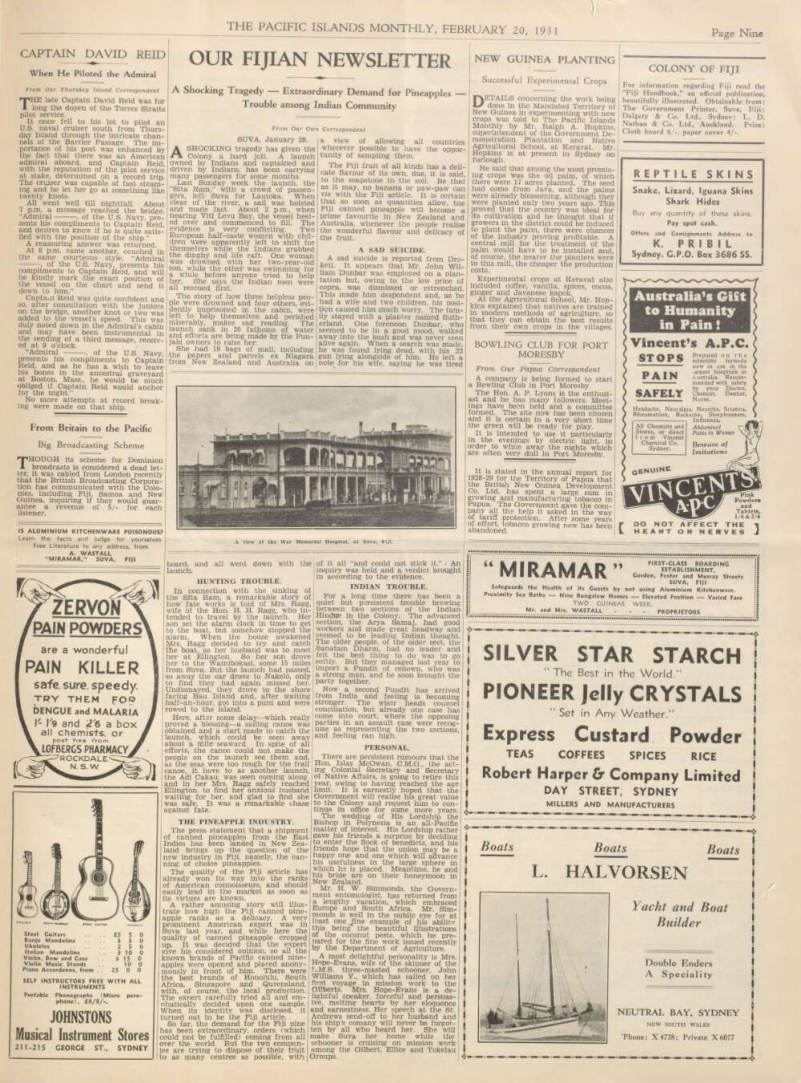
A view of the War Memorial Hospital, at Suva, Fiji.