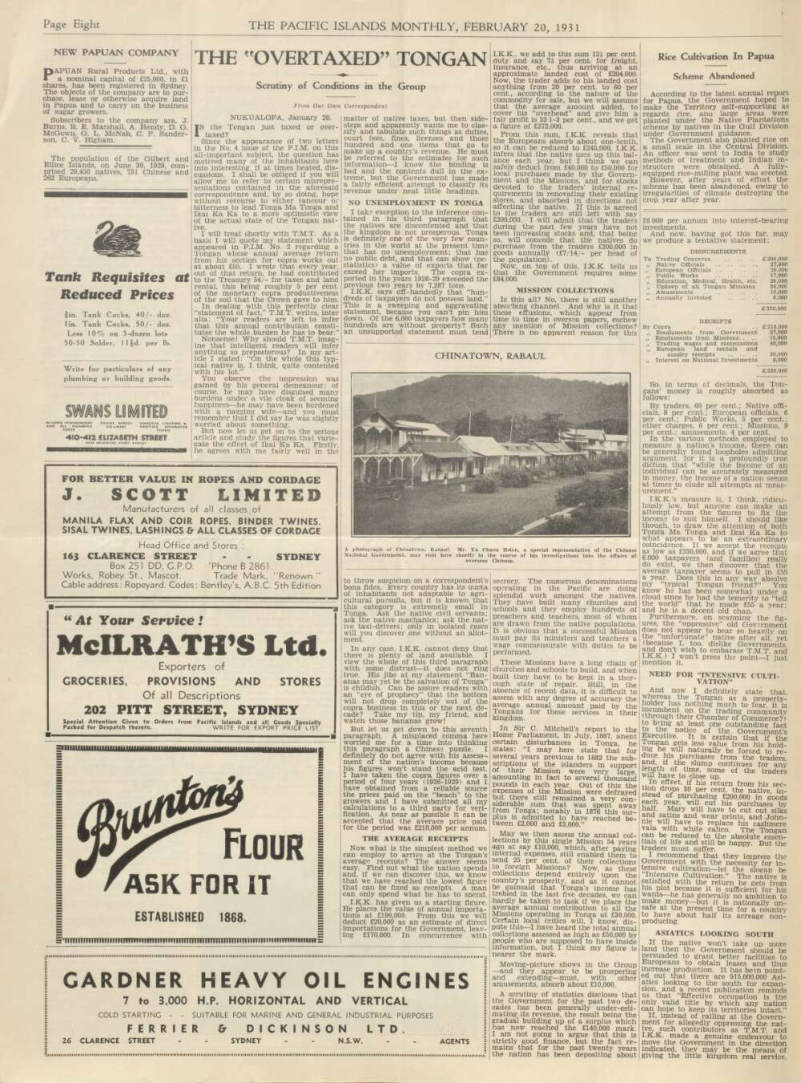
Chinatown, Rabaul
to throw suspicion on a correspondent’s bona fides. Every country has its quota of inhabitants not adaptable to agri cultural pursuits, but it is known that this category is extremely small in Tonga. Ask the native civil servants: ask the native machanics; ask the nat ive taxi-drivers; only in isolated cases will you discover one without an allot ment.
In any case, I.K.K. cannot deny that there is plenty of land available. I view the whole of this third paragraph with some distrust —it does not ring true. His jibe at my statement “Ban anas may yet be the salvation of Tonga” is childish. Can he assure readers with an “eye of prophecy” that the bottom will not drop completely out of the copra business in this or the next de cade? Take my tip, my friend, and watch those bananas grow!
But let us get down to this seventh paragraph. A misplaced comma here worried me for a time into thinking this paragraph a Chinese puzzle. I definitely do not agree with his assess ment of the nation’s income because his figures won’t stand the acid test.
I have taken the copra figures over a period of four years (1926-1929) and I have obtained from a reliable source the prices paid on the “beach” to the growers and I have submitted all my calculations to a third party for veri fication. As near as possible it can be accepted that the average price paid for the period was £210,000 per annum.
The Average Receipts
Now what is the simplest method we can employ to arrive at the Tongan’s average receipts? The answer seems easy. Find out what the nation spends and, if we can discover this, we know that we have reached the lowest figure that can be fixed as receipts. A man can only spend what he has to spend.
I.K.K. has given us a starting figure.
He places the value of annual importa tions at £190,000. Prom this we will deduct £20,000 as an estimate of direct importations for the Government, leav ing £170,000. In concurrence with
secrecy. The numerous denominations operating in the Pacific are doing splendid work amongst the natives.
They have built many churches and schools and they employ hundreds of preachers and teachers, most of whom are drawn from the native populations.
It is obvious that a successful Mission must pay its ministers and teachers a wage commensurate with duties to be performed.
These Missions have a long chain of churches and schools to build, and when built they have to be kept in a thor ough state of repair. Still, in the absence of recent data, it is difficult to assess with any degree of accuracy the average annual amount paid by the Tongans for these services in their kingdom.
In Sir C. Mitchell’s report to the Home Parliament, in July, 1887, anent certain disturbances in Tonga, he states: “I may here state that for several years previous to 1882 the sub scriptions of the islanders in support of their Mission were very large amounting in fact to several thousand pounds in each year. Out of this the expenses of the Mission were defrayed but there still remained a very con siderable sum that was spent away from Tonga; notably in 1876 this sur plus is admitted to have reached be tween £2,000 and £3,000.”
May we then assess the annual col lections by this single Mission 54 years ago at say £10,000, which, after paying internal expenses, still enabled them to send 25 per cent, of their collections to foreign Missions? Now, as these collections depend entirely upon the country’s prosperity, and as it cannot be gainsaid that Tonga’s income has trebled in the last five decades, we can hardly be taken to task if we place the average annual contribution to all the Missions operating in Tonga at £30,000.
Certain local critics will, I know, dis pute this—l have heard the total annual collections assessed as high as £50,000 by people who are supposed to have inside information, but I think my figure is nearer the mark.
Moving-picture shows in the Group —and they appear to be prospering and extending—must, with other amusements, absorb about £10,000.
A scrutiny of statistics discloses that the Government for the past two de cades has been generally under-esti mating its revenue, the result being the gradual building up of a surplus which has now reached the £140,000 mark.
I am not going to argue that this is strictly good finance, but the fact re mains that for the past twenty years the nation has been depositing about
A photograph of Chinatown, Rabaul. Mr. Yu Chuen Hsien, a special representative of the Chinese National Government, may visit here shortly in the course of his investigations into the affairs Of overseas Chinese.