Intensive Penetration of New Territory
New Guinea Administration’s Policy
over 117,000 of the half-million native population of the Mandated Territory of New Guinea have been visited by Government officials, and new tribes are coming under control every year.
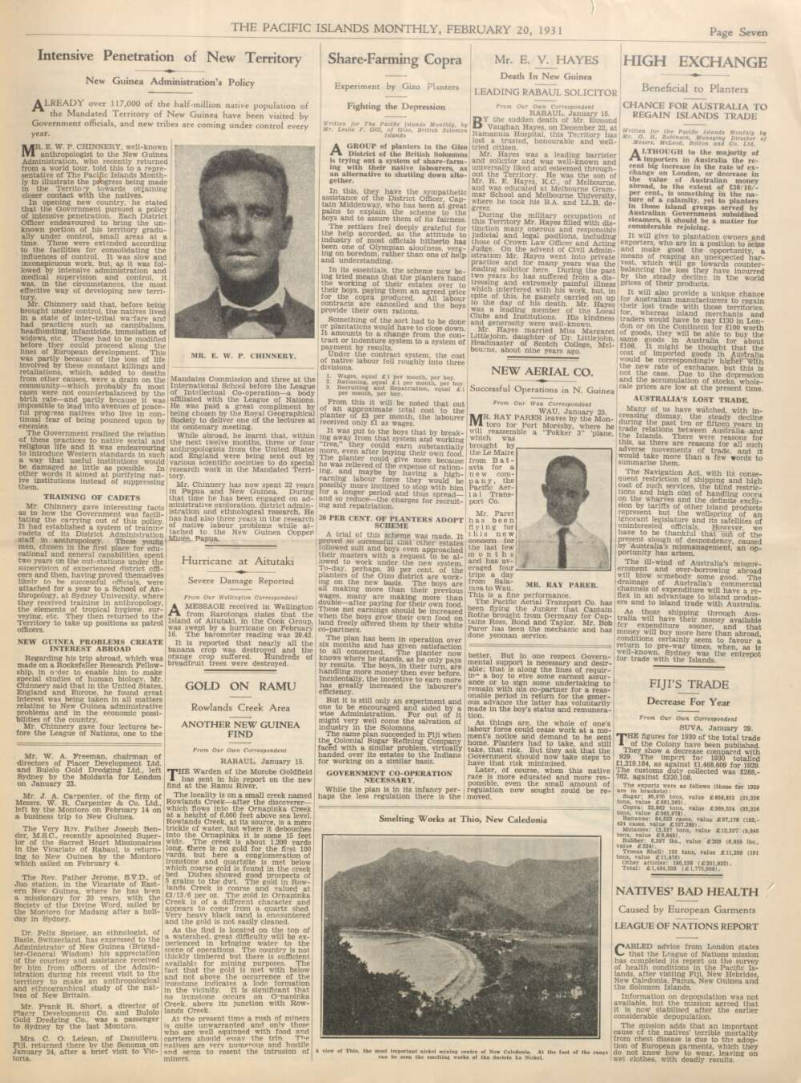
MR. E. W. P. CHINNERY, well-known anthropologist to the New Guinea Administration, who recently returned from a world tour, told this to a repre sentative of The Pacific Islands Month ly to illustrate the progress being made in the Territory towards obtaining closer contact with the natives.
In opening new country, he stated that the Government pursued a policy of intensive penetration. Each District Officer endeavoured to bring the un known portion of his territory gradu ally under control, small areas at a time. These were extended according to the facilities for consolidating the influences of control. It was slow and inconspicuous work, but, as it was fol lowed by intensive administration and medical supervision and control, it was, in the circumstances, the most effective way of developing new terri tory.
Mr. Chinnery said that, before being brought under control, the natives lived in a state of inter-tribal warfare and had practices such as cannibalism, headhunting, infanticide, immolation of widows, etc. These had to be modified before they could proceed along the lines of European development. This was partly because of the loss of life involved by these constant killings and retaliations, which, added to deaths from other causes, were a drain on the community—which probably in most cases were not counterbalanced by the birth rate—and partly because it was impossible to lead into avenues of peace ful progress natives who live in con tinual fear of being pounced upon by enemies.
The Government realised the relation of these practices to native social and religious life and it was endeavouring to introduce Western standards in such a way that useful institutions would be damaged as little as possible. In other words it aimed at purifying nat ive institutions instead of suppressing them.
Training Of Cadets
Mr. Chinnery gave interesting facts as to how the Government was facili tating the carrying out of this policy.
It had established a system of training cadets of its District Administration staff in anthropology. These young men, chosen in the first place for edu cational and general capabilities, spent two years on the out-stations under the supervision of experienced district offi cers and then, having proved themselves likely to be successful officials, were attached for a year to a School of An thropology, at Sydney University, where they received training in anthropology, the elements of tropical hygiene, sur veying, etc. They then returned to the Territory to take up positions as patrol officers.
New Guinea Problems Create
Interest Abroad
Regarding his trip abroad, which was made on a Rockefeller Research Fellow ship, in order to enable him to make special studies of human biology. Mr.
Chinnery said that in the United States, England and Europe, he found great interest was being taken in all matters relating to New Guinea administrative problems and in the economic possi bilities of the country.
Mr. Chinnery gave four lectures be fore the League of Nations, one to the
Mandates Commission and three at the International School before the League of Intellectual Co-operation—a body affiliated with the League of Nations.
He was paid a great compliment by being chosen by the Royal Geographical Society to deliver one of the lectures at its centenary meeting.
While abroad, he learnt that, within the next twelve months, three or four anthropologists from the United States and England were being sent out by various scientific societies to do special research work in the Mandated Terri tory.
Mr. Chinnery has now spent 22 years in Papua and New Guinea. During that time he has been engaged on ad ministrative exploration. district admin istration and ethnological research. He has had also three years in the research of native labour problems while at tached to the New Guinea Copper Mines, Papua.