Thursday Island Topics
Retrenchment in Marine Industries-Fewer Tourists Arriving- Electric Light for Hospital
From Our Own Correspondent
THURSDAY IS U January 27.
TO what extent the marine industries will be carried on during the next two years is very uncertain, but, doubt less, efforts will be made to continue production as far as possible.
In the meantime retrenchment is the order of the day and over 100 Jap anese, mostly old hands in the indus try, left for their homes early in Feb ruary.
The prosperity of local industries de pends on overseas demand, and if it
should improve, work will proceed here much as usual, in spite of the low state of Australian finances.
One result of the hard times is the small number of passengers arriving and leaving the ports, as people can not afford to travel for pleasure, and business depression does not warrant much coming and going.
Curtailment Of Mission
Expenses.
Local news, as may be imagined, is conspicuous by its absence. The Bis hop of Carpentaria reports that the balance-sheets of the various mission enterprises under his charge came out
nated by Messrs. Heinke, of London, is now completed and ready for use.
“Treacle” And The Shark.
The admission of another case of shark bite to the Torres Strait Hospi tal —this time a Malay who was at tacked at Haggerston Island recalls many similar occurrences in the past and reminds us of the constant risk that attends the crews of fishing and diving boats. The most famous of all these tragedies was that of Treacle, an aboriginal from the Lockhart River, whose narrow escape from death has been featured in many newspapers all over the world. So well-known is Treacle’s exploit that not long ago a member of the medical research coun cil in London wrote and asked for a photo of this hero for publication in a book to be devoted to the subject of diving accidents.
Treacle’s whole head and neck were engulfed in the monster’s mouth, but he managed to escape with terrible injuries, and was nursed to recovery in the local hospital. Treacle died of cancer two or three years ago, a not able fact in itself, as this disease is fortunately very rare among the abor iginals.
Cases of this sort do not make very pleasant reading, but they are worth recording if only to stress the remark able fortitude that is shown by natives who have been attacked.
From far away Coconut Island, a little wind-swept, coral atoll that is de scribed with great sympathy and charm by Alain Gerbault in a recent book of travels, comes the hero of another such exploit, and one is glad to make a pub lic tribute in this article to Johnny Maori’s courage. Though shockingly injured and unable to receive medical assistance for some 20 hours, he proved a true stoic in hospital. It was gener ally believed by those who nursed him that the little black pipe that, lit or unlit, stuck out of his mouth through out his long illness, was the chief fac tor in saving his life. Some years ago, the same man was capsized at sea while out alone in his dinghy; for no less than five days he drifted to and fro through lonely waters of the Straits before he was rescued —truly a very stout-hearted fellow—and we are glad to record that most of our Island folk display wonderful powers of endurance and personal bravery.
As an example of this, another inci dent may be quoted. A white lad was diving for trepang in the company of
better than was expected, but the pros pects for 1931 are not so hopeful and curtailment of expense in some way will have to be adopted.
The David Pitt, a cutter owned by Mr. Harvey, of the Papuan Industries, was sold to Mr. Hines, of Daru, re cently.
Swiss Anthropologist’S
Visit.
Dr. Wiertz, a well-known Swiss an thropologist, who had been on a previ ous visit to Dutch New Guinea, re turned there from Daru at Christmas time, after spending some time in Western Papua on anthropological work among the natives. After his first visit, he published a book, which is said to have been very clever, but, being in German, is beyond the ken of most of us. It is hoped that any new work of his, especially with regard to Papua, will be translated into Eng lish.
Hospital’S Financial
Position.
The annual report and balance-sheet of the Torres Strait Hospital was sub mitted to subscribers at the annual meeting on January 20, and it shows the financial position, which has always been very sound, to be satisfactory, though the income is bound to drop during the current year. The manage ment, which is carried on by a com mittee of business men, has been always marked by a careful policy of husband ing resources and yet keeping the in stitution up-to-date.
Further improvements are promised during the year—electric light and an X-ray plant—and these have been made possible chiefly owing to a handsome donation of £515, made by the pearlers in 1930. The compression chamber do
an aboriginal from a very uncivilised part of Cape York Peninsula, when they were rushed at by a shark. The native, without a moment’s hesitation, caught hold of his white companion and lifted him clean out of the water, quite ignoring his own danger. Both of them escaped injury.
Sharks usually make their attack in “dirty water,” and, in too many cases, the victim has never been seen again, but there have been instances in which natives have effected their escape by gouging out the eyes of the shark.
Action of this sort seems to be the most effective form of counter attack.
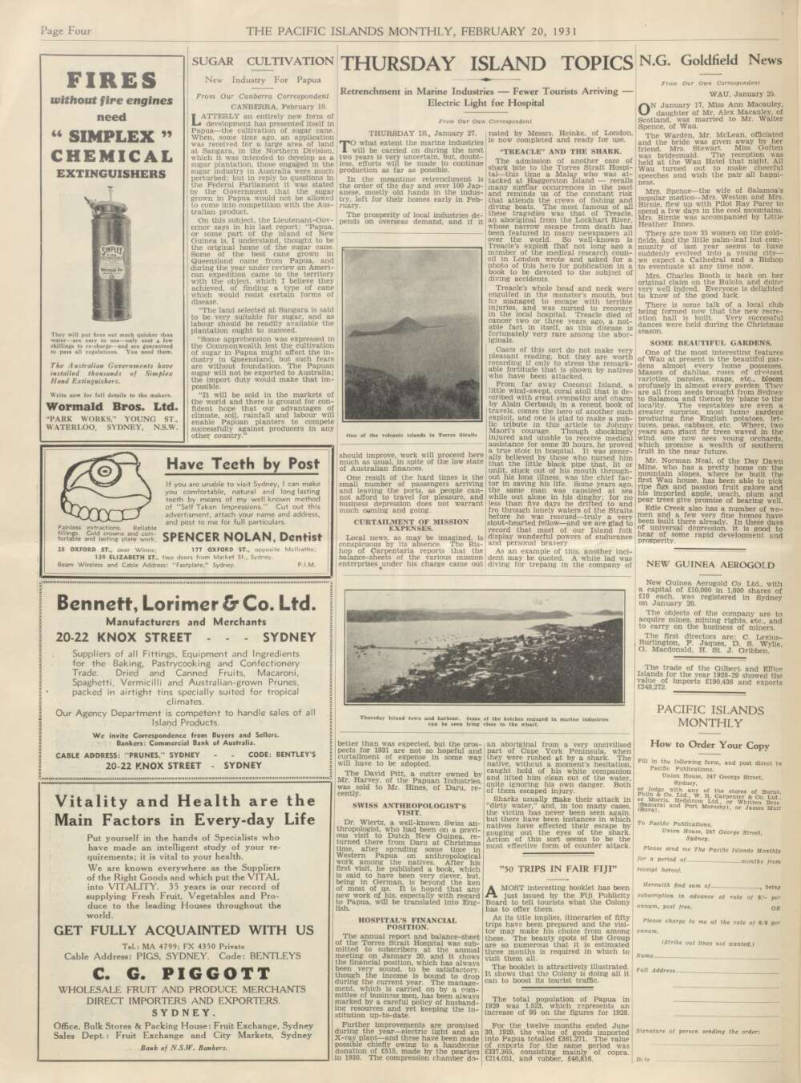
One of the volcanic islands in Torres Straits
Thursday Island town and harbour. Some of the ketches engaged in marine industries can be seen lying close to the wharf.