Tropical Mankind’S Great Foe
pp. 1-2 · Read in the full issue
———♦——— The History of Malaria Fever Some Hints for its Prevention and Treatment
Specially written for The Pacific Islands Monthly by two tropical practitioners MALARIA is such a common, homely sort of an occurrence in the routine of tropical life that very little notice is taken of it.
So frequently does it obtrude that we come to regard an attack —especially in the other fellow—as a "touch of fever,” and many a conscientious planter or official struggles on with his work simply because it is not considered playing the game to give way to it
too easily.
This is an error which is paid for rather dearly, for malaria is one of tropical mankind’s greatest foes.
LOOK at malaria’s record; delve into history and you will find that it has been blamed as one cause of the downfall of the Roman Empire, and it always in the past has been a deterrent to the work of civilisation in the tropics. The ambition of the French to cut the Panama Canal was frustrated by malaria; early efforts at mining in Papua were held back by its malign influence; one might even say that the British lost Sumatra largely on account of its heavy toll on officials at Bencoolen.
If that’s not making, or rather mismaking, history, well, what is?
Even at the present day the position is not much better.
Dr. Torrance, in his interesting book, “Tracking down the Enemies of Man,” states that: “Female mosquitoes cause a greater number of deaths every year than the number of citizens brought into the world by the mothers of any of the great nations. This is a startling statement, but facts bear it out. Actual records show that these insects kill two million people a year, . . .”
Anybody with experience of the disease could believe such figures.
For instance, about two years ago the natives in a little village in Torres Straits, where malaria is by no means common, were attacked almost to a man and many deaths resulted. Lawrence Hope knew what she was talking about when she described malaria’s “Gifts: Death and Delirium.”
Investigations By
Herodotus.
The story of the investigations into malaria fever, which have now brought us to a very complete understanding of the disease, reads like a romance.
It started in a very early stage of the
world’s history with a remarkably accurate description of the disease by Herodotus in the fifth century B.C.
In the Middle Ages our knowledge did not advance, in fact, that was a period of the world’s history when nothing advanced, but in 1640 we read of two doctors, Morton and Torti, first using Cinchona (quinine) in the treatment of ague. That was a step forward, a discovery worthy of being emblazoned on the records of the world’s progress, and yet, outside of academical circles, who has ever heard of the names of these benefactors of humanity?
In 1880 the French doctor, Laveran, discovered the parasitic nature of malaria and demonstrated the various forms of the parasite found within the blood corpuscles of the victims of the disease. But these forms only constitute one stage in the life history of the parasite, and the germ requires another host than Man for the completion of its cycle.
It is to two great Englishmen that we owe the final solution of how we catch malaria Sir Patrick Manson and Sir Ronald Ross. The great Manson, working patiently in his laboratory in Amoy, China, conceived the idea that the mosquito would be found to be the causative agent in malaria, and he handed on his theory to his young colleague, who finally solved the problem of mosquito transmission. His experiments were confirmed by Samborn and Low at the London School of Tropical Medicine. We believe that Dr.
Low practised in the Pacific, and some of those who read this little article may have made his acquaintance.
How Infection Takes Place.
Let us briefly summarise the process of mosquito infection, remembering that it is the female that causes the disease, the male being a poor, harmless sort of crank who lives upon fruit juices only: “In 1900 the tropical colonies of England, Holland, France, Germany, Italy and America were danger zones for white men. The mosquito had absolute right of way and worked as they still do whenever the opportunity is given them. The female blood-suckers gorge themselves with human blood, at the same time sucking into their bodies young germs that patiently swim in the blood, waiting for transference to their new home.
Then, after a few days, these same females hunt up a new victim, suck out a meal of blood, and for payment pump into the blood stream mature and dangerously developed malaria germs, each of which at once takes possession of a red blood cell. In this cell the parasite lives and multiplies into a family, in the process destroying the blood cell thousands and thousands of parasites develop and destroy enormous numbers of blood cells. The effect of this on the human victim is soon strikingly shown. After a number of days, approximately twelve, this causes periodic fevers, anaemia, a large spleen and numerous other conditions, producing less of vitality and weaken ing the body, leading to prostration and possibly death.”—Torrance.
In all respects but one the identification of the offending Anopheles mos-
(Continued On Page 2)
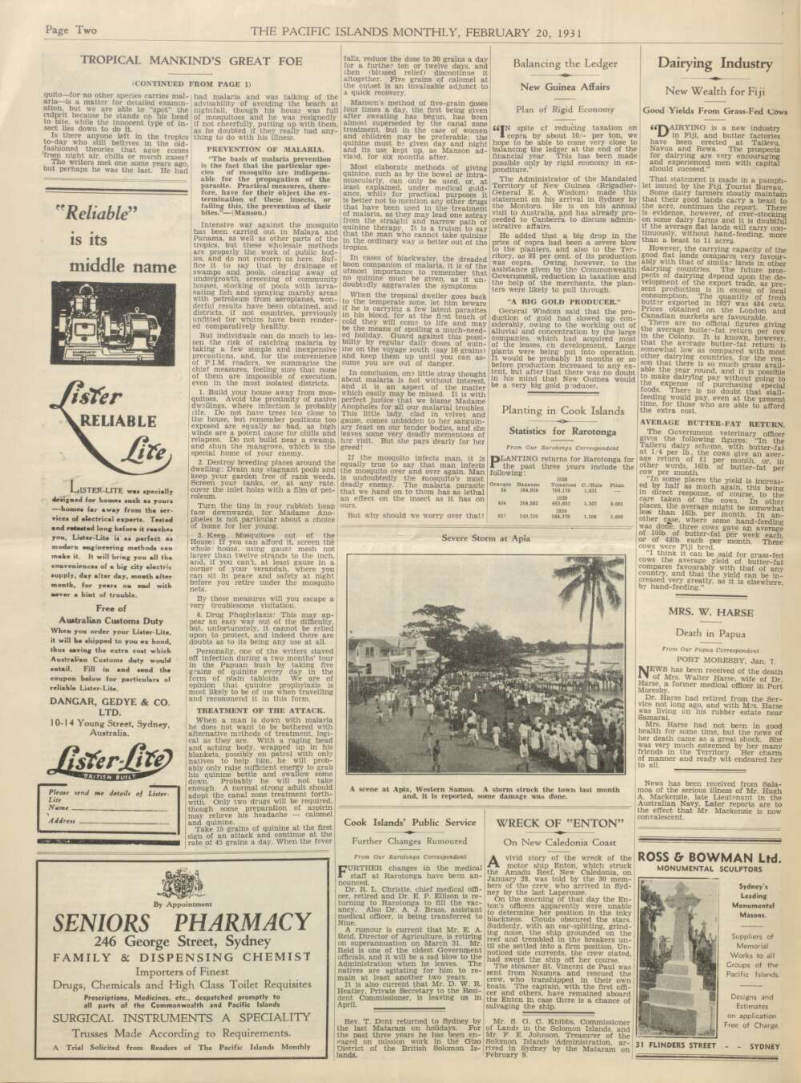
A mangrove swamp in New Guinea. As told in the accompanying article, places like this are the favourite homes of the Anopheles mosquito. ———
aria—is a matter for detailed examination, but we are able to “spot” the culprit because he stands on his head to bite, while the innocent type of insect lies down to do it.
Is there anyone left in the tropics to-day who still believes in the old fashioned theories that ague comes from night air, chills or marsh gases?
The writers met one some years ago, but perhaps he was the last. He had
had malaria and was talking of the advisability of avoiding the beach at nightfall, though his house was full of mosquitoes and he was resignedly if not cheerfully, putting up with them, as he doubted if they really had any thing to do with his illness.
Prevention Of Malaria.
“The basis of malaria prevention is the fact that the particular species of mosquito are indispensable for the propagation of the parasite. Practical measures, there fore, have for their object the extermination of these insects, or failing this, the prevention of their bites.” — (Manson.) Intensive war against the mosquito has been carried out in Malaya and Panama, as well as other parts of the tropics, but these wholesale methods are properly the work of public bodies, and do not concern us here. Suffice it to say that by drainage of swamps and pools, clearing away of undergrowth, screening of community houses, stocking of pools with larva eating fish and spraying marshy areas with petroleum from aeroplanes, wonderful results have been obtained, and districts, if not countries, previously unfitted for whites have been rendered comparatively healthy.
But individuals can do much to lessen the risk of catching malaria by taking a few simple and inexpensive precautions, and, for the convenience of P.I.M. readers, we summarise the chief measures, feeling sure that none of them are impossible of execution, even in the most isolated districts. 1. Build your house away from mosquitoes. Avoid the proximity of native dwellings, where infection is probably rife. Do not have trees too close to the house, but remember positions too exposed are equally as bad, as high winds are a potent cause for chills and relapses. Do not build near a swamp, and shun the mangrove, which is the special home of your enemy. 2. Destroy breeding places around the dwelling: Drain any stagnant pools and keep your garden free of rank weeds.
Screen your tanks, or, at any rate, cover the inlet holes with a film of petroleum.
Turn the tins in your rubbish heap face downwards, for Madame Anopheles is not particular about a choice of home for her young. 3. Keep Mosquitoes out of the House: If you can afford it, screen the whole house, using gauze mesh not larger than twelve strands to the inch, and, if you can’t, at least gauze in a corner of your verandah, where you can sit in peace and safety at night before you retire under the mosquito nets.
By these measures will you escape a very troublesome visitation. 4. Drug Phophylaxis: This may appear an easy way out of the difficulty, but, unfortunately, if cannot be relied upon to protect, and indeed there are doubts as to its being any use at all.
Personally, one of the writers staved off infection during a two months’ tour in the Papuan bush by taking five grains of quinine every day in the form of plain tabloids. We are of opinion that quinine prophylaxis is most likely to be of use when travelling and recommend it in this form.
Treatment Of The Attack.
When a man is down with malaria he does not want to be bothered with alternative methods of treatment, logical as they are. With a raging head and aching body, wrapped up in his blankets, possibly on patrol with only natives to help him, he will probably only raise sufficient energy to grab his quinine bottle and swallow some down. Probably he will not take enough. A normal strong adult should adopt the canal zone treatment forth with. Only two drugs will be required, though some preparation of aspirin may relieve his headache — calomel and quinine.
Take 15 grains of quinine at the first sign of an attack and continue at the rate of 45 grains a day. When the fever
falls, reduce the dose to 30 grains a day for a further ten or twelve days, and then (blessed relief) discontinue altogether. Five grains of calomel at the outset is an invaluable adjunct to a quick recovery.
Manson’s method of five-grain doses four times a day, the first being given after sweating has begun, has been almost superseded by the canal zone treatment, but in the case of women and children may be preferable; the quinine must be given day and night and its use kept up, as Manson advised, for six months after.
Most elaborate methods of giving quinine, such as by the bowel or intramuscularly, can only be used, or, at least explained, under medical guidance, while for practical purposes it is better not to mention any other drugs that have been used in the treatment of malaria, as they may lead one astray from the straight and narrow path of quinine therapy. It is a truism to say that the man who cannot take quinine in the ordinary way is better out of the tropics.
In cases of blackwater, the dreaded boon companion of malaria, it is of the utmost importance to remember that no quinine must be given, as it undoubtedly aggravates the symptoms.
When the tropical dweller goes back to the temperate zone, let him beware if he is carrying a few latent parasites in his blood, for at the first touch of cold they will come to life and may be the means of spoiling a much-needed holiday. Guard against this possibility by regular daily doses of quinine on the voyage south (say 10 grains) and keep them up until you can assume you are out of danger.
In conclusion, ons little stray thought about malaria is not without interest, and it is an aspect of the matter which easily may be missed. It is with perfect justice that we blame Madame Anopheles for all our malarial troubles.
This little lady, clad in velvet and gauze, comes unbidden to her sanguinary feast on our tender bodies, and she leaves some very deadly mementoes of her visit. But she pays dearly for her greed!
If the mosquito infects man, it is equally true to say that man infects the mosquito over and over again. Man is undoubtedly the mosquito’s most deadly enemy. The malaria parasite that we hand on to them has as lethal an effect on the insect as it has on ours.
But why should we worry over that! ———