Papuan News
Slight Recovery in Copra Prices—Many "Pay-offs” at Samarai — Gold on the Tauri River —Water Shortage at Port Moresby
From Our Own Correspondent
Port Moresby, Nov. 15.
COPRA has risen from £14/2/6, to which low price it dropped in Octo ber, to £16/5/-.
This has cheered the planters up a little, for at the former price it was quite unprofitable, and there are ru mours that it is going to rise steadily.
Unfortunately, this is only a rumour.
The desiccated coconut factories have been a great boon to a few plantations, both in the west and east of Papua, buying up the green nuts and paying a better price than that offered for copra. As many planters as are able are selling their coconuts in this way.
Samarai is in the centre of this in dustry and, in consequence, has not felt the pinch so badly as other dis tricts, which are dependent on outside markets. Also the traders in Samarai are enjoying a brief wave of prosperity, owing to so many native labourers being paid off at one time, which gives the place a fictitious feeling of comfort and security, quite in variance to Port Moresby, where “depression” is the only topic of conversation.
Reduced October Exports.
The following exports in October will give a fair idea of the state the territory is in at the present time and its general output; though, besides this list, copra is shipped direct to European ports every three months, through the agency of Burns, Philp, but to no very great degree. 901 packages desiccated coconut. 1453 packages rubber. 369 bags beche-de-mer. 24 bales hemp. 8 bags Mauritius beans. 50 packets sundries.
Result Of Gold Expedition.
The rush to the Tauri River for gold has not quite come up to the expecta tions of the few who had the courage and determination to go prospecting in such a hostile country. The spot where the find was reported is situated on one of the branches of the Tauri River, about 5 days’ walk from the landing.
The party of six, accompanied by Patrol Officer J. Hide, who had found the gold, reached the spot, but here the prospects did not correspond with the previous find. To test the area thoroughly a box was put down and a gang of twenty natives worked on the box, and the average, over five days, was only 3 dwts. per day, which was disappointing. The party then divided, some prospecting further upstream. In one place they obtained prospects of 6 dwts. per day, which proved unsatis factory, also.
The leader of the party says they secured fine colours at the headwaters
of the Tauri, and considers the country promising. He hopes to return to the district shortly. The natives around the Tauri are numerous and hostile.
On four occasions they attacked the camps, and it was impossible to become friendly with them.
The new Tauri find is within the boundaries of the old Lakekamu gold field, which had considerable fame some years back. It would be a great help to Papua if the Tauri River proved successful and we could export gold like New Guinea.
Unique Dances At Hanua
Bada.
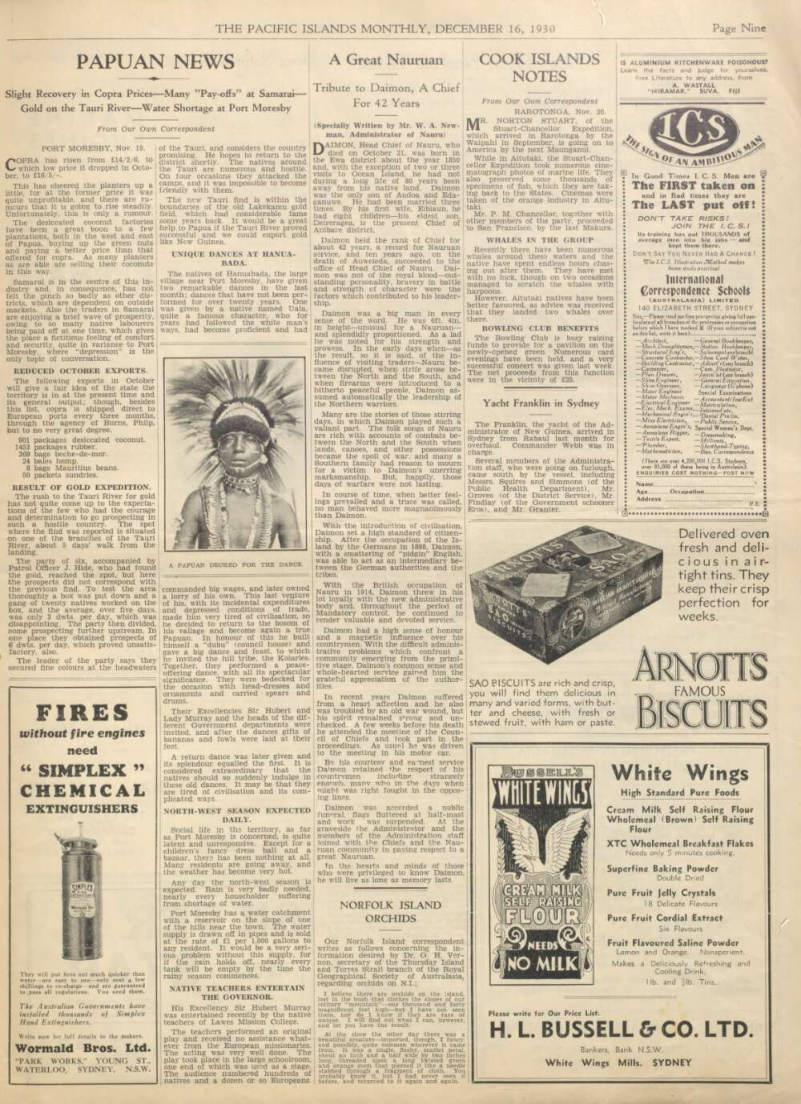
The natives of Hanuabada, the large village near Port Moresby, have given two remarkable dances in the last month; dances that have not been per formed for over twenty years. One was given by a native named Uala, quite a famous character, who for years had followed the white man’s ways, had become proficient and had
commanded big wages, and later owned a lorry of his own. This last venture of his, with its incidental expenditures and depressed conditions of trade, made him very tired of civilisation, so he decided to return to the bosom of his vallage and become again a true Papuan. In honour of this he built himself a “dubu” (council house) and gave a big dance and feast, to which he invited the hill tribe, the Koiaries.
Together, they performed a peace offering dance, with all its spectacular significance. They were bedecked for the occasion with head-dresses and ornaments and carried spears and drums.
Their Excellencies Sir Hubert and Lady Murray and the heads of the dif ferent Government departments were invited, and after the dances gifts of bananas and fowls were laid at their feet.
A return dance was later given and its splendour equalled the first. It is considered extraordinary that the natives should so suddenly indulge in these old dances. It may be that they are tired of civilisation and its com plicated ways.
North-West Season Expected
Daily.
Social life in the territory, as far as Port Moresby is concerned, is quite latent and unresponsive. Except for a children’s fancy dress ball and a bazaar, there has been nothing at all.
Many residents are going away, and the weather has become very hot.
Any day the north-west season is expected. Rain is very badly needed, nearly every householder suffering from shortage of water.
Port Moresby has a water catchment with a reservoir on the slope of, one of the hills near the town. The water supply is drawn off in pipes and is sold at the rate of £1 per 1,000 gallons to any resident. It would be a very seri ous problem without this supply, for if the rain holds off, nearly every tank will be empty by the time the rainy season commences.
Native Teachers Entertain
The Governor.
His Excellency Sir Hubert Murray was entertained recently by the native teachers of Lawes Mission College.
The teachers performed an original play and received no assistance what ever from the European missionaries.
The acting was very well done. The play took place in the large schoolroom, one end of which was used as a stage.
The audience numbered hundreds of natives and a dozen or so Europeans.