Mail Day
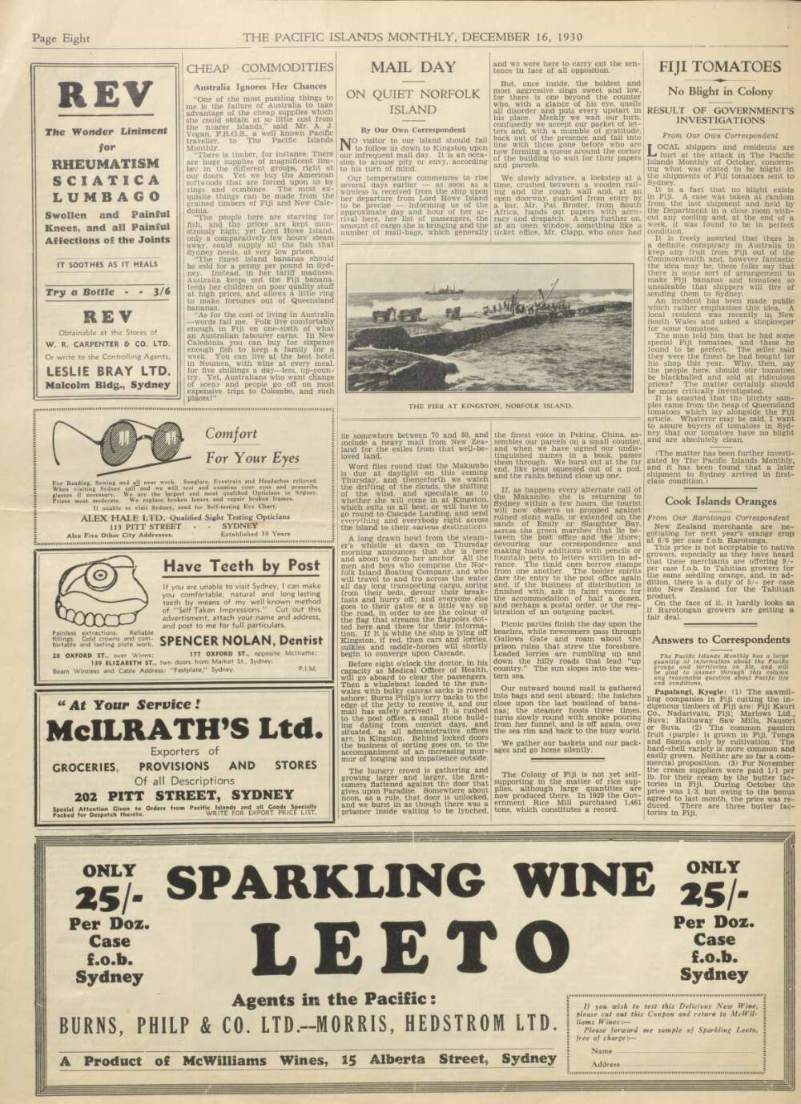
On Quiet Norfolk
Island
By Our Own Correspondent
NO visitor to our island should fail to follow us down to Kingston upon our infrequent mail day. It is an occa sion to arouse pity or envy, according to his turn of mind.
Our temperature commences to rise several days earlier as soon as a wireless is received from the ship upon her departure from Lord Howe Island to be precise informing us of the approximate day and hour of her ar rival here, her list of passengers, the amount of cargo she is bringing and the number of mail-bags, which generally
and we were here to carry out the sen tence in face of all opposition.
But, once inside, the boldest and most aggressive sings sweet and low, for there is one beyond the counter who, with a glance of his eye, quells all disorder and puts every upstart in his place. Meekly we wait our turn, confusedly we accept our packet of let ters and, with a mumble of gratitude, back out of the presence and fall into line with these gone before who are now forming a queue around the corner of the building to wait for their papers and parcels.
We slowly advance, a lockstep at a time, crushed between a wooden rail ing and the rough wall and, at an open doorway, guarded from entry by a bar, Mr. Pat Broder, from South Africa, hands out papers with accu racy and despatch. A step further on, at an open window, something like a ticket office, Mr. Clapp, who once had
lie somewhere between 70 and 80, and include a heavy mail from New Zea land for the exiles from that well-be loved land.
Word flies round that the Makambo is due at daylight on this coming Thursday, and thenceforth we watch the drifting of the clouds, the shifting of the wind, and speculate as to whether she will come in at Kingston, which suits us all best, or will have to go round to Cascade Landing, and send everything and everybody right across the island to their various destinations.
A long drawn howl from the steam er’s whistle at dawn on Thursday morning announces that she is here and about to drop her anchor. All the men and boys who comprise the Nor folk Island Boating Company, and who will travel to and fro across the water all day long transporting cargo, spring from their beds, devour their break fasts and hurry off; and everyone else goes to their gates or a little way up the road, in order to see the colour of the flag that streams the flagpoles dot ted here and there for their informa tion. If it is white the ship is lying off Kingston, if red, then cars and lorries, sulkies and saddle-horses will shortly begin to converge upon Cascade.
Before eight o’clock the doctor, in his capacity as Medical Officer of Health, will go aboard to clear the passengers.
Then a whaleboat loaded to the gun wales with bulky canvas sacks is rowed ashore; Burns Philp’s lorry backs to the edge of the jetty to receive it, and our mail has safely arrived! It is rushed to the post office, a small stone build ing dating from convict days, and situated, as all administrative offices are, in Kingston. Behind locked doors the business of sorting goes on, to the accompaniment of an increasing mur mur of longing and impatience outside.
The hungry crowd is gathering and growing larger and larger, the first comers flattened against the door that gives upon Paradise. Somewhere about noon, as a rule, that door is unlocked, and we burst in as though there was a prisoner inside waiting to be lynched,
the finest voice in Peking, China, as sembles our parcels on a small counter, and when we have signed our undis tinguished names in a book, passes them through. We burst out at the far end, like peas squeezed out of a pod, and the ranks behind close up one.
If, as happens every alternate call of the Makambo. she is returning to Sydney within a few hours, the tourist will now observe us propped against ruined stone walls, or extended on the sands of Emily or Slaughter Bay, across the green marshes that lie be tween the post office and the shore; devouring our correspondence and making hasty additions with pencils or fountain pens, to letters written in ad vance. The timid ones borrow stamps from one another. The bolder spirits dare the entry to the post office again and, if the business of distribution is finished with, ask in faint voices for the accommodation of half a dozen, and perhaps a postal order, or the reg istration of an outgoing packet.
Picnic parties finish the day upon the beaches, while newcomers pass through Gallows Gate and roam about the prison ruins that strew the foreshore.
Loaded lorries are rumbling up and down the hilly roads that lead “up country.” The sun slopes into the wes tern sea.
Our outward bound mail is gathered into bags and sent aboard; the hatches close upon the last boatload of bana nas; the steamer hoots three times, turns slowly round with smoke pouring from her funnel, and is off again, over the sea rim and back to the busy world.
We gather our baskets and our pack ages and go home silently.
The Colony of Fiji is not yet self supporting in the matter of rice sup plies, although large quantities are now produced there. In 1929 the Gov ernment Rice Mill purchased 1,461 tons, which constitutes a record.