Soldier Administrator Of
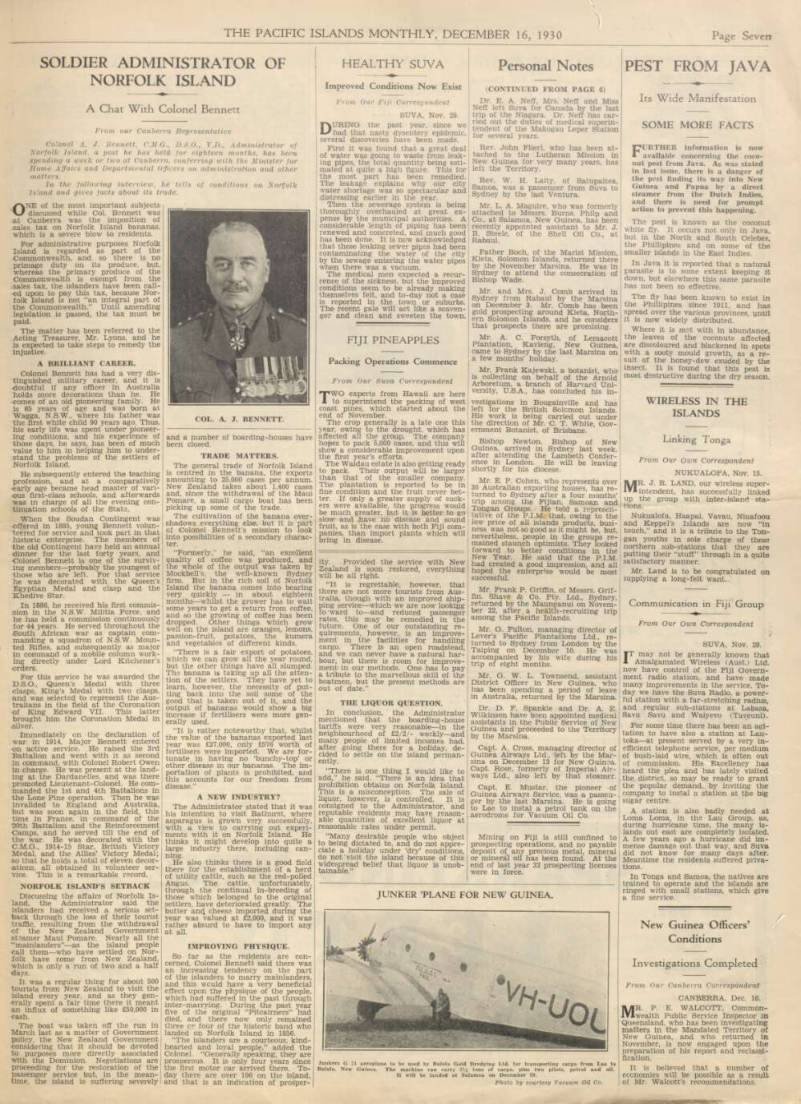
Norfolk Island
A Chat With Colonel Bennett
From our Canberra Representative Colonel A. J. Bennett, C.M.G., D.S.O., V.D., Administrator of Norfolk Island, a post he has held for eighteen months, has been spending a week or two at Canberra, conferring with the Minister for Home Affairs and Departmental Officers on administration and other matters.
In the following interview, he tells of conditions on Norfolk Island and gives facts about its trade.
ONE of the most important subjects discussed while Col. Bennett was at Canberra was the imposition of sales tax on Norfolk Island bananas, which is a severe blow to residents.
For administrative purposes Norfolk Island is regarded as part of the Commonwealth, and so there is no primage duty on its produce, but, whereas the primary produce of the Commonwealth is exempt from the sales tax, the islanders have been call ed upon to pay this tax, because Nor folk Island is not “an integral part of the Commonwealth.” Until amending legislation is passed, the tax must be paid.
The matter has been referred to the Acting Treasurer, Mr. Lyons, and he is expected to take steps to remedy the injustice.
A Brilliant Career.
Colonel Bennett has had a very dis tinguished military career, and it is doubtful if any officer in Australia holds more decorations than he. He comes of an old pioneering family. He is 65 years of age and was born at Wagga, N.S.W., where his father was the first white child 90 years ago. Thus, his early life was spent under pioneer ing conditions, and his experience of those days, he says, has been of much “value to him in helping him to under stand the problems of the settlers of Norfolk Island.
He subsequently entered the teaching profession, and at a comparatively early age became head master of vari ous first-class schools, and afterwards was in charge of all the evening con tinuation schools of the State.
When the Soudan Contingent was offered in 1885, young Bennett volun teered for service and took part in that historic enterprise. The members of the old Contingent have held an annual dinner for the last forty years, and Colonel Bennett is one of the surviv ing members —probably the youngest of those who are left. For that service he was decorated with the Queen’s Egyptian Medal and clasp and the Khedive Star.
In 1886, he received his first commis sion in the N.S.W. Militia Force, and he has held a commission continuously for 44 years. He served throughout the South African war as captain com manding a squadron of N.S.W. Moun ted Rifles, and subsequently as major in command of a mobile column work ing directly under Lord Kitchener’s orders.
For this service he was awarded the D.S.O., Queen’s Medal with three clasps, King’s Medal with two clasps, and was selected to represent the Aus tralians in the field at the Coronation of King Edward VII. This latter brought him the Coronation Medal in silver.
Immediately on the declaration of war in 1914, Major Bennett entered on active service. He raised the 3rd Battalion and went with it as second in command, with Colonel Robert Owen in charge. He was present at the land ing at the Dardanelles, and was there promoted Lieutenant-Colonel. He com manded the 1st and 4th Battalions in the Lone Pine operation. Then he was invalided to England and Australia, but was soon again in the field, this time in France, in command of the 20th Battalion and the Reinforcement Camps, and he served till the end of the war. He was decorated with the C.M.G., 1914-15 Star, British Victory Medal, and the Allies’ Victory Medal; so that he holds a total of eleven decor ations, all obtained in volunteer ser vice. This is a remarkable record.
Norfolk Island’S Setback
Discussing the affairs of Norfolk Is land, the Administrator said the islanders had received a serious set back through the loss of their tourist traffic, resulting from the withdrawal of the New Zealand Government steamer Maui Pomare. Nearly all the "mainlanders"—as the island people call them —who have settled on Nor folk have come from New Zealand, which is only a run of two and a half days.
It was a regular thing for about 500 tourists from New Zealand to visit the island every year, and as they gen erally spent a fair time there it meant an influx of something like £50,000 in cash.
The boat was taken off the run in March last as a matter of Government policy, the New Zealand Government considering that it should be devoted to purposes more directly associated with the Dominion. Negotiations are proceeding for the restoration of the passenger service but, in the mean time, the island is suffering severely
and a number of boarding-houses have been closed.
Trade Matters.
The general trade of Norfolk Island is centred in the banana, the exports amounting to 25,000 cases per annum.
New Zealand takes about 1,400 cases and, since the withdrawal of the Maui Pomare, a small cargo boat has been picking up some of the trade.
The cultivation of the banana over shadows everything else, but it is part of Colonel Bennett’s mission to look into possibilities of a secondary charac ter.
“Formerly,” he said, “an excellent quality of coffee was produced, and the whole of the output was taken by Mockbell’s, the well-known Sydney firm. But in the rich soil of Norfolk Island the banana comes into bearing very quickly in about eighteen months —whilst the grower has to wait some years to get a return from coffee, and so the growing of coffee has been dropped. Other things which grow well on the island are oranges, lemons, passion-fruit, potatoes, the kumera and vegetables of different kinds.
“There is a fair export of potatoes, which we can grow all the year round, but the other things have all slumped.
The banana is taking up all the atten tion of the settlers. They have yet to learn, however, the necessity of put ting back into the soil some of the good that is taken out of it, and the output of bananas would show a big increase if fertilisers were more gen erally used.
“It is rather noteworthy that, whilst the value of the bananas exported last year was £37,000, only £576 worth of fertilisers were imported. We are for tunate in having no ‘bunchy-top’ or other disease in our bananas. The im portation of plants is prohibited, and this accounts for our freedom from disease.”
A New Industry?
The Administrator stated that it was his intention to visit Bathurst, where asparagus is grown very successfully, with a view to carrying out experi ments with it on Norfolk Island. He thinks it might develop into quite a large industry there, including can ning.
He also thinks there is a good field there for the establishment of a herd of utility cattle, such as the red-polled Angus. The cattle, unfortunately, through the continual in-breeding of those which belonged to the original settlers, have deteriorated greatly. The butter and cheese imported during the year was valued at £2,000, and it was rather absurd to have to import any at all.
Improving Physique.
So far as the residents are con cerned, Colonel Bennett said there was an increasing tendency on the part of the islanders to marry mainlanders, and this would have a very beneficial effect upon the physique of the people, which had suffered in the past through inter-marrying. During the past year five of the original “Pitcairners” had died, and there now only remained three or four of the historic band who landed on Norfolk Island in 1856.
“The islanders are a courteous, kind hearted and loyal people,” added the Colonel. “Generally speaking, they are prosperous. It is only four years since the first motor car arrived there. To day there are over 100 on the island, and that is an indication of prosper
ity. Provided the service with New Zealand is soon restored, everything will be all right.
“It is regrettable, however, that there are not more tourists from Aus tralia, though with an improved ship ping service—which we are now looking forward to —and reduced passenger rates, this may be remedied in the future. One of our outstanding re quirements, however, is an improve ment in the facilities for handling cargo. There is an open roadstead, and we can never have a natural har bour, but there is room for improve ment in our methods. One has to pay a tribute to the marvellous skill of the boatmen, but the present methods are out of date.”
The Liquor Question.
In conclusion, the Administrator mentioned that the boarding-house tariffs were very reasonable —in the neighbourhood of £2/2/- weekly—and many people of limited incomes had, after going there for a holiday, de cided to settle on the island perman ently.
“There is one thing I would like to add,” he said. “There is an idea that prohibition obtains on Norfolk Island.
This is a misconception. The sale of liquor, however, is controlled. It is consigned to the Administrator, and reputable residents may have reason able quantities of excellent liquor at reasonable rates under permit.
“Many desirable people who object to being dictated to, and do not appre ciate a holiday under ‘dry’ conditions, do not visit the island because of this widespread belief that liquor is unob tainable.”