Notable Men of The Pacific
WHEN the War came, in 1914, and the world’s trade was thrown into chaos, the buyers and distributors of copra grew panicky. The price fell as low as £3 per ton, and some traders said it was not worth even that. But one man, who knew the copra market better than he knew his own hand, took a different view—and backed his opinion with rare courage. He bought copra at £12 per ton, chartered ships wherever he could find them, got the product to the European and American markets just when the warring nations were commencing a feverish search for vegetable oils —and reaped a fortune.
That man was Walter Randolph Carpenter, who started business as a youth, with no capital, at Thursday Island, 30 years ago, and who is now head of W. R. Carpenter & Co. Ltd.— a firm with huge financial reserves and a turnover of over £1,000,000 annu ally. Although his present business relationships are confined to the Mandated Territory of New Guinea and the Solomons, Mr. Carpenter is one of the best known men in the Pacific; and, although he has established so large and successful an organisation, he is still a comparatively young man.
The son of an American-born father and an English mother, Mr. Carpenter was born in Singapore and educated in Sydney. Before the dawn of this century he was trading in Thursday Island, where he established the well known firm (still successfully operat ing) of J. B. Carpenter and Son Ltd.
There he spent some strenuous years.
He tells to-day, with keen pleasure, of how he introduced the “lay” system of pearl-shelling—simply because he wanted to take part in the industry and he had not enough capital to engage in it under the conditions then existing. In a few years, the old sys tem had disappeared, all the schooners were gone, and the present system has been followed ever since.
About 1908, W.R.C. went to Fiji, to manage the trading firm of Robby Kadd and Co. Ltd. (now Burns, Philp and Co. Ltd.), and he was there for six years. In 1914, he founded his pre sent firm, and the war, with its tre mendous derangement of the copra market, gave him his big chance. He bought every ton of copra he could
find, and he chartered every ship that was available. He paid £15,000 cash for a charter of the Westfield, for one trip with copra—she was sold twelve months later for £3,000. He bought the old sailer Speedway, 670 tons, simply that she might, take one cargo of copra to Europe, and then sold her. It was worth any money to get the copra into the world markets. The firm of W. R. Carpenter and Co. Ltd. became rich and powerful.
The mule-headed officials of Austra lia put incredible restrictions on the handling of copra in Australian ports, and drove away trade worth millions.
Mr. Carpenter was one of those who saw the chance and he arranged ship ments of copra from New Guinea direct to Europe—to the profit of the copra producers and Australia’s loss.
The firm soon became considerable property-owners in the Islands terri tories. After the war, Mr. Carpenter again backed his opinion—his firm, on a large scale, financed the returned soldiers who wished to take up cocoa nut plantations, and again the risk turned up trumps. He stood by the soldier-planters and the planters have stood by him.
The Carpenter firm, in 1920, amal gamated with Messrs. Morris, Hedstrom Ltd., of Fiji. But the new organisation did not run smoothly and the two big firms separated again in 1921. Since then, both have prospered greatly.
Carpenter and Co. Ltd. are among the biggest (if they are not the biggest) shippers of copra in the world. In a good year they handle 50,000 tons — more than the total copra production of the Southern groups (Tonga, Samoa and Fiji) put together. No firm in the world is watching the copra market with keener interest.
Mr. Carpenter has not found much time, in a busy life, for public affairs; but there is no keener student of public finance. His arguments in favour of “unpinning the exchange,” as a means of restoring Australian industrial activ ity, have received much public atten tion lately. He was Mayor of Thursday Island on two occasions. He takes an interest in the Royal Colonial Institute, in Freemasonry, and in motoring. His brother and his two sons are now associated with him in his big firm.
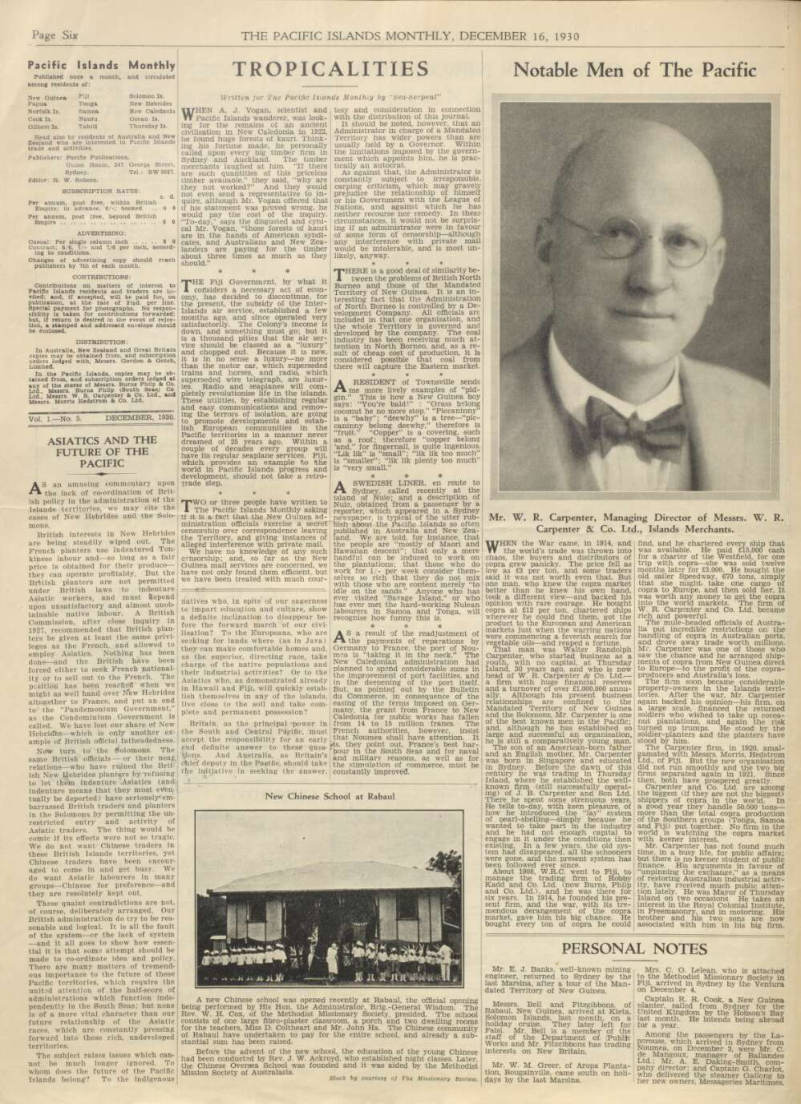
Mr. W. R. Carpenter, Managing Director of Messrs. W. R.
Carpenter & Co. Ltd., Islands Merchants.