Our Fijian Newsletter
Severe Gale Sweeps Colony—Much Damage to Banana Crops
From Our Own Correspondent
Suva, Nov. 28.
THERE is a great deal of talk about hurricanes in Fiji. Indeed, new comers are told so much about hurri canes when they come to Fiji, that they believe they are quite a common sort of thrill.
As a matter of fact, cyclonic storms are rarer in Fiji than they are in Queensland, or perhaps in other parts of Australia. It is twenty years since a real hurricane struck Suva. A lesser one visited the town in 1912, but since then gales have been record ed only at rare intervals.
One of these gales hit the capital on Sunday last. The wind grew in velocity during the day and at 7.55 p.m. reached its peak—71 miles an hour.
Good rain fell all day and much minor damage was reported. A small cutter crashed through the wall of the gaol bath, and, after enjoying a swim there, dived to the bottom, with sev eral planks staved in. The river launch Rogovoka was swept ashore at Suva Point during the height of the gale.
The big liner Rotorua, from London, drew out from the wharf and achored in the harbour, where she safely rode out the storm.
The Rewa River rose 17 feet at Nau sori, and the sugar mill stopped crush ing, owing to the confusion. It is believed that some of the C.S.R. Co’s
northern part of Viti Levu, especially affecting Penang and Ellington, and Nananu Island. At Penang, the sugar mill lost its roof and chimney, while the police office was blown clean away with all the official archives. The re creation hall became a of twist ed timbers. Many other buildings were badly damaged. At Ellington the big shed of the C.S.R. Co. Ltd. was full of bagged sugar, and, I under stand, quite 600 tons is being sent away to be reconditioned, which will mean a substantial loss.
Many Vessels Lost
The list of vessels lost include the Seventh Day Adventist auxiliary ketch Loloma, which was driven ashore at Nabuwalu. The Provincial launch was also wrecked there being thrown right up among the mangroves. At Gau Is land it is reported the Elizabeth was smashed and foundered, Captain Ger rish and a Chinese still being missing.
The native crew was saved. Two cut ters were wrecked on the island of Wakaya and the Makogai launch, Jean, was wrecked on Makogai. The crew of the cutter, Tui Nukurawa, ar rived in Levuka in two open boats.
The Provincial cutter, Marama ni Yanuyanu, is ashore at Naikorokoro. A cutter coming from Wainunu saw some wreckage floating outside the reef and a hatch painted grey has been picked up at Naikorokoro in Ovalau.
floating stock was missing. It is also alleged that a launch and five punts be long to a banana buyer are missing.
Thousands of banana trees were seen floating down to the sea, and it is feared that fruit losses will be heavy.
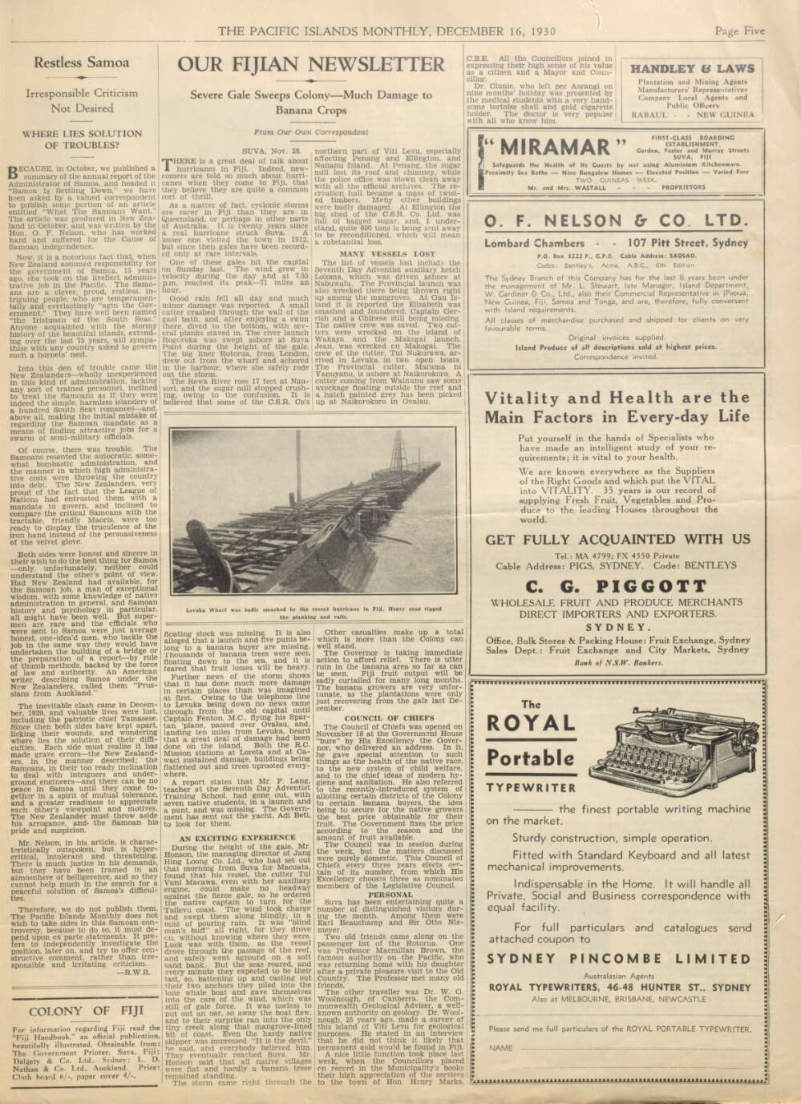
Further news of the storm shows that it has done much more damage in certain places than was imagined at first. Owing to the telephone line to Levuka being down no news came through from the old capital until Captain Fenton. M.C., flying his Spar tan ’plane, passed over Ovalau, and, landing ten miles from Levuka, heard that a great deal of damage had been done on the island. Both the R.C.
Mission stations at Loreta and at Ca waci sustained damage, buildings being flattened out and trees uprooted every where.
A report states that Mr. F. Lang, teacher at the Seventh Day Adventist Training School, had gone out, with seven native students, in a launch and a punt, and was missing. The Govern ment has sent out the yacht, Adi Beti, to look for them.
An Exciting Experience
During the height of the gale, Mr.
Honson, the managing director of Jang King Loong Co. Ltd., who had set out that morning from Suva for Macuata, found that his vessel, the cutter Tui Vuni Macawa, even with her auxiliary engine, could make no headway against the fierce gale, so he ordered the native captain to turn for the Tailevu coast. The wind took charge and swept them along blindly, in a mist of pouring rain. It was “blind man’s buff” all right, for they drove on. without knowing where they were.
Luck was with them, as the vessel drove through the passage of the reef, and safely went aground on a soft sand bank. But the seas roared, and every minute they expected to be their last, so, battening up and casting out their two anchors they piled into the lone whale boat and gave themselves into the care of the wind, which was still of gale force. It was useless to put out an oar, so away the boat flew, and to their surprise ran into the only tiny creek along that mangrove-lined bit of coast. Even the hardy native skipper was impressed. “It is the devil,” he said, and everybody believed him.
They eventually reached Suva. Mr.
Honson said that all native villages were flat and hardly a banana tree remained standing.
The storm came right through the
Other casualties make up a total which is more than the Colony can well stand.
The Governor is taking immediate action to afford relief. There is utter ruin in the banana area so far as can be seen. Fiji fruit output will be sadly curtailed for many long months.
The banana growers are very unfor tunate, as the plantations were only just recovering from the gale last De cember.
Council Of Chiefs
The Council of Chiefs was opened on November 18 at the Government House “bure” by His Excellency the Gover nor, who delivered an address. In it, he gave special attention to such things as the health of the native race, to the new system of child welfare, and to the chief ideas of modern hy giene and sanitation. He also referred to the recently-introduced system of allotting certain districts of the Colony to certain banana buyers, the idea being to secure for the native growers the best price obtainable for their fruit. The Government fixes the price according to the season and the amount of fruit available.
The Council was in session during the week, but the matters discussed were purely domestic. This Council of Chiefs every three years elects cer tain of its number, from which His Excellency chooses three as nominated members of the Legislative Council.
Personal
Suva has been entertaining quite a number of distinguished visitors dur ing the month. Among them were Earl Beauchamp and Sir Otto Nie meyer.
Two old friends came along on the passenger list of the Rotorua. One was Professor Macmillan Brown, the famous authority on the Pacific, who was returning home with his daughter after a private pleasure visit to the Old Country. The Professor met many old friends.
The other traveller was Dr. W. G.
Woolnough, of Canberra, the Com monwealth Geological Adviser, a well known authority on geology. Dr. Wool nough, 25 years ago, made a survey of this island of Viti Levu for geological purposes. He stated in an interview that he did not think it likely that permanent gold would be found in Fiji.
A nice little function took place last week, when the Councillors placed on record in the Municipality’s books their high appreciation of the services to the town of Hon. Henry Marks,
C.B.E. All the Councillors joined in expressing their high sense of his value as a citizen and a Mayor and Coun cillor.
Dr. Clunie, who left per Aorangi on nine months’ holiday was presented by the medical students with a very hand some tortoise shell and gold cigarette holder. The doctor is very popular with all who know him.
Levuka Wharf was badly smashed by the recent hurricane In Fiji. Heavy seas ripped the planking and rails.