Thursday Island Notes
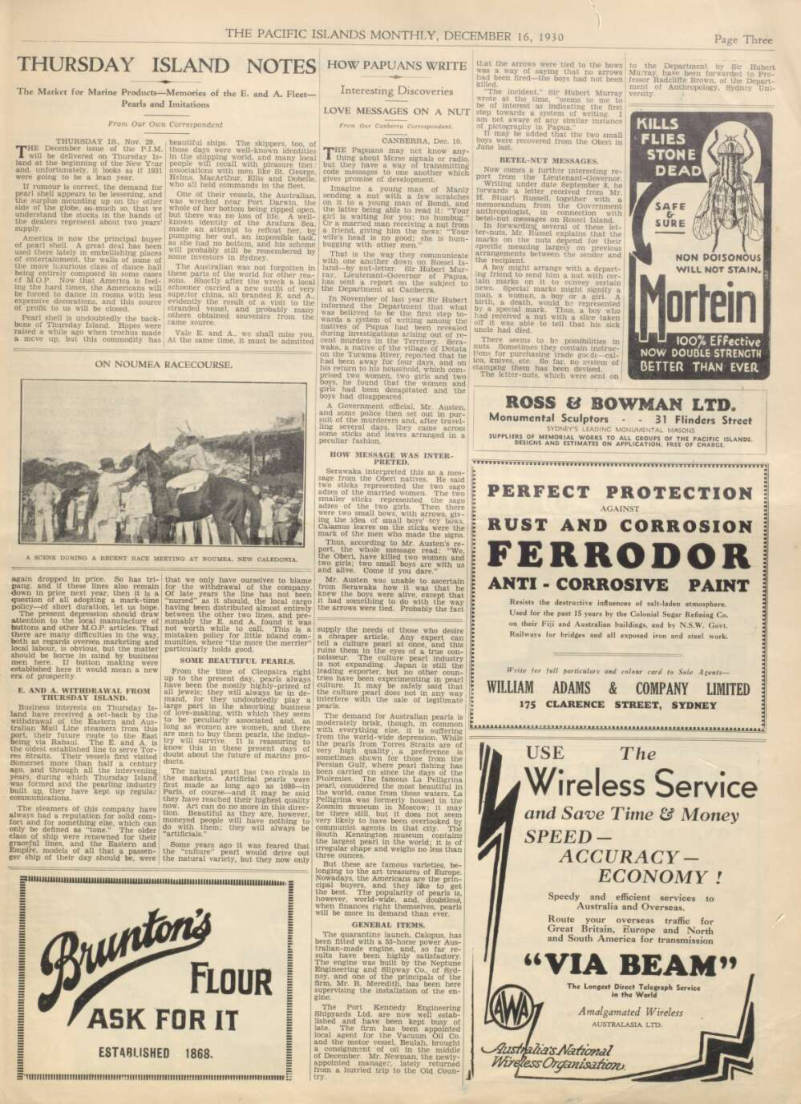
The Market for Marine Products—Memories of the E. and A. Fleet- Pearls and Imitations
From Our Own Correspondent
Thursday Is., Nov. 29.
THE December issue of the P.I.M. will be delivered on Thursday Is land at the beginning of the New Year and, unfortunately, it looks as if 1931 were going to be a lean year.
If rumour is correct, the demand for pearl shell appears to be lessening, and the surplus mounting up on the other side of the globe, so much so, that we understand the stocks in the hands of the dealers represent about two years’ supply.
America is now the principal buyer of pearl shell. A great deal has been used there lately in embellishing places of entertainment, the walls of some of the more luxurious class of dance hall being entirely composed in some cases of M.O.P. Now that America is feel ing the hard times, the Americans will be forced to dance in rooms with less expensive decorations, and this source of profit to us will be closed.
Pearl shell is undoubtedly the back bone of Thursday Island. Hopes were raised a while ago when trochus made a mcve up, but this commodity has
beautiful ships. The skippers, too, of those days were well-known identities in the shipping world, and many local people will recall with pleasure their associations with men like St. George, Helms, MacArthur, Ellis and Dobelle, who all held commands in the fleet.
One of their vessels, the Australian, was wrecked near Port Darwin, the whole of her bottom being ripped open, but there was no loss of life. A well known identity of the Arafura Sea, made an attempt to refloat her, bv pumping her out, an impossible task as she had no and his scheme will probably still be remembered by some investors in Sydney.
The Australian was not forgotten in these parts of the world for other rea sons. Shortly after the wreck a local schooner carried a new outfit of very superior china, all branded E. and A., evidently the result of a visit to the stranded vessel, and probably many others obtained souvenirs from the same source.
Vale E. and A., we shall miss you.
At the same time, it must be admitted
again dropped in price. So has tri pang, and if these lines also remain down in price next year, then it is a question of all adopting a mark-time policy—of short duration, let us hope.
The present depression should draw attention to the local manufacture of buttons and other M.O.P. articles. That there are many difficulties in the way, both as regards oversea marketing and local labour, is obvious, but the matter should be borne in mind by business men here. If button making were established here it would mean a new era of prosperity.
E. And A. Withdrawal From
Thursday Island.
Business interests on Thursday Is land have received a set-back by the withdrawal of the Eastern and Aus tralian Mail Line steamers from this port, their future route to the East being via Rabaul. The E. and A. is the oldest established line to serve Tor res Straits. Their vessels first visited Somerset more than half a century ago. and through all the intervening years, during which Thursday Island was formed and the pearling industry built up, they have kept up regular communications.
The steamers of this company have always had a reputation for solid com fort and for something else, which can only be defined as “tone.” The older class of ship were renowned for their graceful lines, and the Eastern and Empire, models of all that a passen ger ship of their day should be, were
that we only have ourselves to blame for the withdrawal of the company.
Of late years the line has not been “nursed” as it should, the local cargo having been distributed almost entirely between the other two lines, and pre sumably the E. and A. found it was not worth while to call. This is a mistaken policy for little island com munities, where “the more the merrier” particularly holds good.
Some Beautiful Pearls.
From the time of Cleopatra right up to the present day, pearls always have been the mostly highly-prized of all jewels; they will always be in de mand, for they undoubtedly play a large part in the absorbing business of love-making, with which they seem to be peculiarly associated and, as long as women are women, and there are men to buy them pearls, the indus try will survive. It is reassuring to know this in these present days of doubt about the future of marine pro ducts.
The natural pearl has two rivals in the markets. Artificial pearls were first made as long ago as 1680—in Paris, of course—and it may be said they have reached their highest quality now. Art can do no more in this direc tion. Beautiful as they are, however, moneyed people will have nothing to do with them; they will always be “artificials.”
Some years ago it was feared that the “culture” pearl would drive out the natural variety, but they now only
supply the needs of those who desire a cheaper article. Any expert can tell a culture pearl at once, and this ruins them in the eyes of a true con noisseur. The culture pearl industry is not expanding. Japan is still the leading exporter, but no other coun tries have been experimenting in pearl culture. It may be safely said that the culture pearl does not in any way interfere with the sale of legitimate pearls.
The demand for Australian pearls moderately brisk, though, in common with everything else, it is suffering from the world-wide depression. While the pearls from Torres Straits are of very high quality, a preference is sometimes shown for those from the Persian Gulf, where pearl fishing has been carried on since the days of the Ptolemies. The famous La Pelligrina pearl, considered the most beautiful in the world, came from those waters. La Pelligrina was formerly housed in the Zosmin museum in Moscow; it may be there still, but it does not seem very likely to have been overlooked by communist agents in that city. The South Kensington museum contains the largest pearl in the world; it is of irregular shape and weighs no less than three ounces.
But these are famous varieties, be longing to the art treasures of Europe Nowadays, the Americans are the prin cipal buyers, and they like to get the best. The popularity of pearls is however, world-wide, and, doubtless when finances right themselves, pearls will be more in demand than ever.
General Items.
The quarantine launch, Calopus, has been fitted with a 55-horse power Aus tralian-made engine, and, so far re sults have been highly satisfactory.
The engine was built by the Neptune Engineering and Slipway Co., of Syd ney, and one of the principals of the firm, Mr. R. Meredith, has been here supervising the installation of the en gine.
The Port Kennedy Engineering Shipyards Ltd. are now well estab lished and have been kept busy of late. The firm has been appointed local agent for the Vacuum Oil Co. and the motor vessel, Beulah, brought a consignment of oil in the middle of December. Mr. Newman, the newly appointed manager, lately returned from a hurried trip to the Old Coun try.