Asiatic Menace In Pacific
pp. 1-2 · Read in the full issue
———♦——— What Chinese Traders are Doing in The Solomons
Economic Problem Which Demands
Attention
A very serious and rapidly-growing problem, which must be faced by British and French Islands Administrations, is that of Asiatics in the South Seas. There are Chinese in Samoa, Chinese and Hindus in Fiji, Tonkinese in New Hebrides, Tonkinese and Javanese in New Caledonia, and Chinese in the Solomons.
Each community presents special difficulties, while all must be considered in relation to a general policy. The Pacific Islands Monthly proposes to deal with each territory separately; and then to urge on all the authorities concerned the grave need for a common policy. The subject is dealt with in our leading article.
In this issue Mr. Chaperlin, who spent many years in the Pacific as a trader and planter, writes frankly about the Asiatic menace in the Solomon Islands.
Written for The Pacific Islands Monthly by H. Chaperlin
THE problem of the Asiatic immigrant is not new to many tropical countries enjoying the benefits of British administration.
In some of them, it has long since become part and parcel of the accepted order of things, with established settlements and not inconsiderable commercial interests and activities.
In others, it is of more recent date, and the effect of the influx of Asiatics on the economic life of the country concerned is more noticeable.
In no case is this more pronounced than in the British Solomon Islands Protectorate.
During the past twenty years, the number of Asiatics, mostly Chinese, residing in the Protectorate has gradually risen, until this element now forms one-sixth of the total non-native population; and it was not until the year 1922 that any move towards the restriction of such immigration was made by the Administration.
Prior to 1910 there had been but two Chinese employed in the Protectorate, these being cooks, who, on the expiry of their contracts, left the Group and, so far as the writer’s recollection serves, did not return.
Doubtless, the comparatively unsettled state of the Solomons in those days did not offer sufficient inducement or security from the Asiatic point of view, although already an increase in the number of European settlers was becoming apparent. It is doubtful, too, if the significance of the advance guard of Asiatic aliens was realised when, early in 1910, four Chinese artisans were imported by one of the merchant companies.
It must be said in that company’s favour that they had been particularly unfortunate in their experiences with shipwrights, boatbuilders and carpenters of European origin. It had al-
ready been demonstrated by the late Mr. W. Pope, at Aola, that not only boatbuilding, but the repair of fairsized vessels could be undertaken by European labour in a tropical climate.
Furthermore, it had also been possible to at least partly train a few natives to assist in such work, and the “boys” were apt pupils—a fact to which little heed seems to have been given by either the Administration, missions or commercial interests of the time.
Practically co-incident with the big rubber boom in other countries, a mild boom in coconut planting occurred in the Solomons, and most people were then mainly concerned in securing suitable areas for plantations, which threw a heavy burden upon the shoulders of the Resident Commissioner and his Assistant at Tulagi, who were the only two officials available to deal with the applications.
First Chinese Trader
It was not until 1912, however, that the first Chinese trader put in an appearance, and it was then that the initial mistake was really made. This man had come across from what was then the German Territory of New Guinea as a tailor, and if his activities had been restricted to the exercise of his trade, little harm would have been done. However, after unsuccessfully endeavouring to obtain a footing with the merchant companies on account of his desire to trade, he was accommodated by the then Acting Resident Commissioner with the lease of a small area of land at Tulagi, on which a building was erected for him, at Government expense.
It is with regret that one has to record that facilities similar to those granted to this alien had been applied for by, and refused to, a colleague of the writer, some months previously With the expiry of the Chinese artisans’ contracts, soon after the outbreak of war, it was not long before a Chinese settlement had sprung up at Tulagi, the seat of Government, and this settlement was definitely encouraged by the then Acting Resident Commissioner. The attitude of this official can be more easily understoood when it is explained that he was virtually Dictator of the Group, and had been known to express the opinion that “Chinese made excellent colonists” —an expression of opinion which on one occasion at least drew forth the retort that if such was the case, Chinese Civil Servants would be the logical sequel!
Chinatown
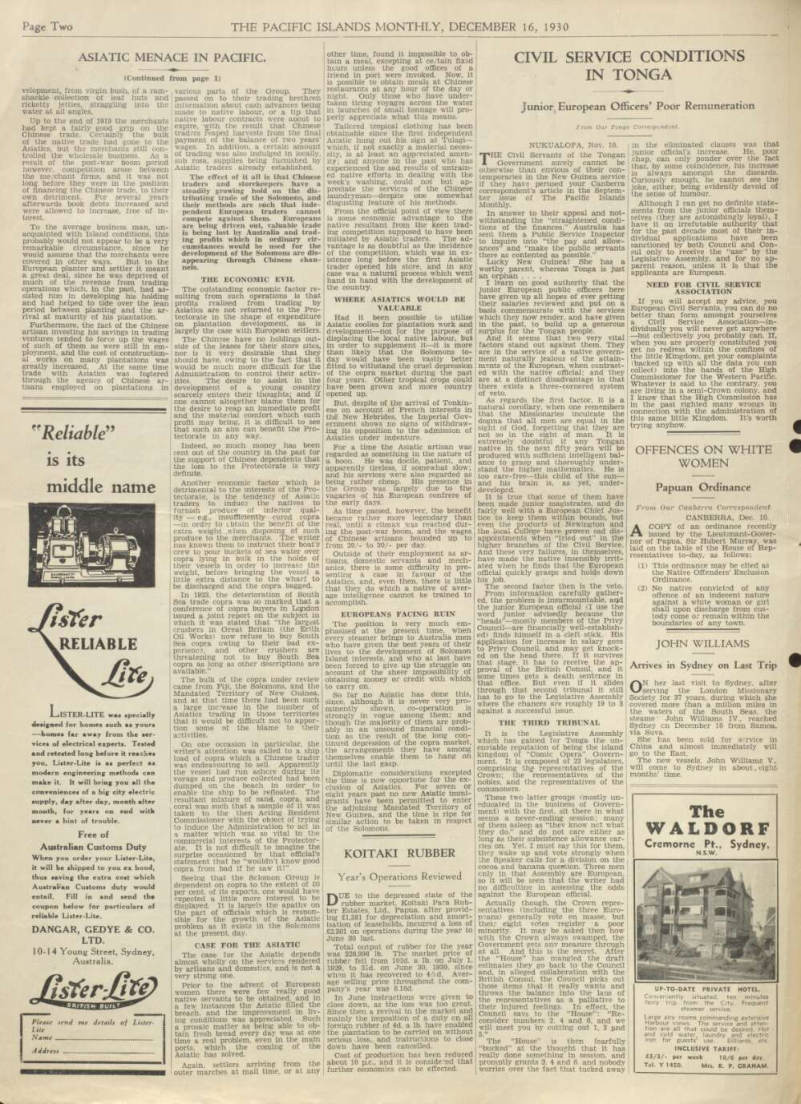
To the writer the development of the Chinese settlement was brought home in a marked manner, since on his return to the Group after four years of absence during the war period, it could not fail to be noticed. Occupying a swampy foreshore site on Tulagi Island it was next to the various houses and offices of the Government officials, easily the most prominent feature of the harbour front—-a de- A photograph of the Chinese section of the town of Tulagi, in the Solomons. The rapid growth of the Chinese community in the Solomons is dealt with in the accompanying article.
(Continued On Page 2)
shackle collection of leaf huts and ricketty jetties, straggling into the water at all angles.
Up to the end of 1919 the merchants had kept a fairly good grip on the Chinese trade. Certainly the bulk of the native trade had gone to the Asiatics, but the merchants still controlled the wholesale business. As a result of the post-war boom period however, competition arose between the merchant firms, and it was not long before they were in the position of financing the Chinese trade, to their own detriment. For several years afterwards book debts increased and were allowed to increase, free of interest.
To the average business man, unacquainted with Island conditions, this probably would not appear to be a very remarkable circumstance, since he would assume that the merchants were covered in other ways. But to the European planter and settler it meant a great deal, since he was deprived of much of the revenue from trading operations which, in the past, had assisted him in developing his holding and had helped to tide over the lean period between planting and the arrival at maturity of his plantation.
Furthermore, the fact of the Chinese artisan investing his savings in trading ventures tended to force up the wages of such of them as were still in employment, and the cost of constructional works on many plantations was greatly increased. At the same time trade with Asiatics was filtered through the agency of Chinese artisans employed on plantations in
various parts of the Group. They passed on to their trading brethren information about cash advances being made to native labour, or a tip that native labour contracts were about to expire, with the result that Chinese traders reaped harvests from the final payment of the balance of two years’ wages. In addition, a certain amount of trading was also indulged in locally, sub rosa, supplies being furnished by Asiatic traders already established.
The effect of it all is that Chinese traders and storekeepers have a steadily growing hold on the distributing trade of the Solomons, and their methods are such that independent European traders cannot compete against them. Europeans are being driven out, valuable trade is being lost by Australia and trading profits which in ordinary circumstances would be used for the development of the Solomons are disappearing through Chinese channels.
The Economic Evil
The outstanding economic factor resulting from such operations is that profits realised from trading by Asiatics are not returned to the Protectorate in the shape of expenditure on plantation development, as is largely the case with European settlers.
The Chinese have no holdings outside of the leases for their store sites, nor is it very desirable that they should have, owing to the fact that it would be much more difficult for the Administration to control their activities. The desire to assist in the development of a young country scarcely enters their thoughts; and if one cannot altogether blame them for the desire to reap an immediate profit and the material comfort which such profit may bring, it is difficult to see that such an aim can benefit the Protectorate in any way.
Indeed, so much money has been sent out of the country in the past for the support of Chinese dependents that the loss to the Protectorate is very definite.
Another economic factor which is detrimental to the interests of the Protectorate, is the tendency of Asiatic traders to induce the natives to furnish produce of inferior qual ity e.g., insufficiently cured copra —in order to obtain the benefit of the extra weight when disposing of such produce to the merchants. The writer has known them to instruct their boat’s crew to pour buckets of sea water over copra lying in bulk in the holds of their vessels in order to increase the weight, before bringing the vessel a little extra distance to the wharf to be discharged and the copra bagged.
In 1923, the deterioration of South Sea trade copra was so marked that a conference of copra buyers in London issued a joint report on the subject in which it was stated that “the largest crushers in Great Britain (the Erith Oil Works) now refuse to buy South Sea copra owing to their bad experience, and other crushers are threatening not to buy South Sea copra as long as other descriptions are available.”
The bulk of the copra under review came from Fiji, the Solomons, and the Mandated Territory of New Guinea, and at that time there had been such a large increase in the number of Asiatics trading in those territories that it would be difficult not to apportion some of the blame to their activities.
On one occasion in particular, the writer’s attention was called to a ship load of copra which a Chinese trader was endeavouring to sell. Apparently the vessel had run ashore during its voyage and produce collected had been dumped on the beach in order to enable the ship to be refloated. The resultant mixture of sand, copra, and coral was such that a sample of it was taken to the then Acting Resident Commissioner with the object of trying to induce the Administration to act in a matter which was so vital to the commercial interests of the Protectorate. It is not difficult to imagine the surprise occasioned by that official’s statement that he “wouldn’t know good copra from bad if he saw it! ”
Seeing that the Solomon Group is dependent on copra to the extent of 80 per cent, of its exports, one would have expected a little more interest to be displayed. It is largely the apathy on the part of officials which is responsible for the growth of the Asiatic problem as it exists in the Solomons at the present day.
Case For The Asiatic
The case for the Asiatic depends almost wholly on the services rendered by artisans and domestics, and is not a very strong one.
Prior to the advent of European women there were few really good native servants to be obtained, and in a few instances the Asiatic filled the breach, and the improvement in living conditions was appreciated. Such a prosaic matter as being able to obtain fresh bread every day was at one time a real problem, even in the main ports, which the coming of the Asiatic has solved.
Again, settlers arriving from the outer marches at mail time, or at any
other time, found it impossible to obtain a meal, excepting at certain fixed hours unless the good offices of a friend in port were invoked. Now, it is possible to obtain meals at Chinese restaurants at any hour of the day or night. Only those who have undertaken tiring voyages across the water in launches of small tonnage will properly appreciate what this means.
Tailored tropical clothing has been obtainable since the first independent Asiatic hung out his sign at Tulagi— which, if not exactly a material necessity, is at least an appreciated amenity; and anyone in the past who has experienced the sad results of untrained native efforts in dealing with the week’s washing, could not but appreciate the services of the Chinese laundryman—despite one somewhat disgusting feature of his methods.
From the official point of view there is some economic advantage to the native resultant from the keen trad ing competition supposed to have been initiated by Asiatic traders. The advantage is as doubtful as the incidence of the competition, which was in existence long before the first Asiatic trader opened his store, and in any case was a natural process which went hand in hand with the development of the country.
Where Asiatics Would Be
Valuable
Had it been possible to utilise Asiatic coolies for plantation work and development—not for the purpose of displacing the local native labour, but in order to supplement it—it is more than likely that the Solomons to day would have been vastly better fitted to withstand the cruel depression of the copra market during the past four years. Other tropical crops could have been grown and more country opened up.
But, despite of the arrival of Tonkinese on account of French interests in the New Hebrides, the Imperial Government shows no signs of withdrawing its opposition to the admission of Asiatics under indenture.
For a time the Asiatic artisan was regarded as something in the nature of a boon. He was docile, patient, and apparently tireless, if somewhat slow; and his services were also regarded as being rather cheap. His presence in the Group was largely due to the vagaries of his European confrere of the early days.
As time passed, however, the benefit became rather more legendary than real, until a climax was reached during the post-war boom, and the wages of Chinese artisans bounded up to from 20/- to 30/- per day.
Outside of their employment as artisans, domestic servants and mechanics, there is some difficulty in presenting a case in favour of the Asiatics, and, even then, there is little that they do which a native of average intelligence cannot be trained to accomplish.
Europeans Facing Ruin
The position is very much emphasised at the present time, when every steamer brings to Australia men who have given the best years of their lives to the development of Solomon Island interests, and who at last have been forced to give up the struggle on account of the sheer impossibility of obtaining money or credit with which to carry on.
So far no Asiatic has done this, since, although it is never very prominently shown, co-operation is strongly in vogue among them; and though the majority of them are probably in an unsound financial condition as the result of the long continued depression of the copra market, the arrangements they have among themselves enable them to hang on until the last gasp.
Diplomatic considerations excepted the time is now opportune for the exclusion of Asiatics. For seven or eight years past no new Asiatic immigrants have been permitted to enter the adjoining Mandated Territory of New Guinea, and the time is ripe for similar action to be taken in respect of the Solomons. ———