Crocodile Farming
Possibilities Being Investigated New Industry for Torres Straits?
From Our Own Correspondent
Thursday Is., Nov. 29.
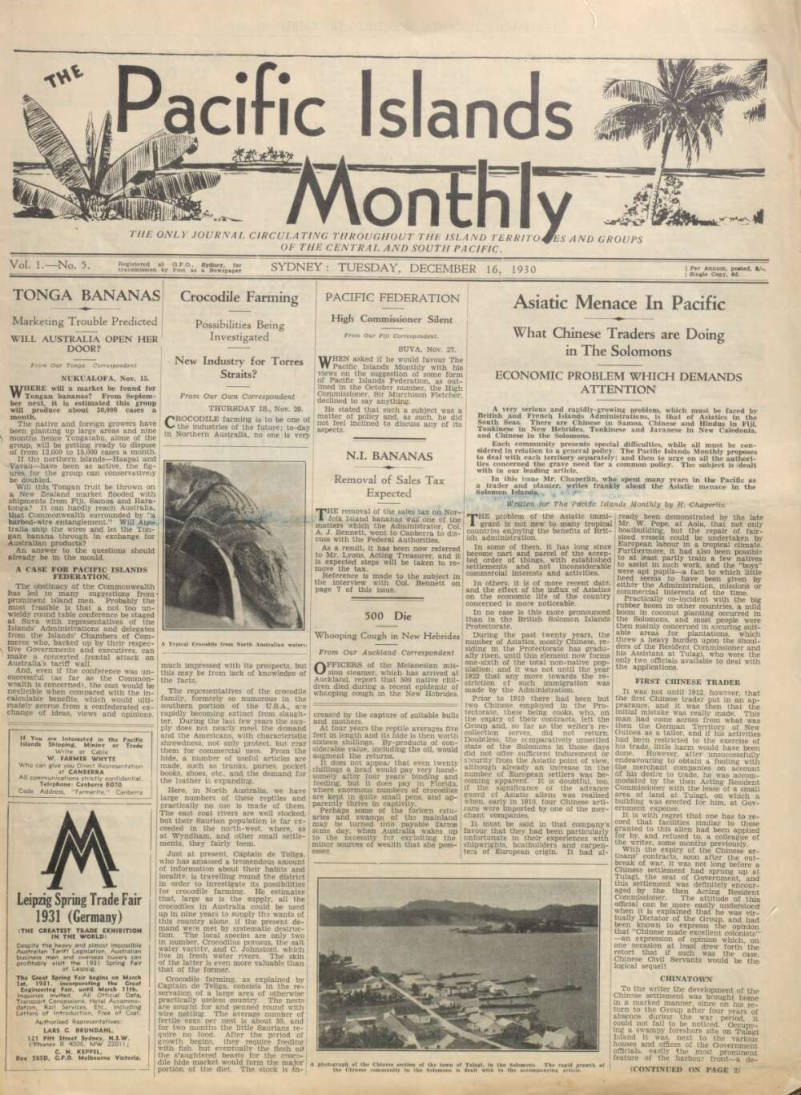
CROCODILE farming is to be one of the industries of the future; to-day in Northern Australia, no one is very A Typical Crocodile from North Australian waters.
much impressed with its prospects, but this may be from lack of knowledge of the facts.
The representatives of the crocodile family, formerly so numerous in the southern portion of the U.S.A., are rapidly becoming extinct from slaughter. During the last few years the supply does not nearly meet the demand and the Americans, with characteristic shrewdness, not only protect, but rear them for commercial uses. From the hide, a number of useful articles are made, such as trunks, purses, pocket books, shoes, etc., and the demand for the leather is expanding.
Here, in North Australia, we have large numbers of these reptiles and practically no use is made of them.
The east coat rivers are well stocked, but their Saurian population is far exceeded in the north-west, where, as at Wyndham, and other small settlements, they fairly teem.
Just at present, Captain de Teliga, who has amassed a tremendous amount of information about their habits and locality, is travelling round the district in order to investigate its possibilities for crocodile farming. He estimates that, large as is the supply, all the crocodiles in Australia could be used up in nine years to supply the wants of this country alone, if the present demand were met by systematic destruction. The local species are only two in number, Crocodilus porosus, the salt water variety, and C. Johnstoni, which live in fresh water rivers. The skin of the latter is even more valuable than that of the former.
Crocodile farming, as explained by Captain de Teliga, consists in the reservation of a large area of otherwise practically useless country. The nests are sought for and penned round with wire netting. The average number of fertile eggs per nest is about 55, and for two months the little Saurians require no food. After the period of growth begins, they require feeding with fish, but eventually the flesh of the slaughtered beasts for the crocodile hide market would form the major portion of the diet. The stock is in-
creased by the capture of suitable bulls and mothers.
At four years the reptile averages five feet in length and its hide is then worth sixteen shillings. By-products of considerable value, including the oil, would augment the returns.
It does not appear that even twenty shillings a head would pay very handsomely after four years’ tending and feeding, but it does pay in Florida, where enormous numbers of crocodiles are kept in quite small pens, and apparently thrive in captivity.
Perhaps some of the forlorn estuaries and swamps of the mainland may be turned into payable farms some day, when Australia wakes up to the necessity fer exploiting the minor sources of wealth that she possesses. ———