Notable Men of The Pacific
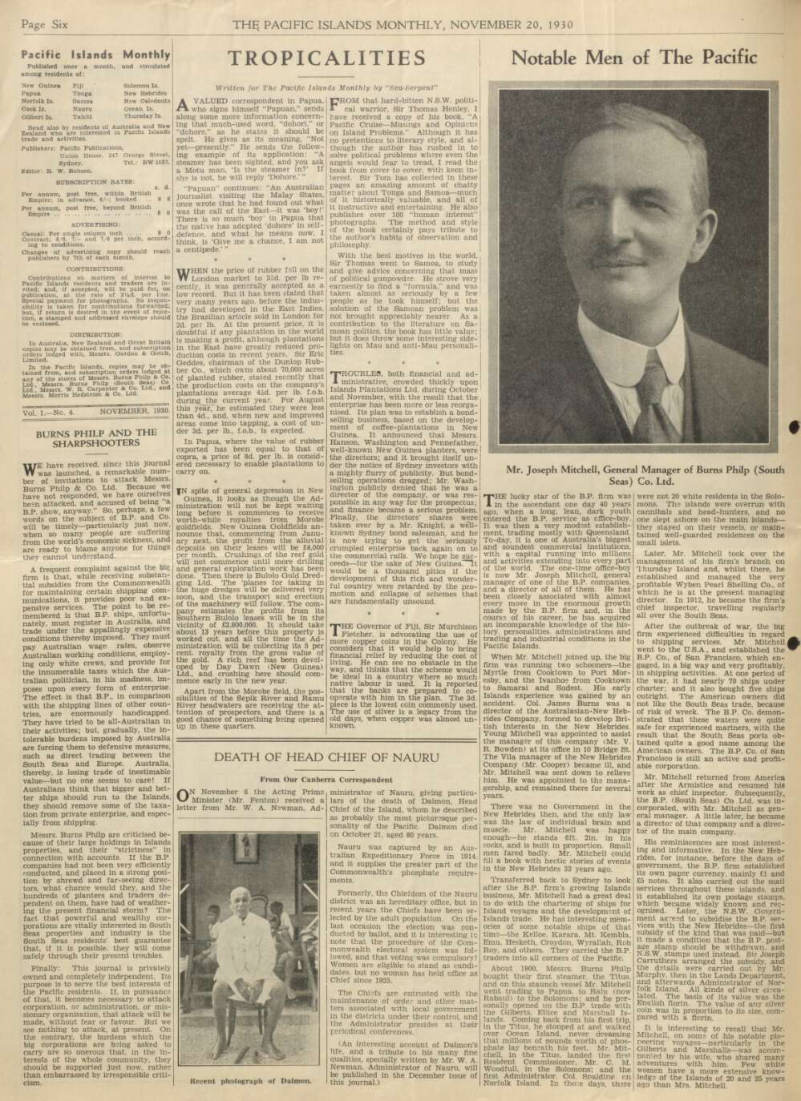
THE lucky star of the B.P. firm was in the ascendant one day 40 years ago, when a long, lean, dark youth entered the B.P. service as office-boy.
It was then a very modest establish ment, trading mostly with Queensland.
To-day, it is one of Australia’s biggest and soundest commercial institutions, with a capital running into millions and activities extending into every part of the world. The one-time office-boy is now Mr. Joseph Mitchell, general manager of one of the B.P. companies, and a director of all of them. He has been closely associated with almost every move in the enormous growth made by the B.P. firm and, in the course of his career, he has acquired an incomparable knowledge of the his tory, personalities, administrations and trading and industrial conditions in the Pacific Islands.
When Mr. Mitchell joined up, the big firm was running two schooners —the Myrtle from Cooktown to Port Mor esby, and the Ivanhoe from Cooktown to Samarai and Sudest. His early Islands experience was gained by an accident. Col. James Burns was a director of the Australasian-New Heb rides Company, formed to develop Bri tish interests in the New Hebrides.
Young Mitchell was appointed to assist the manager of this company (Mr. V.
R. Bowden) at its office in 10 Bridge St.
The Vila manager of the New Hebrides Company (Mr. Cooper) became ill, and Mr. Mitchell was sent down to relieve him. He was appointed to the mana gership, and remained there for several years.
There was no Government in the New Hebrides then, and the only law was the law of individual brain and muscle. Mr. Mitchell was happy enough—he stands 6ft. 2in. in his socks, and is built in proportion. Small men fared badly. Mr. Mitchell could fill a book with hectic stories of events in the New Hebrides 33 years ago.
Transferred back to Sydney to look after the B.P. firm’s growing Islands business, Mr. Mitchell had a great deal to do with the chartering of ships for Island voyages and the development of Islands trade. He has interesting mem ories of some notable ships of that time —the Kelloe, Karara, Mt. Kembla, Emu, Hesketh, Croydon, Wyrallah, Rob Roy, and others. They carried the B.P. traders into all corners of the Pacific.
About 1900, Messrs. Burns Philp bought their first steamer, the Titus, and on this staunch vessel Mr. Mitchell went trading to Papua, to Ralu (now Rabaul) to the Solomons; and he per sonally opened un the B.P. trade with the Gilberts, Ellice and Marshall Is lands. Coming back from his first trip, in the Titus, he stooped at and walked over Ocean Island, never dreaming that millions of pounds worth of phos phate lay beneath his feet. Mr. Mit chell, in the Titus, landed the first Resident Commissioner, Mr. C. M.
Woodfull, in the Solomons; and the first Administrator. Col. Spalding-, on Norfolk Island. In those days, there
were not 20 white residents in the Solo mons. The islands were overrun with cannibals and head-hunters, and no one slept ashore on the main islands — they stayed on their vessels, or main tained well-guarded residences on the small islets.
Later, Mr. Mitchell took over the management of his firm’s branch on Thursday Island and, whilst there, he established and managed the very profitable Wyben Pearl Shelling Co., of which he is at the present managing director. In 1912, he became the firm’s chief inspector, travelling regularly all over the South Seas.
After the outbreak of war, the big firm experienced difficulties in regard to shipping services. Mr. Mitchell went to the U.S.A., and established the B.P. Co., of San Francisco, which en gaged, in a big way and very profitably, in shipping activities. At one period of the war, it had nearly 70 ships under charter; and it also bought five ships outright. The American owners did not like the South Seas trade, because of risk of wreck. The B.P. Co. demon strated that these waters were quite safe for experienced mariners, with the result that the South Seas ports ob tained quite a good name among the American owners. The B.P. Co. of San Francisco is still an active and profit able corporation.
Mr. Mitchell returned from America after the Armistice and resumed his work as chief inspector. Subsequently, the B.P. (South Seas) Co Ltd. was in corporated, with Mr. Mitchell as gen eral manager. A little later, he became a director of that company and a direc tor of the main company.
His reminiscences are most interest ing and informative. In the New Heb rides, for instance, before the days of government, the B.P. firm established its own paper currency, mainly £1 and £5 notes. It also carried out the mail services throughout these islands, and it established its own postage stamps, which became widely known and rec ognised. Later, the N.S.W. Govern ment agreed to subsidise the B.P. ser vices with the New Hebrides—the first subsidy of the kind that was paid—but it made a condition that the B.P. post age stamp should be withdrawn, and N.S.W. stamps used instead. Sir Joseph Carruthers arranged the subsidy, and the details were carried out by Mr.
Murphy, then in the Lands Department, and afterwards Administrator of Nor folk Island. All kinds of silver circu lated. The basis of its value was the English florin. The value of any silver coin was in proportion to its size, com pared with a florin.
It is interesting to recall that Mr.
Mitchell, on some of his notable pio neering voyages—particularly in the Gilberts and Marshalls—was accom panied. by his wife, who shared many adventures with him. Few white women have a more extensive know ledge of the Islands of 20 and 25 years ago than Mrs. Mitchell.
Mr. Joseph Mitchell, General Manager of Burns Philp (South Seas) Co. Ltd.