Kava And The Major
A Memory of Sunny Nukualofa
WHEN we met the Chief Justice of Tonga, in Nukualofa, he intro duced us to the Minister for Lands, and then the five of us went to a little cafe to drink kava.
Nixon and I had had a taste of the stuff over in the Cook Islands. Nick said it was like the washing-water of the week before last, kept in a soap-vat and flavoured with pepper. I agreed.
But kava was new to Major O’Sulli van. The sound of the name tickled his palate. He had tasted many liq uors in many lands and in jovial com pany—and he was eager to add to his experiences.
We threw dice to see who “shouted.”
The Chief Justice explained the sys tem. He was a white man who had settled down happily in the island kingdom after having been driven from Samoa in 1890 by the squawking of the German eagle. The Minister for Lands was a native —all the Tongan Minis ters were natives except the Auditor- General.
We drank. I watched the Major’s face delightedly. It changed from an ticipation to incredulity, then to hor ror and disgust. I checked his hurried attempt to empty his mouthful back into the wooden mug by whispering that such a procedure would give seri ous offence.
The Chief Justice was proudly showing Nick the skin of his hands. When
he rubbed, it gave off a crumbly pow der. That, he explained, happened to all white kava-drinkers. The Major snorted.
The dice were thrown again and, to his visible relief, the Major won, and “shouted.” He had had visions of hav ing to sit through five rounds of kava.
He left before the third round, to at tend urgent business.
That afternoon, in a cocoanut grove some miles out, we attended an old time, ceremonial, kava-drinking, con ducted by the late King George Tabou IV. The procedure was simple. Each person was called up in his order of official importance, received a half-co coanut shell full of kava from the king’s servitor, bowed, drank the liquor, and threw the shell away with an un derhand spinning motion.
When the Major discovered what he was in for, he wanted to go and hide in the bush. We told him that he must respond to his name, and that he must drink the kava. Tongan etiquette on this matter is very strict. The Major declared, unhappily, that: “This damned stuff would be the death of him.”
The Court officials did not know the exact order of the official importance of our party. Nixon and I helped them with the list.
“Kava Kohe-e-e-e!” The call echoed through the forest aisles. Kava was
ready. It was made by squatting men of solemn appearance, who pounded the pepper-tree roots in wooden basins, and added water to the mess. In ancient days, the prettiest girls of the village chewed the roots, and spat the result into bowls, where water was added.
The Major’s name was called early in the list. He stepped up and drank his kava like a man; but he was breathing deeply, and there was feroc ity in his eye when he rejoined us near the Royal group.
To the accompaniment of quaint mis pronunciations of names by the native announcer, we stepped one by one be fore His Majesty, and quaffed the Royal beverage. Then: “Major O’Sullivan!” called the an nouncer, for the second time.
The Major gave a startled yelp. He waved his arms, and wanted to explain that there had been a mistake.
We pushed our friend forwards, whispering urgently. “Drink it —been a mis take —matter of etiquette—can’t explain now.”
The wretched Major seized the bowl and heroically drank. He spluttered and cursed. The bloody fields of Flan ders never heard worse language.
He returned to the steamer and went to bed, and remained there all next day—declared he had been poisoned.
Dr. Pomare (later Sir Maui Pomare, and recently dead), who was a member of our party, prescribed for him.
I never could get the permission of the repentant Nick to disclose the way in which we “cooked” that official list. —
R.W.R.
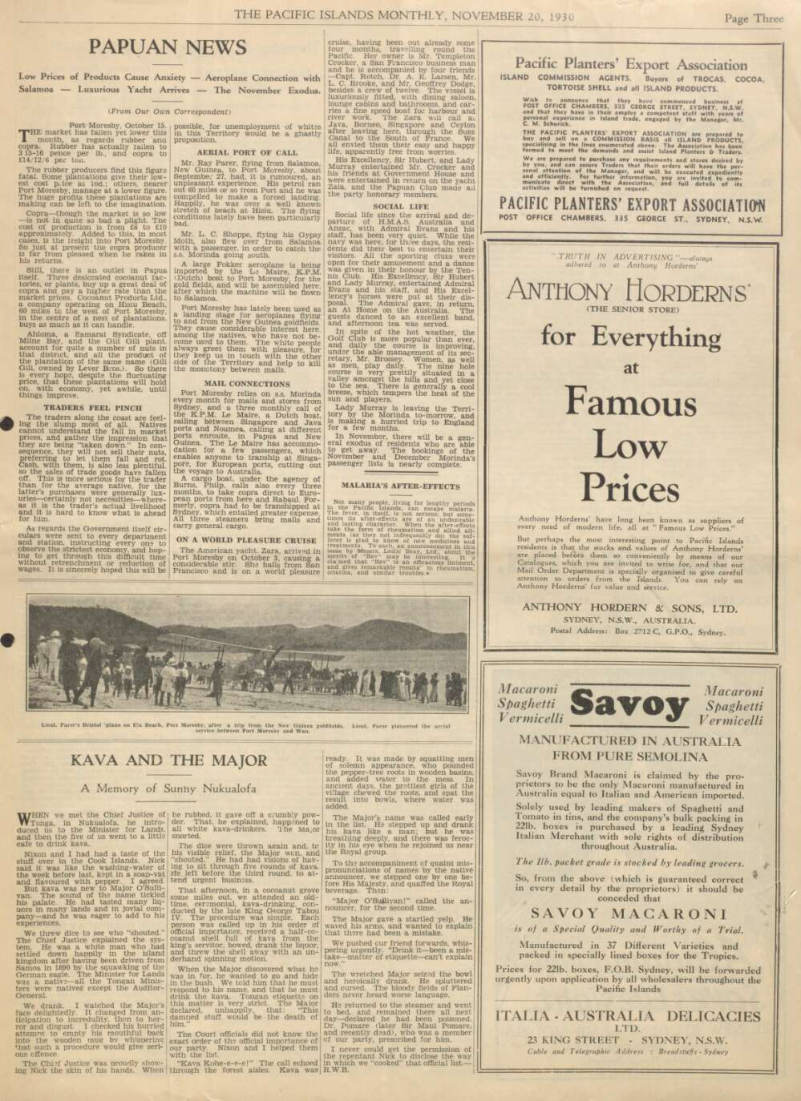
Lieut. Parer’s Bristol ’plane on Ela Beach, Port Moresby, after a trip from the New Guinea goldfields. Lieut. Parer pioneered the aerial service between Port Moresby and Wau.