Papuan News
Low Prices of Products Cause Anxiety Aeroplane Connection with Salamoa — Luxurious Yacht Arrives — The November Exodus.
(From Our Own Correspondent)
Port Moresby, October 15.
THE market has fallen yet lower this month, as regards rubber and copra. Rubber has actually fallen to 315-16 pence per lb., and copra to £14/12/6 per ton.
The rubber producers find this figure fatal. Some plantations give their low est cost price at 10d.; others, nearer Port Moresby, manage at a lower figure.
The huge profits these plantations are making can be left to the imagination.
Copra—though the market is so low —is not in quite so bad a plight. The cost of production is from £8 to £10 approximately. Added to this, in most cases, is the freight into Port Moresby.
So just at present the copra producer is far from pleased when he rakes in his returns.
Still, there is an outlet in Papua itself. Three desiccated cocoanut fac tories, or plants, buy up a great deal of copra and pay a higher rate than the market prices. Cocoanut Products Ltd., a company operating on Hisiu Beach, 60 miles to the west of Port Moresby, in the centre of a nest of plantations, buys as much as it can handle.
Ahioma, a Samarai Syndicate, off Milne Bay, and the Gili Gili plant, account for quite a number of nuts in that district, and all the product of the plantation of the same name (Gili Gili, owned by Lever Bros.). So there is every hope, despite the fluctuating price, that these plantations will hold on, with economy, yet awhile, until things improve.
Traders Feel Pinch
The traders along the coast are feel ing the slump most of all. Natives cannot understand the fall in market prices, and gather the impression that they are being “taken down.” In con sequence, they will not sell their nuts, preferring to let them fall and rot.
Cash, with them, is also less plentiful, so the sales of trade goods have fallen off. This is more serious for the trader than for the average native, for the latter’s purchases were generally lux uries—certainly not necessities—where as it is the trader’s actual livelihood and it is hard to know what is ahead for him.
As regards the Government itself cir culars were sent to every department and station, instructing every one to observe the strictest economy, and hop ing to get through this difficult time without retrenchment or reduction of wages. It is sincerely hoped this will be
possible, for unemployment of whites in this Territory would be a ghastly proposition.
Aerial Port Of Call
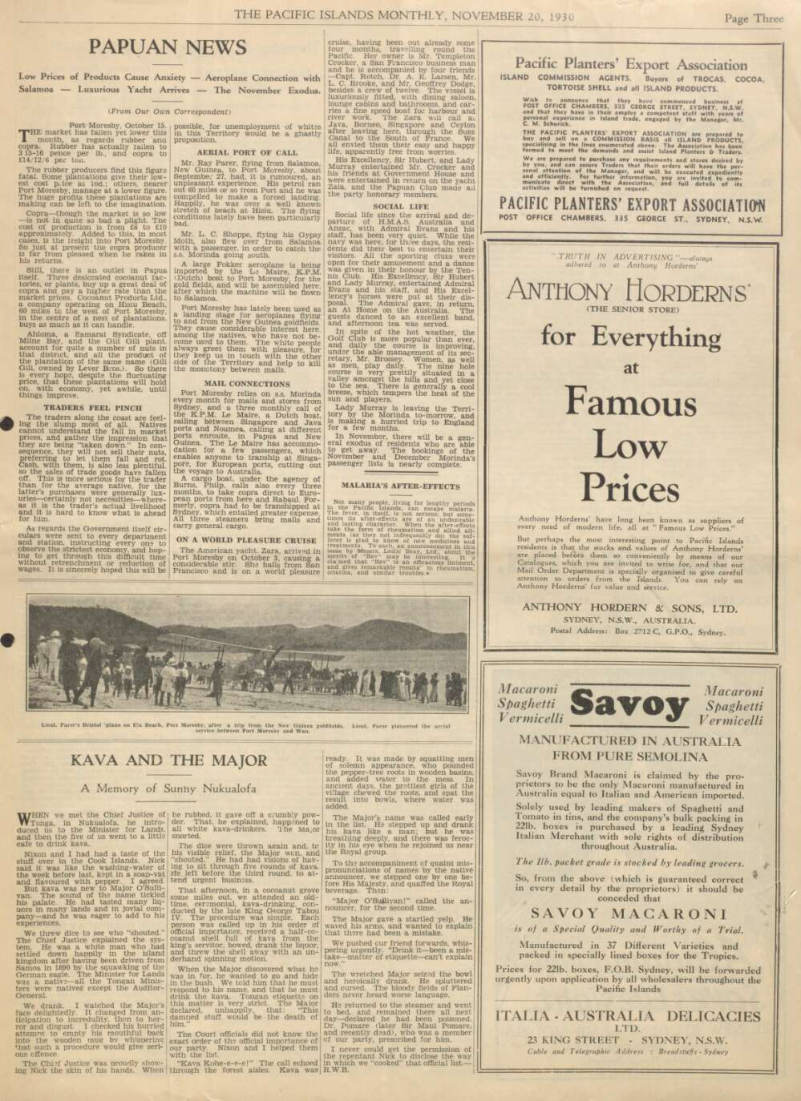
Mr. Ray Parer, flying from Salamoa, New Guinea, to Port Moresby, about September 27, had, it is rumoured, an unpleasant experience. His petrol ran out 60 miles or so from Port and he was compelled to make a forced landing.
Happily, he was over a well known stretch of beach at Hisiu. The flying conditions lately have been particularly bad.
Mr. L. C. Shoppe, flying his Gypsy Moth, also flew over from Salamoa with a passenger, in order to catch the s.s. Morinda going south.
A large Fokker aeroplane is being imported by the Le Maire, K.P.M. (Dutch) boat to Port Moresby, for the gold fields, and will be assembled here, after which the machine will be flown to Salamoa.
Port Moresby has lately been used as a landing stage for aeroplanes flying to and from the New Guinea goldfields.
They cause considerable interest here, among the natives, who have not be come used to them. The white people always greet them with pleasure, for they keep us in touch with the other side of the Territory and help to kill the monotony between mails.
Mail Connections
Port Moresby relies on s.s. Morinda every month for mails and stores from Sydney, and a three monthly call of the K.P.M. Le Maire, a Dutch boat, sailing between Singapore and Java ports and Noumea, calling at different ports enroute. in Papua and New Guinea. The Le Maire has accommo dation for a few passengers, which enables anyone to tranship at Singa pore, for European ports, cutting out the voyage to Australia.
A cargo boat, under the agency of Burns, Philp, calls also every three months, to take copra direct to Euro pean ports from here and Rabaul. For merly, copra had to be transhipped at Sydney, which entailed greater expense.
All three steamers bring mails and carry general cargo.
On A World Pleasure Cruise
The American yacht, Zara, arrived in Port Moresby on October 3, causing a considerable stir. She hails from San Francisco and is on a world pleasure
cruise, having been out already some four months, travelling round the Pacific. Her owner is Mr. Templeton Crocker, a San Francisco business man and he is accompanied by four friends —Capt. Rotch, Dr. A. E. Larsen, Mr.
L. C. Brooke, and Mr. Geoffrey Dodge, besides a crew of twelve. The vessel is luxuriously fitted, with dining saloon, lounge cabins and bathrooms, and car ries a fine speed boat for harbour and river work. The Zara will call at Java, Borneo, Singapore and Ceylon after leaving here, through the Suez Canal to the South of France. We all envied them their easy and happy life, apparently free from worries.
His Excellency, Sir Hubert, and Lady Murray entertained Mr. Crocker and his friends at Government House and were entertained in return on the yacht Zaia, and the Papuan Club made all the party honorary members.
Social Life
Social life since the arrival and de parture of H.M.A.S. Australia and Anzac, with Admiral Evans and his staff, has been very quiet. While the navy was here, for three days, the resi dents did their best to entertain their visitors. All the sporting duos were open for their amusement and a dance was given in their honour by the Ten nis Club. His Excellency, Sir Hubert and Lady Murray, entertained Admiral Evans and his staff, and His Excel lency’s horses were put at their dis posal. The Admiral gave, in return, an At Home on the Australia. The guests danced to an excellent band, and afternoon tea was served.
In spite of the hot weather, the Golf Club is more popular than ever, and daily the course is improving, under the able management of its sec retary, Mr. Brossey. Women, as well as men, play daily. The nine hole course is very prettily situated in a valley amongst the hills and yet close to the sea. There is generally a cool breeze, which tempers the heat of the sun and players.
Lady Murray is leaving the Terri tory by the Morinda to-morrow, and is making a hurried trip to England for a few months.
In November, there will be a gen eral exodus of residents who are able to get away. The bookings of the November and December Morinda’s passenger lists is nearly complete.