Steamer Services
pp. 1-2 · Read in the full issue
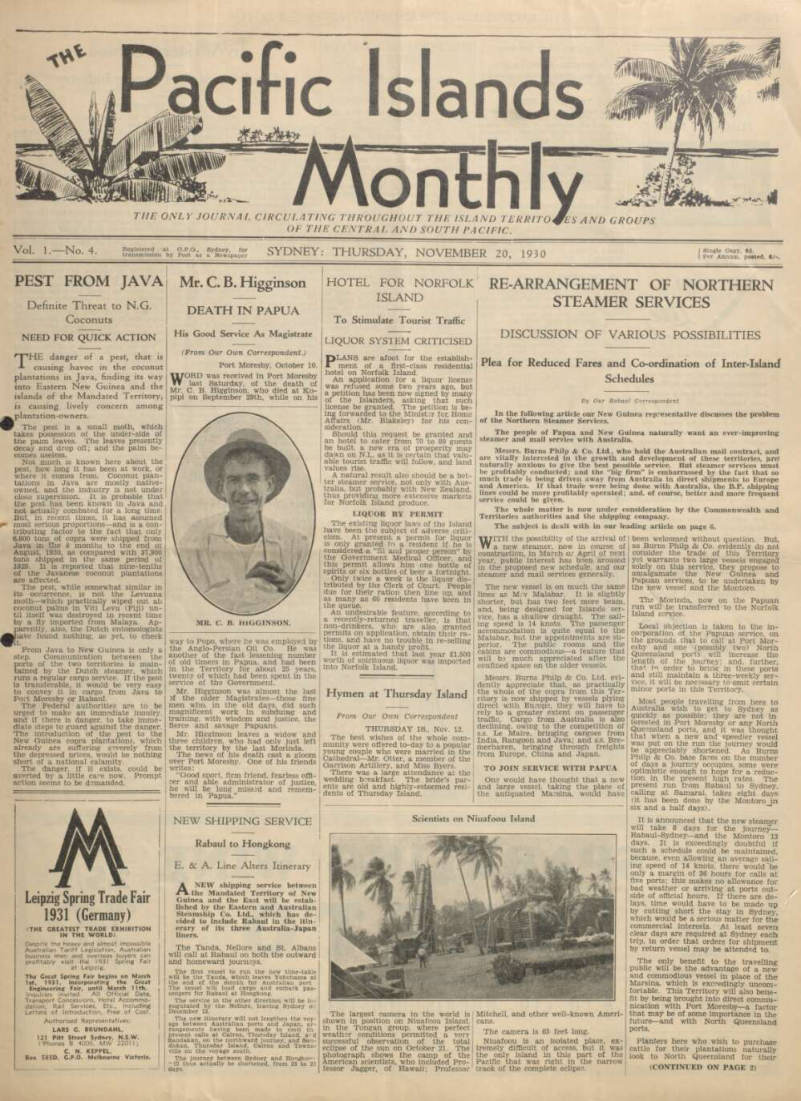
Re-Arrangement Of Northern
Discussion Of Various Possibilities
Plea for Reduced Fares and Co-ordination of Inter-Island Schedules
By Our Rabaul Correspondent
In the following article our New Guinea representative discusses the problem of the Northern Steamer Services.
The people of Papua and New Guinea naturally want an ever-improving steamer and mail service with Australia.
Messrs. Burns Philp & Co. Ltd, who hold the Australian mail contract, and are vitally interested in the growth and development of these territories, are naturally anxious to give the best possible service. But steamer services must be profitably conducted; and the “big firm” is embarrassed by the fact that so much trade is being driven away from Australia in direct shipments to Europe and America. If that trade were being done with Australia, the B.P. shipping lines could be more profitably operated; and, of course, better and more frequent service could be given.
The whole matter is now under consideration by the Commonwealth and Territories authorities and the shipping company.
The subject is dealt with in our leading article on page 6.
WITH the possibility of the arrival of a new steamer, now in course of construction, in March or April of next year, public interest has been aroused in the proposed new schedule, and our steamer and mail services generally.
The new vessel is on much the same lines as M/v Malabar. It is slightly shorter, but has two feet more beam, and, being designed for Islands service, has a shallow draught. The sailing speed is 14 knots. The passenger accommodation is quite equal to the Malabar, but the appointments are superior. The public rooms and the cabins are commodious —a feature that will be much appreciated after the confined space on the older vessels.
Messrs. Burns Philp & Co. Ltd. evidently appreciate that, as practically the whole of the copra from this Territory is now shipped by vessels plying direct with Europe, they will have to rely to a greater extent on passenger traffic. Cargo from Australia is also declining, owing to the competition of s.s. Le Maire, bringing cargoes from India, Rangoon and Java; and s.s. Bremerhaven, bringing through freights from Europe, China and Japan.
To Join Service With Papua
One would have thought that a new and large vessel, taking the place of the antiquated Marsina, would have
been welcomed without question. But, as Burns Philp & Co. evidently do not consider the trade of this Territory yet warrants two large vessels engaged solely on this service, they propose to amalgamate the New Guinea and Papuan services, to be undertaken by the new vessel and the Montoro.
The Morinda, now on the Papuan run will be transferred to the Norfolk Island service.
Local objection is taken to the incorporation of the Papuan service, on the grounds that to call at Port Moresby and one (possibly two) North Queensland ports will increase the length of the journey; and, further, that in order to bring in these ports and still maintain a three-weekly service, it will be necessary to omit certain minor ports in this Territory.
Most people travelling from here to Australia wish to get to Sydney as quickly as possible; they are not in terested in Port Moresby or any North Queensland ports, and it was thought that when a new and speedier vessel was put on the run the journey would be appreciably shortened. As Burns Philp & Co. base fares on the number of days a journey occupies, some were optimistic enough to hope for a reduction in the present high rates. The present run from Rabaul to Sydney, calling at Samarai, takes eight days (it has been done by the Montoro in six and a half days).
It is announced that the new steamer will take 8 days for the journey— Rabaul-Sydney—and the Montoro 13 days. It is exceedingly doubtful if such a schedule could be maintained, because, even allowing an average sail ing speed of 14 knots, there would be only a margin of 36 hours for calls at five ports; this makes no allowance for bad weather or arriving at ports outside of official hours. If there are delays, time would have to be made up by cutting short the stay in Sydney, which would be a serious matter for the commercial interests. At least seven clear days are required at Sydney each trip, in order that orders for shipment by return vessel may be attended to.
The only benefit to the travelling public will be the advantage of a new and commodious vessel in place of the Marsina, which is exceedingly uncomfortable. This Territory will also benefit by being brought into direct communication with Port Moresby—a factor that may be of some importance in the future—and with North Queensland ports.
Planters here who wish to purchase cattle for their plantations naturally look to North Queensland for their
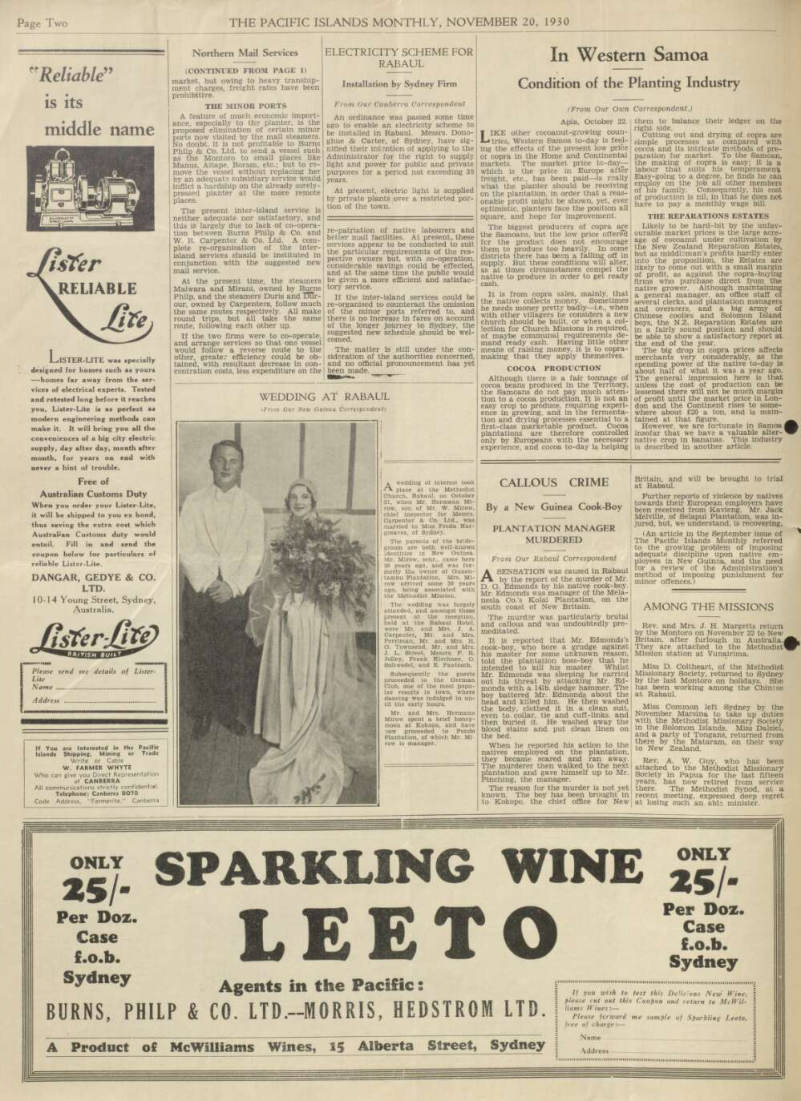
(Continued On Page 2)
market, but owing to heavy transhipment charges, freight rates have been
prohibitive.
The Minor Ports
A feature of much economic importance, especially to the planter, is the proposed elimination of certain minor ports now visited by the mail steamers.
No doubt, it is not profitable to Burns Philp & Co. Ltd. to send a vessel such as the Montoro to small places like Manus, Aitape, Boram, etc.; but to remove the vessel without replacing her by an adequate subsidiary service would inflict a hardship on the already sorely pressed planter at the more remote places.
The present inter-island service is neither adequate nor satisfactory, and this is largely due to lack of co-operation between Burns Philp & Co. and W. R. Carpenter & Co. Ltd. A complete re-organisation of the interisland services should be instituted in conjunction with the suggested new mail service.
At the present time, the steamers Maiwara and Mirani, owned by Burns Philp, and the steamers Duris and Durour, owned by Carpenters, follow much the same routes respectively. All make round trips, but all take the same route, following each other up.
If the two firms were to co-operate, and arrange services so that one vessel would follow a reverse route to the other, greater efficiency could be obtained, with resultant decrease in concentration costs, less expenditure on the
re-patriation of native labourers and better mail facilities. At present, these services appear to be conducted to suit the particular requirements of the respective owners but, with co-operation, considerable savings could be effected, and at the same time the public would be given a more efficient and satisfactory service.
If the inter-island services could be re-organised to counteract the omission of the minor ports referred to, and there is no increase in fares on account of the longer journey to Sydney, the suggested new schedule should be welcomed.
The matter is still under the consideration of the authorities concerned, and no official pronouncement has yet been made. ———