Our Fijian Newsletter
Successful Loan Means New Public Works —How Suva is Extending—Meat Works to Close Down
(From Our Own Correspondent.)
SUVA, October 2.
IN these days of “Otto-itis,” when people in Australia are reported to be surfeited with depression talk, and loaded with an “over optimism,” according to a prominent financial ex pert, it is refreshing to hear that little Fiji has secured a loan on quite pre-war terms, and at a premium, the amount of this latest portion of the half-million loan has been floated at a premium of 10/- per centum. The amount is £90,000.
The allocation of the loan will be determined at a meeting of the Legislative Council, about the middle of October. Some of these thousands have already been spent, and it is probable that some £30,000 of it will go to the building of the bridge across the Rewa River, if the plans, now before the Sec retary of State, are approved.
The loan flotation has created a very pleasant feeling in the Colony,
and residents are naturally elated at the suggestion that our credit stands so well in the financial centre of the Empire.
A Narrow Escape.
After being partly loaded with sugar at Lautoka, the motor ship Jedmoor set out for the big sugar centre at Labasa, under the care of a skilled local pilot. As she approached Malua, the port of Labasa, she ran on to the reef, off Mali Island, which lies off the mouth of Labasa River.
Happily, the stranding was not a serious one, and next day she came off, but was leaking considerably. It was found that there was a hole in the forepeak and also a small one in No. 1 hold, under the water tank. Captain Twentyman, acting for Lloyds’ agents, flew to Labasa and examined the dam age. The holes were temporarily re paired and the motor ship came on to Suva under her own power. The cargo has been shifted aft, and the forefoot of the ship stands up in the air, while engineers are busy effecting more substantial repairs. It is said that these will allow' the Jedmoor to complete her loading and proceed to London.
Lucky Fiji !
A visitor from Australia, and who has lately visited New Zealand, when he heard a local resident wail about bad times, said: “Why, you don’t know what you are talking about! If you had seen the poverty overseas, as I have done, within the past two months, you would shout ‘How lucky we are!’ "No one, who has not been out of Fiji, for the past twelve months, has any con ception of the bad times which are visiting the Dominions.”
The visitor was simply giving a well earned rebuke. The Colony is natu rally passing through a tight pinch, owing to all our leading exports falling on a low world market, but while we have a few unemployed, there is every room for congratulation that matters are as good as they are.
One firm in Suva is actually adding to its manufacturing staff. So far, at the registry, opened by the Tourist Bureau, under Government authority, only about 28 Europeans have reported as being in need of work. There are a good few half-castes also out of work— chiefly carpenters of a sort—and these get odd jobs.
Taken all round, conditions are not too bad, although pessimists say we have not seen the worst yet. There is no doubt that the estimated revenue from Customs will show a deficit, and probably our finances will be about £50,000 behind what was expected, but that will soon be made up when prices readjust themselves There is no need for alarm. Fiji is indeed lucky.
Harbour Reclamation
All round the harbour of Suva there lies a broad shelf of coral reef, which is nearly dry at low water. At several points this area has been reclaimed, and to-day, on this reef foundation, there stands the Kings Wharf, the Boys’ Grammar School, Cable Office, large timber yards and engineer’s and
shipbuilding works, and the Grand Pacific Hotel.
Lately, the Shell Oil Company re claimed a large area, where they have their oil stocks.
Now it is announced that A. H. Mar low and Co. Ltd., who have the biggest sawmill, with engineering works, and shipbuilding yards, are about to reclaim over nine acres of this foreshore, in order to concentrate their several in terests. The move in Suva is north erly, and the town, or the business sec tion, is steadily trending that way.
Fiji’S Air Mail
The air mail continues to be a great success. Not only has it annihilated distance for the expectant planter, who, in the past, has wearily awaited mails, often a fortnight late, but it has on several occasions recently given op portunity for business men to reach a destination in a small percentage of
the usual time. Two instances are given. The insurance representative wanted to inspect a fire at Sigatoka, about 70 miles west of Suva. He was on the spot before the heat had left the remains of the blaze. The other case was when Lloyds’ surveyor wanted to visit the stranded motor vessel Jed moor. He flew to Labasa in under two hours, where a sea trip usually occu pies four to five days.
Suva’S Predicament
Suva has had her little thrill recently Owing to a drought which has af fected the whole colony, the Suva water supply dwindled alarmingly. The usual replenishing of the new big res ervoir is over 770,000 gallons daily while the local consumption is about 650,000 gallons. The Commissioner warned people that all water must be used in a careful manner. It is well known that the natives (which include the Indians) waste water shamefully.
Everyone was cautioned against waste, and a press campaign was carried out in support. The Fiji Times had big headings along the top of each page: “DON’T WASTE WATER,” and every one was advised to boil all water for drinking purposes. The consumption fell to about 440,000 gallons daily.
Then two inches of rain came, and at once, within 24 hours, consumption jumped to nearly the maximum daily allowance. Even when the inflow be came normal, the reservoir was so low that it would take 100 days, at the maximum, to bring the storage back to a satisfactory level. Since then more rain has fallen, and all danger of any immediate shortage has passed. But the incident has warned the Govern ment that the supply is totally inade quate for a growing town, whose people have but a small idea of their responsibilities. In such a climate as this, a lack of water might mean seri ous epidemics.
Closing Down
The Tova Estate and meat-canning factory, known as the Fiji Development Co., has gone into voluntary liquida tion. This is most unfortunate at the present times, when there is so much unemployment, but it is understood that the company has not been a pay ing venture. The estate comprises some 100,000 acres of native-lease land, with a very modern canning factory. The product—various kinds of canned meats —was quite good, and much used locally.
Personal
In March next, Mr. James Palmer, of Levuka, will have reached his 90th year.
He is hale and hearty, and goes about his daily business.
Mrs. Mitchell, wife of Professor Mit chell, chief of the American scientific expedition, which has established its headquarters at Niaufoou, to observe the solar eclipse, is staying at the Grand Pacific Hotel, and has become quite a favourite with all who have had the pleasure of meeting her. She is a scientist herself, and takes a keen in terest in the work of her husband. She
goes on to Pago Pago, en route to Niaufoou, in time, she hopes, to see the eclipse.
Sir Joseph Carruthers is a tempor ary resident of Suva. He is busy writ ing his life’s story, and promises a very interesting account of the political his tory of the Mother State, since the last days of Sir Henry Parkes. Sir Joseph is one of the two surviving members of Parkes’s last Ministry. He is very popular among the bowlers, and is a regular attendant on the Suva green.
Mr. A. J. Vogan, F.R.G.S., has been exploring parts of the Colony in an effort to discover traces of early Malayan carvings or paintings. He claims to have found some of these in the Yasawas. He is off to Sydney by this steamer.
Captain Bennett, a big game hunter, who is said to have been in some of the Prince of Wales’s expeditions, is staying Suva, He has agreed to give a talk to the members of the Young People’s Guild.
One of our most popular citizens, Councillor W. H. Terry, has been seri ously ill for some time, and his friends are glad to hear he is improving. He is still in the hospital. Mr. Terry is our leading shipbuilder, and has many of our local craft to his credit. He has been a power of strength in cricketing circles, and a pillar of St. Andrew’s Church.
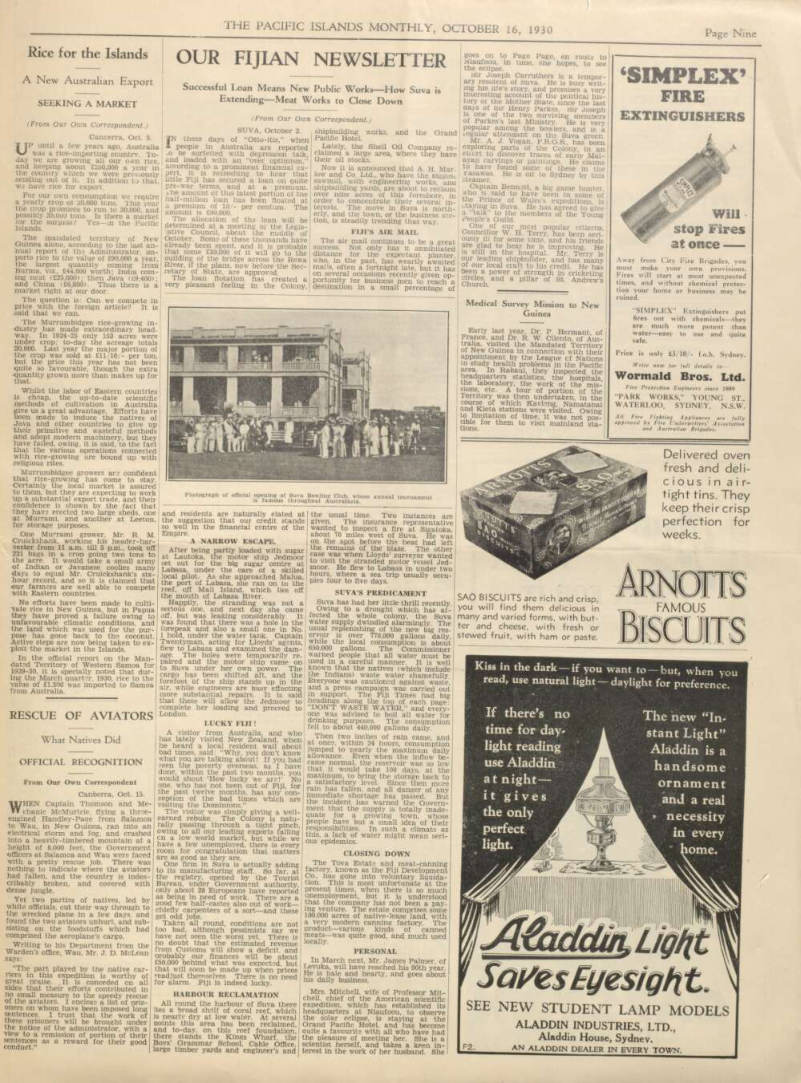
Photograph of official opening of Suva Bowling Club, whose annual tournament is famous throughout Australasia.