Notable Men of The Pacific
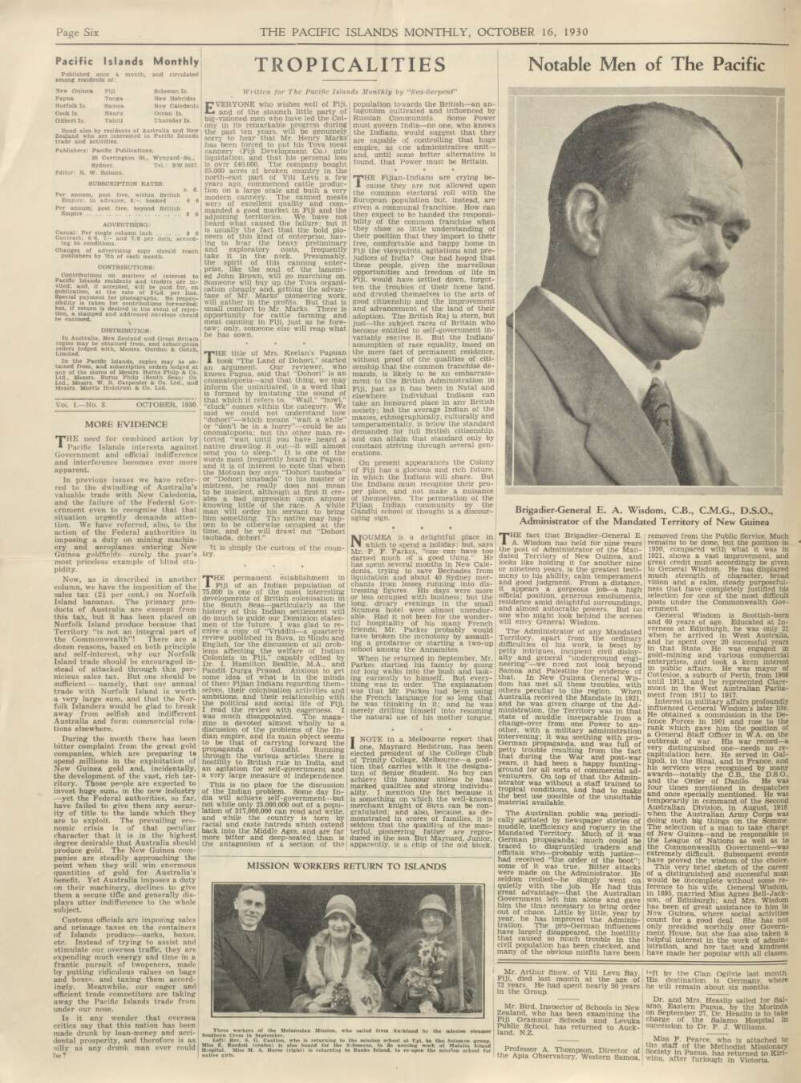
THE fact that Brigadier-General E.
A. Wisdom has held for nine years the post of Administrator of the Man dated Territory of New Guinea, and looks like holding it for another nine or nineteen years, is the greatest testi mony to his ability, calm temperament and good judgment. From a distance, it appears a gorgeous job—a high official position, generous emoluments, residence amid delightful surroundings, and almost autocratic powers. But no one who might look behind the scenes will envy General Wisdom.
The Administrator of any Mandated Territory, apart from the ordinary difficulties of his work, is beset by petty intrigues, incipient civil disloy alty and general “underground engi neering”—we need not look beyond Samoa and Palestine for evidence of that. In New Guinea General Wis dom has met all these troubles, with others peculiar to the region. When Australia received the Mandate in 1921, and he was given charge of the Ad ministration, the Territory was in that state of muddle inseparable from a change-over from one Power to an other, with a military administration intervening; it was seething with pro- German propaganda, and was full of petty trouble resulting from the fact that during the War and post-war years, it had been a happy hunting ground for all sorts of commercial ad venturers. On top of that the Admin istrator was without a staff trained to tropical conditions, and had to make the best use nossible of the unsuitable material available.
The Australian public was periodi cally agitated by newspaper stories of muddle, inefficiency and roguery in the Mandated Territory. Much of it was German propaganda; much could be traced to disgruntled 'traders< and officials who—probably with justice— had received “the order of the boot”; some of it was true. Bitter attacks were made on the Administrator. He seldom replied—he simply went on quietly with the job. He had this great advantage—that the Australian Government left him alone and gave him the time necessary to bring order out of chaos. Little by little, year by year, he has improved the Adminis tration. The pro-German influences have largely disappeared, the hostility that caused so much trouble in the civil population has been checked, and many of the obvious misfits have been
removed from the Public Service. Much remains to be done, but the position in 1930, compared with what it was in 1921, shows a vast improvement, and great credit must accordingly be given to General Wisdom. He has displayed much strength of character, broad vision and a calm, steady purposeful ness that have completely justified his selection for one of the most difficult posts under the Commonwealth Gov ernment.
General Wisdom is Scottish-born and 60 years of age. Educated at In verness at Edinburgh, he was only 21 when he arrived in West Australia, and he spent over 20 successful years in that State. He was engaged in gold-mining and various commercial enterprises, and took a keen interest in public affairs. He was mayor of Cottesloe, a suburb of Perth, from 1908 until 1912, and he represented Clare mont in the West Australian Parlia ment from 1911 to 1917.
Interest in military affairs profoundly influenced General Wisdom’s later life.
He obtained a commission in the De fence Forces in 1901 and rose to the rank which gave him the position of a General Staff Officer in W.A. on the outbreak of war. His war record —a very distinguished one—needs no re capitulation here. He served in Gal lipoli, in the Sinai, and in France, and his services were recognised by many awards—notably the C. B., the D. S. O., and the Order of Danilo. He was four times mentioned in despatches and once specially mentioned. He was temporarily in command of the Second Australian Division, in August, 1918, when the Australian Army Corps was doing such big things on the Somme.
The selection of a man to take charge of New Guinea—and be responsible to the League of Nations as well as to the Commonwealth Government —was extremely difficult. Subsequent events have proved the wisdom of the choice.
This very brief sketch of the career of a distinguished and successful man would be incomplete without some re ference to his wife. General Wisdom, in 1895, married Miss Agnes Bell-Jack son, of Edinburgh; and Mrs. Wisdom has been of great assistance to him in New Guinea, where social activities count for a good deal. She has not only presided worthily over Govern ment House, but she has also taken a helpful interest in the work of admin istration, and her tact and kindness have made her popular with all classes.
Mr. Arthur Snow, of Viti Levu Bay.
Fiji, died last month at the age of 72 years. He had spent nearly 50 years in the Group.
Mr. Bird, Inspector of Schools in New Zealand, who has been examining the Fiji Grammar Schools and Levuka Public School, has returned to Auck land, N.Z.
Professor A. Thompson, Director of the Apia Observatory, Western Samoa,
la ft bv the Clan Ogilvie last month.
His destination is Germany, where he will remain about six months.
Dr. and Mrs. Heaslip sailed for Sal amo. Eastern Papua, by the Morinda on September 27, Dr. Heaslin is to take charge of the Salamo Hospital in succession to Dr. F. J. Williams.
Miss F. Pearce, who is attached to the staff of the Methodist Missionary oociety in Panua. has returned to Kiri wma, after furlough in Victoria.
Brigadier-General E. A. Wisdom, C.B., C.M.G., D.S.O., Administrator of the Mandated Territory of New Guinea