South Seas Tours
Scenes of Great Beauty and Charm Where the B.P. Steamers Go
Persons with the means to travel have many pleasure-trips to choose from. There is no doubt that the most popular are those to the islands of many enchantments in the sunny South Seas.
A large number of new booklets and pamphlets, describing some of the most attractive Pacific Island tours, have just been issued by Burns Philp & Co.
Each trip has some particular feature, apart from contact with native races, who are still living in the fashion which delighted the first travellers to the South Seas, 150 years ago.
Three trips of great charm are to Papua, the Mandated Territory of New Guinea, and the Solomon Islands.
Papua is a country of allurement and adventure. The B.P. steamer to Papua calls at Brisbane, Townsville and Cairns. From Cairns, it goes on to Port Moresby, the seat of Government of Papua. A day’s run from there is Samarai, the commercial centre of the Territory, situated on a small islet of about 58 acres. It is a pretty little place
with its main street of stores and offices alternating with tall waving coconut palms and rows of brilliant crotons and other tropical shrubs. Some half a dozen other interesting ports are visited before the return to Australia.
A round trip to New Guinea lasts five weeks, and during that time many calls are made in the Territory. After Samarai, the steamer passes the D Entrecasteaux and Trobriand Islands, and then on through St. George s Channel, providing scenes of great beauty. Rabaul, the capital of the Territory, is situated on the shores of Simpson's Harbour beneath an almost circular range, the arms of which terminate in volcanic hills known as “The Mother and Daughters.” From Rabaul, visits may be made to hot sulphur springs, and to the islands of Matupi. The voyage is continued through an archipelago of islets and reefs to Kavieng, the principal town of New Ireland. Then there are numerous other ports of call before the return journey is commenced.
The Solomon Islands are only seven days’ steaming time north-east from Sydney. They consist of seven large islands and innumerable small ones, mostly of volcanic origin. Tulagi, the port of entry, rests in a lovely harbour, the approach to which is magnificent, Ths Island steamer “Mataram” calls at more than a score of ports, and the opportunity is available to tourists to pay a visit to many native villages and see for themselves the quaint customs, mode of living and handicrafts of the inhabitants.
ledge or understanding of the high class Polynesian natives. There was much muddling and many errors of administration. The Samoans, whose social and political sensibilities had been frequently lacerated during 50 years of turbulent history, were not in a mood to treat their new masters with patience.
The expression of their discontent and of their national aspirations was the Mau. Many people have tried to define the Mau and each produces something different. Roughly stated, the Mau is simply a fierce patriotic or ganisation of natives who want, if not Samoa for the Samoans, as much of Samoa as they can get.
Nothing can be gained by traversing the history of the past ten years. New Zealand is genuinely doing her utmost to make this country contented and prosperous—the tragedy lies in the fact that for several years she was badly served, and opportunity was given to mischief-makers to stir up much trouble among the natives. Perhaps the agitators were justified. Probably, a serious error was mads when New Zealand took the extreme course of de porting Mau leaders and persons in close sympathy with the Mau. How ever, it is finished, Conditions are bet ter, now. Let the dead past bury its dead.
In December last, certain people con nected with the Mau returned to Sa moa. The Mau, early one morning, came out of the bush and the hills in full strength, to welcome its heroes.
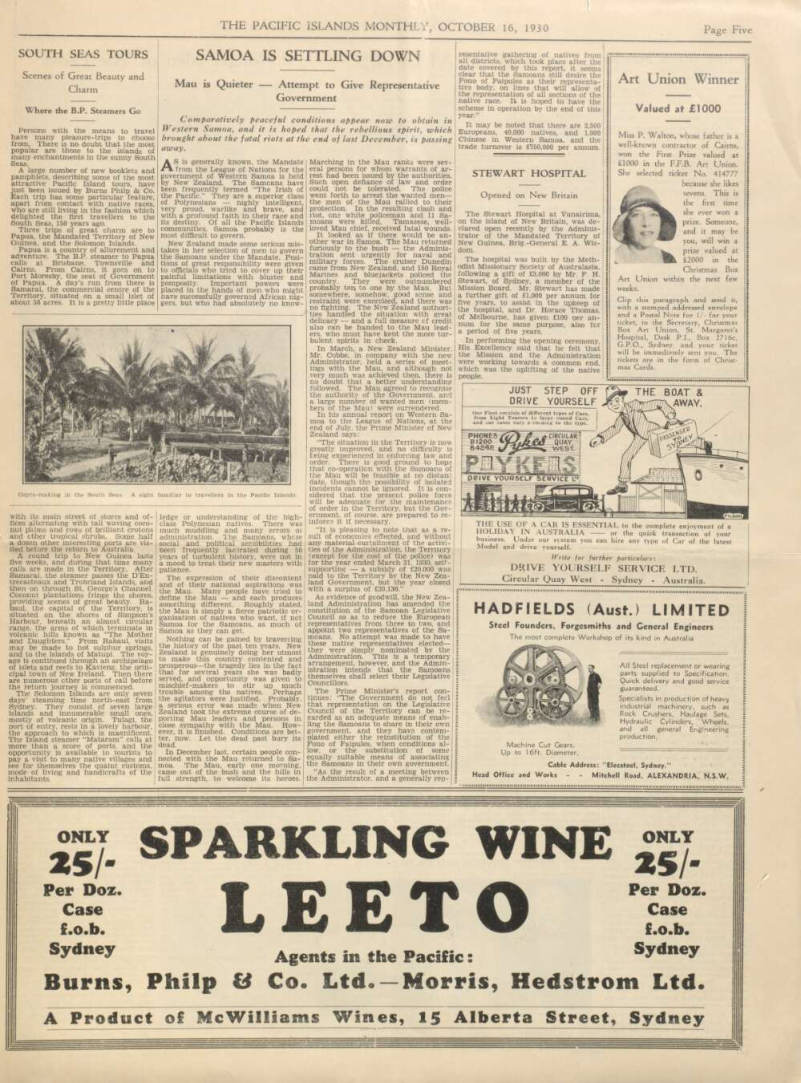
Copra-making In the South Seas. A sight familiar to travellers in the Pacific Islands.