Products Of The South Seas
p. 11 · Read in the full issue
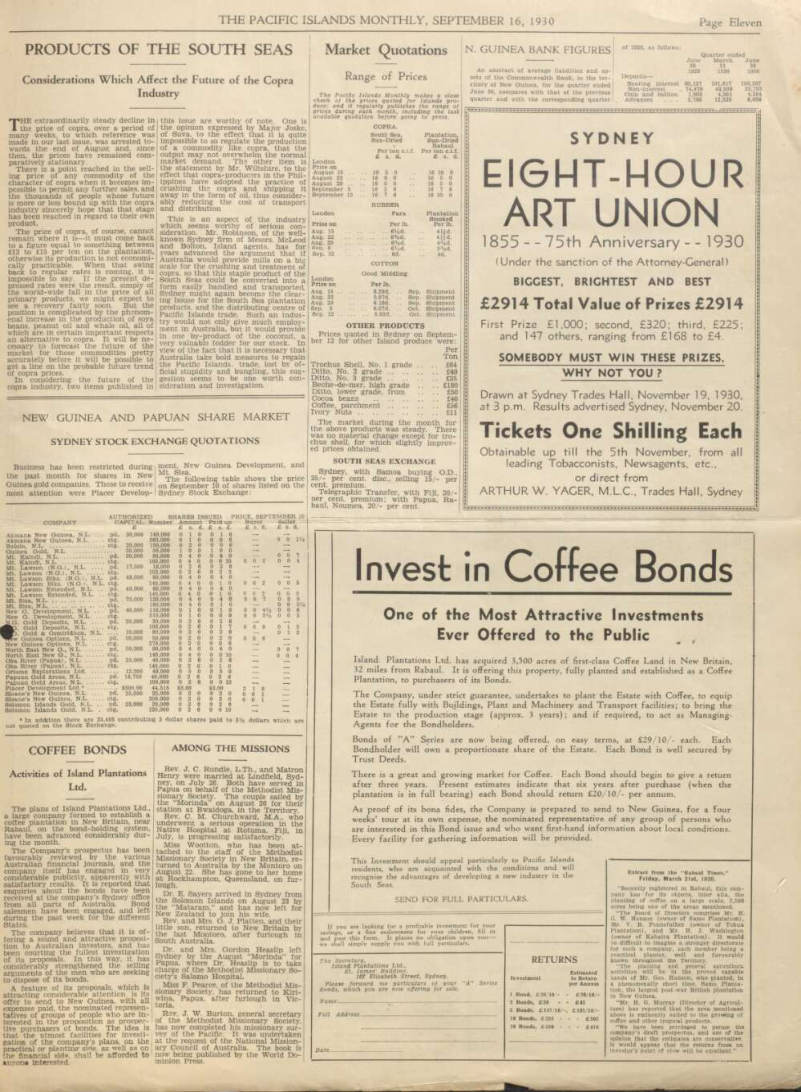
Considerations Which Affect the Future of the Copra Industry
THE extraordinarily steady decline in the price of copra, over a period of many weeks, to which reference was made in our last issue, was arrested to wards the end of August and, since then, the prices have remained com paratively stationary.
There is a point reached in the sell ing price of any commodity of the character of copra when it becomes im possible to permit any further sales, and the thousands of people whose future is more or less bound up with the copra industry sincerely hope that that stage has been reached in regard to their own product.
The price of copra, of course, cannot remain where it is—it must come back to a figure equal to something between £12 to £15 per ton on the plantation, otherwise its production is not economi cally practicable. When that swing back to regular rates is coming, it is impossible to say. If the present de pressed rates were the result, simply of the world-wide fall in the price of all primary products, we might expect to see a recovery fairly soon. But the position is complicated by the phenom enal increase in the production of soya beans, peanut oil and whale oil, all of which are in certain important respects an alternative to copra. It will be ne cessary to forecast the future of the market for those commodities pretty accurately before it will be possible to get a line on the probable future trend of copra prices.
In considering the future of the copra industry, two items published in
this issue are worthy of note. One is the opinion expressed by Major Joske, of Suva, to the effect that it is quite impossible to so regulate the production of a commodity like copra, that the output may not overwhelm the normal market demand. The other item is the statement by Mr. Wiltshire, to the effect that copra-producers in the Phil ippines have adopted the practice of crushing the copra and shipping it away in the form of oil, thus consider ably reducing the cost of transport and distribution.
This is an aspect of the industry which seems worthy of serious con sideration. Mr. Robinson, of the well known Sydney firm of Messrs. McLeod and Bolton, Island agents, has for years advanced the argument that if Australia would provide mills on a big scale for the crushing and treatment of copra, so that this staple product of the South Seas could be converted into a form easily handled and transported, Sydney might again become the clear ing house for the South Sea plantation products, and the distributing centre of Pacific Islands trade. Such an indus try would not only give much employ ment in Australia, but it would provide in one by-product of the coconut, a very valuable fodder for our stock. In view of the fact that it is necessary that Australia take bold measures to regain the Pacific Islands, trade, lost by of ficial stupidity and bungling, this sug gestion seems to be one worth con sideration and investigation.